Lawrence Kupferman Prints and Multiples

American

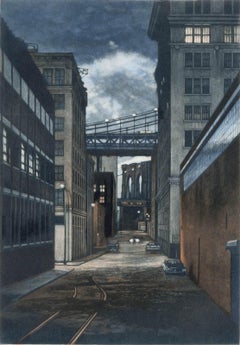
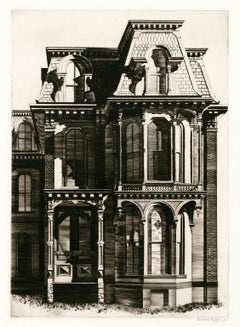
Lawrence Kupferman was born in the Boston area, and he became one of the most important abstract artists to emerge from there in the early 1940s. Kupferman worked as an artist for the WPA in the 1930s, developing a strictly realistic style that depicted Victorian houses and other detailed architectural images.

Around 1943, Kupferman began to integrate more expressionistic forms into his works. He soon moved completely away from the recognizable subject matter and definitively became an abstract painter. In 1946, he studied with the influential German-born artist Karl Zerbe at the School of the Museum of Fine Arts in Boston. Kupferman later attended the Massachusetts College of Art, where he would become a professor and retire as its Head of Painting in 1969. His focus, as it would remain until the late 1960s, was on abstract, marine-like amoeboid forms—intimated, rather than strictly described.

Kupferman was an active participant in a huge thrust in Boston art in the 1940s to create a vibrant art scene that rivaled New York. He has been appropriately credited with bringing Abstract Expressionism to Boston, serving as a critical artistic conduit to New York painters such as Mark Rothko and Hans Hofmann, contacts he made in Provincetown, Massachusetts, where he spent his summers beginning in 1946. Kupferman’s unique brand of abstraction integrated with the already burgeoning figurative expressionism in Boston, and he showed at the Boris Mirksi Gallery, arguably the most important Boston gallery at the time. He served as the Chair of the Modern Artists Group and is considered one of the major Boston artists whose numerous exhibitions throughout the world helped establish that city as a vital art scene.

to
3
1
Overall Width
to
Overall Height
to
2
1
10
1,196
952
937
829
4
2
4
1
1
2
2
2
1
4
Artist: Lawrence Kupferman
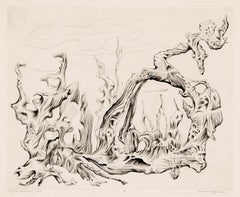
European Landscape —Mid-century American Surrealism
By Lawrence Kupferman
Located in Myrtle Beach, SC
Lawrence Kupferman, 'European Landscape', drypoint, edition 50, 1942. Signed, dated, titled, and numbered '7/50' in pencil. A superb, finely nuanced impression, on cream wove paper; the full sheet with margins (1 to 1 3/4 inches); in excellent condition. Image size 10 7/8 x 13 3/8 inches; sheet size 13 1/8 x 16 1/2 inches. Archivally matted to museum standards, unframed. An impression of this work is included in the permanent collection of the Syracuse University Art Museum. ABOUT THE ARTIST Lawrence Kupferman (1909 - 1982) was born in the Dorchester neighborhood of Boston and grew up in a working-class family. He attended the Boston Latin School and participated in the high school art program at the Museum of Fine Arts, Boston. In the late 1920s, he studied drawing under Philip Leslie Hale at the Museum School—an experience he called 'stultifying and repressive'. In 1932 he transferred to the Massachusetts College of Art, where he first met his wife, the artist Ruth Cobb. He returned briefly to the Museum School in 1946 to study with the influential expressionist German-American painter Karl Zerbe. Kupferman held various jobs while pursuing his artistic career, including two years as a security guard at the Museum of Fine Arts, Boston. During the 1930s he worked as a drypoint etcher for the Federal Art Project, creating architectural drawings in a formally realistic style—these works are held in the collections of the Fogg Museum and the Smithsonian American Art Museum. In the 1940s he began incorporating more expressionistic forms into his paintings as he became progressively more concerned with abstraction. In 1946 he began spending summers in Provincetown, Massachusetts, where he met and was influenced by Mark Rothko, Hans Hofmann, Jackson Pollock, and other abstract painters. At about the same time he began exhibiting his work at the Boris Mirski Gallery in Boston. In 1948, Kupferman was at the center of a controversy involving hundreds of Boston-area artists. In February of that year, the Boston Institute of Modern Art issued a manifesto titled 'Modern Art and the American Public' decrying 'the excesses of modern art,' and announced that it was changing its name to the Institute of Contemporary Art (ICA). The poorly conceived statement, intended to distinguish Boston's art scene from that of New York, was widely perceived as an attack on modernism. In protest, Boston artists such as Karl Zerbe, Jack Levine, and David Aronson formed the 'Modern Artists Group' and organized a mass meeting. On March 21, 300 artists, students, and other supporters met at the Old South Meeting House and demanded that the ICA retract its statement. Kupferman chaired the meeting and read this statement to the press: “The recent manifesto of the Institute is a fatuous declaration which misinforms and misleads the public concerning the integrity and intention of the modern artist. By arrogating to itself the privilege of telling the artists what art should be, the Institute runs counter to the original purposes of this organization whose function was to encourage and to assimilate contemporary innovation.” The other speakers were Karl Knaths...
Category

1940s Surrealist Lawrence Kupferman Prints and Multiples

Materials

Drypoint

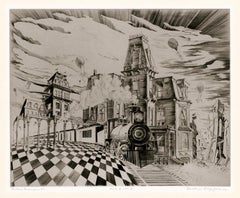
Fantasia Americana, 1880 — Mid-Century American Surrealism
By Lawrence Kupferman
Located in Myrtle Beach, SC
Lawrence Kupferman, 'Fantasia Americana – 1880', drypoint etching with sandground, 1943. Signed, titled, and annotated 'Series A, 1971 2/6' in pencil. A superb, richly-inked impression, on heavy, cream wove paper, with full margins (2 1/2 to 3 1/2 inches); the paper slightly lightened within the original mat opening, otherwise in excellent condition. One of only 6 impressions printed in 1971, with the added sandground grey background tint. Archivally matted to museum standards, unframed. Image size 11 13/16 x 14 3/4 inches; sheet size 18 x 20 1/4 inches. Collections: National Gallery of Art, Zimmerli Art Museum (Rutgers University). ABOUT THE ARTIST Lawrence Kupferman (1909 - 1982) was born in the Dorchester neighborhood of Boston and grew up in a working-class family. He attended the Boston Latin School and participated in the high school art program at the Museum of Fine Arts, Boston. In the late 1920s, he studied drawing under Philip Leslie Hale at the Museum School—an experience he called 'stultifying and repressive'. In 1932 he transferred to the Massachusetts College of Art, where he first met his wife, the artist Ruth Cobb. He returned briefly to the Museum School in 1946 to study with the influential expressionist German-American painter Karl Zerbe. Kupferman held various jobs while pursuing his artistic career, including two years as a security guard at the Museum of Fine Arts, Boston. During the 1930s he worked as a drypoint etcher for the Federal Art Project, creating architectural drawings in a formally realistic style—these works are held in the collections of the Fogg Museum and the Smithsonian American Art Museum. In the 1940s he began incorporating more expressionistic forms into his paintings as he became progressively more concerned with abstraction. In 1946 he began spending summers in Provincetown, Massachusetts, where he met and was influenced by Mark Rothko, Hans Hofmann, Jackson Pollock, and other abstract painters. At about the same time he began exhibiting his work at the Boris Mirski Gallery in Boston. In 1948, Kupferman was at the center of a controversy involving hundreds of Boston-area artists. In February of that year, the Boston Institute of Modern Art issued a manifesto titled 'Modern Art and the American Public' decrying 'the excesses of modern art,' and announced that it was changing its name to the Institute of Contemporary Art (ICA). The poorly conceived statement, intended to distinguish Boston's art scene from that of New York, was widely perceived as an attack on modernism. In protest, Boston artists such as Karl Zerbe, Jack Levine, and David Aronson formed the 'Modern Artists Group' and organized a mass meeting. On March 21, 300 artists, students, and other supporters met at the Old South Meeting House and demanded that the ICA retract its statement. Kupferman chaired the meeting and read this statement to the press: “The recent manifesto of the Institute is a fatuous declaration which misinforms and misleads the public concerning the integrity and intention of the modern artist. By arrogating to itself the privilege of telling the artists what art should be, the Institute runs counter to the original purposes of this organization whose function was to encourage and to assimilate contemporary innovation.” The other speakers were Karl Knaths...
Category

1940s Surrealist Lawrence Kupferman Prints and Multiples

Materials

Drypoint, Etching

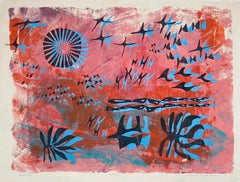
Black Sun
By Lawrence Kupferman
Located in Surfside, FL
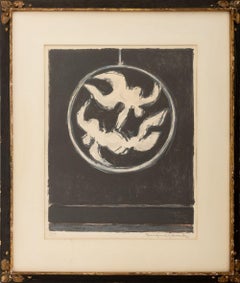
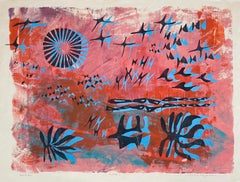
Silkscreen on paper. with some sort of experimental poured stuff on it. there is some loss to the margin but the image is strong. edition 2/6. During the 1930s, Lawrence Edward Kupferman was employed by the WPA Works Progress Administration, making a series of etchings and dry points, mostly of the facades of houses. His style changed completely in the 1940s, becoming first political and expressionist, and later abstract expressionist. He served as chairman of the department of painting at the Massachusetts College of Arts.He studied at the Boston Museum School with Philip Leslie Hale and H. Alden Ripley (1929-1931); Massachusetts School of Art with Ernest L. Majors and Otis Philbrick (1931-1935). Kupferman took motifs from tangible and sensed realities. His atmospheres symbolize cosmic space. Existence is spiritualized as a connected covenant with all of creation. Veil-like, mysterious lines move like vapors over washes of opaque translucent colors that blend, erupt or fade into seas of time-like space and souls become one with an ever-moving, deepening milieu. He admitted, "My figures journey to greet an eternal fellowship with nature’s every particle. . . . "Around 1941, I started to pour paint onto canvases in Provincetown. Jackson Pollock came into my studio to observe how I let paint take on a liquid life or path of its own. Those ethereal poured paintings may have stimulated Pollock's more frantic splashed-on techniques” Kupferman said thoughtfully.Some critics gave him credit for having been one of the pioneering fathers of the poured painting technique. As early as 1943, the Museum of Modern Art, the Whitney Museum of American Art and various publications acknowledged him as a humanistic innovator whose work bluntly exposes humans to themselves. Kupferman, Jack Levine (b. 1915), Hyman Bloom (b. 1913) and David Aronson (b. 1923) founded the "The Boston Urban Jewish School," whose roots ran deep into traditional Hebraic scholarship."Throughout my career," Kupferman admitted, "Boston was a mental and physical prison in which genuineness and spontaneity in art was absent. I summered in Provincetown for artistic sanity. Mark Rothko, Hans Hofmann, Adolph Gottlieb, William Baziotes, Leo Manzu, Byron Brown and I hung out together in an invigorating atmosphere of rediscovery. We started our own renaissance! Together with Robert Motherwell, Richard Pousette-Dart, Weldon Kees...
Category

20th Century Modern Lawrence Kupferman Prints and Multiples

Materials

Paper

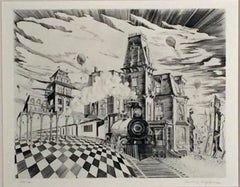
CARRIAGE HOUSE
By Lawrence Kupferman
Located in Portland, ME
Kupferman, Lawrence. FANTASIA AMERICANA. Etching, 1943. 2d edition of 100(c. 1980) with the embossed stmp of the printer. 12 x 14 3/8 inches (Plate); 17 x 19 7/8 inches (sheet). Sig...
Category

Mid-20th Century Lawrence Kupferman Prints and Multiples

Materials

Etching

Related Items
Untitled - Original Etching and Drypoint by Wilfredo Lam - 1960s
By Wilfredo Lam
Located in Roma, IT
Untitled is an original artwork realized by Wifredo Lam in the 1960s. Black and white drypoint. Hand signed in pencil by the artist. Artist's proof (EA hand written on the lower le...
Category

1960s Surrealist Lawrence Kupferman Prints and Multiples

Materials

Drypoint, Etching

Journal D Un Graveur - Vol. 2 Plate 3
By Joan Miró
Located in Roma, IT
This is an original drypoint realized by Joan Miró in 1975. Hand signed in pencil on the lower right and numbered on the lower left. Edition of 75 prints. It represents an abstract s...
Category

1970s Surrealist Lawrence Kupferman Prints and Multiples

Materials

Drypoint

Journal D
Un Graveur - Vol. 2 Plate 3
$1,959
H 22.45 in W 17.92 in D 0.04 in
“Untitled” (from the Lezard aux Plumes d’Or series)
By Joan Miró
Located in Southampton, NY
Colored lithograph on archival paper by Joan Miro. Part of the “Lizard with the Golden Feathers series. Signed in pencil “Miro” lower right. “H.C.” lower left. (See details below) ...
Category

1970s Modern Lawrence Kupferman Prints and Multiples

Materials

Archival Paper, Lithograph

Intimité
By Jacques Villon
Located in Middletown, NY
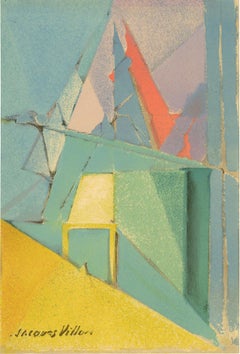
Paris: Mourlot Press, 1964. Lithograph in colors on Velin d’Arches paper, 6 3/4 x 10 inches (170 x 253 mm), full margins. Published by Fernand Mourlot and Jean Adhemar, 1964. In ver...
Category

Mid-20th Century Modern Lawrence Kupferman Prints and Multiples

Materials

Lithograph, Handmade Paper

Intimité
$300
H 6.7 in W 9.97 in
Salvador Dali "Nude with Guitar"
By Salvador Dalí­
Located in Boston, MA
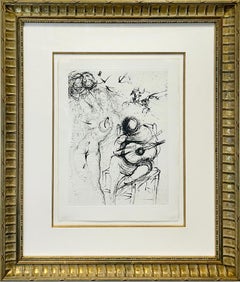
Artist: Dali, Salvador Title: Nude with Guitar Series: Secret Poems of Appolinaire Date: 1967 Medium: Drypoint etching Unframed Dimensions: 15" x 11" Framed Dimensions: 25.25"...
Category

1960s Surrealist Lawrence Kupferman Prints and Multiples

Materials

Drypoint, Etching

Salvador Dali "Nude with Guitar"
$1,520 Sale Price
20% Off
H 25.25 in W 21.5 in
Sator - Etching - 1960s
By Salvador Dalí­
Located in Roma, IT
Etching and drypoint with roulette on Japanese paper from the Series "Faust" (Walpurgis Night). Image dimension 32x24 cm. Hand signed in pencil Artist proof. Blindstamp "Dali", ou...
Category

1960s Surrealist Lawrence Kupferman Prints and Multiples

Materials

Paper, Drypoint, Etching

Sator - Etching  - 1960s
$1,068 Sale Price
25% Off
H 15.24 in W 11.15 in D 0.04 in
"Equal Justice Under Law" Screenprint #99/125 on Wove Paper
By Robert Rauschenberg
Located in Soquel, CA
"Equal Justice Under Law" Screenprint #99/125 on Wove Paper Iconic composition by Robert Rauschenberg (American, 1925-2008). A red envelope and a hand holding sprouted grass the pli...
Category

1970s American Modern Lawrence Kupferman Prints and Multiples

Materials

Laid Paper, Screen

Téléphone-homard cybernétique (Michler/Löpsinger 822-831; Field 75-13)
By Salvador Dalí­
Located in Fairfield, CT
Artist: Salvador Dali (1904-1989) Title: Téléphone-homard cybernétique (Michler/Löpsinger 822-831; Field 75-13), Imaginations et Objets du Futur (Cybernetic lobster phone, Imaginatio...
Category

1970s Surrealist Lawrence Kupferman Prints and Multiples

Materials

Mixed Media, Drypoint, Lithograph, Screen

Three Poems: Nocturne V, Abstract Lithograph by Robert Motherwell
By Robert Motherwell
Located in Long Island City, NY
Artist: Robert Motherwell, American (1915 - 1991) Title: Three Poems: Nocturne V, collaboration with Octavio Paz Year: 1987 Medium: Lithograph on Japon with Chine Colle Edition: 750...
Category

1980s Modern Lawrence Kupferman Prints and Multiples

Materials

Rice Paper, Lithograph

Antiombrelle à atomiseurs de liquides (Michler/Löpsinger 822-831; Field 75-13)
By Salvador Dalí­
Located in Fairfield, CT
Artist: Salvador Dali (1904-1989) Title: Antiombrelle à atomiseurs de liquides (Michler/Löpsinger 822-831; Field 75-13), Imaginations et Objets du Futur (Liquid atomizer anti-shade, ...
Category

1970s Surrealist Lawrence Kupferman Prints and Multiples

Materials

Mixed Media, Drypoint, Lithograph, Screen

Planetary And Scatologic Vision
By Salvador Dalí­
Located in San Francisco, CA
Artist: Salvador Dali (Spanish surrealist, 1904-1989) Title: Planetary and Scatologic Vision Year: 1974 Medium: Engraving with embossing and color lithograph Edition: Numbered...
Category

Late 20th Century Surrealist Lawrence Kupferman Prints and Multiples

Materials

Engraving, Lithograph

Venus de la Constellaciones con Picador - Attr. to S.Dalì - 1975
By Salvador Dalí­
Located in Roma, IT
Venus de la Constellaciones con Picador is an Contemporary Artwork realized in 1975. Etching and Drypoint on Rives Paper. Hand-signed in pencil on the lower right: Dalì; inscribed EA in pencil on the lower left. One of the 25 Artist's Proof aside of the edition of 75 specimens on Rives Paper. The edition was composed of other 75+25 proofs on Arches paper, 75x25 proofs on Lana Paper, 75+25 proofs on Richard de Bas and 75+25 proofs on Japanese paper. The work was dedicated to Luis Romero...
Category

1970s Surrealist Lawrence Kupferman Prints and Multiples

Materials

Drypoint, Etching

Venus de la Constellaciones con Picador - Attr. to S.Dalì - 1975
$1,163 Sale Price
30% Off
H 27.56 in W 23.63 in D 0.04 in
Previously Available Items
Saratoga Springs Victorian
By Lawrence Kupferman
Located in Myrtle Beach, SC
Lawrence Kupferman, 'Saratoga Springs Victorian', drypoint, 1940, edition 100. Signed in pencil. A superb, richly-inked impression, in brown/black ink...
Category

1940s American Realist Lawrence Kupferman Prints and Multiples

Materials

Drypoint

Black Sun
By Lawrence Kupferman
Located in Surfside, FL
Silkscreen on paper. with some sort of experimental poured stuff on it. there is some loss to the margin but the image is strong. edition 2/6. During the 1930s, Lawrence Edward Kupferman was employed by the WPA Works Progress Administration, making a series of etchings and dry points, mostly of the facades of houses. His style changed completely in the 1940s, becoming first political and expressionist, and later abstract expressionist. He served as chairman of the department of painting at the Massachusetts College of Arts.He studied at the Boston Museum School with Philip Leslie Hale and H. Alden Ripley (1929-1931); Massachusetts School of Art with Ernest L. Majors and Otis Philbrick (1931-1935). Kupferman took motifs from tangible and sensed realities. His atmospheres symbolize cosmic space. Existence is spiritualized as a connected covenant with all of creation. Veil-like, mysterious lines move like vapors over washes of opaque translucent colors that blend, erupt or fade into seas of time-like space and souls become one with an ever-moving, deepening milieu. He admitted, "My figures journey to greet an eternal fellowship with nature’s every particle. . . . "Around 1941, I started to pour paint onto canvases in Provincetown. Jackson Pollock came into my studio to observe how I let paint take on a liquid life or path of its own. Those ethereal poured paintings may have stimulated Pollock's more frantic splashed-on techniques” Kupferman said thoughtfully.Some critics gave him credit for having been one of the pioneering fathers of the poured painting technique. As early as 1943, the Museum of Modern Art, the Whitney Museum of American Art and various publications acknowledged him as a humanistic innovator whose work bluntly exposes humans to themselves. Kupferman, Jack Levine (b. 1915), Hyman Bloom (b. 1913) and David Aronson (b. 1923) founded the "The Boston Urban Jewish School," whose roots ran deep into traditional Hebraic scholarship."Throughout my career," Kupferman admitted, "Boston was a mental and physical prison in which genuineness and spontaneity in art was absent. I summered in Provincetown for artistic sanity. Mark Rothko, Hans Hofmann, Adolph Gottlieb, William Baziotes, Leo Manzu, Byron Brown...
Category

20th Century Modern Lawrence Kupferman Prints and Multiples

Materials

Paper

Lawrence Kupferman prints and multiples for sale on 1stDibs.

Find a wide variety of authentic Lawrence Kupferman prints and multiples available for sale on 1stDibs. You can also browse by medium to find art by Lawrence Kupferman in drypoint, engraving, etching and more. Much of the original work by this artist or collective was created during the 20th century and is mostly associated with the Surrealist style. Not every interior allows for large Lawrence Kupferman prints and multiples, so small editions measuring 14 inches across are available. Customers who are interested in this artist might also find the work of Henri Laurens, Alistair Grant, and Julio de Diego. Lawrence Kupferman prints and multiples prices can differ depending upon medium, time period and other attributes. On 1stDibs, the price for these items starts at $550 and tops out at $2,400, while the average work can sell for $900.

Recently Viewed

View All