Le Corbusier, Jeanneret, Perriand Vitrines

The trio of Charlotte Perriand, Le Corbusier and Pierre Jeanneret is known for its widely acclaimed and influential modernist furniture designs.

In the early 1920s, Charles-Édouard Jeanneret, the revered Swiss-French architect known professionally as Le Corbusier, entered into collaboration with his cousin, Pierre Jeanneret, who shared his grand vision for egalitarian building projects and interior design. They later recruited the pioneering young female architect Charlotte Perriand to join their venture.

Perriand's installation Bar sous le toit (“bar under the roof”), a recreation of part of her own apartment shown at the 1927 Salon d’Automne in Paris, caught Le Corbusier's attention and prompted the cousins to recruit her to work at their architecture practice. She would be tasked with designing interiors and furniture. Such status was rare for a woman at the time — in fact, when Perriand sought work at Le Corbusier’s atelier mere months before the exhibition, he famously dismissed her with a sexist remark.

The collective called their shared project l’équipement d'intérieur de l’habitation (“the interior equipment of the house”), and they designed furniture that remains celebrated today. The LC series of armchairs, lounge chairs and sofas, for example, saw the designers working with tubular chrome steel and plush foam cushions upholstered in leather. Bereft of ornament and prized for its functionality, the series is currently manufactured by Cassina. The cohort's LC4 chaise lounge was displayed at the 1929 Salon d’Automne, and the spare but sculptural seat — as well as the group’s other furnishings — influenced the likes of Willy Rizzo as well as a range of other modernist designers and furniture innovators.

Reportedly owing to political differences, the trio’s collaboration ended in 1937. Le Corbusier and Pierre continued working together, primarily in architecture.

In the early 1950s, at the invitation of Indian Prime Minister Jawaharlal Nehru, Le Corbusier and his cousin collaborated on a building project in Chandigarh, India. While the Chandigarh project is most frequently associated with Le Corbusier, he didn’t actually move to India and instead monitored progress during visits to the region. Pierre, however, was extensively involved. As the project’s first chief architect, Pierre remained onsite to oversee implementation of design and to coordinate construction of schools, government housing, shopping centers and more.

In 1940, Charlotte Perriand moved to Japan after France fell to Nazi forces. She was offered a position at the Japanese Ministry of Trade and Industry as a consultant on the country’s industrial arts. While there, Perriand adopted many Japanese artistic principles and incorporated them into her own revolutionary furniture designs. She would also closely collaborate with self-taught French furniture designer Jean Prouvé in the years that followed.

Time has shown that some of the works attributed to the Jeanneret cousins are either Perriand’s own designs or she was an uncredited contributor.

On 1stDibs, find an array of vintage Charlotte Perriand, Le Corbusier and Pierre Jeanneret furniture, including tables, storage cabinets and lighting.

to
Height
to
Width
to
Depth
to
5
5
5
5
5
5
5
5
110
30
20
10
9
Creator: Le Corbusier, Jeanneret, Perriand
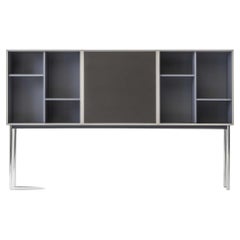
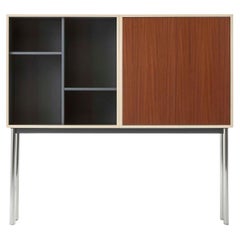
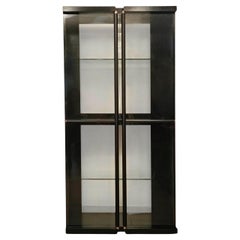
Le Corbusier Casiers Standard P.E.N Cabinet For Cassina
By Le Corbusier, Pierre Jeanneret, Charlotte Perriand Cassina
Located in Barcelona, Barcelona
Le Corbusier Casiers Standard P.E.N Cabinet For Cassina With their timeless, unique features, these combinable modular cabinets are capable of architecturally organizing any room, h...
Category

2010s Italian Mid-Century Modern Le Corbusier, Jeanneret, Perriand Vitrines

Materials

Chrome

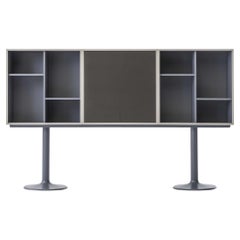
Le Corbusier Casiers Standard, Pieds Corolle Cabinet For Cassina
By Le Corbusier, Pierre Jeanneret, Charlotte Perriand Cassina
Located in Barcelona, Barcelona
Le Corbusier Casiers Standard, Pieds Corolle Cabinet For Cassina With their timeless, unique features, these combinable modular cabinets are capable of architecturally organizing an...
Category

2010s Italian Mid-Century Modern Le Corbusier, Jeanneret, Perriand Vitrines

Materials

Chrome

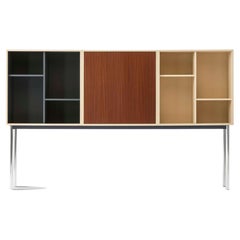
Le Corbusier Casiers Standard P.E.N Cabinet For Cassina
By Le Corbusier, Pierre Jeanneret, Charlotte Perriand Cassina
Located in Barcelona, Barcelona
Le Corbusier Casiers Standard P.E.N Cabinet For Cassina With their timeless, unique features, these combinable modular cabinets are capable of architecturally organizing any room, h...
Category

2010s Italian Mid-Century Modern Le Corbusier, Jeanneret, Perriand Vitrines

Materials

Chrome

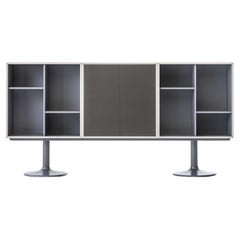
Le Corbusier Casiers Standard, Pieds Corolle Cabinet For Cassina
By Le Corbusier, Pierre Jeanneret, Charlotte Perriand Cassina
Located in Barcelona, Barcelona
Le Corbusier Casiers Standard, Pieds Corolle Cabinet For Cassina With their timeless, unique features, these combinable modular cabinets are capable of architecturally organizing an...
Category

2010s Italian Mid-Century Modern Le Corbusier, Jeanneret, Perriand Vitrines

Materials

Chrome

Le Corbusier Casiers Standard P.E.N Cabinet For Cassina
By Le Corbusier, Pierre Jeanneret, Charlotte Perriand Cassina
Located in Barcelona, Barcelona
Le Corbusier Casiers Standard P.E.N Cabinet For Cassina With their timeless, unique features, these combinable modular cabinets are capable of architecturally organizing any room, h...
Category

2010s Italian Mid-Century Modern Le Corbusier, Jeanneret, Perriand Vitrines

Materials

Chrome

Related Items
Macassar Art Deco Amsterdamse School Display Cabinet by Napoleon Le Grand, 1920s
By t Modelhuis N. Legrand 1, Napoleon le Grand
Located in Amsterdam, NL
Magnificent and rare Art Deco Amsterdamse School display cabinet or vitrine. Design by Napoleon Le Grand for 't Modelhuis N. Legrand Amsterdam. Solid macassar ebony base with two ori...
Category

1920s Dutch Art Deco Vintage Le Corbusier, Jeanneret, Perriand Vitrines

Materials

Glass, Macassar

Macassar Art Deco Amsterdamse School Display Cabinet by Napoleon Le Grand, 1920s
$4,517 Sale Price
20% Off
H 78.35 in W 57.68 in D 20.28 in
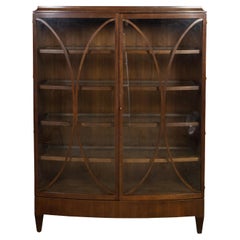
Barbara Barry for Henredon Vitrine Cabinet with Glass Doors and Shelves
By Henredon, Barbara Barry
Located in Atlanta, GA
A Barbara Barry for Henredon wooden bow front vitrine cabinet from the late 20th century with oval motifs, glass doors and glass shelves. Designed by Barbara Barry for Henredon during the later years of the 20th century, this wooden cabinet features a thin curving cornice sitting above two bow-front glass doors, adorned with thin oval motifs and fitted with a single brass pull. These doors open to reveal four glass in wooden frames inner shelves offering convenient display opportunities. The ensemble is raised on four short tapered feet. The décor on the side shows great restraint as it is left bare and the back is simply planked. With its clean lines and modern design, this Barbary Barry for Henredon vintage vitrine...
Category

Late 20th Century American Modern Le Corbusier, Jeanneret, Perriand Vitrines

Materials

Glass, Wood

Sequoia Burl Bar Cabinet by Willy Rizzo for Mario Sabot
By Mario Sabot, Willy Rizzo
Located in Conversano, IT
Elegant, bold, and timeless: this rare bar cabinet designed by Willy Rizzo is the perfect embodiment of his unmistakable style, suspended between rationalist functionalism and sophis...
Category

1970s Italian Hollywood Regency Vintage Le Corbusier, Jeanneret, Perriand Vitrines

Materials

Brass, Chrome

Sequoia Burl Bar Cabinet by Willy Rizzo for Mario Sabot
$6,894
H 74.81 in W 52.17 in D 20.67 in
Hollywood Regency Display Cabinet designed by Paolo Barracchia for Roman Deco
By Paolo Barracchia, Émile-Jacques Ruhlmann
Located in New York, NY
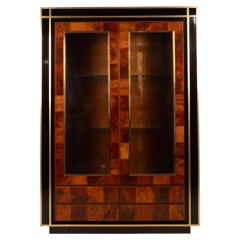
Exceptional Hollywood Regency, Art Deco Revival style display cabinet, vitrine, china cabinet, designed by Paolo Barracchia, for Roman Deco, retailed by Artebella 8687 Melrose Ave LA...
Category

Late 20th Century Italian Hollywood Regency Le Corbusier, Jeanneret, Perriand Vitrines

Materials

Brass

Gilbert Rohde for Herman Miller Display Cabinet from Formal Dining Room Line
By Gilbert Rohde, Herman Miller
Located in Philadelphia, PA
Gilbert Rohde formal dining room display/ China cabinet. Designed in the mid 1930's, unique design that has glass corners and combination of exotic ...
Category

1930s American Art Deco Vintage Le Corbusier, Jeanneret, Perriand Vitrines

Materials

Stainless Steel

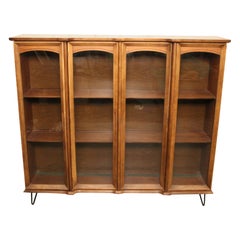
Mid-Century "Outlook" Display Cabinet by Leo Jiranek for Bassett
By Leo Jiranek, Bassett Furniture
Located in Brooklyn, NY
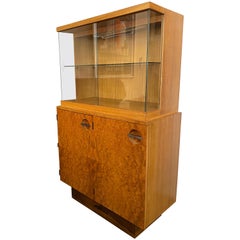
Designed by Leo Jiranek, a forefather of mid-century American Modern furniture, this vintage vitrine was created for his "Outlook" Collection made by Virginia's Bassett Furniture. Hi...
Category

Mid-20th Century American Mid-Century Modern Le Corbusier, Jeanneret, Perriand Vitrines

Materials

Metal

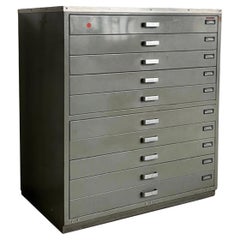
Vintage Italian Industrial Cabinet / drawers for storage drawings and posters
Located in Milano, IT
Industrial furniture from the fifties and the sixties is making a strong comeback, because finally its high design qualities are being recognised and awarder even if most of the time...
Category

1960s Italian Mid-Century Modern Vintage Le Corbusier, Jeanneret, Perriand Vitrines

Materials

Iron

Vintage Italian Industrial Cabinet / drawers  for storage drawings and posters
$3,723 Sale Price
10% Off
H 48.82 in W 28.35 in D 42.92 in
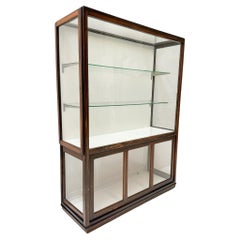
Modern Glass Showcase Cabinet
Located in Queens, NY
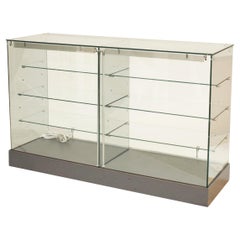
"Modern glass showcase cabinet with steel & aluminum fittings with 2 sliding mirrored doors on a wood base with 6 adjustable glass shelves and l...
Category

20th Century Unknown Mid-Century Modern Le Corbusier, Jeanneret, Perriand Vitrines

Materials

Glass

Modern Glass Showcase Cabinet
$5,500
H 37.5 in W 60 in D 19.5 in
Cabinet 50s reminds Works of Charlotte Perriand, Le Corbusier, Jean Prouvé
By Charlotte Perriand, Jean Prouvé, Le Corbusier, Pierre Jeanneret, Charlotte Perriand Cassina
Located in Paris, FR
Built around the 1950s, this unique rectangular cabinet/sideboard is made entirely of wood with a top that appears to be black melamine and rests on a black wooden base. . It feature...
Category

1950s French Vintage Le Corbusier, Jeanneret, Perriand Vitrines

Materials

Wood

Art Deco Signed Wolfgang Hoffmann for Romweber World s Fair Display Cabinet
By Romweber Furniture Co., Wolfgang Hoffmann
Located in Forney, TX
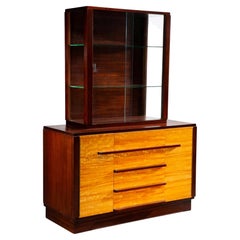
A rare and important Art Deco period Century of Progress Display Cabinet designed by Wolfgang Hoffmann (Austrian, 1900-1969) for Romweber Company, Batesville, Indiana, United States of America. circa 1933-1936 Created for the 1933 Chicago World's Fair, one piece design, having a rectangular showcase top with glass panel sides and a pair of sliding glass doors, over solid wood chest fitted with four drawers affixed with horizontal pulls, flanked by cabinet doors, opening to shelved interior. Rosewood, mahogany, richly figured blonde - golden birch or primavera, and glass. Signed, original label to drawer interior, featuring 1933 World's Fair mark impressed. **Please note, at the time of writing this, a matching sideboard - buffet (shown in last photo) is currently available separately** Provenance / Acquisition: Property from the important and iconic collection of Mr. James I. Rafftesaeth Jr., Dallas, Texas Acquired from highly reputable auction house, Heritage Auctions, Dallas, Texas. 2022 Design Signature Auction catalog #8091 History: Wolfgang Hoffmann was born in Vienna, Austria in 1900. He is the son of famous architect, pedagogue and Wiener Werkstatte cofounder, Joseph Hoffmann (1870-1956). Early on, following his father’s s interests, he was trained in the decorative arts and design. Wolfgang Hoffmann once reminisced, “I spent eight years at the Realschule, then three years went to a special architectural school, where I perfected my technical knowledge of architecture and general construction. From this school, I was graduated to the Kunstgewerbeschule [Studying under Oskar Strnad and Josef Frank in Vienna]. After finishing this school, I had one and a half years of practical in a well known architect’s office. Thereafter I worked in my Father’s office for two years”. Hoffmann met his future wife, Polish immigrant Pola (1902-1984) when they were both studying at the Kunstgewerbeschule. Joseph Urban (1872-1933) was needing an assistant for his architectural business in New York and contacted his friend and colleague, Joseph Hoffmann in Vienna. Hoffmann recommended his son Wolfgang. Urban hired him and sent a first class passage ticket to Vienna for Wolfgang to travel to New York. Wolfgang married Pola and traded his ticket for two tickets to America in steerage, arriving in New York City in December of 1925. Leaving the Urban office after nine months, Wolfgang and Pola formed an independent design practice with offices on Madison Avenue in Manhattan with the purpose of creating contemporary interiors and industrial designs. Early work included theaters, stores, and apartments mostly in New York City. During the late 1920’s and early 1930’s the Hoffmanns designed custom furniture for private clients. Some of these examples were shown in the February 1929 issue of House and Garden. Curiously, the examples’ design was attributed to Urban and the production to Pola Hoffmann, Inc. Established in the fall of 1928, the American Designers’ Gallery was “devoted exclusively to showing objects and interiors for practical use… by fourteen American architects and designers”. Its members included the Hoffmans and Urban as well as ceramist Henry Varnum Poor (1888-1971), architect Raymond Hood (1881-1934), artist designer Winold Reiss (1886-1953), graphic designer Lucien Bernhard (1896-1981), decorator Donald Deskey (1894-1989), and architect Ely Jacques Kahn (1884-1972). The Hoffmanns’ work was included in the American Designers’ Gallery’s two showcase events, its 1928 and 1929 exhibitions. Their dining alcove at the 1929 event featured a bench with a dinette table and two chairs in American walnut designed by Wolfgang and a rug by Pola. Lucien Bernhard, fellow Austrian immigrant who settled in New York a year before the Hoffmanns, operated the gallery and decorating service Contempora with Munich resident Bruno Paul (1874-1968). The Hoffmanns, occasionally participating with Contempora, designed a number of outstanding interiors, including the constructivist living room of 1930 for Mrs. O.R. Sommerich at 40 East 66th street. In 1934, Donald Deskey commissioned Wolfgang to design birchwood furnishings for the eclectic apartment at 625 Park Avenue belonging to Helena Rubinstein. In 1931, Wolfgang exhibited his work at the Pennsylvania Art Museum and the Museum of Modern Art in New York City. The same year, with Kem Weber (1889-1963) he organized the second and final exhibition of AUDAC- “Modern Industrial and Decorative Arts”- at the Brooklyn Museum. At this event, the Hoffmanns showed the dining room previously included in the American Designer’s Gallery’s 1929 exhibition in the Chase Bank Building lobby at 145 West 57th Street in Manhattan. In 1932 Wolfgang was asked to assist Urban in developing the color scheme for the 1933-34 Chicago World’s Fair “A Century of Progress”. He was also commissioned to design the interior and furniture for the fair’s lumber industries house. There he executed its living and dining rooms furnished by Kroehler Manufacturing Company of Chicago; the boys’ room by Shower Brothers...
Category

Early 20th Century American Art Deco Le Corbusier, Jeanneret, Perriand Vitrines

Materials

Glass, Mahogany, Rosewood

Carlo Scarpa for Bernini Black laquered Wood Display Cabinet, Italy 1970s
By Bernini, Carlo Scarpa
Located in Naples, IT
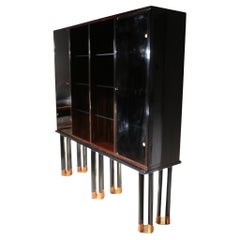
Raro Mobile Vetrina disegnato da Carlo Scarpa per la Ditta Italiana Bernini anni ’70. Struttura in legno tinto nero e vetro con particolare apertura delle ante laterale verso il ce...
Category

1970s Italian Mid-Century Modern Vintage Le Corbusier, Jeanneret, Perriand Vitrines

Materials

Brass

Long Birch Bark Panel And Glass Display Showcase Cabinet for Restoration
Located in Bridgeport, CT
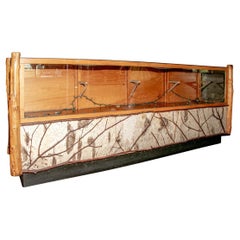
A Deep Country Style display cabinet acquired from a long running Northeastern Woodland theme restaurant. Branch supports with sliding pine back panels and interior twig display shel...
Category

20th Century American Rustic Le Corbusier, Jeanneret, Perriand Vitrines

Materials

Glass, Wood

Le Corbusier, Jeanneret, Perriand vitrines for sale on 1stDibs.

Le Corbusier, Jeanneret, Perriand vitrines are available for sale on 1stDibs. These distinctive items are frequently made of metal and are designed with extraordinary care. There are many options to choose from in our collection of Le Corbusier, Jeanneret, Perriand vitrines, although brown editions of this piece are particularly popular. Many of the original vitrines by Le Corbusier, Jeanneret, Perriand were created in the mid-century modern style in italy during the 21st century and contemporary. Prices for Le Corbusier, Jeanneret, Perriand vitrines can differ depending upon size, time period and other attributes — on 1stDibs, these items begin at $11,675 and can go as high as $11,675, while a piece like these, on average, fetch $11,675.
Questions About Le Corbusier, Jeanneret, Perriand Vitrines
  • 1stDibs ExpertSeptember 27, 2024
    Charles-Édouard Jeanneret was called Le Corbusier because that was the name the French-Swiss designer and architect chose for himself. His maternal grandfather's name was Lecorbésier, and Jeanneret altered the surname to create his adopted name. Le Corbusier was a pioneer of progress-minded modern architecture who sought to impose rational order on the chaos of the world through design. On 1stDibs, shop a diverse assortment of Le Corbusier furniture.

Still Thinking About These?

All Recently Viewed