Lee Jaffe Art
American, b. 1950
Lee Jaffe was born in the Bronx in 1950. He is a successful American artist, filmmaker and musician. Jaffe lives and works in Los Angeles. In 1973, he met Bob Marley and played in his band for several years. During this time, Jaffe created the series of photographic works One Love with photographs of Bob Marley.
to
4
1
5
5
4
1
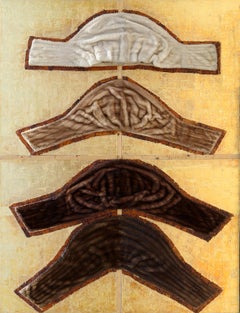
Four Skins, Contemporary Mixed Media on Canvas by Lee Jaffe
By Lee Jaffe
Located in Long Island City, NY
Lee Jaffe, American (1950 - ) - Four Skins, Year: 1983, Medium: Gold Leaf, Mink Skins, and Oil on Canvas, not signed, Size: 86 x 112 in. (218.44 x 284.48 cm)
Category
1980s Contemporary Lee Jaffe Art
Materials
Gold Leaf
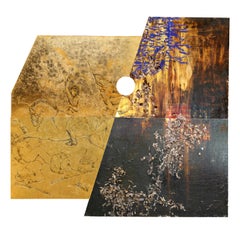
Benedict Arnold at The Battle of Saratoga, Mixed Media on Canvas by Lee Jaffe
By Lee Jaffe
Located in Long Island City, NY
Lee Jaffe, American (1950 - ) - Benedict Arnold at The Battle of Saratoga, Year: 1983, Medium: Gold Leaf, Tar, Turkey Feathers, and Oil on Canvas, not signed, Size: 136 x 144 in....
Category
1980s Contemporary Lee Jaffe Art
Materials
Mixed Media, Oil
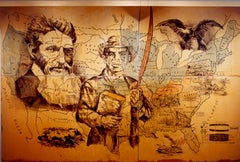
Portrait of John Brown
Nat Turner, American Realist Oil Painting by Lee Jaffe
By Lee Jaffe
Located in Long Island City, NY
Lee Jaffe, American (1950 - ) - Portrait of John Brown and Nat Turner, Year: 1983, Medium: Oil on Canvas, Size: 125 in. x 170 in. (317.5 cm x 431.8 cm)
Category
1980s American Realist Lee Jaffe Art
Materials
Oil
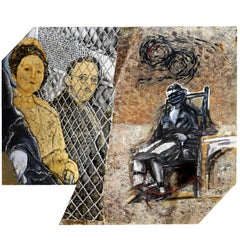
Eclipse/Portrait of Ethel
Julius Rosenberg, Mixed Media on Canvas by Lee Jaffe
By Lee Jaffe
Located in Long Island City, NY
Lee Jaffe, American (1950 - ) - Eclipse/Portrait of Ethel and Julius Rosenberg, Year: 1983, Medium: Silver, Gold Leaf, Copper Wire, and Oil on Canvas, Size: 129 x 153 in. (327.66...
Category
1980s Contemporary Lee Jaffe Art
Materials
Mixed Media, Oil
"One Love" Series, Lee Jaffe, 1973/2010, Photography / Color Print
By Lee Jaffe
Located in Greding, DE
Signed and inscribed Jamaica and dated 1973/2010 lower right.
Lee Jaffe (born 1950 USA) is a successful American artist, filmmaker and musician. He lives and works in Los Angeles. I...
Category
1970s American Modern Lee Jaffe Art
Materials
Color
Related Items
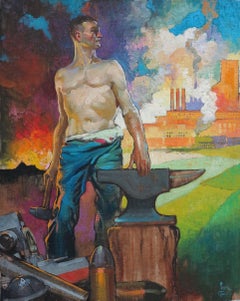
Allegory of Defense Industry (figurative male illustration)
By Frank Godwin
Located in Wilton Manors, FL
Frank Godwin (1889-1959). Allegory of Defense Industry, 1919. Oil on canvas. Signed lower right. Image measures 20.75 x 26.25 inches. The canvas measures 24 x 36 inches in total. Ann...
Category
Early 20th Century American Realist Lee Jaffe Art
Materials
Canvas, Oil

$12,000 Sale Price
40% Off
H 26.25 in W 20.75 in
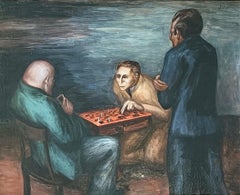
Chess Players WPA Depression Era Mid-20th Century American Scene Realism Modern
By Mervin Jules
Located in New York, NY
Chess Players WPA Depression Era Mid-20th Century American Scene Realism Modern. Signed upper right and verso 8 x 10 inches oil on board.
BIO
The son of a men's haberdasher, Mervin ...
Category
1930s American Realist Lee Jaffe Art
Materials
Oil, Board
$6,800
H 10 in W 12 in D 2 in
Sketching Wisconsin
original oil painting, Signed
By John Steuart Curry
Located in Milwaukee, WI
John Steuart Curry
"Sketching Wisconsin," 1946
oil on canvas
31.13 x 28 inches, canvas
39.75 x 36.75 x 2.5 inches, frame
Signed and dated lower right
Overall excellent condition
Presented in a 24-karat gold leaf hand-carved wood frame
John Steuart Curry (1897-1946) was an American regionalist painter active during the Great Depression and into World War II. He was born in Kansas on his family’s farm but went on to study art in Chicago, Paris and New York as young man. In Paris, he was exposed to the work of masters such as Peter Paul Rubens, Eugène Delacroix and Jacques-Louis David. As he matured, his work showed the influence of these masters, especially in his compositional decisions. Like the two other Midwestern regionalist artists that are most often grouped with him, Grant Wood (American, 1891-1942) and Thomas Hart Benton (American, 1889-1975), Curry was interested in representational works containing distinctly American subject matter. This was contrary to the popular art at the time, which was moving closer and closer to abstraction and individual expression.
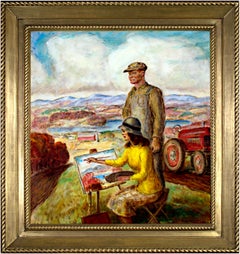
Sketching Wisconsin is an oil painting completed in 1946, the last year of John Steuart Curry’s life, during which time he was the artist-in-residence at the University of Wisconsin in Madison. The painting is significant in Curry’s body of work both as a very revealing self-portrait, and as a landscape that clearly and sensitively depicts the scenery of southern Wisconsin near Madison. It is also a portrait of the artist’s second wife, Kathleen Gould Curry, and is unique in that it contains a ‘picture within a picture,’ a compositional element that many early painting masters used to draw the eye of the viewer. This particular artwork adds a new twist to this theme: Curry’s wife is creating essentially the same painting the viewer is looking at when viewing Sketching Wisconsin.
The triangular composition of the figures in the foreground immediately brings focus to a younger Curry, whose head penetrates the horizon line and whose gaze looks out towards the viewer. The eye then moves down to Mrs. Curry, who, seated on a folding stool and with her hand raised to paint the canvas on the easel before her, anchors the triangular composition. The shape is repeated in the legs of the stool and the easel. Behind the two figures, stripes of furrowed fields fall away gently down the hillside to a farmstead and small lake below. Beyond the lake, patches of field and forest rise and fall into the distance, and eventually give way to blue hills.
Here, Curry has subverted the traditional artist’s self-portrait by portraying himself as a farmer first and an artist second. He rejects what he sees as an elitist art world of the East Coast and Europe. In this self-portrait he depicts himself without any pretense or the instruments of his profession and with a red tractor standing in the field behind him as if he was taking a break from the field work. Here, Curry’s wife symbolizes John Steuart Curry’s identity as an artist. Compared with a self-portrait of the artist completed a decade earlier, this work shows a marked departure from how the artist previously presented and viewed himself. In the earlier portrait, Curry depicted himself in the studio with brushes in hand, and with some of his more recognizable and successful canvases behind him. But in Sketching Wisconsin, Curry has taken himself out of the studio and into the field, indicating a shift in the artist’s self-conception.
Sketching Wisconsin’s rural subject also expresses Curry’s populist ideals, that art could be relevant to anyone. This followed the broad educational objectives of UW’s artist-in-residence program. Curry was appointed to his position at the University of Wisconsin in 1937 and was the first person to hold any such position in the country, the purpose of which was to serve as an educational resource to the people of the state. He embraced his role at the University with zeal and not only opened the doors of his campus studio in the School of Agriculture to the community, but also spent a great deal of time traveling around the state of Wisconsin to visit rural artists who could benefit from his expertise. It was during his ten years in the program that Curry was able to put into practice his belief that art should be meaningful to the rural populace. However, during this time he also struggled with public criticism, as the dominant forces of the art market were moving away from representation. Perhaps it was Curry’s desire for public acceptance during the latter part of his career that caused him to portray himself as an Everyman in Sketching Wisconsin.
Beyond its importance as a portrait of the artist, Sketching Wisconsin is also a detailed and sensitive landscape that shows us Curry’s deep personal connection to his environment. The landscape here can be compared to Wisconsin Landscape of 1938-39 (the Metropolitan Museum of Art), which presents a similar tableau of rolling hills with a patchwork of fields. Like Wisconsin Landscape, this is an incredibly detailed and expressive depiction of a place close to the artist’s heart. This expressive landscape is certainly the result of many hours spent sketching people, animals, weather conditions and topography of Wisconsin as Curry traveled around the state. The backdrop of undulating hills and the sweeping horizon, and the emotions evoked by it, are emphatically recognizable as the ‘driftless’ area of south-central Wisconsin. But while the Metropolitan’s Wisconsin Landscape conveys a sense of uncertainty or foreboding with its dramatic spring cloudscape and alternating bands of light and dark, Sketching Wisconsin has a warm and reflective mood. The colors of the foliage indicate that it is late summer and Curry seems to look out at the viewer approvingly, as if satisfied with the fertile ground surrounding him.
The landscape in Sketching Wisconsin is also revealing of what became one of Curry’s passions while artist-in-residence at UW’s School of Agriculture – soil conservation. When Curry was a child in Kansas, he saw his father almost lose his farm and its soil to the erosion of The Dust Bowl. Therefore, he was very enthusiastic about ideas from UW’s School of Agriculture on soil conservation methods being used on Wisconsin farms. In Sketching Wisconsin, we see evidence of crop rotation methods in the terraced stripes of fields leading down the hillside away from the Curry’s and in how they alternate between cultivated and fallow fields.
Overall, Sketching Wisconsin has a warm, reflective, and comfortably pastoral atmosphere, and the perceived shift in Curry’s self-image that is evident in the portrait is a positive one. After his rise to favor in the art world in the 1930’s, and then rejection from it due to the strong beliefs presented in his art, Curry is satisfied and proud to be farmer in this self-portrait. Curry suffered from high blood...
Category
1940s American Realist Lee Jaffe Art
Materials
Canvas, Oil
$652,500
H 39.75 in W 36.75 in D 2.5 in
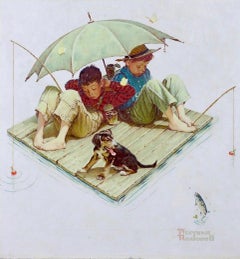
Me and My Pal: Fishing Raft, Four Seasons Calendar Illustration
By Norman Rockwell
Located in Fort Washington, PA
For Norman Rockwell's Four Seasons calendar series for Brown & Bigelow
By the end of World War II, Norman Rockwell was a household name throughout the United States and considered...
Category
1950s American Realist Lee Jaffe Art
Materials
Oil, Canvas
$675,000
H 14 in W 13.25 in
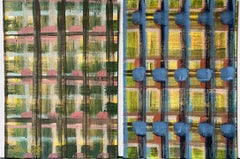
Original The Weaver Diptych-Tartan inspired-British Awarded Artist-oil on paper
Located in London, GB
"The Weaver" Series inviting viewers into a world where memory and present interweaving in a mesmerizing display of visual creativity.
- An Artist Proof's of only Three is offered as...
Category
2010s Contemporary Lee Jaffe Art
Materials
Gold Leaf
$520
H 11.7 in W 16.54 in D 0.08 in
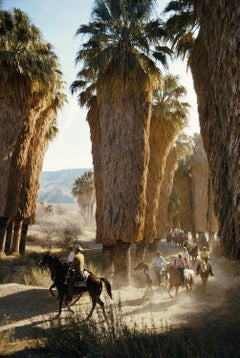
Palm Springs Riders, 1970 - Desert Landscapes in Southern California Hills
By Slim Aarons
Located in Brighton, GB
Palm Springs Riders, 1970 - Desert Landscapes in Southern California Hills
16 x 20" print.
Limited Edition Estate Stamped Print.
Digital C-Type print.
Edition of 150.
Printed Later....
Category
20th Century American Modern Lee Jaffe Art
Materials
Photographic Paper, C Print, Color, Digital
$3,825
H 16 in W 20 in D 0.1 in
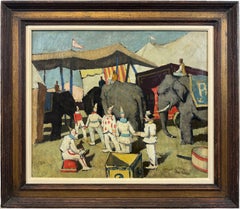
“Circus Yard” American Regionalist, Elephants, Tents, Performers, Clowns, Oil
By Paul Sample
Located in Yardley, PA
“Circus Yard” by Paul Starrett Sample (American, 1896-1974).
A vibrant circus scene by the noted American regionalist, Paul Starrett Sample. This work captures the lively bustle beh...
Category
Mid-20th Century American Realist Lee Jaffe Art
Materials
Canvas, Oil
$12,000
H 26.25 in W 30.25 in D 2 in
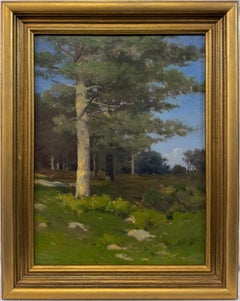
“Eastern White Pines, c. 1910”, New England Landscape, Signed Oil Painting
By Charles Warren Eaton
Located in Yardley, PA
“Eastern White Pines, c. 1910” by Charles Warren Eaton (American, 1857-1937).
A wonderful example of Eaton’s renowned compositions of Eastern white pine trees in his mature style. A...
Category
Early 20th Century American Realist Lee Jaffe Art
Materials
Canvas, Oil, Board
$7,500
H 19.5 in W 15.5 in D 1.5 in
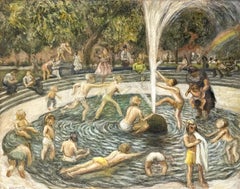
Bathers 1940s Mid 20th Century American Scene Social Realism WPA Modern Ashcan
Located in New York, NY
Bathers 1940s Mid 20th Century American Scene Social Realism WPA Modern Ashcan
Marion Gilmore (1909-1984)
Bathers
15 1/2 x 19 1/2 inches
oil on canvas boar...
Category
1940s American Realist Lee Jaffe Art
Materials
Oil, Board
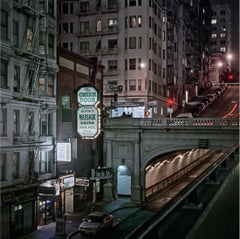
Green Door, San Francisco - American Urban City Landscape Photography
By Morgan Silk
Located in Brighton, GB
'Green Door, San Francisco' is an Archival Inkjet Print by photographer Morgan Silk.
Green Door, San Francisco by Morgan Silk is available in this size of 17" x 23" in an edition o...
Category
21st Century and Contemporary American Modern Lee Jaffe Art
Materials
Archival Ink, Photographic Paper, Color
$649
H 17 in W 23 in D 0.1 in
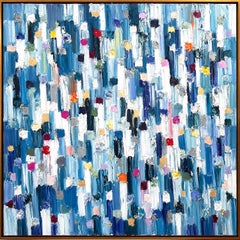
"Dripping Dots - The Maldives" Jewel Toned Contemporary Oil Painting on Canvas
By Cindy Shaoul
Located in New York, NY
With layers of bright oils and whisking brush strokes, the paint is able to shine and shimmer in a very unique pattern. The artist uses gold flakes with thick textured oils and glass...
Category
2010s Contemporary Lee Jaffe Art
Materials
Gold Leaf
$6,000 Sale Price
20% Off
H 49.5 in W 49.5 in D 2 in
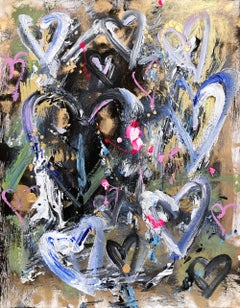
"When You First Kissed Me" Colorful Pop Art Hearts Abstract Painting on Paper
By Cindy Shaoul
Located in New York, NY
Motivated by bold color and fast brushwork, we are moved by the simplicity and thick textured acrylics and oils in these works. Shaoul’s “My Heart Collection” is a vibrant and energe...
Category
2010s Contemporary Lee Jaffe Art
Materials
Oil, Acrylic, Archival Paper, Mixed Media
$500
H 14 in W 11 in D 0.1 in
Lee Jaffe art for sale on 1stDibs.
Find a wide variety of authentic Lee Jaffe art available for sale on 1stDibs. You can also browse by medium to find art by Lee Jaffe in archival paper, digital print, lambda print and more. Much of the original work by this artist or collective was created during the 20th century and is mostly associated with the modern style. Not every interior allows for large Lee Jaffe art, so small editions measuring 12 inches across are available. Customers who are interested in this artist might also find the work of Marion Post Wolcott, Naomi Savage, and Neal Slavin. Lee Jaffe art prices can differ depending upon medium, time period and other attributes. On 1stDibs, the price for these items starts at $4,313 and tops out at $4,313, while the average work can sell for $4,313.