Longton Hall Porcelain
to
1
1
1
1
1
1
1
1
1
1
1
1
1
345
225
166
141
Creator: Longton Hall
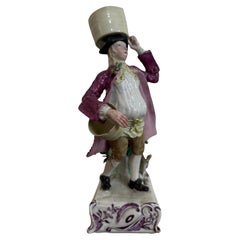
Longton Hall Figure of Milkman, circa 1755
By Longton Hall
Located in Basildon, GB
Longton Hall Figure of Milkman, circa 1755, with two pails, one on his head the other by his side, wearing a black tricorn hat, white shirt, yellow and puce spotted neckerchief, puce...
Category
1750s English Rococo Antique Longton Hall Porcelain
Materials
Porcelain
Related Items
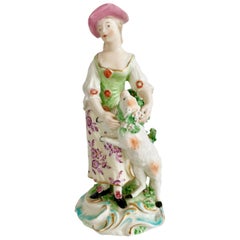
Derby Figure of Shepherdess with Garlanded Lamb, ca 1760
By Derby
Located in London, GB
This is a charming Derby figure of a shepherdess with a garlanded lamb, made in or shortly after 1760. The figure is one half of a set called the "Garland...
Category
1760s English Rococo Antique Longton Hall Porcelain
Materials
Porcelain

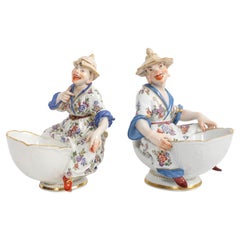
Pair of Meissen Porcelain Chinoiserie Figural Sweetmeat Dishes, J.J. Kandler
By Meissen Porcelain
Located in New York, NY
A fine pair of Meissen porcelain chinoiserie figural sweetmeat dishes, after a model by J.J. Kandler
Each with a Malabar chinoiserie figure seated on...
Category
Mid-20th Century German Rococo Longton Hall Porcelain
Materials
Porcelain
$11,800 / set
H 8 in W 6.75 in D 5.5 in
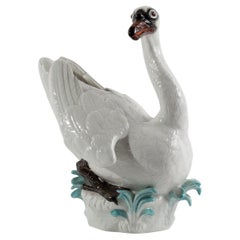
Meissen Porcelain Figure of a Swan, After a Model by Johann Joachim Kändler
By Meissen Porcelain
Located in New York, NY
Meissen Porcelain Figure of a Swan
This porcelain figure represents a swan modeled in a lifelike posture with its wings partially raised and neck gracefully arched. The surface is m...
Category
1920s German Rococo Vintage Longton Hall Porcelain
Materials
Porcelain
$6,500
H 9 in W 7 in D 4.5 in
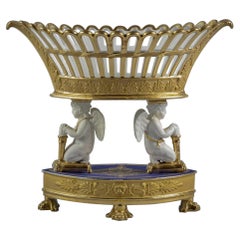
Paris Porcelain Figural Openwork Centerpiece, circa 1830
Located in New York, NY
Paris porcelain figural openwork centerpiece, circa 1830.
Category
1830s French Antique Longton Hall Porcelain
Materials
Porcelain
Antique 21 piece Doric China Longton Stafford Porcelain Tea Set 20th Century
Located in London, GB
This is a wonderful Antique Doric China High Street Longton Staffordshire porcelain tea set Circa 1926 - 35 in date.
It contains 21 pieces and is beautifully made with superb decor...
Category
Early 20th Century English Neoclassical Longton Hall Porcelain
Materials
Porcelain
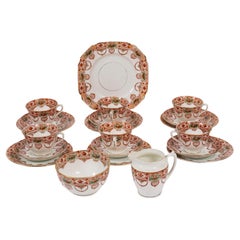
$580 / set
H 0.79 in W 8.67 in D 8.67 in
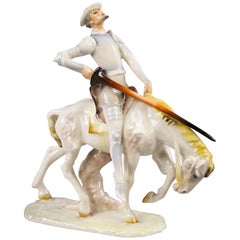
German Porcelain Figure of Don Quixote, circa 1900
Located in New York, NY
Marked Hutschenreuther and impressed by the designer Carl Werner.
Category
Early 1900s German Antique Longton Hall Porcelain
Materials
Porcelain
Chinoiserie German Porcelain Figure of a Nodder, Figure Seated Cross-Legged
By Dresden Porcelain
Located in New York, NY
An antique German porcelain figure seated crossed-leg, "Nodder", dressed in an elaborately hand-painted robe, with his head, hands, and tongue moving, German porcelain by Dresden. Ve...
Category
1890s German Rococo Revival Antique Longton Hall Porcelain
Materials
Porcelain
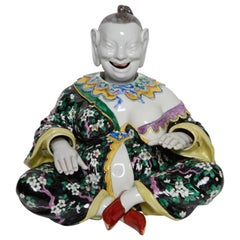
$6,800
H 10 in W 10 in D 10.5 in
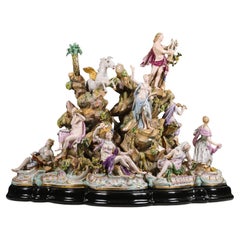
A Monumental Meissen Porcelain Figural Group of Mount Parnassus
By Meissen Porcelain
Located in Brighton, West Sussex
A Monumental Meissen Porcelain Figural Group of Apollo and the Nine Muses on Mount Parnassus.
Comprised of sixteen interlocking parts. Apollo standing holding a lyre and with Pegasus besides a tree, atop a rocky outcrop detailed with foliage and waterfalls above nine goddesses:
Calliope, seated and shown writing, representing eloquence and epic poetry.
Clio, seated with an open book and blowing a trumpet, representing history.
Erato, seated and holding a kithara, representing science and the arts
Euterpe, seated and holding a flute, representing music.
Melpomene, seated holding a knife and with one hand to her head, representing tragedy.
Thalia, seated and holding aloft mask, representing comedy and idyllic poetry.
Urania, seated with telescope and globe, representing astronomy and astrology,
Polyhymnia, standing with one hand raised and holding a book, representing sacred poetry.
Terpsichore, standing, representing dance.
Each piece exceptionally finely detailed and painted. The base portions with rocaille edges. On a later black polished wooden base.
Multiple blue crossed swords marks. Each piece titled to underside.
German, Circa 1880.
Mount Parnassus, is a spur of the Pindus Mountains in central Greece and was sacred to the ancient Greeks and in mythology to Apollo, the god of music and poetry and of the Sun and light. Mount Parnassus the mythical centre of poetry, music, and learning in ancient Greece was a popular theme in Barqoue and Rococo art, often substitutable with Athena’s arrival at Mount Helicon from the fifth book of Ovid’s “Metamorphoses”, where she asks the Muses to show her the new spring which gushed forth from the spot where Pegasus “with his hoof of horn opened the earth” (V, 250-260).
Here, the mountain, formed from rugged rock cliffs, culminates in a plateau on which the youthful Apollo stands and plays the lyre. The Castalian spring flows from beneath Pegasus’ hoof, representing the source of inspiration and attracting the nine muses, who embody the arts and inspire creation through song, music, and dance.
Mount Parnassus was created at the Meissen porcelain manufactory as a table centrepiece and an earlier version, apparently with only five muses, is listed in the inventory of the pastry shop of the Meissen manufactory manager and cabinet minister Heinrich Graf Brühl in 1753. The storage in the pastry shop of approximately 3,000 objects and dishes, including many individual parts for centrepieces, is related to their function as table decorations, replacing decorations previously made by the confectioner from perishable materials such as sugar or wax.
The purpose of this table decoration was as a feast for the eyes to accompany the feast of the banquet. The sculptural figurines often depicted a particular theme, with characters drawn from theatre and opera, from classical mythology or pastoral idylls. Allegories and mythological themes, such as the glorification of fine arts, were also popular. Stylistically, Mount Parnassus fits Kändler’s style of the 1740s, and was sold by Brühl in 1762 to Frederick the Great of Prussia who used mythology as a means of self-expression and had already ordered individual figures of Apollo and the Muses as table decorations in 1744. Today it is in the Museum of Applied Arts, Frankfurt (inv. no. M.L. 41). There is another version of Mount Parnassus, from the collection of Prince Alexander Dolgorukoff, in the Hermitage in Saint Petersburg.
The present version dates to the second half of the nineteenth century when there was a great revival of Kändler rococo figurines which were reissued and a “Second Rococo”. Another nineteenth century example is in the collection of the Museo Francesco Borgogna, Italy (inv. 1906, XIII, 19-20). These nineteenth century versions were made by the Meissen factory using Kändler's period models. It is recorded that a new version of Mount Parnassus, dating to the 1880s, was part of the Royal Porcelain collection in Dresden:
'In the porcelain collection there is a new version from the 1880s based on the old models, the largest group of this genre, the Parnassus, which shows the named muses all around on the lower part of the rock, each practising their own art, while on the top there is Apollo with the lyre and next to it the Castalian spring rises from the hoofbeat of Pegasus. Each figure is executed individually with its rocky background, and all the pieces are then fitted together, as we have already seen in his earlier, larger compositions. The rock pieces are finished off like a pedestal at the bottom with Rococo ornaments.' (Jean Louis Sponsel, Kabinettstücke der Meissner Porzellan-manufaktur von Johann Joachim Kändler, Leipzig, 1900, pp. 203-204).
Kunst und kunsthandwerk; monatsschrift herausgegeben vom Österreichischen museum fuer kunst und industrie, Vienna, 1894, v.7 pt.1, p.133.
Kari Berling, Das Meißner Porzellan und seine Geschichte. Leipzig 1900, S. 99, 187-200.
Helmuth Gröger, Johann Joachim Kaendler. Dresden, 1956.
Peter W Meister, Franz Adrian Dreier, Figürliche Keramik aus zwei Jahrtausenden. Kat Museum für Kunsthandwerk, Frankfurt. Frankfurt 1964, Nr. 90.
Rainer Rückert, Meißener Porzellan, 1710-1810. Kat. Ausst. Bayerisches Nationalmuseum München. München 1966.
Stefan Bursche, Tafelzier des Barock. München 1974, Abb. 300.
"Tafelaufsatz, Der Parnass", Auswahlkatalog, Museum für Kunsthandwerk (Frankfurt am Main, Germany), 1987, pp. 86-87.
Alfred Ziffer, ‘Meissener Porzellanplastik für fürstliches Interieur und Zeremoniell’, Keramos, Issue 241/242, pp. 29–52.
MEISSEN
The production of Meissen porcelain began in 1710 at the manufactory at Meissen...
Category
19th Century German Rococo Antique Longton Hall Porcelain
Materials
Porcelain
$268,272
H 26.78 in W 36.23 in D 24.02 in
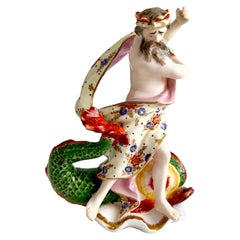
Derby Porcelain Figure of Neptune and Dolphin on a Shell, ca 1785
By Derby
Located in London, GB
This is a stunning porcelain figure of Neptune with a dolphin standing on a sea shell, made by Derby around the year 1785. The figure is in beautiful original condition.
We have one other Neptune figure from 1765, please see separate listing.
The Derby Porcelain factory has its roots in the late 1740s, when Andrew Planché, a Walloon Huguenot refugee, started making simple porcelain toys shaped like animals in his back yard. In 1756 Staffordshire enameller...
Category
1780s English Rococo Antique Longton Hall Porcelain
Materials
Porcelain
$2,100
H 6.25 in W 4.25 in D 3.25 in
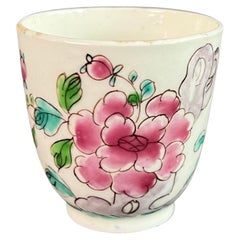
Bow Porcelain Orphaned Coffee Cup, Famille Rose Peony, circa 1755
By Bow Porcelain
Located in London, GB
This is a very charming orphaned coffee cup made by the Bow Porcelain factory in about 1755. The cup is decorated in a Chinese "famille rose" peony pattern. This cup would have been part of a large tea service, and the tiny size shows how expensive coffee was in the 18th Century.
The Bow Porcelain Factory was one of the first potteries in Britain to make soft paste porcelain, and most probably the very first to use bone ash, which later got perfected by Josiah Spode to what is now the universally used "bone china". Bow was the main competitor of the Chelsea Porcelain Factory, but where Chelsea made very fine slipcast porcelain, Bow made a different soft paste porcelain that tended to be softer and could be pressed into moulds. Bow served a larger public generally at lower prices. The factory was only in operation between 1743 and 1774, after which the tradition got incorporated into some of the later famous potteries such as Worcester and Derby.
The cup is unmarked, which is normal for Bow items of this era.
Condition report the cup is in excellent condition without any damage or repairs. There are various glazing imperfections, which are quite normal for porcelain of this era.
Antique British porcelain...
Category
1750s English Rococo Antique Longton Hall Porcelain
Materials
Porcelain
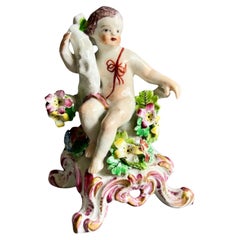
Bow Porcelain Figure of Boy Putto on C-Scroll Base, Georgian circa 1760
By Bow Porcelain
Located in London, GB
This is a wonderful little figure of a boy or putto made by the Bow Porcelain factory in about 1760.
The Bow Porcelain Factory was one of the first potteries in Britain to make soft...
Category
1760s English Rococo Antique Longton Hall Porcelain
Materials
Porcelain
$685
H 4.75 in W 2.5 in D 2.5 in
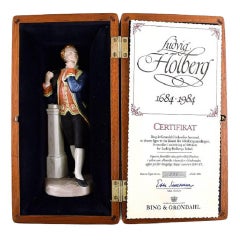
Bing and Grondahl Figure of Oluf Poulsen as Henrik, Holberg Collection
Located in København, Copenhagen
Bing
Grondahl Oluf Poulsen in the role of Henrik,
B&G 8001 Ludvig Holberg 1884 "Henrik" Masquerade (Limited Edition 500 pcs.)
Measures 18.5 cm.
In perfe...
Category
1980s Danish Rococo Vintage Longton Hall Porcelain
Previously Available Items
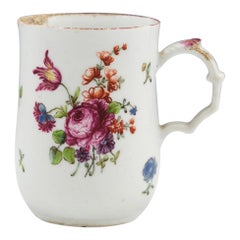
A Longton Hall Porcelain Mug, c1760
By Longton Hall
Located in Tunbridge Wells, GB
A Longton Hall Porcelain Mug, c1760
Additional information:
Date : Circa 1760
Period : George 11 or George 111
Marks :None
Origin Longton, Staffordshire:
Colour :Polychrome
Pattern ...
Category
18th Century English George II Antique Longton Hall Porcelain
Materials
Porcelain
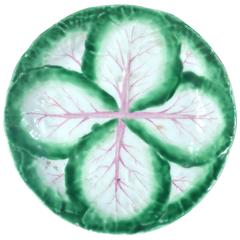
Longton Hall Porcelain Four Leaf Molded Trompe L
oieil Saucer, circa 1754-1757
By Longton Hall
Located in Downingtown, PA
Longton hall porcelain four leaf molded saucer,
circa 1754-1757.
The Longton Hall saucer is moulded with three central large green leaves with puce veini...
Category
Mid-18th Century English Georgian Antique Longton Hall Porcelain
Materials
Porcelain
Longton Hall porcelain for sale on 1stDibs.
Longton Hall porcelain are available for sale on 1stDibs. These distinctive items are frequently made of porcelain and are designed with extraordinary care. There are many options to choose from in our collection of Longton Hall porcelain, although gray editions of this piece are particularly popular. Many of the original porcelain by Longton Hall were created in the neoclassical style in united kingdom during the 18th century and earlier. If you’re looking for additional options, many customers also consider porcelain by Chelsea Porcelain, Wedgwood, and Wedgewood. Prices for Longton Hall porcelain can differ depending upon size, time period and other attributes — on 1stDibs, these items begin at $1,600 and can go as high as $1,600, while a piece like these, on average, fetch $1,600.