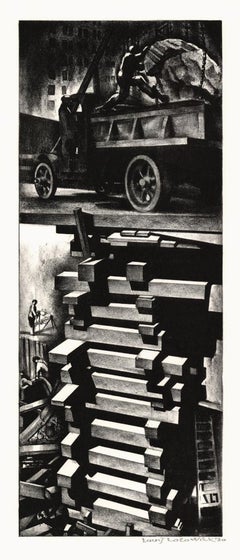
Louis Lozowick Figurative Prints

American, 1892-1973

Louis Lozowick is widely recognized as a key figure in America's Precisionist movement and a leader in mid-20th-century modernist printmaking. His graphic works and paintings have been acquired by numerous museums including the Art Institute of Chicago, Brooklyn Museum, Crystal Bridges Museum of American Art, Fine Arts Museums of San Francisco, Metropolitan Museum of Art, Museum of Modern Art, New York Public Library, Philadelphia Museum of Art, Smithsonian American Art Museum, U. S. Library of Congress and the Whitney Museum of American Art.

to
3
2
Overall Width
to
Overall Height
to
5
13
859
382
367
310
5
2
1
4
1
2
2
1
1
1
1
1
1
5
5
Artist: Louis Lozowick
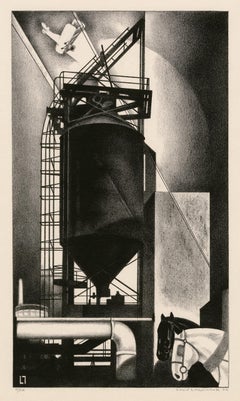
Tanks #1 — American Precisionism
By Louis Lozowick
Located in Myrtle Beach, SC
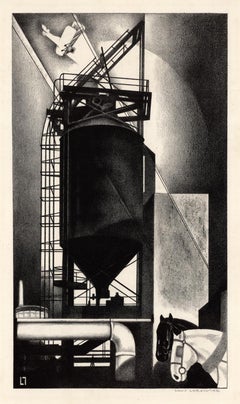
Louis Lozowick, 'Tanks #1', lithograph, 1929, edition 50, Flint 39. Signed, titled, and numbered '11/50' in pencil. Signed with the artist's monogram in the stone, lower left. A superb, richly-inked impression, on cream wove paper, the full sheet with margins (3/4 to 1 7/8 inches), in excellent condition. Matted to museum standards. Image size 13 15/16 x 8 1/16 inches (355 x 204 mm), sheet size 15 3/4 x 11 1/4 inches (400 x 286 mm). Exhibited: 'The American Scene: Prints from Hopper to Pollock', Stephen Coppel, The British Museum, 2008. Literature: 'Prints and Their Creators, A World History', Carl Zigrosser, Crown Publishers Inc, 1974; 'American Lithographers...
Category

1920s American Modern Louis Lozowick Figurative Prints

Materials

Lithograph

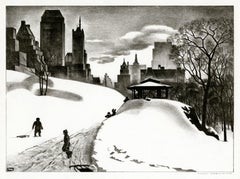
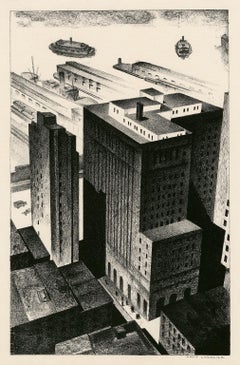
Winter Fun — Mid-century Modernism, Central Park, New York City
By Louis Lozowick
Located in Myrtle Beach, SC
Louis Lozowick, 'Winter Fun', lithograph, 1940, edition 20, 250 (1941). Flint 188. Signed in pencil, with the artist’s monogram in the stone, lower left. A...
Category

1940s American Modern Louis Lozowick Figurative Prints

Materials

Lithograph

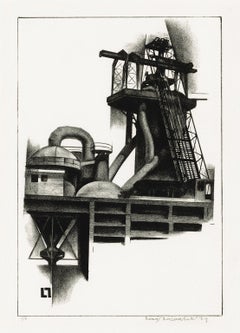
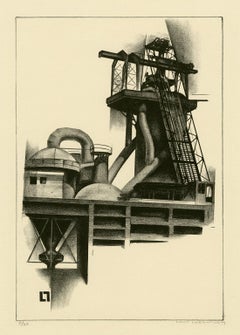
Corner of Steel Plant — American Modernism / Precisionism
By Louis Lozowick
Located in Myrtle Beach, SC
Louis Lozowick, 'Corner of Steel Plant', lithograph, 1929, edition 25, and 10 printed in 1972; Flint 21. Signed, titled, dated, and numbered 'I/X' in penci...
Category

1920s American Modern Louis Lozowick Figurative Prints

Materials

Lithograph

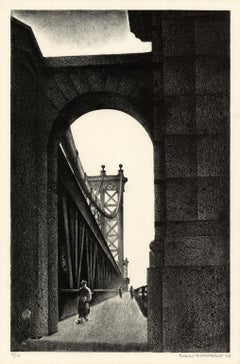
Manhattan Bridge
By Louis Lozowick
Located in New York, NY
This lithograph by Louis Lozowick was created in 1934. This scarce piece was printed in an edition of 10 and in very good condition. It is signed and dated in the lower right with ...
Category

Mid-20th Century Modern Louis Lozowick Figurative Prints

Materials

Lithograph

Tanks #1.
By Louis Lozowick
Located in New York, NY
This 1929 lithograph by Louis Lozowick was printed in an edition of 50. Lozowick signed this impression in pencil lower right with a monogram on stone, in the lower left. The sheet...
Category

Mid-20th Century Modern Louis Lozowick Figurative Prints

Materials

Lithograph

Related Items
Tribute to the Victims (Viet Nam) - Lithograph, 1967
By Alexander Calder
Located in Paris, IDF
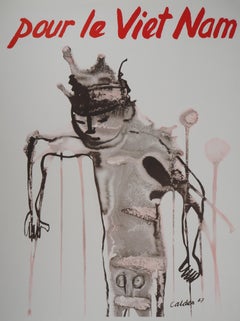
Alexandre Calder (1898 - 1976) Tribute to the Victims, 1967 Lithograph on offset background (Arte atelier) Printed signature in the plate On paper 75 x 44.5 cm (c. 29.5 x 17.3 inch) Original vintage poster INFORMATION: Published by Maeght on the occasion of the artist's exhibition "Pour le Viet Nam...
Category

1960s American Modern Louis Lozowick Figurative Prints

Materials

Lithograph

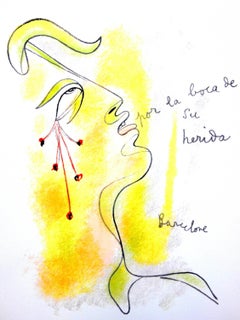
Jean Cocteau - Blue Lady - Original Lithograph
By Jean Cocteau
Located in Collonge Bellerive, Geneve, CH
Original Lithograph by Jean Cocteau Title: Blue Lady Signed in the plate Dimensions: 32 x 25.5 cm Edition: 200 1959 Publisher: Bibliophiles Du Palais Unnumb...
Category

1950s Modern Louis Lozowick Figurative Prints

Materials

Lithograph

Original Pan American World Airways by Clipper to Portugal and Spain poster
By Jean Carlu
Located in Spokane, WA
Original vintage poster: Portugal and Spain by Pan American World Airways Clipper, Artist: Jean Carlu. Pan American original vintage poster large travel size format 27.5" x 41.1" Earliest version (the 1950s) of the poster for travel by Constellation aircraft. Original linen-backed, Pan American World Airways by Clipper vintage poster for travel to Portugal and Spain. Wear and stress marks in the top and bottom dark area but are not tears.. Small touch-up on the left white border. In the middle of this image, it features a matador with a cape hanging off his shoulder. Surrounding the image in vignettes of cut-out windows showing typical landscape scenes and castles. A great smaller format original for "The World's Most Experienced Airline". One of the windmills shown in this image has cloth sails. Trimming the sails allowed the windmill to turn at near the optimal speed in a large range of wind velocities. Pan American World Airways by Clipper. Pan American a.k.a. Pan Am Airlines posters are very collectible and rare year to year. This a great design opportunity for a home with a European flair. The Pan Am Clipper...
Category

1950s American Modern Louis Lozowick Figurative Prints

Materials

Lithograph

Mascara Roja
By Rufino Tamayo
Located in San Francisco, CA
This artwork titled "Mascara Roja" 1969 is an original colors lithograph on B.F.K. Rives paper by renown Mexican artist Rufino Tamayo, 1899-1991. It is hand signed and inscribed H.C. (Hors Commerce) in pencil by the artist. The image size is 21 x 27.25 inches, framed size is 37.25 x 42 inches. Published by Touchtone Publisher, New York, printed by Ateliers Desjobert, Paris. Referenced and pictured in the artist's catalogue raisonne by Pereda, plate #124. Custom framed in a wooden gold leaf frame, with gold and red spacer and fabric matting. It is in excellent condition. About the artist: A native of Oaxaca in Southern Mexico, Rufino Tamayo's father was a shoemaker, and his mother a seamstress. Some accounts state that he was descended from Zapotec Indians, but he was actually 'mestizo' - of mixed indigenous/European ancestry. (Santa Barbara Museum of Art). He began painting at age 11. Orphaned at the age of 12, Tamayo moved to Mexico City, where he was raised by his maternal aunt who owned a wholesale fruit business. In 1917, he entered the San Carlos Academy of Fine Arts, but left soon after to pursue independent study. Four years later, Tamayo was appointed the head designer of the department of ethnographic drawings at the National Museum of Archaeology in Mexico City. There he was surrounded by pre-Colombian objects, an aesthetic inspiration that would play a pivotal role in his life. In his own work, Tamayo integrated the forms and tones of pre-Columbian ceramics into his early still lives and portraits of Mexican men and women. In the early 1920s he also taught art classes in Mexico City's public schools. Despite his involvement in Mexican history, he did not subscribe to the idea of art as nationalistic propaganda. Modern Mexican art at that time was dominated by 'The Three Great Ones' : Diego Rivera, Jose Clemente Orozco, and David Alfaro Siqueros, but Tamayo began to be noted as someone 'new' and different' for his blending of the aesthetics of post Revolutionary Mexico with the vanguard artists of Europe and the United States. After the Mexican Revolution, he focused on creating his own identity in his work, expressing what he thought was the traditional Mexico, and refusing to follow the political trends of his contemporary artists. This caused some to see him as a 'traitor' to the political cause, and he felt it difficult to freely express himself in his art. As a result, he decided to leave Mexico in 1926 and move to New York, along with his friend, the composer Carlos Chavez. The first exhibition of Tamayo's work in the United States was held at the Weyhe Gallery, New York, in that same year. The show was successful, and Tamayo was praised for his 'authentic' status as a Mexican of 'indigenous heritage', and for his internationally appealing Modernist aesthetic. (Santa Barbara Museum of Art). Throughout the late thirties and early forties New York's Valentine Gallery gave him shows. For nine years, beginning in 1938, he taught at the Dalton School in New York. In 1929, some health problems led him to return to Mexico for treatment. While there he took a series of teaching jobs. During this period he became romantically involved with the artist Maria Izquierdo...
Category

Mid-20th Century Modern Louis Lozowick Figurative Prints

Materials

Lithograph

Mascara Roja
Mascara Roja
$5,750
H 37.25 in W 42 in D 2 in
Arnold Ronnebeck Lithograph "Silver Mine, Russell Gulch" Colorado Scene
By Arnold Rönnebeck
Located in Denver, CO
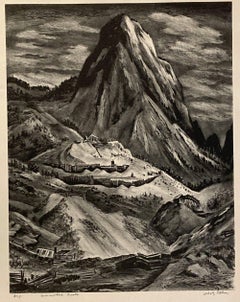
"Silver Mine, Russell Gulch (12/25)" is a striking black-and-white lithograph by German-born American Modernist Arnold Ronnebeck (1885–1947). This rare print depicts a historic minin...
Category

1930s American Modern Louis Lozowick Figurative Prints

Materials

Lithograph

Original For Every Fighter A Woman Worker, Y.W.C.A. vintage poster WW1
By Ernest Hamlin Baker
Located in Spokane, WA
For Every Fighter a Woman Worker. Original vintage poster. Linen Lined. Very good condition. Artist: Ernest Hamlin Baker. Size: 28" x 42". Year: 1918 Linen backed trimme...
Category

1910s American Modern Louis Lozowick Figurative Prints

Materials

Lithograph

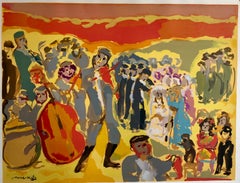
Large French Judaica Lithograph Colorful Jewish Wedding Hebrew Calligraphy
By Théo Tobiasse
Located in Surfside, FL
Theo Tobiasse Title "On the Shores of the Circus" Suite: Song of Songs of King Solomon Year: 1975 Medium: Original lithograph in colors on paper (deckle edged paper) Publisher: Leon Amiel, Paris & New York Signature: Hand signed by the artist Theo Tobiasse, born Tobias Eidesas, 1927 in Jaffa then in British Mandate Palestine, died 2012 in Cagnes-sur-Mer in France. Well known painter, engraver, draftsman and sculptor. French Jewish artist. The youngest son of Chaim (Charles) Eidesas and Brocha (Berthe) Slonimsky from Kaunas, Lithuania, Théo Tobiasse was born in Mandatory Palestine in 1927, where his Jewish parents lived since 1925, far from the threat of pogroms and upheavals of East European policies. The family encountered material difficulties and decided to return to Lithuania, ultimately leaving for Paris in 1931 where his father typographer finds work in a Russian printing press. Theo Tobiasse shows very early talent for drawing and painting, and during a visit to the Special Exhibition of 1937 held in Paris, he is enchanted by Raoul Dufy. The death of his mother (in June 1939) followed by the outbreak of the Second World War, Paris under the German Nazi occupation, the wearing of the yellow star and his registration at the National School of Decorative Arts denied for racist reasons upsets his life. He enrolled in a private advertising design course on the boulevard Saint-Michel, which he abandoned nine months later because his family, narrowly escaping the Winter Vélodrome roundup in July 1942 was forced to hide in an apartment in Paris for two years. At the Liberation of Paris, he quickly began a career as an advertising graphic designer with the Draeger art printer and also produced tapestry cartoons, stage sets and Hermes showcases at the Hermès boutique on rue du Faubourg Saint-Honoré. In 1950, he obtained French nationality and moved to Nice in the Alpes-Maritimes, where he continued his advertising graphic design career. His first paintings were exhibited at the Salon des peintres du Sud-Est in 1960. He was laureate in 1961 the "prize of the young Mediterranean painting" and Armand Drouant offers him a first contract and exhibited at the Faubourg Saint-Honoré Gallery in Paris in 1962. Théo Tobiasse also won the Dorothy Gould Prize in 1961. He decided to devote himself solely to the visual arts. Numerous exhibitions are dedicated to him all over the world, in Paris at the Drouant Gallery, in Geneva, Montreal or Tokyo, then London, Zurich, Lausanne, Los Angeles, Kiev, and then a first personal exhibition in New York (1968). Self-taught, he studied the technique of grand masters in museums during his travels. The reliefs, glazes and colors of Rembrandt's Jewish Fiancee at the Rijksmuseum in Amsterdam, in particular, open up new technical possibilities that he explores in his canvases back to his studio. The figurative subjects without narrative or symbolism (cat, bird, kite, velocipede, etc.) of his first paintings, allow him to focus on the techniques, the color and the texture of oil painting and gouache. From 1964, Theo Tobiasse develops a more personal iconography drawn from his own memories of his childhood in Lithuania, the wanderings of a family seeking a land of asylum and the Holocaust. The train, the one which drove his family from Kaunas to Paris, or the Jews to the camps, becomes a recurring motif and memory a major theme in his work. A visit to Jerusalem, Israel in 1970 brings him closer to his Israeli Jewish origins. He created his first Judaic stained-glass windows on the theme of "Jewish Feasts" for the Jewish Community Center in Nice and a monumental oil painting titled " Que tentes sont beau", O Jacob (1982). He continues to travel and immerse himself in the cultures he meets, New Orleans jazz, Mexican archaeological sites and Native American totems . In New York, he meets Elie Wiesel (1982). While Josy Eisenberg makes a film about Théo Tobiasse, entitled Tell me who you are painting, for French television in 1977, many personal exhibitions are devoted to him in France and abroad, notably at the Passali gallery in Paris, France. Atheneum Museum in Geneva and the Nahan Gallery in New Orleans. In 1983, a retrospective exhibition of his work was organized in Nice , at the Museum of Contemporary Art in Ponchettes. Carborundum engraving, lithography, stained glass, mosaic, pottery, bronze and ceramic sculpture are all tools of expression he first explored in the studio he had built at his home on the heights of Nice (1954 -1972), then to the Rauba Capeu wharf in Nice (1971-1976). He leaves Nice to install his main workshop on his property in Saint-Paul-de-Vence in 1976. In collaboration with Pierre Chave, lithographer in Saint-Paul-de-Vence, Théo Tobiasse is developing a technique for making lithographs of eighteen to twenty colors that he produces for many original portfolio editions published in France, Sweden and the United States. In addition to the theme of memory of the wanderings and exodus of his family and the Jewish people, the personal iconography of Tobiasse comprises three other major themes that recur in his work: The cities that are dear to him (Paris and Jerusalem, first, then New York and Venice from the 1980s); twenty-eight monochrome gouaches, From Notre-Dame to Saint-Germain-des-Près (1969). The Hebrew Bible, an endless source of human dramas, which he re-imagines in contemporary times. Rachel (1978), Sarah and the three messengers (1981),Bathsheba in the Garden of Pomegranates (1982). The woman, lover, erotic and shameless, Daphnis and Chloé (1978), Portrait of a woman immobile in ecstasy , (1978), a creature-sex apple whose skin burns and arms twist (1980). To explore the theme of the erotic woman, Tobiasse adopts nude drawing in graphite, ink and pastel on paper, as well as the writing of poetic texts he inscribed in his drawings and notebooks. The American merchant, Kenneth Nahan Sr., met in 1978, encourages Théo Tobiasse to join in the United States other French painters he represents, including Max Papart and James Coignard. Tobiasse moved to New York in 1984. He first worked at the Chelsea Hotel and then set up his studio in Manhattan. He decides to split his time and his work between Saint-Paul-de-Vence and New York. The first paintings painted in America are distinguished from their European production by their scale and their bright themes. Oil-painted canvases are filled with family portraits, children, and biblical characters. My family came from Lithuania, Little Girl Sitting , Saul and David (1984). In these paintings, families no longer flee the pogroms in the trains, but land in New York, new host country according to his imagination, as in America (1984). He also created the Myriam sculpture in New York, which became the model for the Venus, a monumental bronze sculpture to be installed at the entrance of Saint-Paul-de-Vence in 2007 15. New York joins the inspiring cities of Theo Tobiasse and the woman now personifies freedom. Along with Marc Chagall, Raya Sorkine, Zamy Steynovitz and Yoel Benharrouche, Tobiasse becomes one of the pillars of modern French Judaica...
Category

1970s Modern Louis Lozowick Figurative Prints

Materials

Lithograph

Bicentennial Indian from the Kent Bicentennial Portfolio by Fritz Scholder
By Fritz Scholder
Located in Long Island City, NY
Bicentennial Indian by Fritz Scholder, Native American (1937–2005) Portfolio: Kent Bicentennial Date: 1975 Offset Lithograph (unsigned as issued) Image Size: 9.5 x 13 inches Frame Si...
Category

1970s American Modern Louis Lozowick Figurative Prints

Materials

Lithograph

Original 1933 Concours de Photographie e Cinematographie vintage French poster
Located in Spokane, WA
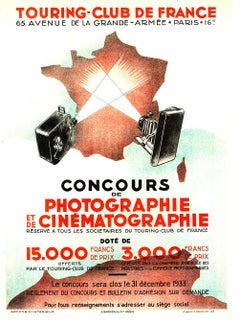
Original 1933 French Poster — Touring Club de France “Concours de Photographie et de Cinématographie” — Art Deco — Linen Backed Vintage Advertising Grade a- condition with minor r...
Category

1930s American Modern Louis Lozowick Figurative Prints

Materials

Lithograph

September Morn - In Celebration of Pride Month
By Joseph Hirsch
Located in New Orleans, LA
Stone and Press Gallery is excited to offer several works in celebration of the LGBTQ community. Three women strolling on a beach. This impression is one of the rare impressions p...
Category

1960s American Modern Louis Lozowick Figurative Prints

Materials

Lithograph

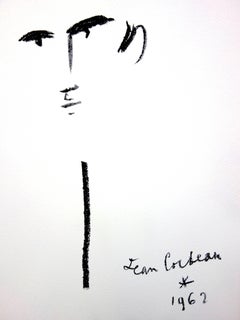
Jean Cocteau - Torrero - Original Lithograph
By Jean Cocteau
Located in Collonge Bellerive, Geneve, CH
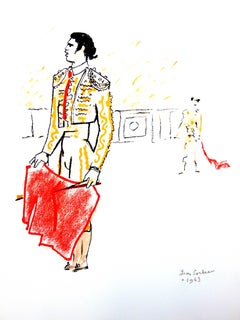
Original Lithograph by Jean Cocteau Title: Taureaux Signed in the plate Dimensions: 40 x 30 cm Edition: 200 Luxury print edition from the portfolio of Trinckvel 1965 From the last po...
Category

1960s Modern Louis Lozowick Figurative Prints

Materials

Lithograph

Charles Locke, McCosh Walk, Princeton University
By Charles Locke
Located in New York, NY
This lithograph is signed in pencil under the image at the lower right. Just above that, in the image, are the artist's initials and the date, 1942. This well-known walkway on the P...
Category

1940s American Modern Louis Lozowick Figurative Prints

Materials

Lithograph

Previously Available Items
Backyards of Broadway — 1920s American Precisionism, New York City
By Louis Lozowick
Located in Myrtle Beach, SC
Louis Lozowick, 'Backyards of Broadway ( Waterfront I )', lithograph, 1926, edition 10, Flint 7. Signed in pencil. A fine, richly-inked impression, on BFK Rives off-white, wove paper...
Category

1920s American Modern Louis Lozowick Figurative Prints

Materials

Lithograph

Corner of Steel Plant
By Louis Lozowick
Located in Myrtle Beach, SC
Louis Lozowick, 'Corner of Steel Plant', lithograph, 1929, edition 25 (10 printed in 1972); Flint 21. Signed, dated and numbered 5/25 in pencil; the artist...
Category

1920s American Modern Louis Lozowick Figurative Prints

Materials

Lithograph

Traffic
By Louis Lozowick
Located in New York, NY
Louis Lozowick created the lithograph entitled Traffic in 1930. This stunning impression is signed and dated in pencil in the lower right just under the image and inscribed "2/20" i...
Category

Mid-20th Century Modern Louis Lozowick Figurative Prints

Materials

Lithograph

Construction (Excavation)
By Louis Lozowick
Located in New York, NY
The lithographic stone for "Construction" was created in 1930 by Louis Lozowick. This is from the 1972 printing by Burr Miller - at Louis Lozowicks request ten additional impression...
Category

Mid-20th Century Modern Louis Lozowick Figurative Prints

Materials

Lithograph

Louis Lozowick figurative prints for sale on 1stDibs.

Find a wide variety of authentic Louis Lozowick figurative prints available for sale on 1stDibs. You can also browse by medium to find art by Louis Lozowick in lithograph and more. Much of the original work by this artist or collective was created during the 20th century and is mostly associated with the modern style. Not every interior allows for large Louis Lozowick figurative prints, so small editions measuring 8 inches across are available. Customers who are interested in this artist might also find the work of Rockwell Kent, Isabel Bishop, and Kerr Eby. Louis Lozowick figurative prints prices can differ depending upon medium, time period and other attributes. On 1stDibs, the price for these items starts at $2,100 and tops out at $40,000, while the average work can sell for $7,500.

Recently Viewed

View All