Louis Renard Prints and Multiples
to
1
Overall Width
to
Overall Height
to
1
1,196
950
937
833
1
1
1
1
1
Artist: Louis Renard
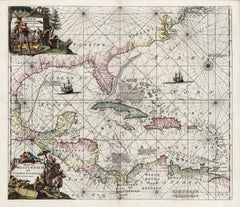
Indiarum Occidentalium Tractus Littorales cum Insulis Caribicis / Pascaert van W
By Louis Renard
Located in New York, NY
This early 18th-century engraved map was published by Louis Renard in Amsterdam. The image size is 19 x 22 " (48.3 x 55.9 cm) plus margins.
A beautifully engraved Dutch sea chart. Shown is the entire Caribbean basin including the eastern seaboard up to Cape Cod and includes Bermuda. Florida is shown with the classic flattened southeastern coast that was derived by Hessel Gerritz. Noted are the routes taken by the Spanish treasure...
Category
18th Century Other Art Style Louis Renard Prints and Multiples
Materials
Engraving
Related Items
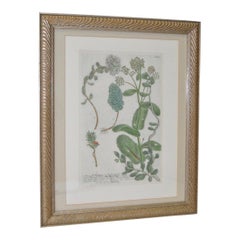
Johann Weinmann 18th Century Hand Colored Copper Plate Engraving
By Johann Wilhelm Weinmann
Located in San Francisco, CA
Rare hand colored copper plate engraving by noted Botanist Johann Wilhelm Weinmann (1683-1741)
Beautiful color after 250+ years!
This wonderful antique engraving is beautifully mat...
Category
18th Century Naturalistic Louis Renard Prints and Multiples
Materials
Engraving

$450
H 20.5 in W 16.5 in D 1 in
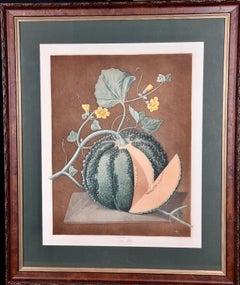
Silver Rock Melon: A Framed 19th C. Color Engraving by George Brookshaw
By George Brookshaw
Located in Alamo, CA
This is a 19th century colored aquatint and stipple engraving finished by hand entitled "Silver Rock Melon", drawn and engraved by George Brookshaw and published in London in 1812 as plate 67 in his 'Pomona Britannica; or, A Collection of the Most Esteemed Fruits'. It depicts a Silver Rock Melon still on the vine, but the melon lies on a heater green mat. A wedge of the melon has been dissected to reveal its inner anatomy, including the seeds. The melon skin is a heather and light green color, while the inner portions are a light peach color. The vine and leaves are shown attractive shades of light green and there are soft yellow flowers. The plant is displayed on a light brown textured background with shadows to impart 3-dimensionality. The scene is reminiscent of an engraving in an 18th century artistically stylized human anatomy atlas. There are wide white margins. The title and inscription lies within the lower border.
This striking engraving is presented in a reddish brown decorative wood frame with a darker brown scroll-work outer trim and a gold-colored inner fillet and a thick heather green mat. The frame measures 25.75" high, 21.5" wide and 1.13" deep. It is glazed with UV conservation glass. There is a short thin vertical line of discoloration in the lower margin through the word "melon" and a tiny spot in the upper margin on the left. The print and frame are otherwise in excellent condition.
There is a second Brookshaw engraving that is framed in identical moulding, although a slightly different size and a different color mat. t depicts a cluster of grapes. The two prints would make a striking display pairing...
Category
Early 19th Century Naturalistic Louis Renard Prints and Multiples
Materials
Engraving, Aquatint
$7,180 Sale Price
20% Off
H 25.75 in W 21.5 in D 1.13 in
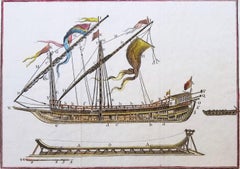
Draught of a Galley /// Old Masters Ship Boat Seascape Construction Diagram Art
By William Henry Toms
Located in Saint Augustine, FL
Artist: William Henry Toms (English, c.1700-1765)
Title: "Draught of a Galley" (Plate 13, Vol. III, page 131)
Portfolio: La Spectacle de la Nature
Year: 1737
Medium: Original Hand-Colored Engraving on laid paper
Limited edition: Unknown
Printer: Unknown, London, UK
Publisher: Humphreys, London, UK
Framing: Recently framed in a Regency style gold moulding with 100% cotton rag matting and 99% UV protective Museum Glass. The frame is an antique frame we've reused, originally built by Knoedler Gallery, New York, NY
Framed size: 10.25" x 10.25"
Sheet size (irregular margins): 6.63" x 8.25"
Image size: 4.75" x 6.75"
Condition: In excellent condition with strong colors and good margins
Rare
Notes:
Comes from the 1737 volume edition of Noël-Antoine Pluche's "La Spectacle de la Nature", translated from the original French by Humphreys as "Nature Displayed". With two soft vertical folds within paper as issued. Various dealer reference numbers and an old price pencil inscribed in margins and on verso.
Biography:
William Henry Toms (c. 1700–1765) was an English engraver. He worked on portraits, book-plates, landscapes and prints of buildings. Among his works were the plates for Robert West's "Perspective Views of All the Ancient Churches in London" (1736–1739). In 1741, he worked with Thomas Badeslade on "Chorographia Britanniae or a New Set of Maps of all the Counties in England and Wales". The maps were republished on 29 September 1742, with additional place names. Among Toms's apprentices was the engraver and publisher John Boydell. W. H. Toms lived in Masham Street, London, and was the father of the painter Peter Toms. Toms died in 1765.
Noël-Antoine Pluche (1688-1761) , known as the abbé Pluche, was a French priest...
Category
1730s Baroque Louis Renard Prints and Multiples
Materials
Watercolor, Laid Paper, Engraving, Intaglio
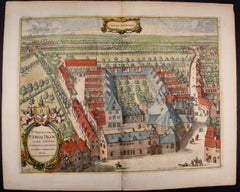
Cartusia Bruxellensis Monastery in Brussels: A 17th C. Hand-colored Engraving
By Lucas Vorsterman the Younger
Located in Alamo, CA
This is a 17th century hand-colored copperplate engraving entitled "Cartusia Bruxellensis" by Lucas Vorsterman, the Younger, after a drawing by Jacob van Werden or Jacques van Weerden, published in 1659 in Antonius Sanderus' book 'Chorographia sacra Brabantiae sive celebrium aliquot in ea provincia ecclesiarum et coenobiorum descriptio . . . Brussel' (A sacred chorography of Brabant, or a description of several famous churches and convents in that province). It also appeared in other publications by Sanderus. In the 17th century, Brussels was within the Duchy of Brabant.
This engraving depicts a bird's-eye view of the Scheut Carthusian Monastery in Brussels. Scheut is a district of Anderlecht, a municipality of Brussels, Belgium. The monastery housed monks, who took a vow of silence, in 20 rooms. There is a central courtyard with trees and shrubs. Monks are depicted strolling along its pathways. The cells for the friars are in the middle the cloister. There are people along the streets in the foreground and to the right of the large, imposing monastery. Some are on horseback, others are walking. In the lower right, what appears to be a dog pulls a small cart containing barrels, possibly of beer or wine. Districts and neighborhoods are labelled in the background, including Scheut, Anderlecht and Ransfort. A very ornate cartouche in the lower left contains Latin and the artist's attribution. Another decorative cartouche in the upper central area contains the title.
This beautifully hand-colored and detailed engraving is printed on laid, chain-linked paper with wide, full margins. The sheet measures 17.25" high and 21.25" wide. It has Latin text on the verso. It has a central vertical fold, as issued, which is reinforced on the verso. Two small spots in the lower margin may actually represent drops of watercolor paint used to color the engraving. It is otherwise in very good condition.
Antonius Sanderus (1586-1664) was a Flemish Catholic cleric and historian. He was born "Antoon Sanders", but Latinized his name like many writers and scholars of his time. He was the author of several books, including 'Chorographia Sacra Brabantiae', which was illustrated with this engraving.
Lucas Vorsterman the Younger (1624-between 1666 & 1676) was a Flemish Baroque engraver and draughtsman. He produced engravings after the work of contemporary painters and for books by Antwerp publishers.
Jacob van Werden or Jacques van Weerden (active 1643-1669), was a Flemish draughtsman, cartographer, military engineer and archer who was active in the Habsburg Netherlands. His drawings were used as designs for prints executed by various printmakers. He worked on maps, topographical views, historical scenes, portraits and book illustrations. He had a career as a military engineer and a member of the guard of the Spanish King. He advised on various military engineering projects and was an engineer of the Spanish army...
Category
Mid-17th Century Old Masters Louis Renard Prints and Multiples
Materials
Engraving
$1,020 Sale Price
20% Off
H 17.25 in W 21.25 in
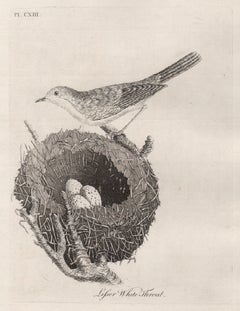
Lesser White Throat, bird and nest engraving by John Latham
By John Latham
Located in Melbourne, Victoria
Copper-line engraving. 1781. From John Latham's 'General Synopsis of Birds' 1781-1785, and its Supplements. Plate number top left. Laid paper with water...
Category
Late 18th Century Naturalistic Louis Renard Prints and Multiples
Materials
Engraving
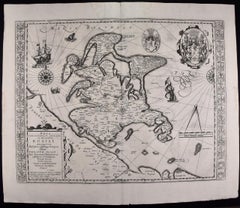
Rugen Island, Germany: An Early 17th Century Map by Mercator and Hondius
By Gerard Mercator
Located in Alamo, CA
This is an early 17th century map entitled "Nova Famigerabilis Insulae Ac Ducatus Rugiae Desciptio" (Map of Rugen Island, Germany) by Gerard Mercator and Henricus and Joducus Hondiu...
Category
Early 17th Century Old Masters Louis Renard Prints and Multiples
Materials
Engraving
$540 Sale Price
20% Off
H 18.38 in W 21.75 in
View of Seravalle, Italy: A 16th Century Hand-colored Map by Braun
Hogenberg
By Franz Hogenberg
Located in Alamo, CA
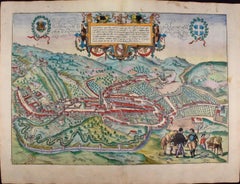
This is an original 16th century copperplate originally hand-colored engraved map of View of Seravalle, Italy entitled "Seravallum Celeberrimum Marchiae Tarvisiniae in Agro Foro Juliensi Opp. - Seravalli, quam vides, Spectator, iconem, operi huic nostro suis sumptib. . . ." by Georg Braun & Franz Hogenberg, from their famous city atlas "Civitates Orbis Terrarum", published in Augsberg, Germany in 1575.
The map depicts a view of Seravalle, now Vittorio Veneto, in San Marino, Italy, north of Venice, in a topographically accurate bird's-eye view from the south. A water-filled moat is seen to the south of the city walls and farmland to the east. Two men are depicted standing on a hill in the lower right in conversation next to grain sacks and a grazing horse, while a younger man behind them to the right herds a mule carrying presumably pigs. A very colorful and ornate title cartouche is in the upper center and coat-of-arms are in the right and left upper corners. Serravalle lies in an idyllic setting in the foothills and surrounded by orchards. St Mary's Cathedral with its tall bell tower is prominent in the center of the town. The marketplace and town hall with a bell tower in the square are depicted. Houses and shops are around the main square. Serravalle's importance as an agricultural centre is emphasized by the figures in the foreground. In 1337 Serravalle was conquered by the Republic of Venice. In 1866 the town was united with neighbouring Ceneda to form the town of Vittorio Veneto.
The following is an English translation of an excerpt from the French description of the city on the back of the map: "Serravalle, a market town renowned for cloth, wine and grain, is in such a beautiful situation that the number of its inhabitants, attracted by the loveliness of the place, has grown so much at times that the wall encircling it has had to be enlarged for the third time. The city with the surrounding town once belonged to the Church in Ceneda as an imperial fief. It subsequently became the seat of the Da Camino family (a princely house that at that time was one of the five most noble in all Italy). Now the city is under the sway of the Venetians but is prudently governed by them. For they send only one city councillor with instructions to ensure that justice prevails and to collect duties. In all else, power lies in the hands of the noble families."
This is a translation of the Latin in the title cartouche on the front: "The picture of the town of Serravalle, which you see, viewer, has been contributed to our work entirely at his own expense by Minutius, son of Hieronymus Minutius, a noble gentleman and one renowned for the far-reaching competence of his jurisdiction. We saw him sojourning in Cologne, where he was on business for Gregory XIII; while our good wishes accompany him, we should also like to accompany him on his way with this remembrance, even though it might be against his will, so that even those who have not seen him may learn of his excellence. However, those who do not yet know him will also see his excellence if God the Almighthy does not summon erring souls too soon back to the eternal seat of the Blessed."
References: Van der Krogt 4, 4728, State 1; Taschen, Braun and Hogenberg, p.331; Fauser, #14960
This striking hand-colored city view is printed on laid, chain-linked paper with wide margins. The sheet measures 16" high by 21" wide. There is a central vertical fold as issued and French text on the verso, with Latin on the front. There is some discoloration in the upper and right margins which may represent some watercolor paint from the time of the original hand-coloring of the map. There is a small hole to the right of the upper portion of the vertical fold, which is only visible when held up to light and an area of reinforcement on the verso of the lower vertical fold. The map is otherwise in very good to excellent condition.
Braun and Hogenberg's 'The Civitates Orbis Terrarum' was the second atlas of maps ever published and the first atlas of cities and towns of the world. It is one of the most important books published in the 16th century. Most of the maps in the atlas were engraved by Franz Hogenberg and the text, with its descriptions of the history and additional factual information of the cities, was written by a team of writers and edited by Georg Braun. The work contained 546 bird-eye views and map views of cities and towns from all over the world. It gave graphic representation of the main features of the illustrated cities and towns, including the buildings and streets. Although the ordinary buildings are stylized, the principal buildings are reproduced from actual drawings created on location. The principal landmarks and streets can still be recognized today. In addition, the maps often include the heraldic arms of the city, the nature of the surrounding countryside, the important rivers, streams and harbors, even depicting stone bridges, wooden pontoons, flat-bottomed ferries, ships and working boats, wharves and jetties, as well as land-based activities, including horsemen, pedestrians, wagons, coaches, and palanquins. Small vignettes are often included which illustrate the trade, occupations and habits of the local inhabitants, such as agriculture, paper-making and textiles, as well as local forms of punishment, such as gibbets, wheels, floggings etc. Large figures dressed in their local costume are often presented out of proportion in the foreground. The aim of the authors was to give as much information as possible in a pleasing visual form. They succeeded in creating maps that were both informative and decorative works of art. The atlas is a wonderful glimpse of life in medieval Europe.
Georg Braun (1541-1622) was German Catholic...
Category
16th Century Old Masters Louis Renard Prints and Multiples
Materials
Engraving
$780 Sale Price
20% Off
H 16 in W 21 in
18th Century Map Engraving - Mechlin, or Malines
Located in Corsham, GB
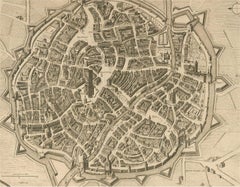
A map of Mechelen, known as Malines in French and Mechlin in English, a city and municipality in the province of Antwerp in the Flemish Region of Belgium. A birds-eye view plan of th...
Category
18th Century Louis Renard Prints and Multiples
Materials
Engraving
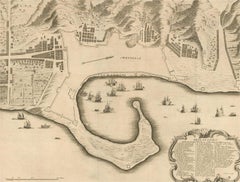
18th Century Map Engraving - Plan of the Works of the City of Messina, Sicily
Located in Corsham, GB
A map of Messina, a harbour city in northeast Sicily. Inscribed with the title in plate to the lower edge, 'Plan of the Works of the City of Messina, one of the strongest and most co...
Category
18th Century Louis Renard Prints and Multiples
Materials
Engraving
$285 Sale Price
20% Off
H 15.36 in W 19.3 in
View of Meissen, Germany: A 16th Century Hand-colored Map by Braun
Hogenberg
By Franz Hogenberg
Located in Alamo, CA
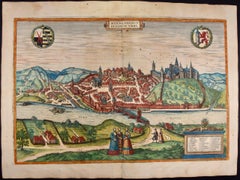
This is a 16th century original hand-colored copperplate engraved map of View of View of Meissen, Germany entitled "Misena Hermun Duvorum Urbs" by Georg Braun & Franz Hogenberg, from their famous city atlas "Civitates Orbis Terrarum", published in Cologne, Germany in 1575.
The map depicts a side view and bird's-eye view, looking across the Elbe River (labelled Albis Fluvius on the map; White River in Latin) from the northeast. In the foreground are three women in conversation on a hill above the city, along with a man and a woman in conversation by a road, all dressed in contemporary costumes of the upper class. A coat-of-arms is present in each upper corner. A great castle sits atop a hill in the background on the left. Meissen grew up around Albrechtsburg castle, built by Emperor Henry I around AD 929, and was granted a municipal charter at the end of the 12th century. From 1471 onwards, the castle complex was reconstructed as the residence of the Saxon electors on the northeast corner of the Domberg (Cathedral Hill). Meissen cathedral is a Gothic hall church begun c. 1270; in 1413 a bolt of lightning destroyed its west towers, which were replaced only in the 20th century. Meissen lies to the northwest of Dresden, Germany in Saxony. Meissen is famous for its Meissen porcelain and the Albrechtsburg castle
The following is an English translation of an excerpt from Braun's description of the city: "This city is surrounded by very many rivers, to the east flows the Elbe, to the south the Triebisch, to the west are the mountains, to the north the Meisse, after which the city is said to be named. The city is well-situated in its surroundings, the navigable rivers, the mountains and the healthy air. Around the city there is a good land to grow grain, fertile vineyards on the hillsides and without doubt the mountains are not without ore, for one mile away, up the Elbe, is Scharfenberg, where silver and lead ore are mined.."
References: Van der Krogt 4, 2684; Taschen, Braun and Hogenberg...
Category
16th Century Old Masters Louis Renard Prints and Multiples
Materials
Engraving
$780 Sale Price
20% Off
H 15.75 in W 21.25 in
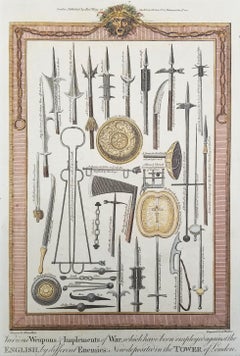
Various Weapons
Implements of War /// Edward Barnard
s "History of England"
Located in Saint Augustine, FL
Artist: Edward Barnard (English, 1717-1781)
Title: "Various Weapons & Implements of War ... Which have been Employed Against the English, by Different Enemies: Now Deposited in the Tower of London"
Portfolio: New Complete and Authentic History of England
Circa: 1785
Medium: Original Hand-Colored Etching on laid paper
Limited edition: Unknown
Printer: Alex Hogg, London, UK
Publisher: Alex Hogg, London, UK
Sheet size: 15.38" x 9.63"
Image size: 11.75" x 7.94"
Condition: Slight toning to edges. Has been professionally stored away for decades. It is otherwise a strong impression in excellent condition
Notes:
Provenance: private collection - Cheltenham, UK. Engraved by English artist George Walker (1781-1856) after a drawing by English artist William Hamilton (1751-1801). Comes from Barnard's one volume "New Complete and Authentic History of England", (1783, 1785, 1790) (First - third editions), which consists of 105 engravings. Printed in one color from one copper plate: black.
Biography:
Edward Barnard (1717-1781) was an English cleric and academic, provost of Eton from 1764. Barnard was second son of Rev. George Barnard...
Category
1780s Old Masters Louis Renard Prints and Multiples
Materials
Watercolor, Laid Paper, Engraving, Intaglio
White Hamburgh Grape: A Framed 19th C. Color Engraving by George Brookshaw
By George Brookshaw
Located in Alamo, CA
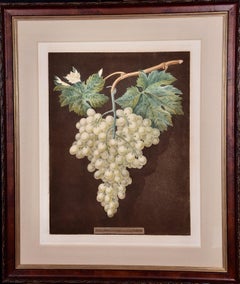
This is a 19th century colored aquatint and stipple engraving finished by hand entitled "White Hamburgh Grape", drawn and engraved by George Brookshaw and published in London in 1812 as plate 60 in his 'Pomona Britannica; or, A Collection of the Most Esteemed Fruits'. It depicts a cluster of pale green grapes still on the vine. The vine and leaves are shown in attractive shades of green and brown. The plant lays on a brown textured background with shadows to impart 3-dimensionality. The scene is reminiscent of an engraving in an 18th century artistically stylized human anatomy atlas. There is a light brown title rectangle in the lower center which is blank, suggesting this may be a more rare preproduction proof. There are wide white margins.
This striking engraving is presented in a reddish brown decorative wood frame with a darker brown scroll-work outer trim and a gold-colored inner fillet and a thick light beige mat. The frame measures 26" high, 22" wide and 1.13" deep. It is glazed with UV conservation glass. There is a tiny spot in the lower margin on the left and another in the left margin. The print and frame are otherwise in excellent condition.
There is a second Brookshaw engraving that is framed in identical moulding, although a slightly different size and a different color mat. It depicts a Silver Rock Melon. The two prints would make a striking display pairing...
Category
Early 19th Century Naturalistic Louis Renard Prints and Multiples
Materials
Engraving, Aquatint
$3,180 Sale Price
20% Off
H 25.75 in W 22.5 in D 1.13 in
Louis Renard prints and multiples for sale on 1stDibs.
Find a wide variety of authentic Louis Renard prints and multiples available for sale on 1stDibs. You can also browse by medium to find art by Louis Renard in engraving and more. Not every interior allows for large Louis Renard prints and multiples, so small editions measuring 25 inches across are available. Customers who are interested in this artist might also find the work of Giovanni Battista Piranesi, Giovanni Battista Tiepolo, and Francisco Goya. Louis Renard prints and multiples prices can differ depending upon medium, time period and other attributes. On 1stDibs, the price for these items starts at $4,000 and tops out at $4,000, while the average work can sell for $4,000.