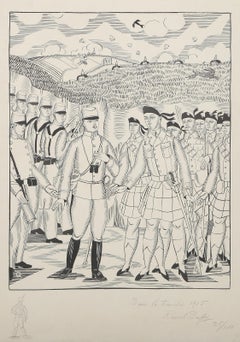
Louis Schanker Figurative Prints
"Though much of my work is generally classified as abstract, all of my work develops from natural forms. I have great respect for the forms of nature and an inherent need to express myself in relation to those forms. No matter how far my experimental design may take me … there remains always a core of objective reality which I have no desire to destroy or even to impair but only to investigate, analyze, develop." Louis Schanker was one of many members of the American Abstract Artists who chose to base his art in the objects, patterns, and rhythms of nature. Although never a student of Hans Hofmann, Schanker's ideas about art had many parallels with Hofmann's. Concern for the spatial dynamics of a painting's surface, and an insistence on some aspect of nature as a starting point for art, are two areas that mirror a shared philosophy between the two artists. Although much of Schanker's later work is completely abstract, during the 1930s and 1940s he frequently used direct, identifiable themes—motifs drawn from sports, his early years working for a circus, and even socially conscious subjects not normally employed by abstract artists. During the mid 1930s, Schanker began making prints and subsequently became a graphic arts supervisor for the WPA. He also completed murals for radio station WNYC, the Neponsit Beach Hospital in Long Island, and the Science and Health building at the 1939 New York World's Fair. During World War II, Schanker worked as a shipfitter and began teaching the technique of color woodblock printing at the New School for Social Research. In 1949, he became an assistant professor at Bard College, where he remained until his retirement. Throughout the 1930s and 1940s, Schanker exhibited frequently in group shows both in museums and in commercial galleries. He became especially well known for his innovations as a printmaker. Schanker belonged to The Ten, a group that exhibited together in protest against the hegemony of Americanscene painting in Whitney exhibitions and in support of artistic experimentation and an international (rather than nativist) outlook in art.
1930s Louis Schanker Figurative Prints
Linocut
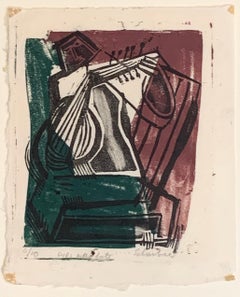
1940s Louis Schanker Figurative Prints
Woodcut
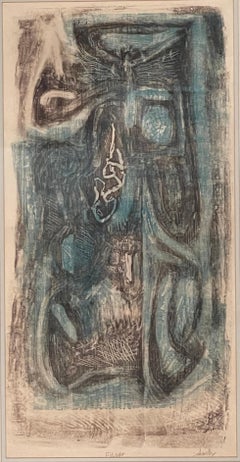
1960s Surrealist Louis Schanker Figurative Prints
Woodcut
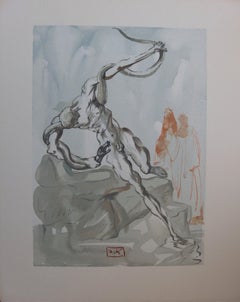

Mid-19th Century Modern Louis Schanker Figurative Prints
Woodcut
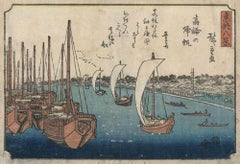
Early 2000s Contemporary Louis Schanker Figurative Prints
Linocut
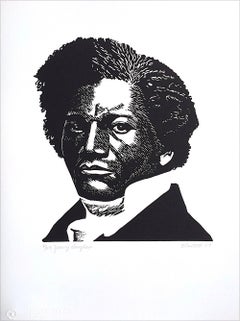
Early 2000s Contemporary Louis Schanker Figurative Prints
Ink, Linocut, Woodcut, Engraving
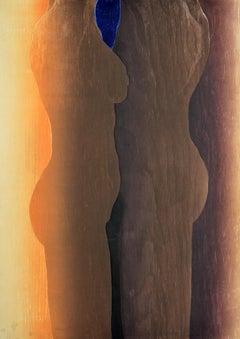
1920s Expressionist Louis Schanker Figurative Prints
Woodcut
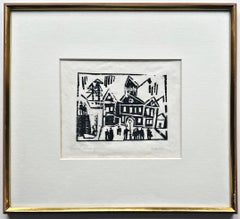
1930s Expressionist Louis Schanker Figurative Prints
Woodcut
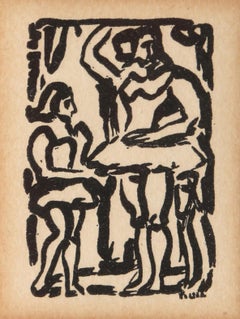
Early 20th Century Modern Louis Schanker Figurative Prints
Woodcut
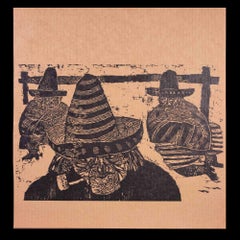
1960s Cubist Louis Schanker Figurative Prints
Paper, Linocut
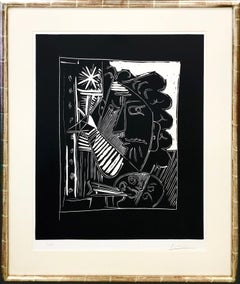
2010s Contemporary Louis Schanker Figurative Prints
Woodcut
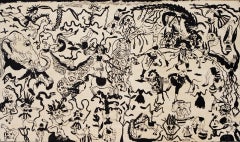
Early 20th Century Modern Louis Schanker Figurative Prints
Woodcut
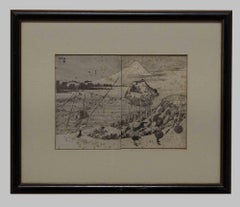
1950s Modern Louis Schanker Figurative Prints
Linocut
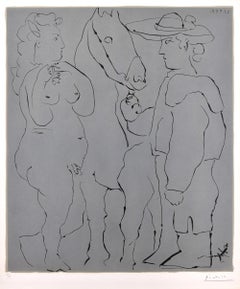
1910s Impressionist Louis Schanker Figurative Prints
Graphite, Woodcut