Louise Nevelson Animal Prints

American, 1899-1988

Louise Nevelson was one of the leading American female sculptors of the 20th century, and she did it on her own terms. She was a pioneer of installation art and created large-scale monochromatic sculptures that are today known for their provocative, compartmentalized forms. While her assemblages involved a range of materials, she is best known for her wooden sculptures. Working in a single color was her signature, and all-encompassing color demanded an all-encompassing focus for this artist — she even kept separate studios for work in black, white and gold. 

Nevelson was born in what is now Ukraine in 1899 and emigrated to the United States with her family in 1905. She moved to New York City as a young woman in 1920 to study at the Art Students League. In the 1930s, Nevelson traveled around Europe, came into contact with the works of Picasso, studied with Hans Hofmann and assisted Diego Rivera in New York City. 

Nevelson had her first solo show in 1941 at the Nierendorf Gallery in New York. In the late 1940s, she studied with Stanley William Hayter and worked as a ceramicist in the workshop of revered furniture designer Vladimir Kagan, who let her take scraps from the factory to use in her sculptures. (As a child, Nevelson had also worked with discarded wood from her father's lumber yard.)

By the early 1950s, Nevelson had traveled to Guatemala and Mexico. She was inspired by pre-Columbian art and the totemic works of ancient cultures. Nevelson began creating the first of her iconic wood sculptures and later participated in the legendary “Sixteen Americans” exhibition at the Museum of Modern Art. Her work was acquired by prominent institutions in the years that followed. 

Nevelson made reliefs in shadow boxes and was for a time affiliated with New York City’s Sidney Janis Gallery as its first female Abstract Expressionist artist (her work was abstract but she also drew on the Cubist and Constructivist movements). In the early 1960s, Nevelson showed her art in Chicago, Manhattan, Paris and West Germany. It was around this time that she exhibited at Pace Gallery in Boston and New York. The gallery represented her for the duration of her career.

Nevelson died in 1988, but her legacy is immense. Her work is held in virtually every major American art museum, including the Museum of Modern Art, the Metropolitan Museum of Art, the Los Angeles County Museum of Art and the National Gallery of Art. Her permanent large-scale public sculptures are installed all over the country, including in Louise Nevelson Plaza in New York City's Financial District.

On 1stDibs, find original Louise Nevelson sculptures, prints and drawings.

to
1
1
1
Overall Width
to
Overall Height
to
1
1
46
195
162
119
97
3
2
1
2
1
1
1
1
1
3
1
1
3
Artist: Louise Nevelson
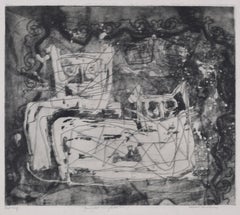
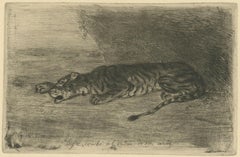
Animal Kingdom (Magnificent Jungle Cats)
By Louise Nevelson
Located in Fairlawn, OH
Animal Kingdom (Magnificent Jungle Cats) Etching, 1953-1955 Signed and titled in pencil by the artist (see photos) Annotated: "First Proof" (see photo) Estate stamp verso (see photo)...
Category

1950s American Modern Louise Nevelson Animal Prints

Materials

Etching

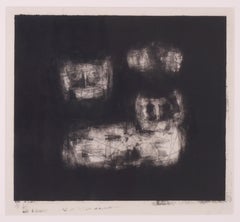
Magnificent Jungle Cats
By Louise Nevelson
Located in Fairlawn, OH
Magnificent Jungle Cats Etching, drypoint and monoprint inking of the plate Printed by the artist at Atelier 17, New York Annotated 1/5 in pencil Estate stamp and number, verso Editi...
Category

1950s Abstract Louise Nevelson Animal Prints

Materials

Etching

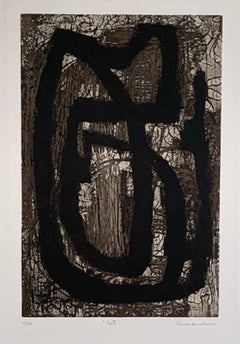
CAT
By Louise Nevelson
Located in Portland, ME
Nevelson, Louise. CAT. Baro 80. Etching and drypoint, 1965/6. Edition of 40 (There were also three Trial Proofs and four Artist's Proofs). Signed and numbered in pencil. 17 1/2 x 11 1/2 inches (plate), (sheet). The edition was printed at the Hollander Graphic...
Category

1960s Louise Nevelson Animal Prints

Materials

Drypoint, Etching

Related Items
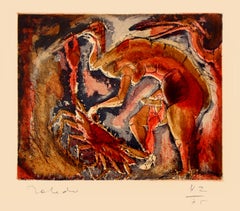
CANGREJO MANO LARGA
By Francisco Toledo
Located in New York, NY
paper: 22 x 15 in. printed image: 4 3/4 x 6 in. english translation: Long Hand Crab Latin
Category

Late 20th Century Post-Modern Louise Nevelson Animal Prints

Materials

Archival Paper, Drypoint, Etching, Aquatint
20th century drypoint etching figurative animal print horses sketch signed
By Claude Weisbuch
Located in Milwaukee, WI
"Combat Equestre" is an original lithograph by Claude Weisbuch. The artist signed the piece lower right and wrote the edition number (24/100) in the lower left. This piece depicts mu...
Category

1970s Modern Louise Nevelson Animal Prints

Materials

Drypoint, Etching

Mary Chenoweth Abstract Birds in Flight Vintage Mid-Century Modern Lithograph
Located in Denver, CO
This vintage original lithograph by celebrated American modernist Mary Chenoweth (1918–1999) presents a dynamic abstract interpretation of birds in flight. Chenoweth’s innovative pri...
Category

1970s American Modern Louise Nevelson Animal Prints

Materials

Lithograph

Original Stan Galli "Pacific Northwest" United Air Lines Vintage Poster
By Stan Galli
Located in Spokane, WA
Original Stan Galli "Pacific Northwest" United Air Lines Vintage Poster – Stunning Mid-Century Travel Art. Archival linen backed in excellent condition, ready to frame. Grade A. ...
Category

1960s American Modern Louise Nevelson Animal Prints

Materials

Offset

Origiinal FRANCE, Paese dei Casstelli, vintage French travel poster on linen
By Jean Picart Le Doux
Located in Spokane, WA
Original 1950 “France, Paese dei Castelli” Vintage Poster Artist Jean Picart Le Doux Linen-Backed French Castles Travel Art Rare Mid-Century Collectible Add a touch of French el...
Category

1950s American Modern Louise Nevelson Animal Prints

Materials

Lithograph

2 Lazy 2 P
Located in Phoenix, AZ
2 Lazy 2P, ca. 1939 Lon Megargee Serigraph 20 x 24 inches Signed in screen Original serigraph print by Lon Megargee 1883 - 1960 Featured in "Hot Irons" by Oren Arnold and John Hale, 1940 SHIPPING CHARGES INCLUDE SHIPPING, PACKAGING & INSURANCE Lon Megargee created this serigraph from his commission with Oren Arnold and John Hale to do their dust jacket for the book, " Hot Irons", 1940. Arnold and Hale wanted to establish a reference work, an "authority", with a entertaining history about the evolution of the brand. Megargee created a painting of a steer that was branded with the script, 2 Lazy 2 P. Surrounding the steer is a random display of famous brands of ranches in the Southwest. It was well received and must have prompted Megargee to create the likeness as a print. The brand is described in chapter thirteen, page 207-208 and says, " Ed Stram, who was Arizona state veterinarian for sixteen years, fire-branded his cattle with this peculiar crest. It isn't peculiar unless you have an equally peculiar sense of humor. At a glance it appears to be just another typically unimaginative brand, but it has been used to make many a thousand girls blush, and a few thousand bashful young men as well". COLLIER GALLERY, FINE ART ESTATE OF LON MEGARGEE Born and raised in Philadelphia, Pennsylvania, Lon Megargee, at age 13, ran away from his upper class home and went West in 1896 led by his zest for the wild and adventuresome life. There he established a reputation as a cowboy painter and illustrator with work most associated with Arizona Brewing Company ads featuring humorous aspects of cowboy life. In his youth, he worked as a free-lance cowboy, exhibition roper, poker dealer, and bronco buster in Arizona, and then went east again to study art in Philadelphia at the Pennsylvania Academy of Fine Arts, and to New York at the Art Students League and Pratt Institute. He returned to Arizona, living in Cave Creek, Salt River Canyon, Phoenix and the last years of his life near Sedona. His Phoenix home later became a popular hotel and dining place called the Hermosa Inn. Megargee was a ranch owner and also did oil canvases of the places he loved and the cowboy life he admired. By 1910, he was among the earliest resident artists, and was probably the best known artist in Arizona. His name was first associated with a landscape series of 15 large murals for the Capitol Building, newly constructed just after Arizona became a state in 1912. Another one of his paintings, Elemental, was the first painting by an artist living in Arizona to be acquired for the Municipal Collection of Phoenix. These works were chosen from entries in the State Fair, where he continued to win prizes for figure and landscape painting. From 1911 to 1953, he did numerous commission works for the Santa Fe Railroad, including a work titledNavajos Watching a Santa Fe Train. Between 1915 and 1930, he also painted in the Los Angeles area of California and had entries in the California State Fair. He died in Cottonwood, Arizona. After his death, theSaturday Evening Post had a double-page reproduction of his painting Cowboy's Dream. Creator of the iconic logo for the Stetson Hat Company, " Last Drop From his Stetson", still in use today. Fine Art Estate of Lon Megargee We offer signed in print and original signature block prints. Custom, hand carved, signature frames, with archival standards and a speciality in hand dyed mats and french matting are provided for a beautiful and timeless presentation. Megargee explored different mediums; printmaking captivated him in particular. The contrast of the black and white block print method captured perfectly his interpretation of a bold American West. The first print was produced around 1921 and culminated with the creation of “The Cowboy Builds a Loop” in 1933 with 28 images and poetry by his friend, Roy George. Megargee continued producing prints throughout the 1940s and early 50s. At age 13, Lon Megargee came to Phoenix in 1896 following the death of his father in Philadelphia. For several years he resided with relatives while working at an uncle’s dairy farm and at odd jobs. He returned to Philadelphia in 1898 – 1899 in order to attend drawing classes at the Pennsylvania Academy of the Fine Arts. Back in Phoenix in 1899, he decided at the age of 16 to try to make his living as a cowboy. Lon moved to the cow country of Wickenburg where he was hired by Tex Singleton’s Bull Ranch. He later joined the Three Bar Ranch . . . and, after a few years, was offered a job by Billy Cook...
Category

1930s American Modern Louise Nevelson Animal Prints

Materials

Screen

2 Lazy 2 P
$1,800
H 20 in W 24 in
20th century drypoint etching figurative animal print black and white signed
By John Edward Costigan
Located in Milwaukee, WI
"Boy With Cows" is an original drypoint etching by John Edward Costigan. It depicts a young boy with three cows standing in a watering hole. The artist si...
Category

1930s American Realist Louise Nevelson Animal Prints

Materials

Drypoint, Etching

The Butterfly.
By Edmund Blampied
Located in Storrs, CT
Edmund Blampied, R.E. The Butterfly. 1928-29. Drypoint. Appleby 133. 9 5/8 x 7 7/8). Etching (sheet 15 1/4 x 10 3/16)on 100. A rich impression printed on cream-colored laid 'F.J.He...
Category

Early 20th Century Modern Louise Nevelson Animal Prints

Materials

Drypoint, Etching

The Butterfly.
The Butterfly.
$1,200 Sale Price
40% Off
H 9.63 in W 7.88 in D 0.5 in
The Goldfinch, 1942 (Histoire Naturelle - Textes de Buffon, B.348 )
By Pablo Picasso
Located in Greenwich, CT
The Goldfinch is an aquatint and drypoint print on chine from one of the deluxe copies of Picasso's 1942 Histoire Naturelle - Textes de Buffon series. The image size is 11.2 x 8.25 inches, unsigned as issued, and framed in a contemporary silver and gray moulding. One of about 36 prints that exist with Picasso's remarqued title in French, from the edition of 262 (there were 226 portfolios, some with additional sets on varying papers). Catalogue - Cramer #37 The exceptional etchings from Picasso’s Histoire Naturelle – Textes de Buffon are a masterful combination of sugar-lift aquatint and drypoint, showcasing a full range of gray tonalities. The etchings of animals, birds and insects are considered some of the most beautiful and most unusual examples of Picasso’s graphic work. Roger Lacourière, Picasso’s master printer, pulled the prints for each etching between 1939-1942. It was Lacourière who taught Picasso the sugar-lift aquatint technique which allowed him to mimic the effect of brushstrokes in these etched images. Picasso first explored the technique in his plates for the Vollard Suite, but it was in the creation of the Buffon images that he fully realized its stunning, painterly potential. For the edition, 226 portfolios were produced with the first thirty-six counting as deluxe compilations. These rare deluxe sets were on diverse papers (chine, japon or vergé ancien) and each included a complete additional suite showing Picasso’s title remarques along the bottom. As such, the remarqued versions of the prints are quite rare with just thirty-six of each produced for the edition (with the exception of The Wolf which is never remarqued – the image always fills the entire etching plate). These prints are based on the writings of French naturalist Georges-Louis Leclerc, Comte de Buffon, who extensively documented the natural world in his monumental work Histoire Naturelle. Picasso’s association with the project to illustrate parts of the Buffon came during a tumultuous time in European history – the prelude to, and early years of, World War II. As the continent was ravaged, Picasso lived through the disaster in Paris, which the Germans occupied in 1940. These prints could be seen as a political statement – Picasso channeling his artistic expression into a form of resistance art...
Category

20th Century Modern Louise Nevelson Animal Prints

Materials

Drypoint, Aquatint

Hooked Salmon, angling fish etching by George Marples, circa 1920
Located in Melbourne, Victoria
Marples was a painter, etcher, writer on ornithology, and principal of Huddersfield, Hull and Liverpool School of Art. He specialized in etchings of fish...
Category

1920s Other Art Style Louise Nevelson Animal Prints

Materials

Etching, Drypoint

The Passing Parade, 20th Century Lithograph, Southwestern Desert with Antelope
By Ila Mae McAfee
Located in Denver, CO
This stunning original lithograph, titled The Passing Parade, is a signed piece by renowned American artist Ila Mae McAfee (1897-1995). Created in the 20th century, the artwork depic...
Category

20th Century American Modern Louise Nevelson Animal Prints

Materials

Lithograph

To the Sea
By Jack Coughlin 1
Located in New Orleans, LA
Born in Greenwich, Connecticut, Jack Coughlin studied at the Rhode Island School of Design in Providence and the Art Students League of New York. He is b...
Category

1960s American Modern Louise Nevelson Animal Prints

Materials

Aquatint

To the Sea
To the Sea
$131 Sale Price
34% Off
H 16 in W 19.5 in

Louise Nevelson animal prints for sale on 1stDibs.

Find a wide variety of authentic Louise Nevelson animal prints available for sale on 1stDibs. You can also browse by medium to find art by Louise Nevelson in etching, drypoint, engraving and more. Much of the original work by this artist or collective was created during the 20th century and is mostly associated with the modern style. Not every interior allows for large Louise Nevelson animal prints, so small editions measuring 14 inches across are available. Customers who are interested in this artist might also find the work of Ray H. French, Alexander Calder, and Carol Wax. Louise Nevelson animal prints prices can differ depending upon medium, time period and other attributes. On 1stDibs, the price for these items starts at $4,200 and tops out at $7,500, while the average work can sell for $5,500.
Questions About Louise Nevelson Animal Prints
  • 1stDibs ExpertMarch 22, 2022
    Some of Louise Nevelson's sculptures were called environments. These collage-like walls consisted of wooden boxes filled with found objects. Some of her most famous environments include the Black Wall from 1959 and The Great Wall from 1970. Find a selection of Louise Nevelson art on 1stDibs.
  • 1stDibs ExpertApril 5, 2022
    Louise Nevelson is best known for her work creating wooden structures and sculptures. However, she also explored using plexiglass, aluminum and steel in her art. Her work is considered fundamental to the history of Feminist art and has challenged the stereotype of the male sculptor, solidifying her place in art history. Shop a selection of Louise Nevelson pieces from some of the world’s top art dealers on 1stDibs.
  • 1stDibs ExpertApril 5, 2022
    Louise Nevelson used found wooden forms and made sculptures in steel, aluminum, plexiglass and other materials. Her artistic journey often featured wood, as she found it fascinating, but she added plastics and formica in the 1960s. In the 1970s she began to work on a gigantic scale with aluminum and steel. Shop a selection of Louise Nevelson pieces from some of the world’s top art dealers on 1stDibs.

Recently Viewed

View All