Lyonel Feininger Art
American, 1871-1956
Lionel Feininger (1871–1956), a German-American painter, graphic artist, and caricaturist, developed a distinctive style influenced by Cubism and Expressionism. Born in New York City but raised in Germany, Feininger honed his skills at the Hamburg School of Arts and Crafts before studying under renowned artists in Berlin. Initially associated with the avant-garde group "Die Brücke" (The Bridge), Feininger's style evolved over time, gravitating towards Cubism after being inspired by artists like Picasso and Braque. His participation in the "Der Blaue Reiter" (The Blue Rider) exhibition in 1911 further solidified his reputation as an essential figure in the Expressionist movement. Returning to the United States during World War I, Feininger became associated with the American avant-garde, though the Nazis later targeted his works in the "Degenerate Art" exhibition. Feininger experimented with various mediums throughout his career, producing bold and vibrant works depicting urban landscapes and architectural motifs. His legacy as a pioneer of modern art continues to resonate, with his contributions to Cubism, Expressionism, and abstract art celebrated worldwide. Feininger passed away in 1956, leaving behind a rich and influential body of work.to
1
14
4
18
11
6
5
4
3
2
2
1
1
1
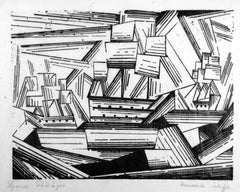
Kreuzende Segelschiffe 2 (Cruising Sailing Ships 2)
By Lyonel Feininger
Located in New York, NY
Lyonel Feininger, “Kreuzende Segelschiffe 2 (Cruising Sailing Ships 2)”
1919, Woodcut.
Prasse W175. Edition 275 unsigned for portfolio Die tunlte Jahresgabe des Kreises graphischer ...
Category
1910s Bauhaus Lyonel Feininger Art
Materials
Woodcut
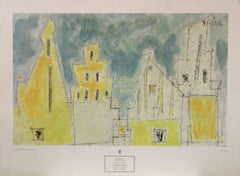
"Gothic Gables" New York Graphic Society 1966, Printed in Switzerland
By Lyonel Feininger
Located in Chesterfield, MI
"Gothic Gables" Poster/Print by LYONEL FEININGER (American-German, 1871-1956). The print measures approximately 20 x 27 inches and is unframed. Published by New York Graphic Society 1966. Printed in Switzerland...
Category
1960s Lyonel Feininger Art
Materials
Lithograph
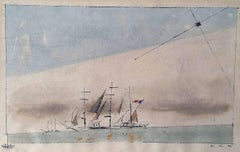
Bauhaus . Untitled (French Barque under Staysail)
By Lyonel Feininger
Located in Miami, FL
Bauhaus Iconic work by the master or Cubism and Expressionism
Dalzell Hatfield Gallery, Los Angeles
Bonhams,
Exhibited: Moller Fine Art, "Precision ...
Category
1940s Expressionist Lyonel Feininger Art
Materials
Watercolor, Pencil
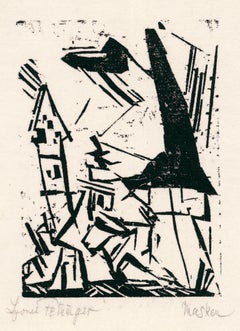
Masken (Masks)
— German Expressionism, Bauhaus
By Lyonel Feininger
Located in Myrtle Beach, SC
Lyonel Feininger, 'Masken (Masks)' also 'Carnival Masks', woodcut, 1920, proofs only. Prasse W193. Signed and titled in pencil. Annotated '1973', the artist’s inventory number. A fin...
Category
1920s Bauhaus Lyonel Feininger Art
Materials
Woodcut
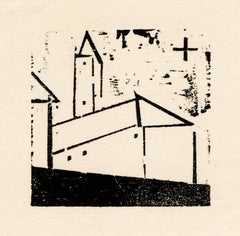
Church with Star
– Artist
s Personal Letterhead, Bauhaus Modernism
By Lyonel Feininger
Located in Myrtle Beach, SC
Lyonel Feininger, 'Church with Star (Kirche mit Stern)', woodcut, 1936, one of a small but unknown number of letterhead proofs; Prasse W265. Annotated 'W 265' (Feininger catalogue number) and inventory no. '2808' in pencil, in the bottom right sheet corner. A fine impression, on cream, laid letterhead stock; hinge remains on the left and right top sheet edges, verso, in excellent condition. Very scarce.
Image size 2 3/8 x 2 3/8 inches; sheet size 10 1/16 x 7 1/16 inches. Archivally sleeved, unmatted.
ABOUT THE ARTIST
Lyonel Feininger (1871-1956) was born in New York City into a musical family—his father was a violinist and composer, his mother was a singer and pianist. He studied violin with his father, and by the age of 12, he was performing in public, but he also drew incessantly, most notably the steamboats and sailing ships on the Hudson and East Rivers, and the landscape around Sharon, Conn., where he spent time on a farm owned by a family friend. At the age of 16 he left New York to study music and art in Germany, from where his parents emigrated. Drawn more to the visual arts, he attended schools in Hamburg, Berlin, and Paris from 1887 to 1892.
After completing his studies, Feininger began his artistic career as a cartoonist and illustrator, his originality leading him to great success. In 1906, after working for a dozen years in Germany, he was offered a job as a cartoonist at the Chicago Tribune, the largest circulation newspaper in the Midwest. He worked there for a year, inventing what became the standard design for the comic strip: in the words of John Carlin, “an overall pattern. . . that allowed the page to be read both as a series of elements one after the other, like language and as a group of juxtaposed images, like visual art.” His originality did not end there: he went on to become one of the great abstract painters. Like Kandinsky, music was his model, but Kandinsky only knew music from the outside—as a listener (inspired initially by Wagner, then by Schoenberg)—while Feininger knew it from the inside. He lived in Paris from 1906 to 1908, during which time he met and was influenced by the work of progressive painters Robert Delaunay and Jules Pascin, as well as that of Paul Cezanne and Vincent van Gogh. He began painting full-time, developing his distinctive Iyrical style based on Cubist and Expressionist idioms and a concern for the emotive qualities of light and color. He exhibited with the Der Blaue Reiter group in 1913, and in 1917, he had his first solo exhibition at Galerie Der Sturm in Berlin.
One year after his solo exhibition, in 1918, Feininger began making woodcuts. He became enamored with the medium, producing an impressive 117 in his first year of exploring the printmaking medium. In 1919 at the invitation of the architect Walter Gropius, he was appointed the first master at the newly formed Staatliches Bauhaus in Weimar. His woodcut of a cathedral crowned...
Category
1930s Bauhaus Lyonel Feininger Art
Materials
Woodcut
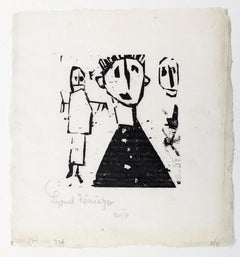
Stehkragen (rare hand signed woodcut)
By Lyonel Feininger
Located in Aventura, FL
Woodcut print on paper. Hand signed and dated by Lyonel Feininger. Unknow edition. Image size approx 3.9 x 3.9 inches. Sheet size 7 x 6.5 inches.
Artwork is in excellent conditio...
Category
1920s Contemporary Lyonel Feininger Art
Materials
Silk, Screen

$6,750 Sale Price
25% Off
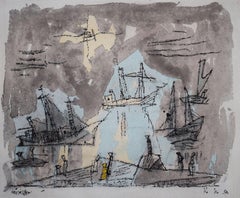
Sailing Ships, Boats, and Figures on the Shore - Sailing Ships Coastline
By Lyonel Feininger
Located in London, GB
This work is hand signed in ink by the artist “Feininger” in the lower left margin.
It is also dated in black ink "ii . ix . 50" [2nd September 1950] at the lower right corner.
Pro...
Category
1950s Lyonel Feininger Art
Materials
Paper, Ink, Watercolor, Pen
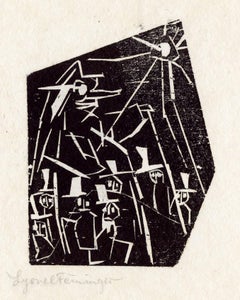
Da - Da I
— German Expressionism, Rare
By Lyonel Feininger
Located in Myrtle Beach, SC
Lyonel Feininger, 'Da-Da I' also titled by the artist 'Der Abgott' (The Idol), woodcut, 1918, a proof impression. Prasse W91. Signed in pencil and annotated '1876', the artist’s inv...
Category
1920s Bauhaus Lyonel Feininger Art
Materials
Woodcut
Connecticut Hills
By Lyonel Feininger
Located in Miami, FL
This later work by Lyonel Feininger approaches almost full abstraction. It was executed in 1950 at a crucial moment in American art history. Abstract Expressionism and non-representational art were in full gear and taking the world by storm. Yet Feininger who was associated with the German expressionist groups: Die Brücke...
Category
1990s Abstract Expressionist Lyonel Feininger Art
Materials
India Ink, Watercolor
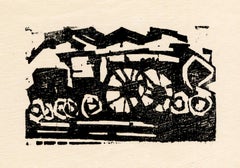
Little Locomotive
– Artist
s Personal Letterhead, Bauhaus Modernism
By Lyonel Feininger
Located in Myrtle Beach, SC
Lyonel Feininger, 'Little Locomotive (Kleine Lokomotive)', woodcut, 1936, one of a small but unknown number of letterhead proofs; Prasse W158. Annotated 'W 158' (Feininger catalogue number) and '1936' in pencil, in the bottom right sheet corner.
A fine impression, on cream, laid letterhead stock; hinge remains on the left and right top sheet edges, verso, in excellent condition. Very scarce.
Image size 2 1/4 x 3 5/16 inches; sheet size 10 x 7 inches. Archivally sleeved, unmatted.
Exhibited: 'Lyonel Feininer, Woodcuts Used As Letterheads'; Associated American Artists; Feb 4 - March 2, 1974; New York, NY.
Collections: Cleveland Museum of Art, Museum of Modern Art, Staatliche Museen zu Berlin (East Berlin KK).
ABOUT THE ARTIST
Lyonel Feininger (1871-1956) was born in New York City into a musical family—his father was a violinist and composer, his mother was a singer and pianist. He studied violin with his father, and by the age of 12, he was performing in public, but he also drew incessantly, most notably the steamboats and sailing ships on the Hudson and East Rivers, and the landscape around Sharon, Conn., where he spent time on a farm owned by a family friend. At the age of 16 he left New York to study music and art in Germany, from where his parents emigrated. Drawn more to the visual arts, he attended schools in Hamburg, Berlin, and Paris from 1887 to 1892.
After completing his studies, Feininger began his artistic career as a cartoonist and illustrator, his originality leading him to great success. In 1906, after working for a dozen years in Germany, he was offered a job as a cartoonist at the Chicago Tribune, the largest circulation newspaper in the Midwest. He worked there for a year, inventing what became the standard design for the comic strip: in the words of John Carlin, “an overall pattern. . . that allowed the page to be read both as a series of elements one after the other, like language and as a group of juxtaposed images, like visual art.” His originality did not end there: he went on to become one of the great abstract painters. Like Kandinsky, music was his model, but Kandinsky only knew music from the outside—as a listener (inspired initially by Wagner, then by Schoenberg)—while Feininger knew it from the inside. He lived in Paris from 1906 to 1908, during which time he met and was influenced by the work of progressive painters Robert Delaunay and Jules Pascin, as well as that of Paul Cezanne and Vincent van Gogh. He began painting full-time, developing his distinctive Iyrical style based on Cubist and Expressionist idioms and a concern for the emotive qualities of light and color. He exhibited with the Der Blaue Reiter group in 1913, and in 1917, he had his first solo exhibition at Galerie Der Sturm in Berlin.
One year after his solo exhibition, in 1918, Feininger began making woodcuts. He became enamored with the medium, producing an impressive 117 in his first year of exploring the printmaking medium. In 1919 at the invitation of the architect Walter Gropius, he was appointed the first master at the newly formed Staatliches Bauhaus in Weimar. His woodcut of a cathedral crowned...
Category
1930s Bauhaus Lyonel Feininger Art
Materials
Woodcut
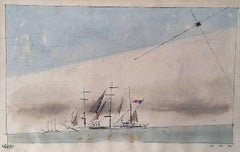
Bauhaus . Untitled (French Barque under Staysail)
By Lyonel Feininger
Located in Miami, FL
Bauhaus Iconic work by the master or Cubism and Expressionism
Dalzell Hatfield Gallery, Los Angeles
Bonhams,
Exhibited: Moller Fine Art, "Precision ...
Category
1940s Expressionist Lyonel Feininger Art
Materials
Watercolor, Pencil
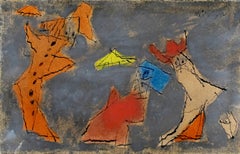
Three Figures with Umbrellas - Watercolor German American Bauhaus
By Lyonel Feininger
Located in London, GB
This work is hand signed in ink by the artist "Feininger" at the upper right corner.
Provenance:
The Collection of Peter Kamnitzer.
Peter Kamnitzer (1922-2016) was a renowned and r...
Category
1950s Bauhaus Lyonel Feininger Art
Materials
Paper, Ink, Watercolor, Pen
Three Masted Ship, 2
– Artist
s Personal Letterhead, Bauhaus Modernism
By Lyonel Feininger
Located in Myrtle Beach, SC
Lyonel Feininger, 'Three Masted Ship, 2 (Dreimastiges Schiff, 2)', woodcut, 1937, one of a small but unknown number of letterhead proofs; Prasse W296. Feininger estate stamp and inventory no. 'W 865' in pencil, bottom left sheet corner. Annotated 'W 296' and 'on block : 3702a' in pencil, bottom right sheet corner.
A fine impression, on cream, laid, letterhead stock; hinge remains on the left and right top sheet edges, verso, in excellent condition. Very scarce.
Image size 2 1/4 x 2 11/16 inches; sheet size 10 x 6 3/4 inches. Archivally sleeved, unmatted.
Exhibited: 'Lyonel Feininer, Woodcuts Used As Letterheads'; Associated American Artists; Feb 4 - March 2, 1974; New York, NY.
ABOUT THE ARTIST
Lyonel Feininger (1871-1956) was born in New York City into a musical family—his father was a violinist and composer, his mother was a singer and pianist. He studied violin with his father, and by the age of 12, he was performing in public, but he also drew incessantly, most notably the steamboats and sailing ships on the Hudson and East Rivers, and the landscape around Sharon, Conn., where he spent time on a farm owned by a family friend. At the age of 16 he left New York to study music and art in Germany, from where his parents emigrated. Drawn more to the visual arts, he attended schools in Hamburg, Berlin, and Paris from 1887 to 1892.
After completing his studies, Feininger began his artistic career as a cartoonist and illustrator, his originality leading him to great success. In 1906, after working for a dozen years in Germany, he was offered a job as a cartoonist at the Chicago Tribune, the largest circulation newspaper in the Midwest. He worked there for a year, inventing what became the standard design for the comic strip: in the words of John Carlin, “an overall pattern. . . that allowed the page to be read both as a series of elements one after the other, like language and as a group of juxtaposed images, like visual art.” His originality did not end there: he went on to become one of the great abstract painters. Like Kandinsky, music was his model, but Kandinsky only knew music from the outside—as a listener (inspired initially by Wagner, then by Schoenberg)—while Feininger knew it from the inside. He lived in Paris from 1906 to 1908, during which time he met and was influenced by the work of progressive painters Robert Delaunay and Jules Pascin, as well as that of Paul Cezanne and Vincent van Gogh. He began painting full-time, developing his distinctive Iyrical style based on Cubist and Expressionist idioms and a concern for the emotive qualities of light and color. He exhibited with the Der Blaue Reiter group in 1913, and in 1917, he had his first solo exhibition at Galerie Der Sturm in Berlin.
One year after his solo exhibition, in 1918, Feininger began making woodcuts. He became enamored with the medium, producing an impressive 117 in his first year of exploring the printmaking medium. In 1919 at the invitation of the architect Walter Gropius, he was appointed the first master at the newly formed Staatliches Bauhaus in Weimar. His woodcut of a cathedral crowned...
Category
1930s Bauhaus Lyonel Feininger Art
Materials
Woodcut
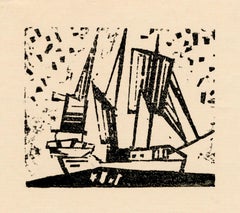
Church with House and Tree
– Artist
s Personal Letterhead, Bauhaus Modernism
By Lyonel Feininger
Located in Myrtle Beach, SC
Lyonel Feininger, 'Church with House and Tree (Kirche mit Haus und Baum)', woodcut, 1936, one of a small but unknown number of letterhead proofs; Prasse W290 V. Inscribed 'J. F. note paper', in pencil, in the artist’s hand; with the Feininger estate stamp and catalog no. 'W 859' in pencil. Annotated 'W.290 V state 3609' in pencil, in the bottom right sheet corner.
A fine impression, on cream, laid letterhead stock; hinge remains on the left and right top sheet edges, verso, in excellent condition. Very scarce.
Image size 2 3/8 x 2 3/4 inches; sheet size 10 x 7 5/16 inches. Archivally sleeved, unmatted.
Exhibited: 'Lyonel Feininer, Woodcuts Used As Letterheads'; Associated American Artists; Feb 4 - March 2, 1974; NY, NY.
ABOUT THE ARTIST
Lyonel Feininger (1871-1956) was born in New York City into a musical family—his father was a violinist and composer, his mother was a singer and pianist. He studied violin with his father, and by the age of 12, he was performing in public. Still, he also drew incessantly, most notably the steamboats and sailing ships on the Hudson and East Rivers, and the landscape around Sharon, Conn., where he spent time on a farm owned by a family friend. At the age of 16 he left New York to study music and art in Germany, from where his parents emigrated. Drawn more to the visual arts, he attended schools in Hamburg, Berlin, and Paris from 1887 to 1892.
After completing his studies, Feininger began his artistic career as a cartoonist and illustrator, his originality leading him to great success. In 1906, after working for a dozen years in Germany, he was offered a job as a cartoonist at the Chicago Tribune, the largest circulation newspaper in the Midwest. He worked there for a year, inventing what became the standard design for the comic strip: in the words of John Carlin, “an overall pattern. . . that allowed the page to be read both as a series of elements one after the other, like language and as a group of juxtaposed images, like visual art.” His originality did not end there: he went on to become one of the great abstract painters. Like Kandinsky, music was his model, but Kandinsky only knew music from the outside—as a listener (inspired initially by Wagner, then by Schoenberg)—while Feininger knew it from the inside. He lived in Paris from 1906 to 1908, during which time he met and was influenced by the work of progressive painters Robert Delaunay and Jules Pascin, as well as that of Paul Cezanne and Vincent van Gogh. He began painting full-time, developing his distinctive Iyrical style based on Cubist and Expressionist idioms and a concern for the emotive qualities of light and color. He exhibited with the Der Blaue Reiter group in 1913, and in 1917, he had his first solo exhibition at Galerie Der Sturm in Berlin.
One year after his solo exhibition, in 1918, Feininger began making woodcuts. He became enamored with the medium, producing an impressive 117 in his first year of exploring the printmaking medium. In 1919 at the invitation of the architect Walter Gropius, he was appointed the first master at the newly formed Staatliches Bauhaus in Weimar. His woodcut of a cathedral crowned...
Category
1930s Bauhaus Lyonel Feininger Art
Materials
Woodcut
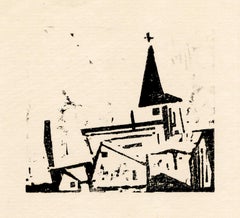
Church with House and Tree
– Artist
s Personal Letterhead, 1940s Modernism
By Lyonel Feininger
Located in Myrtle Beach, SC
Lyonel Feininger, 'Church with House and Tree (Kirche mit Haus und Baum)', woodcut, 1936, one of a small but unknown number of letterhead proofs; Prasse W290 IV. Annotated 'PW 290 state IV / IV 3669', in pencil, in the bottom right sheet corner. With the artist's typed address and date adjacent to the letterhead image: 'Falls Village, Connecticut September 26th, 1940'.
A fine impression, on buff, wove letterhead stock; several small losses, and tears, in the sheet edges (not affecting the image area); a crease in the bottom right sheet edge, otherwise in good condition. Very scarce.
Image size: 2 3/8 x 2 3/4 inches; sheet size 11 x 8 5/8 inches. Archivally sleeved, unmatted.
Feininger moved from Germany to New York City in 1938 and began spending his summers in Falls Village in 1940.
Exhibited: 'Lyonel Feininer, Woodcuts Used As Letterheads'; Associated American Artists; Feb 4 - March 2, 1974; New York, NY.
ABOUT THE ARTIST
Lyonel Feininger (1871-1956) was born in New York City into a musical family—his father was a violinist and composer, his mother was a singer and pianist. He studied violin with his father, and by the age of 12, he was performing in public, but he also drew incessantly, most notably the steamboats and sailing ships on the Hudson and East Rivers, and the landscape around Sharon, Conn., where he spent time on a farm owned by a family friend. At the age of 16 he left New York to study music and art in Germany, from where his parents emigrated. Drawn more to the visual arts, he attended schools in Hamburg, Berlin, and Paris from 1887 to 1892.
After completing his studies, Feininger began his artistic career as a cartoonist and illustrator, his originality leading him to great success. In 1906, after working for a dozen years in Germany, he was offered a job as a cartoonist at the Chicago Tribune, the largest circulation newspaper in the Midwest. He worked there for a year, inventing what became the standard design for the comic strip: in the words of John Carlin, “an overall pattern. . . that allowed the page to be read both as a series of elements one after the other, like language and as a group of juxtaposed images, like visual art.” His originality did not end there: he went on to become one of the great abstract painters. Like Kandinsky, music was his model, but Kandinsky only knew music from the outside—as a listener (inspired initially by Wagner, then by Schoenberg)—while Feininger knew it from the inside. He lived in Paris from 1906 to 1908, during which time he met and was influenced by the work of progressive painters Robert Delaunay and Jules Pascin, as well as that of Paul Cezanne and Vincent van Gogh. He began painting full-time, developing his distinctive Iyrical style based on Cubist and Expressionist idioms and a concern for the emotive qualities of light and color. He exhibited with the Der Blaue Reiter group in 1913, and in 1917, he had his first solo exhibition at Galerie Der Sturm in Berlin.
One year after his solo exhibition, in 1918, Feininger began making woodcuts. He became enamored with the medium, producing an impressive 117 in his first year of exploring the printmaking medium. In 1919 at the invitation of the architect Walter Gropius, he was appointed the first master at the newly formed Staatliches Bauhaus in Weimar. His woodcut of a cathedral crowned...
Category
1930s Bauhaus Lyonel Feininger Art
Materials
Woodcut
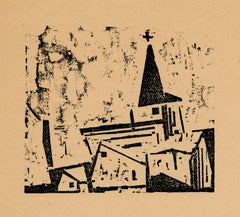
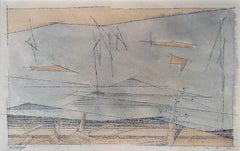
Connecticut Hills
By Lyonel Feininger
Located in Miami, FL
Executed in 1950 during the heyday of Abstract Expressionism and non-representational art, Feininger reduces a landscape to the bare minimums of lines and wash.
Moeller Fine Art
Category
1950s Abstract Geometric Lyonel Feininger Art
Materials
Watercolor, Pencil
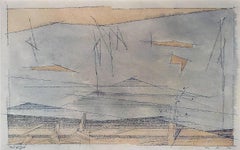
Steamboat Odin Dampfer Odin - German Woodcut
By Lyonel Feininger
Located in London, GB
This original woodcut is hand signed in pencil "Lyonel Feininger" at the lower left margin.
It is also inscribed with the work number by the artist “1815” in the lower centre of the...
Category
1910s Expressionist Lyonel Feininger Art
Materials
Woodcut
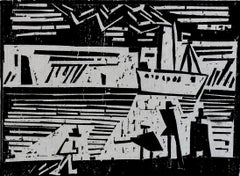
On the Quay Wall Auf der Quaimauer, 1921
By Lyonel Feininger
Located in London, GB
LYONEL FEININGER 1871-1956
1871 - New York - 1956 (American/German)
Title: On the Quay Wall Auf der Quaimauer, 1921
Technique: Original Hand Signed Woodcut on Wove Paper
Paper...
Category
1920s Expressionist Lyonel Feininger Art
Materials
Woodcut
Related Items
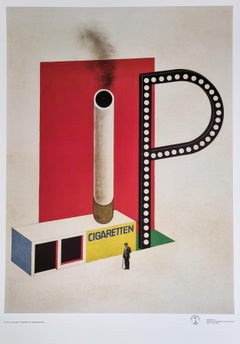
Sale and Marketing Kiosk for P Cigarettes (Bauhaus) (20% OFF + Free Shipping)
By Herbert Bayer
Located in Kansas City, MO
Herbert Bayer
Sale and Marketing Kiosk for P Cigarettes (Verkauf- und Werbekiosk, Zigarettenmarke P ), 1924
Offset Lithograph
Year: 1994
Size: 33.2 × 23.2 inches
Publisher: Bauhaus A...
Category
1920s Bauhaus Lyonel Feininger Art
Materials
Lithograph
$120 Sale Price
20% Off
H 33.2 in W 23.2 in
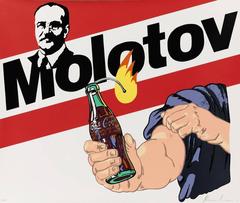
Molotov Cocktail
By Alexander Kosolapov
Located in New York, NY
Molotov Cocktail, 1991
Screenprint
37x44 inches
Edition of 95
Alexander Kosolapov (Russian: Александр Семёнович Косолапов) (born January 1, 1943, in Moscow, Russia) is an American sculptor and painter. He immigrated to the United States in 1975 and has since lived and worked in New York. In the late 1950's Kosolapov attended the Art School of the Surikov Moscow Art Institute. Amongst his classmates were Leonid Sokov...
Category
1990s Contemporary Lyonel Feininger Art
Materials
Screen
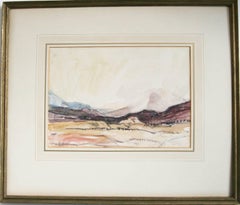
Glen Orchy.
By David Young Cameron
Located in Storrs, CT
Glen Orchy. c. 1925. Watercolor, pencil and conte crayon on paper. 9 1/4 x 13 (sheet 10 3/8 x 13 1/4). Ex-collection L.G. Duke,purchased at Sotheby's, London '10.12.70'. Mat line; ot...
Category
20th Century Modern Lyonel Feininger Art
Materials
Watercolor, Pencil
Conceptual art photo engraving and screenprint 2005 27x33in hrs min kcal fat
Located in Miami, FL
Raul Cordero (Cuba, 1971)
'32 hrs 53 min kcal: 783 fat: 35%', 2005
photo engraving and screenprint on paper Guarro Biblos 250g.
26.8 x 33.3 in. (68 x 84.5...
Category
Early 2000s Contemporary Lyonel Feininger Art
Materials
Screen, Engraving, Aquatint

$2,300
H 26.8 in W 33.3 in
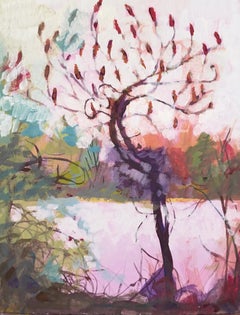
Sumac, colorful Abstract Impressionist landscape gouache
By Sandy Litchfield
Located in New York, NY
Sandy Litchfield found peace and inspiration in regular solitary walks through nature throughout the pandemic. Her most recent body of work diaristically documents her constitutional...
Category
2010s Abstract Impressionist Lyonel Feininger Art
Materials
Paper, Gouache
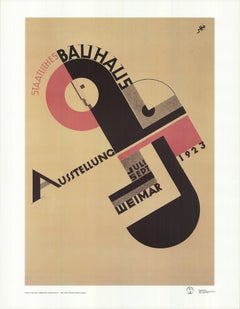
Joost Schmidt-Bauhaus Exhibition-1995- Vintage
Located in Brooklyn, NY
Schmidt's 1923 poster for the Bauhaus Exhibition is celebrated for its innovative use of geometric forms and typographic elements, reflecting the school's avant-garde approach to des...
Category
Mid-20th Century Bauhaus Lyonel Feininger Art
Materials
Offset
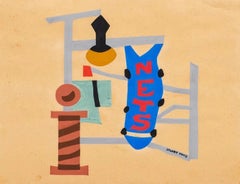
"NY Street Signs" Mid-20th Century WPA 1938 Modernist Abstract Realism Pop Art
By Stuart Davis
Located in New York, NY
"NY Street Signs" Mid-20th Century WPA 1938 Modernist Abstract Realism Pop Art
Stuart Davis (American, 1892-1964) "Street Signs" Modernist gouache and traces of pencil on paper in the proto-pop art style Davis is celebrated for, 1938, signed to lower right, framed. Image: 11 1/4 x 15 1/4 inches. Frame by Bark: 18 1/2 x 22 inches.
LITERATURE: A, Boyajian, M. Rutkowski, Stuart Davis, A Catalogue Raisonne, Vol. 2, New Haven, Connecticut, 2007, vol. II, p. 632, no. 1232, illustrated.
EXHIBITIONS: ACA Galleries, New York American Artists' Congress: Group Exhibition of Paintings and Sculpture, Dec. 3-16, 1939 (SDAB I, 12/3/39, p. 129). Outlines Gallery, Pittsburgh, Stuart Davis, Mar. 3-16, 1946. Coleman Art Gallery, Philadelphia, 5 Prodigal Sons: Former Philadelphia Artists: Ralston Crawford, Stuart Davis, Charles Demuth, Julian Levi, Charles Sheeler, Oct 4 - 30, 1947 (pamphlet), no. 12.
PROVENANCE: The artist; Mr. and Mrs. Frank Bowles, New York, Apr. 3, 1956; thence by descent, Private Collection, New York.
NOTES: According to the Catalogue Raissonne, "the title 'Street Signs' is recorded in the artist's account books...
Category
1930s American Modern Lyonel Feininger Art
Materials
Paper, Gouache, Pencil
$125,000
H 18.5 in W 22 in D 1 in
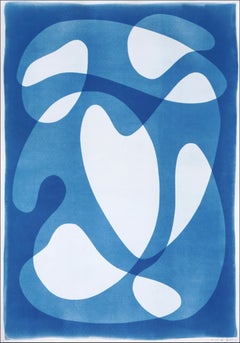
Mid-Century Shapes IV, White and Blue Abstract Floating Shapes, Unique Cyanotype
By Kind of Cyan
Located in Barcelona, ES
This is an exclusive handprinted unique cyanotype that takes its inspiration from the mid-century modern shapes.
It's made by layering paper cutouts and different exposures using uv-...
Category
2010s Bauhaus Lyonel Feininger Art
Materials
Photographic Film, Emulsion, Watercolor, Photographic Paper, Monotype, P...
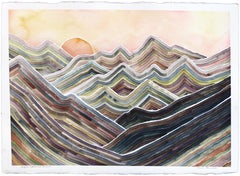
Angeles National Forest - Abstract Muted Colorful Landscape Nature Painting
Located in Los Angeles, CA
Heidi Lowell is a multidisciplinary artist based in Austin, Texas, whose practice is deeply rooted in the earth itself. Harvesting site-specific soils and plant materials from across...
Category
2010s Abstract Lyonel Feininger Art
Materials
Paper, Watercolor
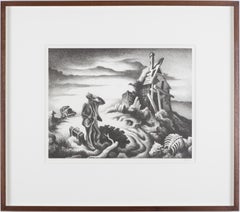
Prodigal Son
By Thomas Hart Benton
Located in London, GB
A man raises his hand to his chin, his neck tilted and face turned to look at a dilapidated farmhouse, barely held together by planks of wood and exposed to the elements. Behind him ...
Category
1930s American Modern Lyonel Feininger Art
Materials
Lithograph
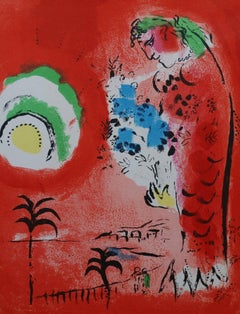
Marc Chagall The Bay of Angels
By Marc Chagall
Located in Washington, DC
Marc Chagall The Bay of Angels
Artist: Marc Chagall
Medium: Lithograph
Title: The Bay of Angels
Portfolio: 1960 Mourlot Lithographe I
Year: 1960
Editio...
Category
1960s Lyonel Feininger Art
Materials
Lithograph
DESERT BARRIER
By Frances H. Gearhart
Located in Santa Monica, CA
FRANCES H. GEARHART (1869-1958)
DESERT BARRIER c. 1933
Color block print, unsigned 12 x 9 ¼”. Typical original margins on good fibrous japan paper. Many very good impressions by G...
Category
1930s American Impressionist Lyonel Feininger Art
Materials
Woodcut
Previously Available Items
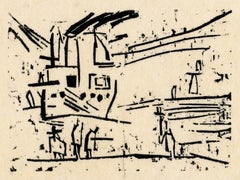
Ausfahrender Dampfer Odin (Outboard Steamer Odin)
— German Expressionism
By Lyonel Feininger
Located in Myrtle Beach, SC
Lyonel Feininger, 'Ausfahrender Dampfer Odin (Outboard Steamer Odin)', woodcut, 1918, proofs only. Prasse W75. Signed in pencil and annotated '1860', the artist’s inventory number. A...
Category
1910s Bauhaus Lyonel Feininger Art
Materials
Woodcut
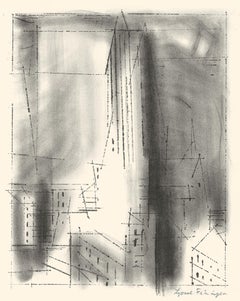
Manhattan 1, stone 2
— Mid-Century Modernism, New York City
By Lyonel Feininger
Located in Myrtle Beach, SC
Lyonel Feininger, 'Manhattan 1, stone 2', lithograph, 1951, edition 25. Prasse L 16. Titled 'Manhattan I and Stone II' in pencil, in the bottom right sheet edge. A fine impression on off-white Rives wove paper, with full margins (1 1/2 to 2 3/4 inches), in excellent condition. Scarce. Matted to museum standards, unframed.
Image size 11 1/4 x 8 5/8 inches (286 x 219 mm); 16 x 11 1/2 sheet size: inches (406 x 292 mm). Matted to museum standards, unframed.
ABOUT THIS WORK
Feininger produced only 20 lithographs throughout his prolific career—a handful of much earlier works created from 1906-12 were never editioned, with only a few proofs providing a record of those formative experiments. The success of his signature work, 'Off the Coast, Stone 3' created in 1951 for the Print Club of Cleveland, led the artist to produce five other lithographs from 1951-1955 printed by master lithographer George C. Miller as was the Print Club edition.
Impressions of this work are held in the collections of the Boston Public Library, Cambridge Fine Arts Museum, Cleveland Museum of Art, Bezalel National Art Museum (Jerusalem), Philadelphia Museum of Art, and the Washington Library of Congress.
ABOUT THE ARTIST
Lyonel Feininger (1871-1956) was born in New York City into a musical family—his father was a violinist and composer, his mother was a singer and pianist. He studied violin with his father, and by the age of 12, he was performing in public. Still, he also drew incessantly, most notably the steamboats and sailing ships on the Hudson and East Rivers, and the landscape around Sharon, Conn., where he spent time on a farm owned by a family friend. At the age of 16 he left New York to study music and art in Germany, from where his parents emigrated. Drawn more to the visual arts, he attended schools in Hamburg, Berlin, and Paris from 1887 to 1892.
After completing his studies, Feininger began his artistic career as a cartoonist and illustrator, his originality leading him to great success. In 1906, after working for a dozen years in Germany, he was offered a job as a cartoonist at the Chicago Tribune, the largest circulation newspaper in the Midwest. He worked there for a year, inventing what became the standard design for the comic strip: in the words of John Carlin, “an overall pattern. . . that allowed the page to be read both as a series of elements one after the other, like language and as a group of juxtaposed images, like visual art.” His originality did not end there: he went on to become one of the great abstract painters. Like Kandinsky, music was his model, but Kandinsky only knew music from the outside—as a listener (inspired initially by Wagner, then by Schoenberg)—while Feininger knew it from the inside. He lived in Paris from 1906 to 1908, during which time he met and was influenced by the work of progressive painters Robert Delaunay and Jules Pascin, as well as that of Paul Cezanne and Vincent van Gogh. He began painting full-time, developing his distinctive Iyrical style based on Cubist and Expressionist idioms and a concern for the emotive qualities of light and color. He exhibited with the Der Blaue Reiter group in 1913, and in 1917, he had his first solo exhibition at Galerie Der Sturm in Berlin.
One year after his solo exhibition, in 1918, Feininger began making woodcuts. He became enamored with the medium, producing an impressive 117 in his first year of exploring the printmaking medium. In 1919 at the invitation of the architect Walter Gropius, he was appointed the first master at the newly formed Staatliches Bauhaus in Weimar. His woodcut of a cathedral...
Category
1950s Bauhaus Lyonel Feininger Art
Materials
Lithograph
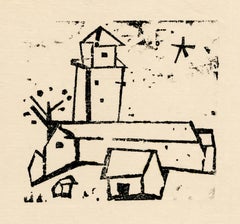
Church with Houses
— Artist
s Personal Letterhead, Bauhaus Modernism
By Lyonel Feininger
Located in Myrtle Beach, SC
Lyonel Feininger, 'Church with Houses' also 'Tree and Star' ('Kirche mit Hausern', 'Baum und Stern'), woodcut, 1933, one of a small but unknown number of letterhead proofs; Prasse W275. Annotated 'W 275' (Feininger catalogue number) and inventory number '3033' in pencil, in the bottom right sheet corner. A fine, richly-inked impression, on cream, laid letterhead paper, in excellent condition. Very scarce.
Image size 2 7/16 x 2 5/8 inches; sheet size 10 x 6 7/8 inches. Archivally sleeved, unmatted.
Exhibited: 'Lyonel Feininer, Woodcuts Used As Letterheads'; Associated American Artists; Feb 4 - March 2, 1974; New York, NY.
ABOUT THE ARTIST
Lyonel Feininger (1871-1956) was born in New York City into a musical family—his father was a violinist and composer, his mother was a singer and pianist. He studied violin with his father, and by the age of 12, he was performing in public, but he also drew incessantly, most notably the steamboats and sailing ships on the Hudson and East Rivers, and the landscape around Sharon, Conn., where he spent time on a farm owned by a family friend. At the age of 16 he left New York to study music and art in Germany, from where his parents emigrated. Drawn more to the visual arts, he attended schools in Hamburg, Berlin, and Paris from 1887 to 1892.
After completing his studies, Feininger began his artistic career as a cartoonist and illustrator, his originality leading him to great success. In 1906, after working for a dozen years in Germany, he was offered a job as a cartoonist at the Chicago Tribune, the largest circulation newspaper in the Midwest. He worked there for a year, inventing what became the standard design for the comic strip: in the words of John Carlin, “an overall pattern. . . that allowed the page to be read both as a series of elements one after the other, like language and as a group of juxtaposed images, like visual art.” His originality did not end there: he went on to become one of the great abstract painters. Like Kandinsky, music was his model, but Kandinsky only knew music from the outside—as a listener (inspired initially by Wagner, then by Schoenberg)—while Feininger knew it from the inside. He lived in Paris from 1906 to 1908, during which time he met and was influenced by the work of progressive painters Robert Delaunay and Jules Pascin, as well as that of Paul Cezanne and Vincent van Gogh. He began painting full-time, developing his distinctive Iyrical style based on Cubist and Expressionist idioms and a concern for the emotive qualities of light and color. He exhibited with the Der Blaue Reiter group in 1913, and in 1917, he had his first solo exhibition at Galerie Der Sturm in Berlin.
One year after his solo exhibition, in 1918, Feininger began making woodcuts. He became enamored with the medium, producing an impressive 117 in his first year of exploring the printmaking medium. In 1919 at the invitation of the architect Walter Gropius, he was appointed the first master at the newly formed Staatliches Bauhaus in Weimar. His woodcut of a cathedral crowned...
Category
1930s Bauhaus Lyonel Feininger Art
Materials
Woodcut
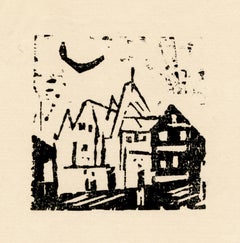
Buildings with Crescent Moon (Gebaude mit Mondsichel) – Artist
s letterhead
By Lyonel Feininger
Located in Myrtle Beach, SC
Lyonel Feininger, 'Buildings with Crescent Moon (Gebaude mit Mondsichel)', woodcut, 1936, one of a small but unknown number of letterhead proofs; Prasse W214 III. Annotated 'W 214 II...
Category
1930s Bauhaus Lyonel Feininger Art
Materials
Woodcut
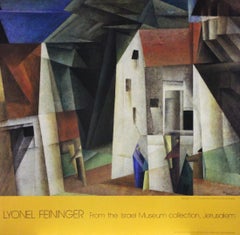
Poster, Israel Museum Collection
By Lyonel Feininger
Located in Chesterfield, MI
LYONEL FEININGER (American-German, 1871-1956). Poster-From the Israel Museum Collection, Jerusalem, featuring “Mellingen VI 1922." Printed by Hamaker Pre...
Category
Late 20th Century Lyonel Feininger Art
Materials
Lithograph
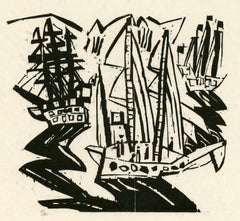
Ships (Three Sailing Ships)
By Lyonel Feininger
Located in Myrtle Beach, SC
Lyonel Feininger, 'Ships (Three Sailing Ships)', woodcut, 1919, proofs only; posthumous edition 100 (1964), Prasse W151 II. Numbered '55/100' in pencil; F...
Category
1910s Bauhaus Lyonel Feininger Art
Materials
Woodcut
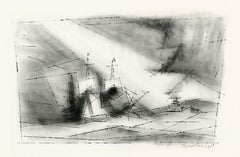
Off the Coast, stone 3 (Vor Der Kuste, Stein 3)
By Lyonel Feininger
Located in Myrtle Beach, SC
Lyonel Feininger, 'Off the Coast, stone 3 (Vor Der Kuste, Stein 3)', lithograph, 1951, edition 250, Prasse L 14 II. Signed in pencil. Printed by master lithographer George C. Miller,...
Category
1950s Bauhaus Lyonel Feininger Art
Materials
Lithograph
Warfleet, 1 ( Kriegsflotte, 1)
By Lyonel Feininger
Located in Myrtle Beach, SC
No. 8 of the portfolio 'Zwolf Holzschnitte von Lyonel Feininger', 1921; Staatliches Bauhaus Weimar, publisher. A fine, black impression, on fibrous cream Japan paper; the full sheet ...
Category
1920s Bauhaus Lyonel Feininger Art
Materials
Woodcut

Off the Coast, Third Stone (Vor der Kuste, Stein 3)
By Lyonel Feininger
Located in Fairlawn, OH
Signed by the artist in pencil lower right; The Print Club of Cleveland stamp verso (Lugt 2049b)
Edition: 250 signed impressions plus 10 for the artist
Exhibitions:
The Prin...
Category
1950s Lyonel Feininger Art
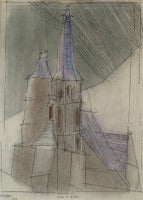
The Towers of Saint Blaise
By Lyonel Feininger
Located in London, GB
This work is hand signed by the artist "Feininger" at the lower left. It is also dated "1940" next to the signature. The work is furthermore titled "Towers of St Blaise...
Category
Lyonel Feininger Art
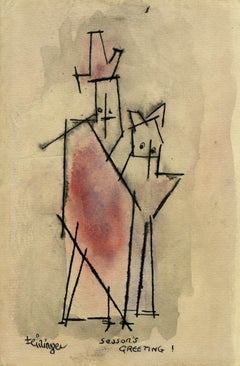
Ghosties
By Lyonel Feininger
Located in Fairlawn, OH
Signed in ink lower left Annotated "Seasons Greetings" in ink lower center.
Ink and Watercolor on paper
Feininger made a series of "Ghosties" watercolor drawings that he sent to fr...
Category
1950s Abstract Lyonel Feininger Art
Materials
Ink, Watercolor
Lyonel Feininger art for sale on 1stDibs.
Find a wide variety of authentic Lyonel Feininger art available for sale on 1stDibs. You can also browse by medium to find art by Lyonel Feininger in woodcut print, lithograph and more. Much of the original work by this artist or collective was created during the 20th century and is mostly associated with the Expressionist style. Not every interior allows for large Lyonel Feininger art, so small editions measuring 3 inches across are available. Customers who are interested in this artist might also find the work of and Guy Georget. Lyonel Feininger art prices can differ depending upon medium, time period and other attributes. On 1stDibs, the price for these items starts at $200 and tops out at $263,300, while the average work can sell for $8,800.