Mark Catesby Art
English, 1682-1749
Mark Catesby (24 March 1683 – 23 December 1749) was an English naturalist. Between 1729 and 1747 Catesby published his Natural History of Carolina, Florida and the Bahama Islands, the first published account of the flora and fauna of North America. It included 220 plates of birds, reptiles, amphibians, fish, insects, mammals and plants. Mark Catesby's The Natural History of Carolina, Florida and the Bahama Islands is generally credited as the first published work to provide illustrations and descriptions of North American flora and fauna. From 1722-1726 Catesby, an English naturalist, ranged over South Carolina, Georgia and the Bahamas sketching and collecting specimens of native plants and animals. Little is known of Catesby's early life. He was born in eastern England in 1683. Although Catesby does not appear to have attended university or studied for the Bar, he was sufficiently educated to write clear English and Latin. His interest in and knowledge of plants may have derived from his uncle, who maintained a botanical garden. Catesby also appears to have benefited from an acquaintance with John Ray, a leading English naturalist of the 17th century and the co-author of an early classic study of birds. It is unclear when or how Catesby developed his skills as an artist.
Catesby's first visit to North America occurred in 1712 when he traveled to Williamsburg, Virginia, to live with his sister and her husband, who had settled there. During his seven-year stay, he explored the length of the James River sketching plants and collecting botanical samples. Upon Catesby's return to England in 1719, his work in Virginia drew the attention of several influential members of the Royal Society. And with their financial backing, Catesby returned to North America three years later, arriving in Charleston in May 1722. During his four-year stay, he traveled throughout South Carolina, coastal Georgia and to the Bahamas. The sketches and specimens Catesby gathered during his second North American trip formed the basis for The Natural History of Carolina, Florida and the Bahama Islands. Although most often found as a two-volume set, Catesby's Natural History was published in 11 discrete sections from 1734-1747 and sold by subscription. Although Catesby died in 1749, his work was republished in 1754 and again in 1771. Catesby's work predated the classification system developed by Swedish botanist Carl Linneaus. However, the 1771 edition, featured here, includes a catalog of the Linnean names for the plants and animals Catesby featured in Natural History.to
1
1
Overall Width
to
Overall Height
to
2
2
1
1
1
2
1
1
1
1
1
1
1
1
1
3
10,222
2,785
2,504
1,384
1
2
Artist: Mark Catesby
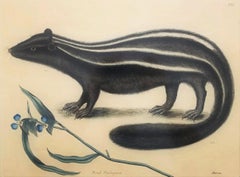
Putorius
Pseudo Phalangium (The Pole-Cat) (Skunk) /// Mark Catesby Animal Art
By Mark Catesby
Located in Saint Augustine, FL
Artist: Mark Catesby (English, 1638-1749)
Title: "Putorius & Pseudo Phalangium (The Pole-Cat) (Skunk)" (Plate/Tab 62)
Portfolio: Natural History of Carolina, Florida & the Bahama Isl...
Category
1770s Old Masters Mark Catesby Art
Materials
Watercolor, Handmade Paper, Etching, Intaglio
18th Century Catesby Hand-colored Bird
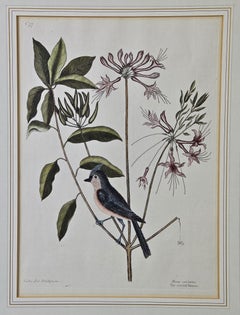
Plant Engraving "The Crested Titmous"
By Mark Catesby
Located in Alamo, CA
A hand-colored copperplate engraving of a bird and plants by Mark Catesby (1683-1749) entitled "The Crested Titmous" from "The Natural History of Carolina, Georgia, Florida and the Bahama Islands", published in 1731. It depicts a small Crested Titmous bird, facing left, perched on the stem of a plant with clusters of mauve colored star-like flowers.
This original Catesby hand-colored engraving, on laid paper with a large central Fleur-de-Lys watermark, is presented in a cream color French mat. The mat measures 20" x 15.5" and the sheet measures 18.75" x 14.75".
Mark Catesby was born in England to a prosperous family, but he traveled to America, first to visit his sister and her husband in 1712. From 1712 to 1719 he explored America observing its birds and plants, taking notes, creating drawings and collecting specimens. He returned to England with this material and created more detailed drawings. His next visit to America 1722-1726 allowed for more detailed research. Upon his return to England he created his monumental and beautiful work "The Natural History of Carolina, Florida, and Bahama Islands", which was published in London in two folio volumes of 11 parts each consisting of 20 plates...
Category
Mid-18th Century Naturalistic Mark Catesby Art
Materials
Engraving
Related Items
Bloodhound, early 19th century English dog engraving
By Philip Reinagle
Located in Melbourne, Victoria
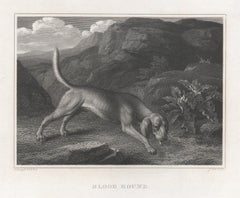
'Blood Hound'
Copper-line engraving by J Scott (1774-1827) after Philip Reinagle (1749-1815), 1803.
Philip Reinagle was one of the best of the sporti...
Category
Early 19th Century Naturalistic Mark Catesby Art
Materials
Engraving

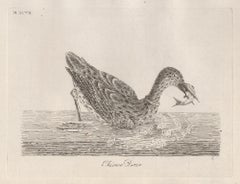
Chinese Diver, 18th century bird engraving by John Latham
By John Latham
Located in Melbourne, Victoria
Copper-line engraving. 1781. From John Latham's 'General Synopsis of Birds' 1781-1785, and its Supplements. Plate number top left. Laid paper.
John Latham was the leading English or...
Category
Late 18th Century Naturalistic Mark Catesby Art
Materials
Engraving
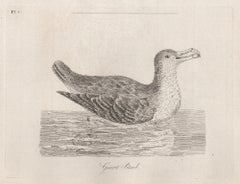
Giant Petrel, 18th century bird engraving by John Latham
By John Latham
Located in Melbourne, Victoria
Copper-line engraving. 1781. From John Latham's 'General Synopsis of Birds' 1781-1785, and its Supplements. Plate number top left. Laid paper.
John Latham was the leading English or...
Category
Late 18th Century Naturalistic Mark Catesby Art
Materials
Engraving
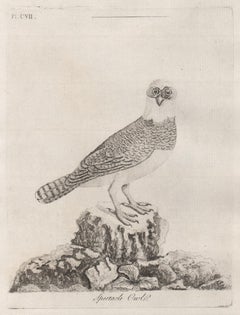
Spectacle Owl, 18th century bird engraving by John Latham
By John Latham
Located in Melbourne, Victoria
Copper-line engraving. 1781. From John Latham's 'General Synopsis of Birds' 1781-1785, and its Supplements. Plate number top left. Laid paper with watermark.
John Latham was the lea...
Category
Late 18th Century Naturalistic Mark Catesby Art
Materials
Engraving
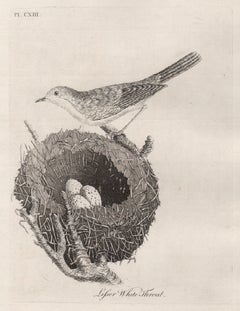
Lesser White Throat, bird and nest engraving by John Latham
By John Latham
Located in Melbourne, Victoria
Copper-line engraving. 1781. From John Latham's 'General Synopsis of Birds' 1781-1785, and its Supplements. Plate number top left. Laid paper with water...
Category
Late 18th Century Naturalistic Mark Catesby Art
Materials
Engraving
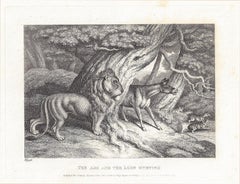
Ass and the Lion Hunting, antique animal fable etching by Samuel Howitt
By Samuel Howitt
Located in Melbourne, Victoria
Original antique etching by Samuel Howitt (1756-1822) . C1810. Published by Edward Orme.
An early 19th century etching by Howitt from a series depicting ...
Category
Early 19th Century Naturalistic Mark Catesby Art
Materials
Engraving, Etching
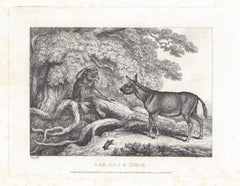
Ass, Ape
Mole, antique animal fable etching by Samuel Howitt
By Samuel Howitt
Located in Melbourne, Victoria
Original antique etching by Samuel Howitt (1756-1822) . C1810. Published by Edward Orme.
An early 19th century etching by Howitt from a series depicting ...
Category
Early 19th Century Naturalistic Mark Catesby Art
Materials
Engraving, Etching
$65
H 6.3 in W 8.27 in
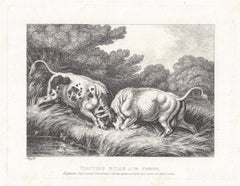
Fighting Bulls and Frogs, antique animal fable etching by Samuel Howitt
By Samuel Howitt
Located in Melbourne, Victoria
Original antique etching by Samuel Howitt (1756-1822) . C1810. Published by Edward Orme.
An early 19th century etching by Howitt from a series depicting ...
Category
Early 19th Century Naturalistic Mark Catesby Art
Materials
Engraving, Etching
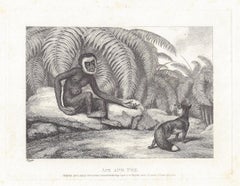
Ape and Fox, antique animal fable etching by Samuel Howitt
By Samuel Howitt
Located in Melbourne, Victoria
Original antique etching by Samuel Howitt (1756-1822) . C1810. Published by Edward Orme.
An early 19th century etching by Howitt from a series depicting ...
Category
Early 19th Century Naturalistic Mark Catesby Art
Materials
Engraving, Etching
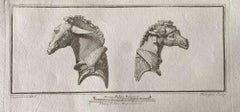
Animal Figures from Ancient Rome - Original Etching by Various Masters - 1750s
Located in Roma, IT
Animal Figures from Ancient Rome, from the Series "The Antiquities of Herculaneum Exposed", is anoriginal etching from the end of the 18th century, made by Various Old MastersIn very...
Category
1750s Old Masters Mark Catesby Art
Materials
Etching
$355
H 4.73 in W 9.85 in D 0.04 in
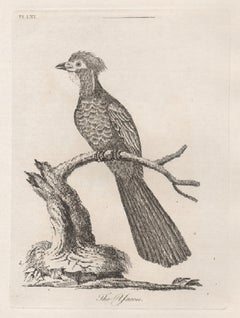
The Yacou, 18th century bird engraving by John Latham
By John Latham
Located in Melbourne, Victoria
Copper-line engraving. 1781. From John Latham's 'General Synopsis of Birds' 1781-1785, and its Supplements. Plate number top left. Laid paper.
John Latham was the leading English or...
Category
Late 18th Century Naturalistic Mark Catesby Art
Materials
Engraving
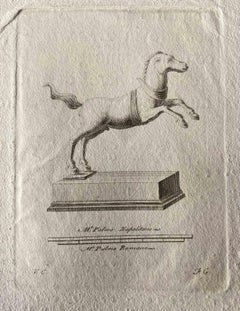
Animal Figures from Ancient Rome - Original Etching by Various Masters - 1750s
Located in Roma, IT
Animal Figures from Ancient Rome, from the Series "The Antiquities of Herculaneum Exposed", is anoriginal etching from the end of the 18th century, made by Various Old MastersIn very...
Category
1750s Old Masters Mark Catesby Art
Materials
Etching
$237
H 5.36 in W 3.55 in D 0.04 in
Previously Available Items
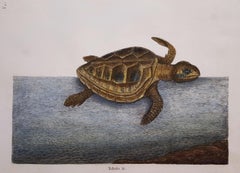
The Loggerhead Turtle
By Mark Catesby
Located in Saint Augustine, FL
An original hand-colored copper plate etching on handmade laid paper by English artist Mark Catesby (1638-1749) titled "The Loggerhead Turtle", (plat...
Category
1750s Baroque Mark Catesby Art
Materials
Watercolor, Etching
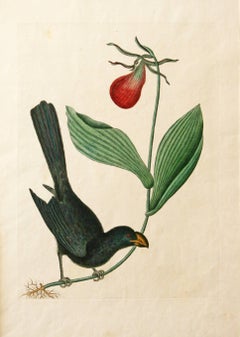
The Razor-billed Blackbird of Jamaica, hand-colored engraving, 1754
By Mark Catesby
Located in Paonia, CO
Mark Catesby ( 1683-1749 )
"The Natural History of Carolina, Florida and the Bahama Islands"
The Razor-billed Blackbird of Jamaica
hand-colored engraving, 1754
paper size...
Category
1750s Mark Catesby Art
Materials
Engraving
Mark Catesby art for sale on 1stDibs.
Find a wide variety of authentic Mark Catesby art available for sale on 1stDibs. If you’re browsing the collection of art to introduce a pop of color in a neutral corner of your living room or bedroom, you can find work that includes elements of orange and other colors. You can also browse by medium to find art by Mark Catesby in etching, paint, watercolor and more. Not every interior allows for large Mark Catesby art, so small editions measuring 16 inches across are available. Customers who are interested in this artist might also find the work of Samuel Sydney, Walter Crane, and Johan Christoph Volkhamer. Mark Catesby art prices can differ depending upon medium, time period and other attributes. On 1stDibs, the price for these items starts at $750 and tops out at $2,950, while the average work can sell for $2,885.