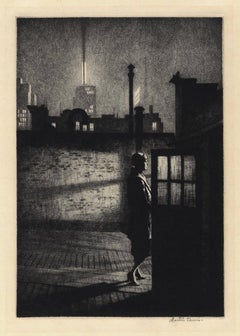
Martin Lewis Art

American, Australian, 1881-1962

Martin Lewis was born in Castlemaine, Victoria, Australia, on June 7th, 1881. He was the second of eight children and had a passion for drawing. 

At the age of 15, Lewis left home and traveled in New South Wales, Australia, and in New Zealand, working as a pothole digger and a merchant seaman. He returned to Sydney and settled into a Bohemian community outside Sydney. Two of his drawings were published in the radical Sydney newspaper, The Bulletin. He studied with Julian Ashton at the Art Society's School in Sydney. Ashton was an English-born Australian artist and teacher known for his support of the Heidelberg School and for his influential art school in Sydney. 

In 1900, Lewis left Australia for the United States. His first job was in San Francisco, painting stage decorations for William McKinley's presidential campaign of 1900. By 1909, Lewis was living in New York, where he found work in commercial illustration. His earliest known etching is dated 1915. However, the level of skill in this piece suggests he had been working in the medium for some time previously. It was during this period that he helped Edward Hopper learn the basics of etching

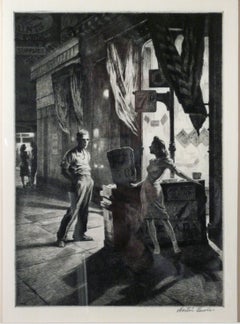
In 1920, after the breakup of a romance, Lewis traveled to Japan, where for two years he drew and painted and studied Japanese art. The influence of Japanese prints is very evident in Lewis's prints after that period. In 1925, he returned to etching and produced most of his well-known works between 1925 and 1935. Lewis's first solo exhibition in 1929 was successful enough for him to give up commercial work and concentrate entirely on printmaking. 

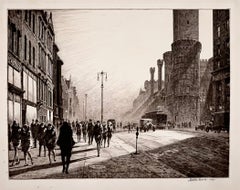
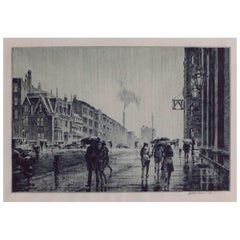
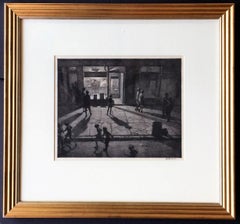
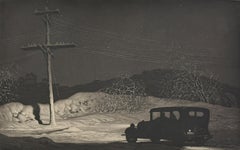
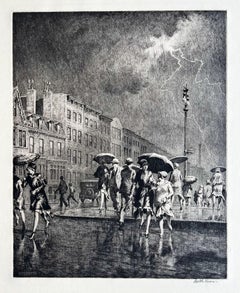
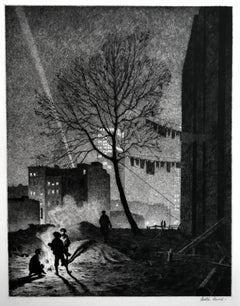
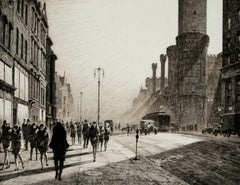
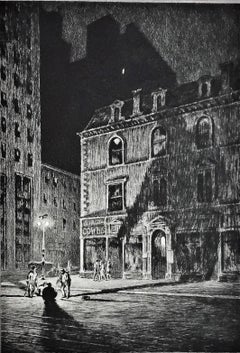
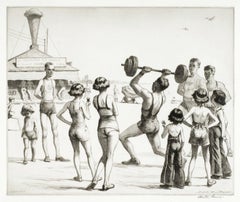
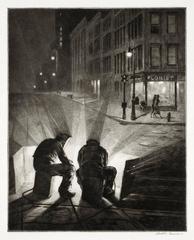
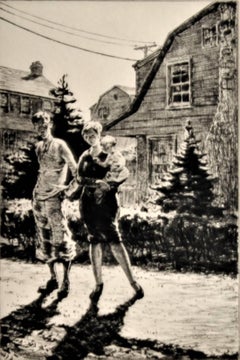
Lewis is most famous for his black and white prints, mostly of night scenes of non-tourist, real-life street scenes of New York City. During the Depression, however, he was forced to leave the city for four years between 1932 and 1936 and move to Newtown, Connecticut. His work from this period includes a number of rural, night-time, and winter landscape scenes in this area. 

Lewis returned to Manhattan in 1936 and continued to etch and paint. He taught printmaking at the Art Students League of New York from 1944 until his retirement in 1952. Now he is considered one of the most important American printmakers of the twentieth century.

Find original Martin Lewis prints and other art on 1stDibs.

(Biography provided by Allinson Gallery, Inc.)

to
3
24
24
13
11
10
7
1
1
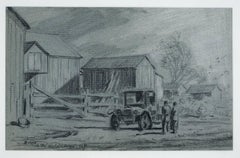
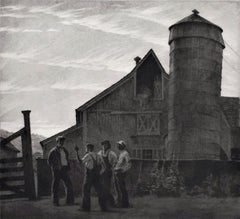
Barns in the Helderberg, New York (rural 1930s American scene with vintage car)
By Martin Lewis
Located in New Orleans, LA
"Barns in the Helderberg, New York" by Martin Lewis shows neighbors (one in a Model T car) visiting outside a series of barns with a tree in the background...
Category

1930s American Modern Martin Lewis Art

Materials

Chalk, Charcoal

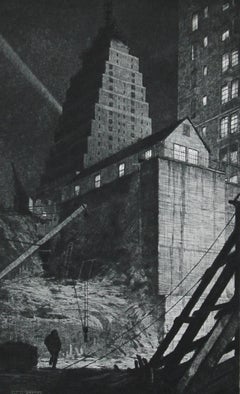
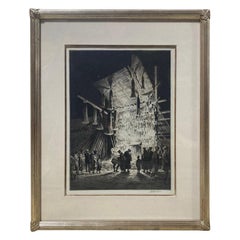
Building a Babylon, Tudor City, NY.
By Martin Lewis
Located in Plano, TX
McCarron 76. 12 7/8 x 7 7/8 (sheet 16 5/8 x 12 1/4). 6th trial proof (McCarron records 84 impressions including 4 trial proofs). Illustrated L'Amérique de la Dépression: Artistes En...
Category

Early 20th Century American Modern Martin Lewis Art

Materials

Drypoint, Etching

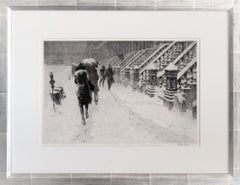
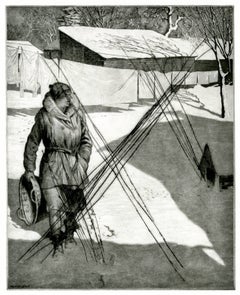
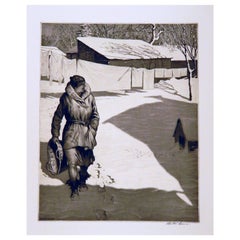
Stoops in Snow
By Martin Lewis
Located in Plano, TX
Stoops in Snow. 1930. Drypoint and sandpaper ground. McCarron catalog 89.state ii. 9 x 14 7/8 (sheet 13 1/4 x 18 7/16 ). Edition 115 recorded impressio...
Category

1930s American Modern Martin Lewis Art

Materials

Drypoint, Etching

Stoops in Snow
Stoops in Snow
$35,000 Sale Price
30% Off
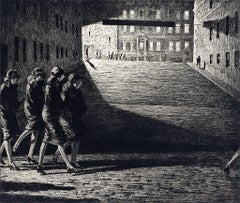
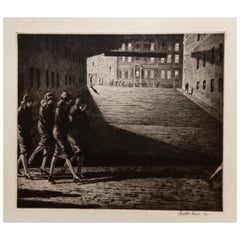
Shadows on the Ramp
By Martin Lewis
Located in Plano, TX
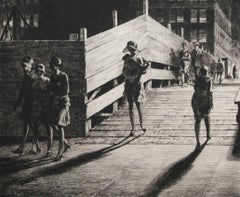
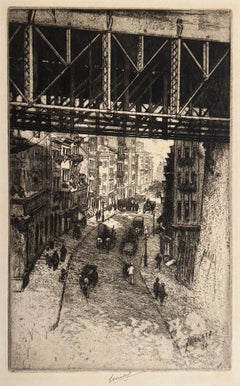
Shadows on the Ramp. 1927. Drypoint and sand ground. McCarron 64. 9 x 10 1/2 (sheet 12 3/8 x 14). Edition 75 recorded impressions. A rich, tonal impression with drypoint burr, printe...
Category

1920s American Modern Martin Lewis Art

Materials

Drypoint, Etching

Fifth Avenue Bridge.
By Martin Lewis
Located in Plano, TX
Fifth Avenue Bridge. 1928. Drypoint. McCarron 72. 9 7/8 x 12 (sheet 12 3/4 x 15). Edition of 108 recorded impressions. A rich impression printed on cream laid paper, with full margin...
Category

1920s American Modern Martin Lewis Art

Materials

Drypoint, Etching

Tree, Manhattan — Classic American Realism
By Martin Lewis
Located in Myrtle Beach, SC
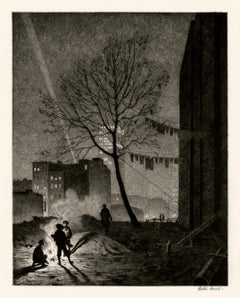
Martin Lewis, 'Tree, Manhattan', drypoint, 1930, edition 91 (including 10 trial proofs), McCarron 87. Signed in pencil. A superb, atmospheric impression, in warm black ink, on cream...
Category

1930s American Realist Martin Lewis Art

Materials

Drypoint

Spring Night Greenwich Village
By Martin Lewis
Located in New York, NY
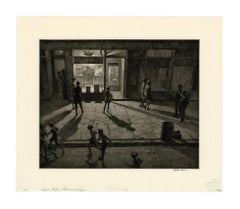
Spring Night, Greenwich Village--1930, Drypoint and Sand Ground.McCarron 85, only state. Edition 92. Signed in pencil. Signed in the plate, lower rig...
Category

1930s Martin Lewis Art

Materials

Drypoint

"Under the Street Lamp" Imp. Etching
By Martin Lewis
Located in Houston, TX
Copperplate etching by Martin Lewis titled "Under the Street Lamp." Edition of 100. Printed on laid paper with watermark and 83 recorded impressions. McCarron catalogue raisonne #70. Signed in pencil with "imp" next to the signature. In the bottom right corner is a penciled 75 and in the top right corner is a 50. The etching is framed and was taken out of the frame for condition report and photographs. The gallery label is on the back of the matte inside the frame. Dimensions without Frame: H 15 in x W 9.5 in. Artist Biography: Martin Lewis (1881-1962) was born in Castlemaine, Victoria, Australia on 7 June 1881. He was the second of eight children and had a passion for drawing. At the age of 15, he left home and traveled in New South Wales, Australia, and in New Zealand, working as a pothole digger and a merchant seaman. He returned to Sydney and settled into a Bohemian community outside Sydney. Two of his drawings were published in the radical Sydney newspaper, The Bulletin. He studied with Julian Ashton at the Art Society's School in Sydney. Ashton, an English-born Australian artist and teacher, known for his support of the Heidelberg School and for his influential art school in Sydney. In 1900, Lewis left Australia for the United States. His first job was in San Francisco, painting stage decorations...
Category

1920s Naturalistic Martin Lewis Art

Materials

Etching, Laid Paper

Street Booth, Tokyo, New Year s Eve
By Martin Lewis
Located in Middletown, NY
A superb impression of Martin Lewis's consummate image of Japan. Etching with drypoint on fine cream laid paper, 13 7/8 x 10 3/8 inches (352 x 265 mm); sheet 17 3/4 x 14 1/4 inches ...
Category

Mid-20th Century American Modern Martin Lewis Art

Materials

Handmade Paper, Laid Paper, Drypoint, Etching
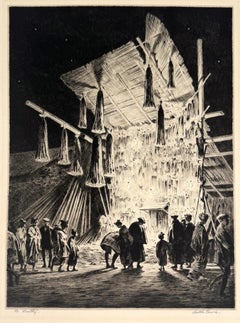
QUARTER OF NINE - SATURDAY S CHILDREN
By Martin Lewis
Located in Portland, ME
Lewis, Martin (American, born Australia, 1881-1962). QUARTER OF NINE, SATURDAY'S CHILDREN. McCarron 79. Drypoint, 1929. McCarron says the intended edition was 100 , but 107 were prin...
Category

1920s Martin Lewis Art

Materials

Drypoint

Martin Lewis Original Etching, 1928 - “Rain on Murray Hill”
By Martin Lewis
Located in Phoenix, AZ
Original drypoint in mint condition printed in greenish black ink on wove paper by well-known New York artist and printmaker Martin Lewis (1881-1962). The print is signed in pencil ...
Category

Early 20th Century Martin Lewis Art

Materials

Paper

Spring Night, Greenwich Village
By Martin Lewis
Located in Plano, TX
Spring Night, Greenwich Village. 1930. Drypoint and sand ground. McCarron 85. 10 x 12 3/8 (sheet 13 1/4 x 15 5/8)). Edition 92. A rich, tonal impress...
Category

1930s American Modern Martin Lewis Art

Materials

Drypoint, Etching

"Which Way?" Martin Lewis, Atmospheric, Snowy 1930s Setting, Outdoor Scene
By Martin Lewis
Located in New York, NY
Martin Lewis Which Way?, 1932 Signed lower right Aquatint etching on pale blue paper Plate 10 1/4 x 15 3/4 inches Sheet 14 1/4 x 19 1/2 inches Edition of approximately 53 Provenance...
Category

1930s Realist Martin Lewis Art

Materials

Paper, Etching

Martin Lewis Signed Limited Ed. Etchng Street Booth, Tokyo New Years Eve, 1927
By Martin Lewis
Located in Studio City, CA
A beautiful and exceedingly engaging limited edition etching/print titled "Street Booth, Tokyo New Years Eve" by famed Australian/American painter/artist/master printmaker Martin Lewis (1881-1962). This image was created in 1927. Lewis was born in Castlemaine, Victoria, Australia in 1881 but migrated to the United States in 1900. After working in San Francisco and New York he then traveled to Japan to study Japanese art for two years. Lewis eventually returned to the US and settled back in New York in the early 1920s where he would experience his most artistically productive breakthrough period (between 1925-1935) in which he would create some of his most well-known works including this piece. Today, Lewis is universally considered to be one of the most important American printmakers of the twentieth century - a master of light and shadow. This work is a drypoint etching, printed in black ink on cream wove paper with full margins. A brilliant, luminous, and richly-inked impression. From a noted (McCarron, Paul. The Prints of Martin Lewis: A Catalogue Raisonne, p. 60) edition of 40 recorded impressions. According to McCarron, this is the most accomplished of Lewis' Japan prints: "New Year''s Day is an important holiday in Japan. The Japanese traditionally decorate their streets and homes with shimenawa, knotted straw ropes blessed and purified by Shinto priests...
Category

1920s American Vintage Martin Lewis Art

Materials

Wood, Paper

Martin Lewis Original Etching, 1927 - “Shadows on the Ramp”
By Martin Lewis
Located in Phoenix, AZ
Original etching with drypoint in mint condition by well-known New York artist and printmaker Martin Lewis (1881-1962). The print is signed in pencil lower right. The title is: “Sha...
Category

Early 20th Century Martin Lewis Art

Materials

Paper

White Monday
By Martin Lewis
Located in Fairlawn, OH
Signed in the plate lower left Note: Printed on September 26, 1980 in an edition of 4 restrikes. Reference: Paul McCarron, The Prints of Martin Lewis: A Catalogue Raisonne (Bro...
Category

1970s Martin Lewis Art

Materials

Drypoint

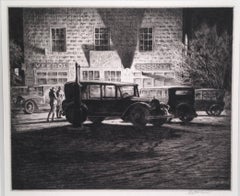
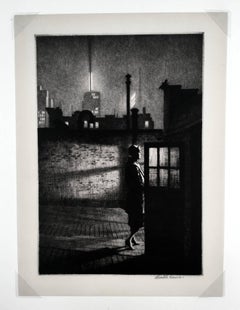
Shadows, Garage at Night
By Martin Lewis
Located in New York, NY
Martin Lewis (1881-1962, Shadows, Garage at Night, drypoint, 1928, signed in pencil lower right [also signed in the plate lower right]. Reference: McCarron 69, only state, from the t...
Category

1930s American Realist Martin Lewis Art

Materials

Drypoint

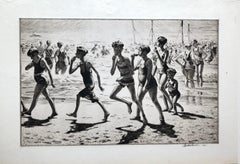
ICE CREAM CONES
By Martin Lewis
Located in Portland, ME
Lewis, Martim (American, born Australia, 1881-1962). ICE CREAM CONES. McCarron 78. Drypoint, 1928. Edition of 75, of which only 70 were printed. Signed in pencil, lower right. 9 3/4 ...
Category

1920s Martin Lewis Art

Materials

Drypoint

Martin Lewis 20th Century Master Printmaker, Etching, 1932 "White Monday"
By Martin Lewis
Located in Phoenix, AZ
Original drypoint etching and aquatint in mint condition by well-known artist and printmaker Martin Lewis, (1881-1962) The print has full margins with deckle edges and is signed in p...
Category

Mid-20th Century Martin Lewis Art

Materials

Paper

Little Penthouse
By Martin Lewis
Located in New York, NY
Martin Lewis (1881-1962), Little Penthouse, drypoint, 1931, signed in pencil lower right [signed in the plate in a rectangle lower left]. Reference: McCarron 91, only state. Printed ...
Category

1930s American Realist Martin Lewis Art

Materials

Drypoint

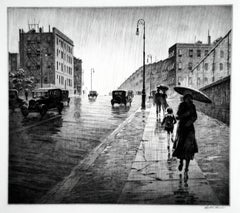
Rainy Day, Queens
By Martin Lewis
Located in New York, NY
Martin Lewis (1881-1962), Rainy Day, Queens, drypoint, 1931, signed in pencil lower right [also signed in the plate lower right]. Reference: McCarron 94, only state, from the edition...
Category

1930s American Realist Martin Lewis Art

Materials

Drypoint

Break in the Thunderstorm
By Martin Lewis
Located in New York, NY
Martin Lewis (1881-1962, Break in the Thunderstorm, drypoint, 1930, signed and titled in pencil (also signed in the plate in a rectangle lower left). Reference: McCarron 86, second s...
Category

1930s Realist Martin Lewis Art

Materials

Drypoint

Tree, Manhattan
By Martin Lewis
Located in New York, NY
Martin Lewis (1881-1962), Tree, Manhattan, drypoint, 1930, signed in pencil lower right [also signed in the plate lower left]. Reference: McCarron 87, only state; 91 recorded impress...
Category

1930s American Realist Martin Lewis Art

Materials

Drypoint

Quarter of Nine, Saturday s Children.
By Martin Lewis
Located in Plano, TX
Quarter of Nine, Saturday's Children. 1929. Drypoint. McCarron 78. 9 3/4 x 12 3/4 (sheet 12 7/8 x 17 7/8). Illustrated: American Etchers: Martin Lewis. Edition 107. A fine impression...
Category

1920s American Modern Martin Lewis Art

Materials

Drypoint, Etching

Related Items
Tugs on the Hudson
By Charles Frederick William Mielatz
Located in Middletown, NY
Drypoint etching with engraving printed in black ink on Japanese mulberry paper, 4 1/2 x 3 3/8 inches (113 x 84 mm), full margins. In superb condition. A beautiful New York City river...
Category

Early 20th Century American Modern Martin Lewis Art

Materials

Handmade Paper, Drypoint, Etching

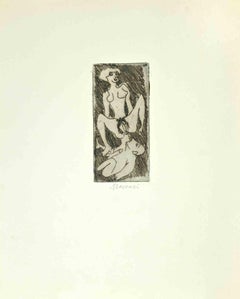
Erotic Scene - Etching by Mino Maccari - Mid-20th Century
By Mino Maccari
Located in Roma, IT
Erotic Scene is an Etching and Drypoint realized by Mino Maccari in the Mid-20th Century. Hand-signed in the lower part. Good conditions. Mino Maccari (Siena, 1924-Rome, June 16, ...
Category

Mid-20th Century Modern Martin Lewis Art

Materials

Paper, Etching, Drypoint

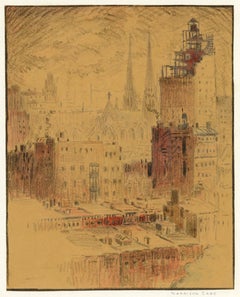
Saint Patrick s Cathedral from Midtown Manhattan
Located in Middletown, NY
Graphite with watercolor and black crayon on cream wove paper mounted to board, 12 1/2 x 10 1/2 inches (318 x 267 mm), full margins. Signed in pencil on the mount. In excellent condi...
Category

Early 20th Century American Modern Martin Lewis Art

Materials

Crayon, Watercolor, Graphite

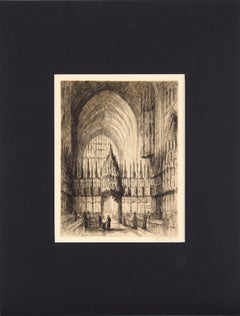
Chester Cathedral - Drypoint Etching in Ink on Paper
Located in Soquel, CA
Chester Cathedral - Drypoint Etching in Ink on Paper Dramatic drypoint etching by J. Alphege Brewer (British, 1881-1946). This composition shows the interior of Chester Cathedral in Brewer's characteristic style - highly detailed and with strong contrast. The scene encompasses the cathedral from floor to ceiling, capturing the immense size of the building. There are several people in the scene which contribute to the sense of scale. Signed by hand "J. Alphege Brewer" in the lower right corner. Titled "Chester Cathedral" in plate, lower left corner. Includes original card with artist's name. Presented in a new black mat with foamcore backing. Mat size: 16"H x 12"W Paper size: 10.75"H x 7.75"W James Alphege Brewer was well known in the early 20th century as a producer of color etchings of European cathedrals and other scenes of church, college, and community. He was born July 24, 1881, in the Kensington section of London, England, the son of Henry W. Brewer, noted artist of historical architecture and prominent convert to the Catholic Church, and the grandson of John Sherren Brewer, Jr., “the brilliant editor of the Calendar of Letters of Henry VIII.” His great uncle was E. Cobham Brewer, the polymath who compiled Brewer’s Dictionary of Phrase and Fable. Among his older siblings were the artist Henry C. Brewer and the organist and writer John Francis Brewer. Brewer attended the Westminster School of Art in London, where his brother Henry also trained. In 1910, he married Florence Emma Lucas, an accomplished painter in oil and watercolor, whose father was the noted landscape artist George Lucas and whose great uncle was David Lucas, the famous engraver for John Constable. Florence's brothers Edwin and George assisted Brewer in the printing of Brewer's etchings. Brewer exhibited at the Royal Academy (RA) and the Royal Institute of Painters in Watercolour (RI), at the Paris Salon of the Académie des Beaux-Arts, and in the shows of the Royal Cambrian Academy (RCA). He became an associate of the Royal Cambrian Academy in 1929 and a full member in the last two years of his life. He was also a member of the Hampstead Society of Artists, the Society of Graphic Art, and the Ealing Arts Club, where he was first Honorary Art Secretary and then Honorary Art Chairman. Most of Brewer's larger etchings were published by Alfred Bell...
Category

Early 20th Century Romantic Martin Lewis Art

Materials

Paper, Ink, Drypoint

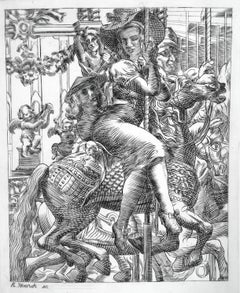
Merry-Go-Round
By Reginald Marsh
Located in New York, NY
Reginald Marsh (1898-1954), Merry-Go-Round, etching and engraving, 1938, signed in pencil lower right and inscribed Forty Proofs lower left, [also signed in the plate lower left and inscribed SC]. Reference: Sasowsky 179, fourth state (of 4). In good condition, with margins (a paper loss upper right corner well outside of the platemark, stains from prior hinging, notations in pencil lower margin edge). 10 x 8, the sheet 11 1/2 x 9 1/8 inches. A very good impression, printed in black on a wove paper with a partial FRANCE watermark. Sasowsky notes that Marsh printed 15 impressions of this state (and only one or two of the prior states), and considered only 10 of the 15 valuable. His notation “Forty Proofs” is therefore surely an expression of a hoped-for edition size, as opposed to an actual edition size. We have found this quite often the case with Marsh prints – he indicates an edition size but the actual number of impressions printed is considerably smaller. There is an eerie, almost ominous note in this, as in several of Marsh’s merry-go-round prints...
Category

1930s American Realist Martin Lewis Art

Materials

Engraving, Etching

Reginald Marsh "Brooklyn Bridge" NYC Modernism WPA Mid-Century Watercolor Modern
By Reginald Marsh
Located in New York, NY
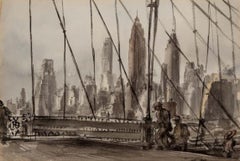
Reginald Marsh "Brooklyn Bridge" NYC Modernism WPA Mid-Century Watercolor Modern Reginald Marsh (American, 1898-1954) Brooklyn Bridge, 1940, Signed and dated Reginald Marsh May 1940 (lr), Watercolor over traces of pencil on paper , 15 x 22 inches sight. Reginald Marsh was born in Paris, France in 1898, the child of artist parents. He was born over a small cafe on Paris' Left Bank. He was brought to the United States in 1900 and was drawing before he was three. He studied art at Yale University and the Art Students League, during which time he worked primarily as an illustrator for New York newspapers and magazines. After studying in Paris in 1925 and 1926, he turned seriously to painting. In 1929 he was introduced to the egg-tempera medium, which he used extensively the rest of his life. Marsh's gusto for painting the bottom crust of society contrasted curiously with his background. His parents, both well-known artists, were steeped in academic traditions. He attended Lawrenceville Academy and Yale; perhaps this elite background made it possible to paint the earthy people he did with a journalist's objectivity. An admirer of Rubens and Delacroix, he disliked modernist art; indeed, his lifelong preoccupation was with people - enjoying themselves at beaches, at amusement parks, or on crowded city streets. Marsh was a second-generation Ash Can School painter and printmaker, best known as an urban regionalist. He spent his days sketching in small notebooks...
Category

1940s American Modern Martin Lewis Art

Materials

Paper, Watercolor

Cherry Street
By Charles Frederick William Mielatz
Located in Middletown, NY
A view of lower Manhattan's Cherry Street as it appeared at the turn of the 20th century. One of only 5 proof impressions. New York: 1904. Drypoint with aquatint on watermarked, cr...
Category

Early 20th Century American Modern Martin Lewis Art

Materials

Handmade Paper, Drypoint, Etching

Street Booth, Tokyo, New Year s Eve
By Martin Lewis
Located in Middletown, NY
A superb impression of Martin Lewis's consummate image of Japan. Etching with drypoint on fine cream laid paper, 13 7/8 x 10 3/8 inches (352 x 265 mm); sheet 17 3/4 x 14 1/4 inches ...
Category

Mid-20th Century American Modern Martin Lewis Art

Materials

Handmade Paper, Laid Paper, Drypoint, Etching

Indian Friendship Dance
By Gene Kloss
Located in Fairlawn, OH
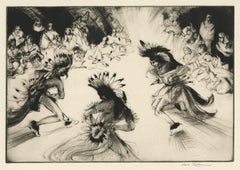
Indian Friendship Dance Drypoint, 1953 Signed in pencil lower right, (see photo) Edition 200 Published by The Society of American Graphic Artists, New York An impression is in the collection of SAAM, Washington and RISD Museum, Condition: Excellent Very rich impression with burr and selective whiping of the ink for atmospheric nocturnal effect. Image/Plate size: 8 3/16 x 11 15/16 inches Sheet size: 11 1/8 x 17 inches Reference: Kloss 450 "'Indian Friendship Dance' is an eloquent statement of something which Gene Kloss has both observed and participated in. It is an Indian dance that is thought of as entertainment, rather than ceremony, but it is essentially an idea expressed in action, and an idea that has universal meaning. The young men who dance wear costumes of exquisite workmanship, intricately wrought with beads and feathers and subtle combinations of colors. The dancers are trained from childhood but develop their own steps and exhibit distinctive strength and grace. Singers and a tom-tom accompany the dance and since it usually takes place at night, a campfire is the source of light. The conclusion occurs when all the onlookers, old and young and from many places, join hands with the dancers in a slow revolving movement, while those who can, sing the difficult but meaningful Indian song that flows with the rhythmical dance step and speaks of fellowship, brotherhood, friendship." - An excerpt from a descriptive statement, written by Lynd Ward, and distributed with the drypoint at the time of publication." Courtesy Old Print Shop Born Alice Glasier in Oakland, CA, Kloss grew up amid the worldly bustle of the San Francisco Bay Area. She attended the University of California at Berkeley, graduating with honors in art in 1924. She discovered her talents in intaglio printmaking during a senior-year course in figurative drawing. The professor, Perham Nahl, held up a print from Kloss’ first plate, still damp from the printing process, and announced that she was destined to become a printmaker. In 1925, Gene married Phillips Kloss, a poet and composer who became her creative partner for life. The match was uncanny, for in her own way Gene, too, was a poet and a composer. Like poetry, her artworks capture a moment in time; like music, her compositions sing with aesthetic harmony. Although she was largely self-taught, Kloss was a printmaking virtuoso. On their honeymoon the Klosses traveled east from California, camping along the way. They spent two week is Taos Canyon – with a portable printing press cemented to a rock near their campsite – where Gene learned to appreciate the wealth of artistic subject matter in New Mexico. The landscape, the cultures, and the immense sky left an indelible impression on the couple, who returned every summer until they made Taos their permanent home 20 years later. Throughout her life, Kloss etched more than 625 copper plates, producing editions ranging from five to 250 prints. She pulled every print in every edition herself, manually cranking the wheel of her geared Sturges press until she finally purchased a motorized one when she was in her 70s. Believing that subject matter dictated technique, she employed etching, drypoint, aquatint, mezzotint, roulette, softground, and a variety of experimental approaches, often combining several techniques on the same plate. She also produced both oil and watercolor paintings. Kloss’ artworks are filled with drama. Her prints employ striking contrasts of darkness and light, and her subjects are often illuminated by mysterious light sources. Though she was a devout realist, there is also a devout abstraction on Kloss’ work that adds an almost mythical quality. For six decades Kloss documented the cultures of the region-from images of daily life to those of rarely seen ceremonies. She and her husband shared a profound respect for the land and people, which made them welcome among the Native American and Hispanic communities. Kloss never owned a camera but relied instead on observation and recollection. Her works provide an inside look at the cultures she depicted yet at the same time communicate the awe and freshness of an outsider’s perspective. Although Kloss is best known for her images of Native American and Penitente scenes, she found artistic inspiration wherever she was. During the early years of their marriage, when she and Phil returned to the Bay Area each winter to care for their aging families, she created images of the California coast. And when the Klosses moved to southwestern Colorado in 1965, she etched the mining towns and mountainous landscapes around her. In 1970 the Klosses returned to Taos and built a house north of town. Though her artwork continued to grow in popularity, she remained faithful to Taos’ Gallery A, where she insisted that owner Mary Sanchez keep the prices of her work reasonable regardless of its market value. Kloss continued to etch until 1985, when declining health made printmaking too difficult. From her first exhibition at San Francisco’s exclusive Gump’s in 1937 to her 1972 election to full membership in the National Academy of Design, Kloss experienced a selective fame. She received numerous awards, and though she is not as well known as members of the Taos Society of Artists...
Category

1950s American Realist Martin Lewis Art

Materials

Drypoint

Indian Friendship Dance
$2,500
H 8.19 in W 11.94 in
Estes Park Colorado American Modernist Watercolor Landscape Painting, WPA 1930s
By James Russell Sherman
Located in Denver, CO
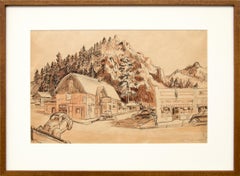
Vintage 1930s watercolor and ink painting of Estes Park, Colorado, by American artist James Russell Sherman (1906-1989). This captivating work features a detailed view of storefronts...
Category

1930s American Modern Martin Lewis Art

Materials

Watercolor

A Stylized, Modern 1930s Art Deco Drawing of Two Young Men Planting a Tree
By Harold Haydon
Located in Chicago, IL
A Stylized, 1930s Art Deco Pastel Landscape Drawing of Two Young Men Planting a Tree by Notable Chicago Modern Artist, Harold Haydon (Am. 1909-1994). Artwork size: 9 x 12 inches, u...
Category

1930s American Modern Martin Lewis Art

Materials

Paper, Charcoal, Pastel

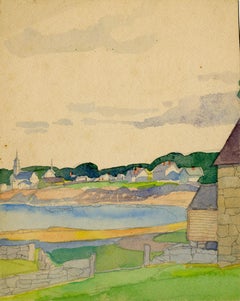
Chapel and houses along a lake, New England Landscape - American School, 19th C
Located in Middletown, NY
Watercolor and pencil on buff wove watercolor paper, 10 x 8 inches (255 x 203 mm). In good condition with overall minor toning. Some watercolor paint splatters on the verso, contem...
Category

Early 1900s American Modern Martin Lewis Art

Materials

Watercolor, Pencil

Previously Available Items
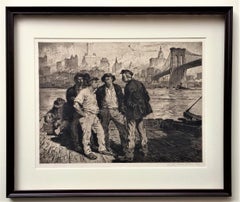
Dock Workers under the Brooklyn Bridge
By Martin Lewis
Located in Plano, TX
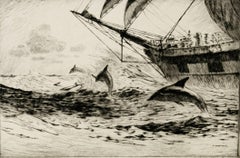
Martin Lewis, N.A. (Dock Workers under the Brooklyn Bridge). c. 1916-18. Aquatint and etching. McCarron 15. 17 3/4 x 23 3/4 (sheet 26 x 31). 5 recorde...
Category

1910s American Modern Martin Lewis Art
Materials

Etching, Aquatint

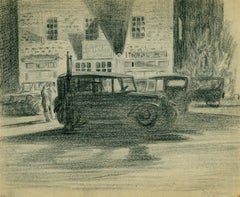
Shadows -- Garage at Night
By Martin Lewis
Located in Plano, TX
Shadows -- Garage at Night. c. 1928. Conte crayon drawing. Study for the drypoint, McCarron 69. 10 1/8 x 12 3/4 (the drypoint measures 9 7/8 x 11 7/8). The drypoint is illustrated in...
Category

1920s American Modern Martin Lewis Art

Materials

Crayon

The Great Shadow
By Martin Lewis
Located in Plano, TX
The Great Shadow. 1925. Drypoint. McCarron 44. 9 7/8 x 7 inches (sheet 13 3/4 x 10 1/4). Edition of 86 recorded impressions (intended edition 100). A superb impression with carefully...
Category

1920s American Modern Martin Lewis Art

Materials

Drypoint, Etching

The Great Shadow
The Great Shadow
H 18.75 in W 14.75 in D 1 in
CHANCE MEETING
By Martin Lewis
Located in Portland, ME
Lewis, Martin. CHANCE MEETING. McCarron 131. Drypoint, 1940-41. Edition of 105. Signed in pencil, lower right. 10 1/2 x 7 1/2 inches, 265 x 188 mm. In excellent condition.
Category

1940s Martin Lewis Art

Materials

Drypoint

Oncoming Rain
By Martin Lewis
Located in New York, NY
Martin Lewis created the copper plate for "Oncoming Rain" in 1929 using drypoint and sand ground techniques. The intended edition size was 50 impressions but only 19 have been record...
Category

Mid-20th Century American Realist Martin Lewis Art

Materials

Drypoint

Oncoming Rain
Oncoming Rain
H 11.38 in W 13.38 in D 0.94 in
Down to the Sea.
By Martin Lewis
Located in New York, NY
Martin Lewis created the copper plate for "Down to the Sea" in 1929, using drypoint and sand ground techniques. The edition size is listed as 75 impressions but only 65 have been re...
Category

Mid-20th Century American Realist Martin Lewis Art

Materials

Drypoint

Down to the Sea.
Down to the Sea.
H 19.5 in W 24 in D 1 in
Strength and Beauty.
By Martin Lewis
Located in New York, NY
This drypoint with sand ground by Martin Lewis was created in 1937. It is signed, lower right, in pencil. The printed image size is 10 7/8 x 13" (27.5 x 33 cm). Edition unknown wi...
Category

1930s American Realist Martin Lewis Art

Materials

Drypoint

Politics
By Martin Lewis
Located in Plano, TX
Politics. 1936. Drypoint and sand ground. McCarron catalog 118 state ii. 9 3/4 x 10 5/8 (sheet 13 7/8 x 15). Trial proof 10, edition 27 (including 11 trial proofs). McCarron cites this impression to describe the second state. A rich, tonal impression printed on 'FJ Head & Co' cream wove paper with full margins. Provenance: estate of Delores D. Di Paola. Signed and annotated 'trial proof 10' in pencil. Housed in a subtle 17 3/4 x 18 1/2-inch silver-gold modern frame that enhances the tonality of the evening sky. The scene is Kent Hollow, a valley in the Appalachian Mountains in the town of Kent in Litchfield County, Connecticut. It is situated in the upper reaches of the West Aspetuck River, one of the cleanest rivers in Southern New England. Martin Lewis (1881–1962) was born in Castlemaine, Victoria, Australia on 7 June 1881. He was the second of eight children and had a passion for drawing. At the age of 15, he left home and traveled in New South Wales, Australia, and in New Zealand, working as a pothole digger and a merchant seaman. He returned to Sydney and settled into a Bohemian community outside Sydney. Two of his drawings were published in the radical Sydney newspaper, The Bulletin. He studied with Julian Ashton at the Art Society's School in Sydney. Ashton, a famous painter, was also one of the first Australian artists to take up printmaking. In 1900, Lewis left Australia for the United States. His first job was in San Francisco, painting stage decorations...
Category

1930s American Modern Martin Lewis Art

Materials

Drypoint

Politics
Politics
H 17.75 in W 18.5 in D 0.5 in
Trade Winds
By Martin Lewis
Located in Plano, TX
McCarron catalog number 25. Image: 7 7/8 x 11 3/4. Sheet 12 x 15 1/4. Edition of 22 recorded impressions (intended edition 50). A rich impression with drypoint burr printed on cr...
Category

1910s American Modern Martin Lewis Art

Trade Winds
Trade Winds
H 7.88 in W 11.75 in D 0.5 in
Arc Welders at Night.
By Martin Lewis
Located in New York, NY
Printed on light blue paper. This original print by Martin Lewis was made using drypoint and a sand ground on a copper plate in 1937. The exact edition is unknown - 33 impressions ...
Category

1930s American Realist Martin Lewis Art

Materials

Drypoint

Sunday Garden Inspection.
By Martin Lewis
Located in Plano, TX
Sunday Garden Inspection. 1927. Drypoint. McCarron catalog 67 state ii. 11 3/4 x 8 (sheet 16 x 11 5/8). Edition of 34 recorded impressions (intended edition 50). A rich, well-inked...
Category

20th Century American Modern Martin Lewis Art

Materials

Drypoint, Etching

Little Penthouse.
By Martin Lewis
Located in New York, NY
Drypoint, 1931. Signed in pencil. Edition 75, recorded impressions 84. Image size 9 7/8 x 6 13/16" (25.2 x 17.3 cm). McCarron #91. Very good condition. Framed. This print was...
Category

1930s American Realist Martin Lewis Art

Materials

Drypoint

Little Penthouse.
Little Penthouse.
H 18.38 in W 16 in D 1.5 in

Martin Lewis art for sale on 1stDibs.

Find a wide variety of authentic Martin Lewis available for sale on 1stDibs. You can also browse by medium to find art by Martin Lewis in drypoint, engraving, etching and more. Much of the original work by this artist or collective was created during the 20th century and is mostly associated with the modern style. Not every interior allows for large Martin Lewis, so small editions measuring 7 inches across are available. Customers who are interested in this artist might also find the work of Thomas Hart Benton, David Klein, and Adolf Dehn. Martin Lewis prices can differ depending upon medium, time period and other attributes. On 1stDibs, the price for these items starts at $700 and tops out at $80,000, while the average work can sell for $24,500.

Artists Similar to Martin Lewis