Marty Marcus Sculptures
to
2
Overall Height
to
2
2
1
1
1
1
2
2
214
213
150
131
2
Artist: Marty Marcus
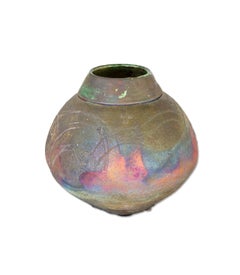
"Raku Vase with Fireworks, " colorful unique vase design lovers
By Marty Marcus
Located in Milwaukee, WI
"Raku Vase with Fireworks" is an original ceramic vase by Marty Marcus. The artist signed the piece on the bottom. It features brightly colored abstract patterns on an earth-toned background. The vessel is a unique piece of décor priced well under $900. Part of the Design Lovers Sale...
Category
1980s Post-Modern Marty Marcus Sculptures
Materials
Ceramic
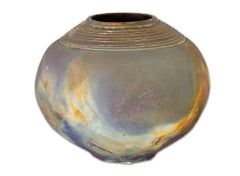
"Raku Vase with Concentric Rings, " Ceramic signed by Marty Marcus
By Marty Marcus
Located in Milwaukee, WI
"Raku Vase with Concentric Rings" is a ceramic piece signed on the bottom by the artist Marty Marcus. The vase has a variety of gorgeous color variations.
7 1/4" height; 8 1/2" dia...
Category
1980s Marty Marcus Sculptures
Materials
Ceramic
Related Items
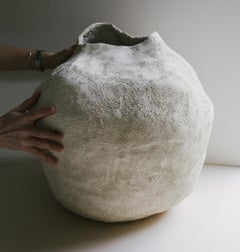
"Large Vessel" - abstract sculpture - Barbara Hepworth
By Susan Hable
Located in Atlanta, GA
Susan Hable is inspired by the work of David Hockney, Milton Avery, Henri Matisse, Alex Katz, Howard Hodgkins, Hilma af Klint, Georgia O'Keeffe, Barbara Hepworth and Constantin Brâncuși.
With humor and a bit of mischief, Susan Hable’s “Don't Pick The Flowers!” is a body of work that is at once a refuge and a playground. Inspired by her sumptuous garden just outside of her Athens studio, Susan flows from one medium to the next from painting to collage to sculpture. Susan sees her garden as a place for adventure and daydreaming, challenging her perceptions of what her Art can be. Even a weedy ground cover has caught Susan’s eye, an overlooked invasive is seen in a new light becoming a dreamlike fairytale path. Her work asks us to engage in life, go for a walk and play.
Susan Hable Smith is the artist and designer behind the boldly colored and hand drawn patterns of Hable Construction...
Category
2010s Abstract Marty Marcus Sculptures
Materials
Stoneware

$4,200
H 20 in W 23 in D 23 in
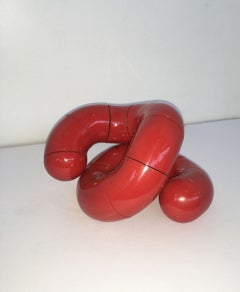
1980 Italy Post-Modern Abstract Kinetic Sculpture Les Simonnet Polimorphes
Located in Brescia, IT
This engaging and kinetic artwork was created by the French artist Jean Marie and Marthe Simonnet Title "Polimorphes" translated in "Polymorphic".
This artwork is Kinetic and can c...
Category
Late 20th Century Post-Modern Marty Marcus Sculptures
Materials
Plastic
$1,285
H 1.97 in W 13.78 in D 1.97 in
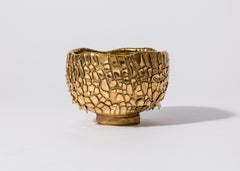
Shino Bowl
Located in Hong Kong, HK
Takuro Kuwata 桑田卓郎
Shino Bowl with golden and kairagi glaze
Takuro Kuwata's Shino bowls are a modern, avant-garde reinterpretation of traditional Japane...
Category
2010s Marty Marcus Sculptures
Materials
Gold
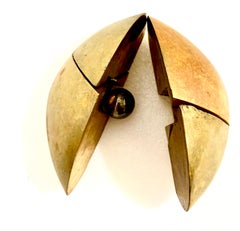
Spanish Catalan Xavier Corbero Bronze Steel Architectural Abstract Sculpture
By Xavier Corberó i Olivella
Located in Surfside, FL
Xavier Corberó Olivella (1935 – 2017)
Estructuras Continual
Bronze sculpture. Comprised of four elements, independant, 1 spheric.
5 X 8 X 7 inches approximately. The pieces are kinetic and moveable so dimensions are a bit variable.
This is accompanied by a hand signed and dated photo certificate of the piece. A silver gelatin photograph. The photo is badly torn.
Xavier Corberó i Olivella (1935 – 2017) was a prominent Catalan artist, best known for monumental public sculpture and his palatial house complex in Esplugues de Llobregat near Barcelona. He has been described as "widely considered the most important Catalan artist since Antonio Gaudí," as "one of Spain’s most celebrated sculptors" and as having "perhaps influenced Barcelona more than any artist since Gaudí." Corberó's grandfather Pere Corberó i Casals (1875-1959) was an entrepreneur and artist whose works included the bronze memorial on the birthplace of Enrique Granados, also in Lleida. He was a cofounder of Barcelona's association for the promotion of decorative arts, a precursor to the Design Museum, now known as the Foment de les Arts i el Disseny. The Corberó foundry produced sculptures by prominent Catalan sculptors of the time such as Pablo Gargallo, Josep Viladomat and Frederic Marès. It was also an industrial and commercial business that sold bronze doors, chandeliers, fountains, and other decorative items, with a showroom in downtown Barcelona at Rambla de Catalunya 105, in a building designed by Arnau Calvet i Peyronill, and a workshop nearby at Carrer Aribau 103.
Pere's son and Corberó's father, Xavier Corberó i Trepat (1901-1981), also worked in the family bronze...
Category
1960s Post-Modern Marty Marcus Sculptures
Materials
Bronze, Steel
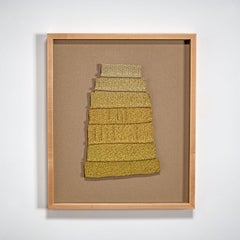
Gold Laugh, Post-Modern Metallic Woven Abstract Textile Sculpture/Embroidery
By Micheline Beauchemin
Located in Wilton, CT
Gold Laugh (1980-85) metallic and acrylic thread, cotton. Gold, Metallic Woven Abstract Textile Sculpture.
Textile artist, Micheline Beauchemin (1929-2009) was born in Longqueuil, Quebec, Canada. She has created a repertory of various works which includes theatre curtains, tapestries, wall hangings, embroidery murals, flexible walls, stained glass works, scale models, collages, toys, costumes and illustrations. Micheline Beauchemin began her career making stained-glass windows but early on turned to weaving and embroidering spectacular wall hangings in vibrant colors, including blues and greens. travelled and studied in Japan, China, India, North Africa, the Canadian Arctic and the Andes, adding depth and mystery to the love of light, water, wings and nets that is evident in her body of work.
Beauchemin’s works are included in the collections of the National Gallery of Canada, Ottawa; the Montreal Museum of Fine Arts; the Musée du Québec; Pearson Airport, Toronto; the Canada Council, Ottawa; the Canadian Museum of Civilization, Gatineau; the Bibliothèque Centrale, Quebec; the Taxation Data Centre, Shawinigan; the Revenue Building, Québec; North York...
Category
1980s Post-Modern Marty Marcus Sculptures
Materials
Metal
$3,800
H 25.25 in W 21.25 in D 2.25 in
Pichet Têtes, Pablo Picasso, 1950
s, Sculpture, Ceramic, Pitcher, Design
By Pablo Picasso
Located in Geneva, CH
Pichet Têtes, Pablo Picasso, 1950's, Sculpture, Ceramic, Pitcher, Design
Pichet têtes
Ed. 500 pcs
1956
White earthenware clay, oxidized paraffin decorati...
Category
1950s Post-Modern Marty Marcus Sculptures
Materials
Ceramic, Clay

$20,643
H 5.52 in W 3.55 in
Totem
Located in Washington, DC
Sculpture by Brazilian-born artist Elizabeth Freire. Sculpture is mounted on marble base and signed "EF". B&W photo is of Ms. Freire with renowned sculptor Etienne Martin at the Ecole Nationals des Beaux-Arts in Paris.
Elizabeth Freire is a Brazilian-born, contemporary American artist. At the age of eighteen, she left Rio de Janeiro and moved to Paris to study sculpture at l’Ecole Nationale Superieure des Beaux-Arts, receiving her Diploma there in 1979 under the direction of Claude Viseux, Etienne Martin, and Cesar. During that time she worked as an apprentice at the Fonderie de France where she learned bronze technique and she also attended etching courses at l’Ecole de Montparnasse.
In 1976, she won a commission to make three life-size figures representing the printing company, “Les Imprimeries de Boulogne,” at the International Printing Fair in Paris. She spent 1977 in Aix-en-Provence where she carved the local stone of Rogne.
Returning to Paris, the painter Lutka Pink introduced her to Otero, Frans Krajcberg and Hajdu from whom she received valuable lessons. In 1978, she traveled to Brazil where she was invited to participate in the exhibit ‘A Century of Sculpture in Brazil’. She also met with the sculptor Sergio Camargo...
Category
Early 2000s Modern Marty Marcus Sculptures
Materials
Terracotta
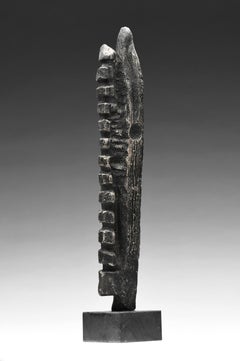
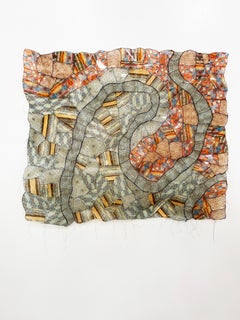
Above it All - Abstract Wire Wall Sculpture
By Gwen Samuels
Located in Boston, MA
Above it All
48.0 x 40.0 x 1.0, 2.0 lbs
Mixed Media
Hand signed by artist
Artist's Commentary:
"The inspiration for, Above it All is what you see when you look out the window of ...
Category
21st Century and Contemporary Post-Modern Marty Marcus Sculptures
Materials
Mixed Media
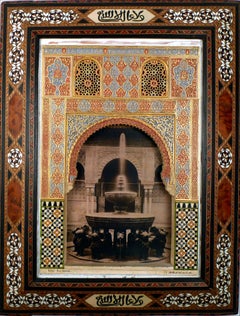
"Alhambra Facade Model", Early 20th Century Polychromed Stucco Plaque by R. Rus
By Rafael Rus Acosta
Located in Madrid, ES
RAFAEL RUS ACOSTA
Spanish, Early 20th Century
ALHAMBRA FACADE MODEL PLAQUE
signed "Rafael Rus Acosta" (lower left), and inscribed "Granada" (lower righ...
Category
1920s Marty Marcus Sculptures
Materials
Ceramic, Gesso
$4,164
H 14.38 in W 9.85 in D 1.19 in
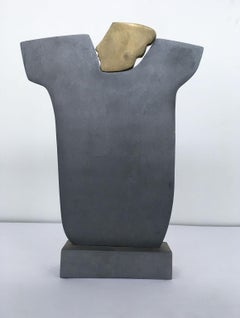
1980 Italy Abstract Bronze Sculpture by Ottorino Tonelli Giulietta Juliet
Located in Brescia, IT
This artwork was created by the Italian artist Ottorino Tonelli.
Ottorino Tonelli was born in 1948 in Carrara, where he lives and works. After having completed his studies at the Flo...
Category
Late 20th Century Post-Modern Marty Marcus Sculptures
Materials
Bronze
$1,177
H 4.34 in W 2.76 in D 0.99 in
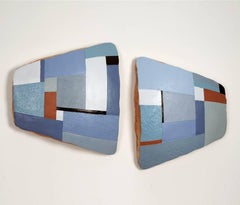
Shift #7
By Gregor Turk
Located in Atlanta, GA
"Shift #7" is a geographical ceramic piece featuring a range of bright to pale blue and terracotta hues.
As a self-proclaimed topophiliac, Gregor Turk is known for ceramic sculptur...
Category
2010s Contemporary Marty Marcus Sculptures
Materials
Ceramic
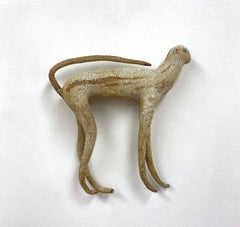
Contemporary Ceramic Animal Sculpture White Snake Cat Wall hung Robin Whiteman
By Robin Whiteman
Located in Buffalo, NY
A whimsical contemporary wall sculpture by American female artist Robin Whiteman.
This work is currently in an exhibition at Raft of Sanity gallery in Buffalo.
Category
2010s Contemporary Marty Marcus Sculptures
Materials
Ceramic, Clay, Glaze
$624 Sale Price
20% Off
H 8 in W 8 in D 4 in
Previously Available Items
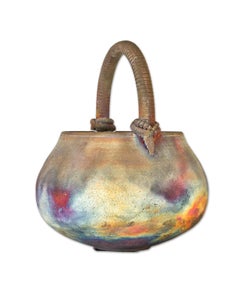
"Raku Basket with Handle, " Multi-colored Ceramic signed by Marty Marcus
By Marty Marcus
Located in Milwaukee, WI
"Raku Basket with Handle" is an original ceramic vessel by Marty Marcus. The artist signed and dated the piece on the bottom. It features bright neon areas over a earth-colored groun...
Category
1980s Post-Modern Marty Marcus Sculptures
Materials
Ceramic
Marty Marcus sculptures for sale on 1stDibs.
Find a wide variety of authentic Marty Marcus sculptures available for sale on 1stDibs. You can also browse by medium to find art by Marty Marcus in ceramic and more. Customers who are interested in this artist might also find the work of Bruno Chersicla, and Patrizia Guerresi Maïmouna. Marty Marcus sculptures prices can differ depending upon medium, time period and other attributes. On 1stDibs, the price for these items starts at $550 and tops out at $1,100, while the average work can sell for $825.