Maude Leach Drawings and Watercolor Paintings

American, 1870-1927

Maude Leach lived in Denver, Colorado and was mostly known for her representational oil paintings. Leach's paintings were primarily of Colorado landscapes and California seascapes. Some of her favorite subjects include Pike's Peak in the Rocky Mountains, the Garden of the Gods near Colorado Springs and Point Loma in California. Maude Leach studied at the Silver Lake Art School in Perry, New York, and graduated in 1891. Leach also studied with Rose Clark in Buffalo, New York. Her teacher was a painter who also worked collaboratively with Elizabeth Wade in the new medium of photography.

(Biography provided by Reeves Antiques)
to
1
Overall Width
to
Overall Height
to
1
1
1
1
1
1
1
1
971
401
330
279
1
Artist: Maude Leach
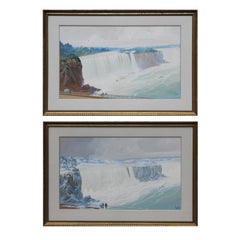
Niagra Falls Spring and Winter Watercolor Landscapes
By Maude Leach
Located in Houston, TX
Original watercolor landscape painting of Niagra falls in the winter and in the spring. The pair of paintings are signed by the artist in the bottom corne...
Category

20th Century Naturalistic Maude Leach Drawings and Watercolor Paintings

Materials

Watercolor

Related Items
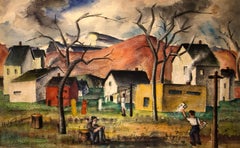
WPA 1940s Framed Figurative Village Landscape with Figures, Houses Mountains
By Charles Ragland Bunnell
Located in Denver, CO
This evocative watercolor on paper painting, titled The Way War First Comes (1940), was created by noted American artist Charles Ragland Bunnell (1897-1968) during the Depression era...
Category

1940s American Modern Maude Leach Drawings and Watercolor Paintings

Materials

Watercolor

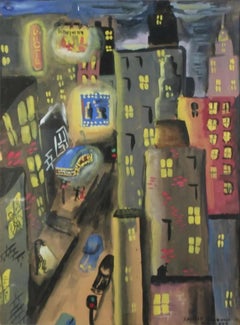
"Times Square" Mid 20th Century 1937 Modernism Broadway Drawing NYC Cityscape
Located in New York, NY
"Times Square" Mid 20th Century 1937 Modernism Broadway Drawing NYC Cityscape Philip Goodwin (20th Century) "Times Square," 23 ½ x 17 ¼ inches. Gouache...
Category

1930s American Modern Maude Leach Drawings and Watercolor Paintings

Materials

Paper, Gouache

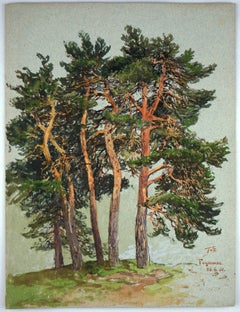
Norwegian Pine Grove - The inner glow of the trees -
Located in Berlin, DE
Themistokles von Eckenbrecher (1842 Athens - 1921 Goslar), Norwegian pine grove, 1901. Watercolor on blue-green paper, 30 x 22 cm. Signed, dated and inscribed in his own hand "TvE. Fagermes [i.e. Fagermes]. 26.6.[19]01." - Slight crease throughout at left margin, otherwise in good condition. About the artwork Themistokles von Eckenbrecher often traveled to Norway to study the nature that fascinated him there. On June 26, 1901, near the southern Norwegian town of Fagernes, in the summer evening sun, he saw a small pine grove, which he immediately captured in a watercolor. He exposed the trees growing on a small hill in front of the background, so that the pines completely define the picture and combine to form a tense motif. The tension comes from the contrast of form and color. The trunks, growing upward, form a vertical structure that is horizontally penetrated by the spreading branches and the pine needles, which are rendered as a plane. This structural tension is further intensified by the color contrast between the brown-reddish iridescent trunks and branches and the green-toned needlework. Themistokles von Eckenbrecher, however, does not use the observed natural scene as an inspiring model for a dance of color and form that detaches itself from the motif and thus treads the path of abstracting modernism. Its inner vitality is to be brought to light and made aesthetically accessible through the work of art. It is precisely in order to depict the inner vitality of nature that von Eckenbrecher chooses the technique of watercolor, in which the individual details, such as the needles, are not meticulously worked out, but rather a flowing movement is created that unites the contrasts. The trees seem to have formed the twisted trunks out of their own inner strength as they grew, creatingthose tense lineations that the artist has put into the picture. The inner strength continues in the branches and twigs, culminating in the upward growth of the needles. At the same time, the trunks, illuminated by the setting sun, seem to glow from within, adding an almost dramatic dimension to the growing movement. Through the artwork, nature itself is revealed as art. In order to make nature visible as art in the work, von Eckenbrecher exposes the group of trees so that they are bounded from the outside by an all-encompassing contour line and merge into an areal unity that enters into a figure-ground relationship with the blue-greenish watercolor paper. The figure-ground relationship emphasizes the ornamental quality of the natural work of art, which further enforces the artwork character of the group of trees. With the presentation of Themistokles von Eckenbrecher's artistic idea and its realization, it has become clear that the present watercolor is not a study of nature in the sense of a visual note by the artist, which might then be integrated into a larger work context, but a completely independent work of art. This is why von Eckenbrecher signed the watercolor. In addition, it is marked with a place and a date, which confirms that this work of nature presented itself to him in exactly this way at this place at this time. At the same time, the date and place make it clear that the natural work of art has been transferred into the sphere of art and thus removed from the time of the place of nature. About the artist Themistocles' parents instilled a life of travel in their son, who is said to have spoken eleven languages. His father, who was interested in ancient and oriental culture, was a doctor and had married Francesca Magdalena Danelon, an Italian, daughter of the British consul in Trieste. During a stay in Athens - Gustav von Eckenbrecher was a friend of Heinrich von Schliemann and is said to have given him crucial clues as to the location of Troy - Themistokles saw the light of day in 1842. After an interlude in Berlin, where Themistokles was educated at the English-American School, the journey began again. From 1850 to 1857 the family lived in Constantinople, after which the father opened a practice in Potsdam, where Themistokles, who wanted to become a painter, was taught by the court painter Carl Gustav Wegener. In 1861 the von Eckenbrechers left Potsdam and settled in Düsseldorf. There Themistokles received two years of private tuition from Oswald Aschenbach, who greatly admired the talented young artist. After his artistic training, he undertook extensive travels, often accompanied by Prince Peter zu Sayn-Wittgenstein, which took him to northern and eastern Europe, but above all to the Middle East and even to South America. The paintings that resulted from these journeys established his artistic reputation and led to his participation in large panoramas such as the 118 x 15 metre Entry of the Mecca Caravan into Cairo, painted for the City of Hamburg in 1882. 1882 was also the start of a total of 21 study trips to Scandinavia, most of them to Norway, and the unique Norwegian landscape with its rugged fjords became a central motif in his work. Along with Anders Askevold and Adelsteen Normann...
Category

Early 1900s Naturalistic Maude Leach Drawings and Watercolor Paintings

Materials

Watercolor

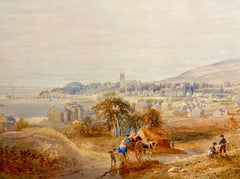
View of Dunoon on the Clyde, Scottish landscape and Figures, 19th Century
Located in Hillsborough, NC
Scottish artist Robert Carrick (1829-1904) is renowned for his landscape and figurative paintings in oil and watercolor. This painting features detailed drawings of figures in the foreground with wagon, and the town and scenery in the background, painted over in watercolor in rich raw umber and red-brown tones in the foreground and blue green tones in the background. Carrick showed promise at a young age, exhibiting his work at the Royal Academy age 16. He was a member of the Royal Institute. This two-toned watercolor work has detailed figures, wagon with hay in the forefront above a view of Dunoon town near Glasgow as it was long ago. Signed by the artist, lower left with an inscription that reads: 'View of Dunoon, Argyllshire drawn by Robert Carrick, Glasgow, for David Allan'. Verso includes a copy of the same inscription. Saltire Gallerie replaced the cracked and dirty plain glass with art glass and added an acid-free paper behind the work. While doing this work we found an art giclee, included with the painting. Presented in a patterned wooden frame with art glass. Dunoon was a thriving town on the river at the time of this work, and later became part of Glasgow. The view from above the town is a popular one, as Saltire Gallerie has another view of Dunoon from above by Scottish artist Patrick Downie...
Category

19th Century Naturalistic Maude Leach Drawings and Watercolor Paintings

Materials

Watercolor, Board, Pencil

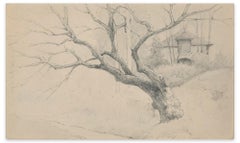
Tree and House - Charcoal by E.-L. Minet - Early 1900
By Emile-Louis Minet
Located in Roma, IT
Tree and House is a precious pencil study realized by the French painter Emile-Louis Minet. The state of preservation is excellent. The piece of paper comes from a sketchbook, and it...
Category

Early 1900s Naturalistic Maude Leach Drawings and Watercolor Paintings

Materials

Charcoal, Pencil

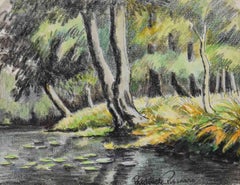
L Ile des Oiseaux by Paulémile Pissarro - Landscape watercolour
By Paul Emile Pissarro
Located in London, GB
L'Ile des Oiseaux by Paulémile Pissarro (1884-1972) Watercolour and charcoal on paper 23 x 31 cm (9 x 12 ¹/₄ inches) Signed lower right, Paulémile Pissarro Provenance Private collec...
Category

20th Century Post-Impressionist Maude Leach Drawings and Watercolor Paintings

Materials

Paper, Ink, Watercolor

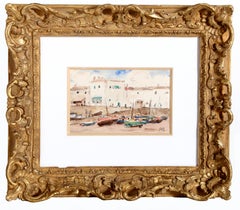
Boats on the Shore, Impressionist Watercolor Painting by Georges d Espagnat
By Georges d Espagnat
Located in Long Island City, NY
Artist: Georges d’Espagnat, French (1870 - 1950) Title: Boats on the Shore Year: circa 1910 Medium: Watercolor on Paper, signed Size: 4.5 x 7 in. (11.43 x 17.78 cm) Frame Size: 13.5 ...
Category

Early 20th Century Impressionist Maude Leach Drawings and Watercolor Paintings

Materials

Paper, Watercolor

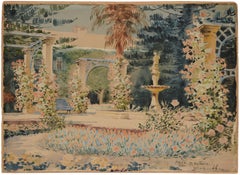
"San Anton Palace Malta" Early 20th Cent. Garden and Fountain Watercolor Russian
Located in Soquel, CA
A significant early 20th century landscape watercolor of the paradisical gardens at San Anton Palace in Attard, Malta by Nicholas Krasnoff, 1920 (Russian, 1864-1939). This beautiful piece is a wonderful example of the renowned Russian architect's prized watercolors, created while he was exiled to Malta in the early 1920's. Depicting a lush garden full of blooming, colorful flowers and a stately fountain at the San Anton Palace in Malta, one can see the deft hand and attention to detail rendered by the proficient artist and architect's hand. Signed "N. Krasnoff" lower right. Titled and dated "Malta, St. Antonio 1920". Unframed. Measures 10.25"H x 14.25"W. Right corner has a crease from being bent. Nikolay Petrovich Krasnov, also known as Nicholas Krasnoff or Peter Nicholas Krasnoff, was a Russian Serbian architect and painter. He served as Chief Architect of Yalta, Crimea (1887-1899). From 1922 he lived and worked in the Kingdom of Yugoslavia, and was a key figure in the architectural development of Belgrade. Attending the Moscow School of Painting, Sculpture and Architecture in 1876, aged 12. As a young artist he received patronage from Sergey Tretyakov, brother of the founder of Moscow's Tretyakov Gallery, and entrepreneur Petar Gubonyin. In 1887 Krasnov became Chief Architect in Yalta. At the age of 23, Krasnov had large responsibility for the rapid growth of the city. He expanded the promenade, which by 1913 became the city's main street, before creating a new city plan in 1889 (including a new sewer system, planning regulations, new streets, prevention of unregulated construction, a school and children's hospital, and the construction of the Pushkin Boulevard). Two concrete bridges were built over the river, and the embankment strengthened. Krasnov also ran a private practice in Yalta until 1911. Among his most famous work is the Livadia Palace, later the location of the 1945 Yalta Conference. Designed over 60 buildings in Crimea, blending a modernist style with local traditions. Also of note: Dulber Palace, Koreiz (1895-97), Alexander Nevsky Cathedral, Yalta (1902), Yusupov Palace, Koreiz (1909), Kokkoz Jami Mosque, Sokolyne (1910). In 1913, he presented a collection of illustrations he had produced of his works to the Saint Petersburg Academy of Arts, where he held the title of academician. An opponent of the Russian Revolution, he left Yalta with his family in 1919 for Malta, alongside the Dowager Empress Marie Feodorovna, sister of Queen Alexandra, and over 600 members of the Russian aristocracy. Nikolay was in a group housed in the empty Villa St Ignatius, which had been a Jesuit college and then a hospital during World War I. To earn money, Nikolay painted many scenes of Malta, signing his paintings as N. Krasnoff. He is known as Nicholas Krasnoff in Malta. In May 2016 MaltaPost issued a commemorative set of stamps in his honor. In 1922 Krasnov moved to Belgrade, then part of the Kingdom of Yugoslavia, where he became head of the Department of Monumental Architectural Developments and Monuments. His building designs in Serbia number around 60, and were created under the name Nikola Krasnov, as a mark of respect to his adopted homeland. His key works in Belgrade include: Ministry of Forestry building (now Ministry of Foreign Affairs) (1923) which bears a memorial plaque...
Category

1920s Impressionist Maude Leach Drawings and Watercolor Paintings

Materials

Paper, Watercolor, Illustration Board

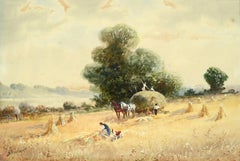
Wheat Field Harvest, Early 20th Century Figurative Landscape
Located in Soquel, CA
Early 20th century Italian figurative landscape of a traditional wheat field harvest scene, by S. Frosini (Italian, 20th Century). This figurative landscape in gouache depicts in gre...
Category

Early 20th Century Impressionist Maude Leach Drawings and Watercolor Paintings

Materials

Gouache, Illustration Board

Wheat Field Harvest, Early 20th Century Figurative Landscape
$600 Sale Price
20% Off
H 13.25 in W 19.75 in D 0.13 in
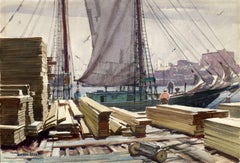
The Lumber Wharf
By Gordon Grant
Located in New York, NY
Gordon Hope Grant (1875-1962) created the watercolor entitled “The Lumber Wharf” in circa 1947. It is signed in the lower left 1 inch above the paper edge. The watercolor paper size ...
Category

1940s Naturalistic Maude Leach Drawings and Watercolor Paintings

Materials

Watercolor

The Lumber Wharf
The Lumber Wharf
$4,700
H 24 in W 28 in D 0.13 in
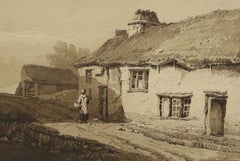
Cottages in Devon
By Samuel Prout
Located in Middletown, NY
An early Devonshire landscape, ex-collection West Collection of British Watercolors & the Fine Art Society, London. Circa 1800 Ink and brown wash on paper, 7 1/8 x 10 1/4 inches (...
Category

Early 1800s Realist Maude Leach Drawings and Watercolor Paintings

Materials

Ink, Watercolor, Graphite

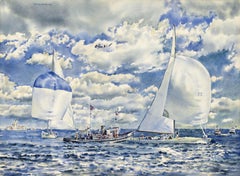
America s Cup - 1967. Wing Mark, Intrepid and Dame Pattie.
By Joseph Webster Golinkin
Located in New York, NY
AMERICA'S CUP - 1967. WING MARK. INTREPID - DAME PATTIE [AUS]. This Joseph Webster Golinkin watercolor of the 1967 America's Cup depicts the...
Category

1960s Naturalistic Maude Leach Drawings and Watercolor Paintings

Materials

Watercolor

Maude Leach drawings and watercolor paintings for sale on 1stDibs.

Find a wide variety of authentic Maude Leach drawings and watercolor paintings available for sale on 1stDibs. You can also browse by medium to find art by Maude Leach in paint, watercolor and more. Not every interior allows for large Maude Leach drawings and watercolor paintings, so small editions measuring 32 inches across are available. Customers who are interested in this artist might also find the work of Bruno Surdo, Adrienne Sherman, and Emile Lejeune. Maude Leach drawings and watercolor paintings prices can differ depending upon medium, time period and other attributes. On 1stDibs, the price for these items starts at $1,800 and tops out at $1,800, while the average work can sell for $1,800.

Recently Viewed

View All