Maude Leach Landscape Drawings and Watercolors

American, 1870-1927

Maude Leach lived in Denver, Colorado and was mostly known for her representational oil paintings. Leach's paintings were primarily of Colorado landscapes and California seascapes. Some of her favorite subjects include Pike's Peak in the Rocky Mountains, the Garden of the Gods near Colorado Springs and Point Loma in California. Maude Leach studied at the Silver Lake Art School in Perry, New York, and graduated in 1891. Leach also studied with Rose Clark in Buffalo, New York. Her teacher was a painter who also worked collaboratively with Elizabeth Wade in the new medium of photography.

(Biography provided by Reeves Antiques)
to
1
Overall Width
to
Overall Height
to
1
1
1
1
1
1
1
1
331
140
123
66
1
Artist: Maude Leach
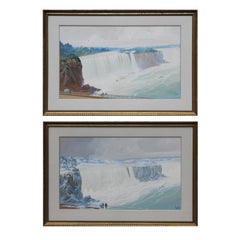
Niagra Falls Spring and Winter Watercolor Landscapes
By Maude Leach
Located in Houston, TX
Original watercolor landscape painting of Niagra falls in the winter and in the spring. The pair of paintings are signed by the artist in the bottom corne...
Category

20th Century Naturalistic Maude Leach Landscape Drawings and Watercolors

Materials

Watercolor

Related Items
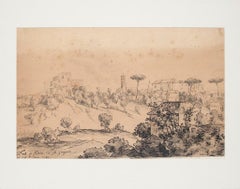
St. Gregory in Rome - Ink and Watercolor by J. P. Verdussen - 1741
By Jan Peeter Verdussen
Located in Roma, IT
St. Gregory in Rome is a beautiful artwork realized by Jan Peter Verdussen in 1741. Ink and watercolour on brown paper. In very good codition. Dated on the lower margin. The origin...
Category

1740s Modern Maude Leach Landscape Drawings and Watercolors

Materials

Ink, Watercolor

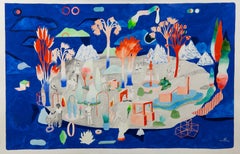
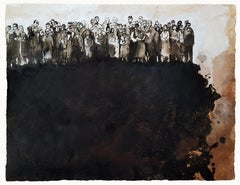
Demonstration #1 Hélène Duclos, 21st Century, Contemporary figurative art blue
By Hélène Duclos
Located in Paris, FR
Gouache, coloured pencil and graphite on paper Signed lower right Unique work 1 / Hélène DUCLOS, 2016 – Artist Statement “Questioning the human condition and the position of being ...
Category

21st Century and Contemporary Contemporary Maude Leach Landscape Drawings and Watercolors

Materials

Paper, Gouache

Norwegian Pine Grove - The inner glow of the trees -
Located in Berlin, DE
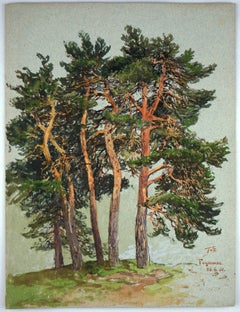
Themistokles von Eckenbrecher (1842 Athens - 1921 Goslar), Norwegian pine grove, 1901. Watercolor on blue-green paper, 30 x 22 cm. Signed, dated and inscribed in his own hand "TvE. Fagermes [i.e. Fagermes]. 26.6.[19]01." - Slight crease throughout at left margin, otherwise in good condition. About the artwork Themistokles von Eckenbrecher often traveled to Norway to study the nature that fascinated him there. On June 26, 1901, near the southern Norwegian town of Fagernes, in the summer evening sun, he saw a small pine grove, which he immediately captured in a watercolor. He exposed the trees growing on a small hill in front of the background, so that the pines completely define the picture and combine to form a tense motif. The tension comes from the contrast of form and color. The trunks, growing upward, form a vertical structure that is horizontally penetrated by the spreading branches and the pine needles, which are rendered as a plane. This structural tension is further intensified by the color contrast between the brown-reddish iridescent trunks and branches and the green-toned needlework. Themistokles von Eckenbrecher, however, does not use the observed natural scene as an inspiring model for a dance of color and form that detaches itself from the motif and thus treads the path of abstracting modernism. Its inner vitality is to be brought to light and made aesthetically accessible through the work of art. It is precisely in order to depict the inner vitality of nature that von Eckenbrecher chooses the technique of watercolor, in which the individual details, such as the needles, are not meticulously worked out, but rather a flowing movement is created that unites the contrasts. The trees seem to have formed the twisted trunks out of their own inner strength as they grew, creatingthose tense lineations that the artist has put into the picture. The inner strength continues in the branches and twigs, culminating in the upward growth of the needles. At the same time, the trunks, illuminated by the setting sun, seem to glow from within, adding an almost dramatic dimension to the growing movement. Through the artwork, nature itself is revealed as art. In order to make nature visible as art in the work, von Eckenbrecher exposes the group of trees so that they are bounded from the outside by an all-encompassing contour line and merge into an areal unity that enters into a figure-ground relationship with the blue-greenish watercolor paper. The figure-ground relationship emphasizes the ornamental quality of the natural work of art, which further enforces the artwork character of the group of trees. With the presentation of Themistokles von Eckenbrecher's artistic idea and its realization, it has become clear that the present watercolor is not a study of nature in the sense of a visual note by the artist, which might then be integrated into a larger work context, but a completely independent work of art. This is why von Eckenbrecher signed the watercolor. In addition, it is marked with a place and a date, which confirms that this work of nature presented itself to him in exactly this way at this place at this time. At the same time, the date and place make it clear that the natural work of art has been transferred into the sphere of art and thus removed from the time of the place of nature. About the artist Themistocles' parents instilled a life of travel in their son, who is said to have spoken eleven languages. His father, who was interested in ancient and oriental culture, was a doctor and had married Francesca Magdalena Danelon, an Italian, daughter of the British consul in Trieste. During a stay in Athens - Gustav von Eckenbrecher was a friend of Heinrich von Schliemann and is said to have given him crucial clues as to the location of Troy - Themistokles saw the light of day in 1842. After an interlude in Berlin, where Themistokles was educated at the English-American School, the journey began again. From 1850 to 1857 the family lived in Constantinople, after which the father opened a practice in Potsdam, where Themistokles, who wanted to become a painter, was taught by the court painter Carl Gustav Wegener. In 1861 the von Eckenbrechers left Potsdam and settled in Düsseldorf. There Themistokles received two years of private tuition from Oswald Aschenbach, who greatly admired the talented young artist. After his artistic training, he undertook extensive travels, often accompanied by Prince Peter zu Sayn-Wittgenstein, which took him to northern and eastern Europe, but above all to the Middle East and even to South America. The paintings that resulted from these journeys established his artistic reputation and led to his participation in large panoramas such as the 118 x 15 metre Entry of the Mecca Caravan into Cairo, painted for the City of Hamburg in 1882. 1882 was also the start of a total of 21 study trips to Scandinavia, most of them to Norway, and the unique Norwegian landscape with its rugged fjords became a central motif in his work. Along with Anders Askevold and Adelsteen Normann...
Category

Early 1900s Naturalistic Maude Leach Landscape Drawings and Watercolors

Materials

Watercolor

View of Dunoon on the Clyde, Scottish landscape and Figures, 19th Century
Located in Hillsborough, NC
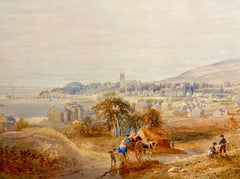
Scottish artist Robert Carrick (1829-1904) is renowned for his landscape and figurative paintings in oil and watercolor. This painting features detailed drawings of figures in the foreground with wagon, and the town and scenery in the background, painted over in watercolor in rich raw umber and red-brown tones in the foreground and blue green tones in the background. Carrick showed promise at a young age, exhibiting his work at the Royal Academy age 16. He was a member of the Royal Institute. This two-toned watercolor work has detailed figures, wagon with hay in the forefront above a view of Dunoon town near Glasgow as it was long ago. Signed by the artist, lower left with an inscription that reads: 'View of Dunoon, Argyllshire drawn by Robert Carrick, Glasgow, for David Allan'. Verso includes a copy of the same inscription. Saltire Gallerie replaced the cracked and dirty plain glass with art glass and added an acid-free paper behind the work. While doing this work we found an art giclee, included with the painting. Presented in a patterned wooden frame with art glass. Dunoon was a thriving town on the river at the time of this work, and later became part of Glasgow. The view from above the town is a popular one, as Saltire Gallerie has another view of Dunoon from above by Scottish artist Patrick Downie...
Category

19th Century Naturalistic Maude Leach Landscape Drawings and Watercolors

Materials

Watercolor, Board, Pencil

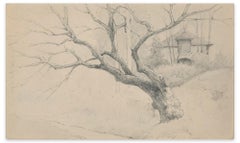
Tree and House - Charcoal by E.-L. Minet - Early 1900
By Emile-Louis Minet
Located in Roma, IT
Tree and House is a precious pencil study realized by the French painter Emile-Louis Minet. The state of preservation is excellent. The piece of paper comes from a sketchbook, and it...
Category

Early 1900s Naturalistic Maude Leach Landscape Drawings and Watercolors

Materials

Charcoal, Pencil

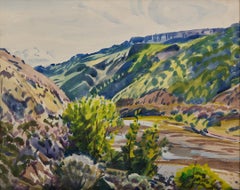
Moraine Valley, Rocky Mountain National Park, Colorado, 20th Century
By Frank Wilcox
Located in Beachwood, OH
Frank Nelson Wilcox (American, 1887-1964) Moraine Valley, Rocky Mountain National Park, Colorado, c. 1950 Watercolor on paper Unsigned 19 x 24 inches Provenance: From the Estate of Frank Nelson Wilcox Frank Nelson Wilcox (October 3, 1887 – April 17, 1964) was a modernist American artist and a master of watercolor. Wilcox is described as the "Dean of Cleveland School painters," though some sources give this appellation to Henry Keller or Frederick Gottwald. Wilcox was born on October 3, 1887 to Frank Nelson Wilcox, Sr. and Jessie Fremont Snow Wilcox at 61 Linwood Street in Cleveland, Ohio. His father, a prominent lawyer, died at home in 1904 shortly before Wilcox' 17th birthday. His brother, lawyer and publisher Owen N. Wilcox, was president of the Gates Legal Publishing Company or The Gates Press. His sister Ruth Wilcox was a respected librarian. In 1906 Wilcox enrolled from the Cleveland School of Art under the tutelage of Henry Keller, Louis Rorimer, and Frederick Gottwald. He also attended Keller's Berlin Heights summer school from 1909. After graduating in 1910, Wilcox traveled and studied in Europe, sometimes dropping by Académie Colarossi in the evening to sketch the model or the other students at their easels, where he was influenced by French impressionism. Wilcox was influenced by Keller's innovative watercolor techniques, and from 1910 to 1916 they experimented together with impressionism and post-impressionism. Wilcox soon developed his own signature style in the American Scene or Regionalist tradition of the early 20th century. He joined the Cleveland School of Art faculty in 1913. Among his students were Lawrence Edwin Blazey, Carl Gaertner, Paul Travis, and Charles E. Burchfield. Around this time Wilcox became associated with Cowan Pottery. In 1916 Wilcox married fellow artist Florence Bard, and they spent most of their honeymoon painting in Berlin Heights with Keller. They had one daughter, Mary. In 1918 he joined the Cleveland Society of Artists, a conservative counter to the Bohemian Kokoon Arts Club, and would later serve as its president. He also began teaching night school at the John Huntington Polytechnic Institute at this time, and taught briefly at Baldwin-Wallace College. Wilcox wrote and illustrated Ohio Indian Trails in 1933, which was favorably reviewed by the New York Times in 1934. This book was edited and reprinted in 1970 by William A. McGill. McGill also edited and reprinted Wilcox' Canals of the Old Northwest in 1969. Wilcox also wrote, illustrated, and published Weather Wisdom in 1949, a limited edition (50 copies) of twenty-four serigraphs (silk screen prints) accompanied by commentary "based upon familiar weather observations commonly made by people living in the country." Wilcox displayed over 250 works at Cleveland's annual May Show. He received numerous awards, including the Penton Medal for as The Omnibus, Paris (1920), Fish Tug on Lake Erie (1921), Blacksmith Shop (1922), and The Gravel Pit (1922). Other paintings include The Trailing Fog (1929), Under the Big Top (1930), and Ohio Landscape...
Category

1950s American Modern Maude Leach Landscape Drawings and Watercolors

Materials

Watercolor

"Persepective", Pigments Watercolor Acrylic Paper Drawing
By Frank Girard
Located in Clermont-Ferrand, Auvergne-Rhône-Alpes
Titled "Perspective", this artwork created by Frank Girard, utilizes pigments, Chinese ink, watercolors, acrylics, and colored pencils on 400g/m2 neutral white paper. It remains unfr...
Category

2010s Realist Maude Leach Landscape Drawings and Watercolors

Materials

Paper, Ink, Acrylic, Watercolor, Color Pencil, Pigment

"Persepective",  Pigments Watercolor Acrylic Paper Drawing
$837 Sale Price
20% Off
H 13.39 in W 17.33 in D 0.02 in
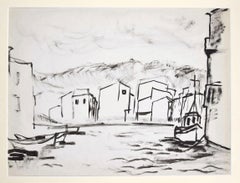
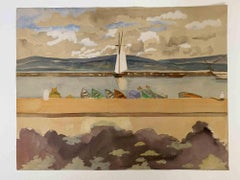
The Port - China Ink and Watercolor by H. Hausmann - Mid-20th Century
Located in Roma, IT
The Port is an original drawing in china ink and watercolor realized by Herta Hausmann (1892-1972). Hand-signed on the lower right. Good conditions. This interesting drawing repre...
Category

Mid-20th Century Maude Leach Landscape Drawings and Watercolors

Materials

Watercolor, Ink

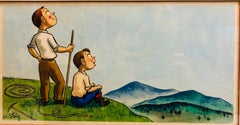
Whimsical Illustration Hiking Cartoon, 1938 Mt Tremblant Ski Lodge William Steig
By William Steig (b.1907)
Located in Surfside, FL
Lighthearted Illustration of Outdoor Pursuits This one being cross country hiking signed "W. Steig" Provenance: from Mrs. Joseph B. Ryan, Commissioned by Joe Ryan for the bar at his ski resort, Mount Tremblant Lodge, in 1938. Mont Tremblant, P.Q., Canada Watercolor and ink on illustration board, sights sizes 8 1/2 x 16 1/2 in., framed. In 1938 Joe Ryan, described as a millionaire from Philadelphia, bushwhacked his way to the summit of Mont Tremblant and was inspired to create a world class ski resort at the site. In 1939 he opened the Mont Tremblant Lodge, which remains part of the Pedestrian Village today. This original illustration is on Whatman Illustration board. the board measures 14 X 22 inches. label from McClees Galleries, Philadelphia, on the frame backing paper. William Steig, 1907 – 2003 was an American cartoonist, sculptor, and, in his later life, an illustrator and writer of children's books. Best known for the picture books Sylvester and the Magic Pebble, Abel's Island, and Doctor De Soto, he was also the creator of Shrek!, which inspired the film series of the same name. He was the U.S. nominee for both of the biennial, international Hans Christian Andersen Awards, as a children's book illustrator in 1982 and a writer in 1988. Steig was born in Brooklyn, New York in 1907, and grew up in the Bronx. His parents were Polish-Jewish immigrants from Austria, both socialists. His father, Joseph Steig, was a house painter, and his mother, Laura Ebel Steig, was a seamstress who encouraged his artistic leanings. As a child, he dabbled in painting and was an avid reader of literature. Among other works, he was said to have been especially fascinated by Pinocchio.He graduated from Townsend Harris High School at 15 but never completed college, though he attended three, spending two years at City College of New York, three years at the National Academy of Design and a mere five days at the Yale School of Fine Arts before dropping out of each. Hailed as the "King of Cartoons" Steig began drawing illustrations and cartoons for The New Yorker in 1930, producing more than 2,600 drawings and 117 covers for the magazine. Steig, later, when he was 61, began writing children's books. In 1968, he wrote his first children's book. He excelled here as well, and his third book, Sylvester and the Magic Pebble (1969), won the Caldecott Medal. He went on to write more than 30 children's books, including the Doctor DeSoto series, and he continued to write into his nineties. Among his other well-known works, the picture book Shrek! (1990) formed the basis for the DreamWorks Animation film Shrek (2001). After the release of Shrek 2 in 2004, Steig became the first sole-creator of an animated movie franchise that went on to generate over $1 billion from theatrical and ancillary markets after only one sequel. Along with Maurice Sendak, Saul Steinberg, Ludwig Bemelmans and Laurent de Brunhofff his is one of those rare cartoonist whose works form part of our collective cultural heritage. In 1984, Steig's film adaptation of Doctor DeSoto directed by Michael Sporn was nominated for the Academy Award for Best Animated Short Film. As one of the most admired cartoonists of all time, Steig spent seven decades drawing for the New Yorker magazine. He touched generations of readers with his tongue–in–cheek pen–and–ink drawings, which often expressed states of mind like shame, embarrassment or anger. Later in life, Steig turned to children's books, working as both a writer and illustrator. Steig's children's books were also wildly popular because of the crazy, complicated language he used—words like lunatic, palsied, sequestration, and cleave. Kids love the sound of those words even if they do not quite understand the meaning. Steig's descriptions were also clever. He once described a beached whale as "breaded with sand." Throughout the course of his career, Steig compiled his cartoons and drawings into books. Some of them were published first in the New Yorker. Others were deemed too dark to be printed there. Most of these collections centered on the cold, dark psychoanalytical truth about relationships. They featured husbands and wives fighting and parents snapping at their kids. His first adult book, Man About Town, was published in 1932, followed by About People, published in 1939, which focused on social outsiders. Sick of Each Other, published in 2000, included a drawing depicting a wife holding her husband at gunpoint, saying, "Say you adore me." According to the Los Angeles Times, fellow New Yorker artist Edward Sorel...
Category

1930s Naturalistic Maude Leach Landscape Drawings and Watercolors

Materials

Archival Ink, Watercolor, Illustration Board

The Boat in the Dock - Original Watercolor - 1945 ca
Located in Roma, IT
The boat in the dock is an original drawing in watercolor on paper realized by an anonymous artist in 1945 ca. Good conditions. The artwork represents a beautiful sea in the perspe...
Category

1940s Modern Maude Leach Landscape Drawings and Watercolors

Materials

Watercolor

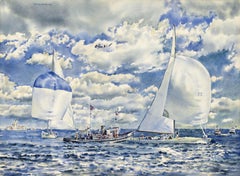
America s Cup - 1967. Wing Mark, Intrepid and Dame Pattie.
By Joseph Webster Golinkin
Located in New York, NY
AMERICA'S CUP - 1967. WING MARK. INTREPID - DAME PATTIE [AUS]. This Joseph Webster Golinkin watercolor of the 1967 America's Cup depicts the...
Category

1960s Naturalistic Maude Leach Landscape Drawings and Watercolors

Materials

Watercolor

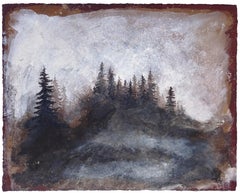
"The Faraway Forest", Pigments Watercolor Acrylic Paper Drawing
By Frank Girard
Located in Clermont-Ferrand, Auvergne-Rhône-Alpes
Titled "The faraway forest", this artwork created by Frank Girard, utilizes pigments, Chinese ink, watercolors, acrylics, and colored pencils on 400g/m2 neutral white paper. It remai...
Category

2010s Realist Maude Leach Landscape Drawings and Watercolors

Materials

Paper, Ink, Acrylic, Watercolor, Color Pencil, Pigment

"The Faraway Forest",  Pigments Watercolor Acrylic Paper Drawing
$837 Sale Price
20% Off
H 13.39 in W 17.33 in D 0.02 in

Maude Leach landscape drawings and watercolors for sale on 1stDibs.

Find a wide variety of authentic Maude Leach landscape drawings and watercolors available for sale on 1stDibs. You can also browse by medium to find art by Maude Leach in paint, watercolor and more. Not every interior allows for large Maude Leach landscape drawings and watercolors, so small editions measuring 32 inches across are available. Customers who are interested in this artist might also find the work of Bruno Surdo, André Roland Brudieux, and Emily Stackhouse. Maude Leach landscape drawings and watercolors prices can differ depending upon medium, time period and other attributes. On 1stDibs, the price for these items starts at $1,800 and tops out at $1,800, while the average work can sell for $1,800.

Still Thinking About These?

All Recently Viewed