Max Ernst More Prints

American, German, French, 1891-1976

Born in Germany in 1891, later naturalized as an American, then a French citizen, Max Ernst was a pioneer in the Dada and Surrealist movements, the boundaries of which he pushed with his unconventional methods of printmaking, drawing and collage.

Ernst had no formal art training — and that may have been his greatest asset. He produced his first work following four years serving in World War I. At the time, he was in Cologne, Germany, working closely with fellow Dada pioneers Jean Arp and Johannes Baargeld. His output during this period consisted largely of collages, which allowed him to represent the shards, rubble and explosions from his traumatic wartime experience.

In 1922, Ernst moved to France, where he soon became affiliated with Surrealism, the avant-garde art movement taking shape in Paris. Alongside Man Ray, Joan Miró and a couple of others, Ernst was among the first visual artists to experiment with imagery and techniques associated with Surrealism.

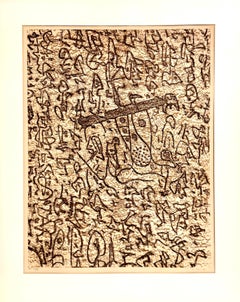
Ernst’s greatest contribution to the Surrealist movement was his invention of frottage (French for “rubbing”), wherein an artist rubs a pencil or crayon over a paper atop a textured surface, and later grattage (French for “scraping”), where a similar technique is applied with paint. Both methods showcase Ernst’s fascination with the unconscious and serendipitous elements of artistic creation, a theme that connected the Dadaists and the Surrealists. Ernst had deep knowledge of psychoanalysis and Sigmund Freud’s dream theories, which were big influences on Surrealists. He was among the first Surrealists to use Freud’s work to examine his own creative impulses. He also published a series of books of his collages, all of which were deeply symbolic and often philosophical.

When Germany occupied France during World War II, Ernst escaped to America with the help of patron and collector Peggy Guggenheim, whom he married in 1941. While living in New York, Ernst’s work and techniques proved instrumental in inspiring the early development of Abstract Expressionism — influencing Robert Motherwell and Jackson Pollock in particular. He later moved to Sedona, Arizona, where he lived with his fourth wife, Dorothea Tanning, a fellow Surrealist and prolific visual artist and poet.

While Ernst and Tanning are largely responsible for Sedona’s reputation as an artist colony, they relocated to France in the 1950s and remained until Ernst’s death in Paris in 1976.

Find original Max Ernst art on 1stDibs.

to
1
1
1
1
Overall Width
to
Overall Height
to
2
1
176
693
454
220
170
3
2
1
3
2
1
1
2
1
Artist: Max Ernst
Max Ernst Dada Surrealist Hand Signed Lithograph Poster for a Jewish Museum
By Max Ernst
Located in Surfside, FL
Max Ernst (German, American, 1891-1976) Color lithograph Titled, "Poster For The Jewish Museum" 1966 Hand signed lower right Hand numbered HC I/XVII Dimensions: 34.75 x 28.5 sight 25 X 19.25 Max Ernst (German 1891 – 1976) was a German-born painter, sculptor, printmaker, graphic artist, and poet. A prolific artist, Ernst was a primary pioneer of the Dada movement and surrealism in Europe. He had no formal artistic training, but his experimental attitude toward the making of art resulted in his invention of frottage—a technique that uses pencil rubbings of textured objects and relief surfaces to create images—and grattage, an analogous technique in which paint is scraped across canvas to reveal the imprints of the objects placed beneath. Max Ernst showed for the first time in 1912 at the Galerie Feldman in Cologne. At the Sonderbund exhibition of that year in Cologne he saw the work of Paul Cezanne, Edvard Munch, Pablo Picasso, Paul Gauguin and Vincent van Gogh. In 1913 he met Guillaume Apollinaire and Robert Delaunay and traveled to Paris. Ernst participated that same year in the Erste deutsche Herbstsalon. In 1914 he met Jean Arp in Cologne who was to become a lifelong friend. In 1921 Ernst exhibited at the Galerie au Sans Pareil in Paris. He was involved in Surrealist activities in the early 1920s with Paul Eluard and André Breton. His work was exhibited that year together with that of the Das Junge Rheinland group, at Galerie Feldman in Cologne, and then in several group exhibitions in 1913. In his paintings of this period, Ernst adopted an ironic style that juxtaposed grotesque elements alongside Cubist and Expressionist motifs. Ernst fought in world war I. Several German Expressionist painters died in action during the war, among them August Macke and Franz Marc. In 1918, Ernst was demobilised and returned to Cologne. He soon married art history student Luise Straus, of Jewish ancestry, whom he had met in 1914. In 1919, he visited Paul Klee in Munich and studied paintings by Giorgio de Chirico. In the same year, inspired by de Chirico and mail-order catalogues, teaching-aide manuals and similar sources, he produced his first collage works (notably Fiat modes, a portfolio of lithographs), a technique which later dominated his artistic pursuits. Also in 1919, Ernst, social activist Johannes Theodor Baargeld and several colleagues founded the Cologne Dada group. In 1919–20, Ernst and Baargeld published various short-lived magazines such as Der Strom, die Schammade and organised Dada exhibitions. Ernst and Luise's son Ulrich Jimmy Ernst was born on 24 June 1920; he later would also become a painter. In 1921, he met Paul Éluard, who became a lifelong friend. Éluard bought two of Ernst's paintings (Celebes and Oedipus Rex) and selected six collages to illustrate his poetry collection Répétitions. A year later the two collaborated on Les malheurs des immortels and then with André Breton, whom Ernst met in 1921, on the magazine Littérature. Ernst developed a fascination with birds which was prevalent in his work. His alter ego in paintings, which he called Loplop, was a bird. He suggested that this alter-ego was an extension of himself stemming from an early confusion of birds and humans. In 1927, he married Marie-Berthe Aurenche and it is thought his relationship with her may have inspired the erotic subject matter of The Kiss and other works of that year. He collaborated with Joan Miro on designs for Sergei Diaghilev Ballet that same year. The following year the artist collaborated with Salvador Dali and the Surrealist Luis Bunuel on the film L'Age d'or. His first American show was held at the Julien Levy Gallery, New York, in 1932. In 1936 Ernst was represented in Fantastic Art, Dada, Surrealism at the Museum of Modern Art in New York. Ernst began to sculpt in 1934 and spent time with Alberto Giacometti. In 1938, the American heiress and artistic patron Peggy Guggenheim acquired a number of Max Ernst's works, which she displayed in her new gallery in London. Ernst and Guggenheim were married from 1942 to 1946. In September 1939, the outbreak of World War II caused Ernst, being German, to be interned as an "undesirable foreigner" in Camp des Milles, near Aix-en-Provence, along with fellow surrealist, Hans Bellmer, who had recently emigrated to Paris. He had been living with his lover and fellow surrealist painter, Leonora Carrington who, not knowing whether he would return, saw no option but to sell their house to repay their debts and leave for Spain. Thanks to the intercession of Paul Éluard and other friends, including the journalist Varian Fry, he was released a few weeks later. Soon after the German occupation of France, he was arrested again, this time by the Gestapo, but managed to escape to America with the help of Fry and Peggy Guggenheim, a member of a wealthy American art collecting family. Ernst and Peggy Guggenheim arrived in the United States in 1941 and were married at the end of the year. Along with other artists and friends (Marcel Duchamp and Marc Chagall) who had fled from the war and lived in New York City, Ernst helped inspire the development of abstract expressionism. His marriage to Guggenheim did not last. In October 1946 he married American surrealist painter Dorothea Tanning in a double ceremony with Man Ray and Juliet P. Browner in Beverly Hills, California. The couple made their home in Sedona, Arizona from 1946 to 1953. He and Tanning hosted intellectuals and European artists such as Henri Cartier-Bresson and Yves Tanguy. Sedona proved an inspiration for the artists and for Ernst, who compiled his book Beyond Painting and completed his sculptural masterpiece Capricorn while living in Sedona. As a result of the book and its publicity, Ernst began to achieve financial success. From the 1950s he lived mainly in France. In 1954 he was awarded the Grand Prize for painting at the Venice Biennale. In 2005, "Max Ernst: A Retrospective" opened at the Metropolitan Museum of Art. Contemporary artist tapestries have had their true believers. He produced a tapestry for Gloria Ross...
Category

1960s Surrealist Max Ernst More Prints

Materials

Lithograph

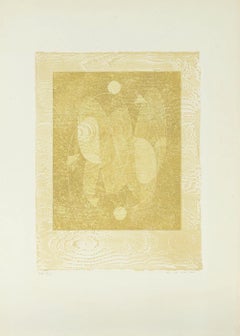
Hommage à San Lazzaro
By Max Ernst
Located in OPOLE, PL
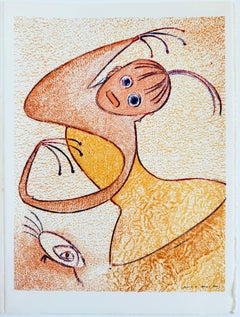
Max Ernst (1891-1976) - Hommage à San Lazzaro Lithograph from 1975. Edition 371/575 (Photocopy of the colophone is included). Dimensions of work: 31 x 24 cm. Plate signed. Each ...
Category

1970s Modern Max Ernst More Prints

Materials

Lithograph

"Bonjour" by Max Ernst, Good Day, Surrealism, Light Colors, Figurative
By Max Ernst
Located in Köln, DE
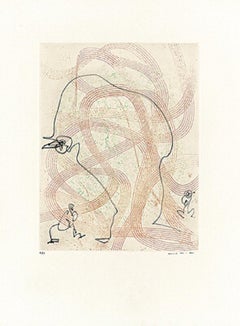
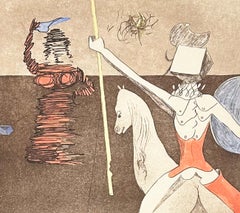
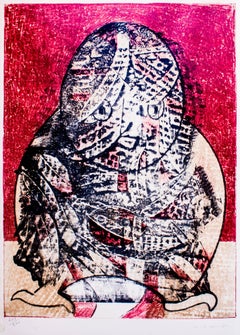
Etching in colours by Max Ernst. "Bonjour", 1966 66,5 x 50,1 cm Copy 7/99 Edition of 111 copies (approx.)
Category

1960s Surrealist Max Ernst More Prints

Materials

Etching, Aquatint

Related Items
Atelier Mourlot - New York (NYC Skyline) by Bernard Buffet
By Bernard Buffet
Located in New York, NY
Arches Poster Paper - Perfect Condition A+ When The Mourlot Studio opened a branch in New York City, after a successful exhibition organized by the Smithsonian Institute in 1963, it...
Category

1960s Modern Max Ernst More Prints

Materials

Lithograph

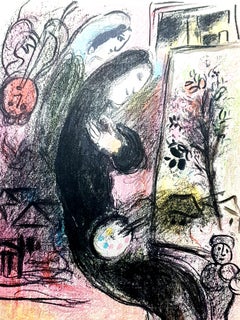
Marc Chagall - The Red Rider - Original Lithograph
By Marc Chagall
Located in Collonge Bellerive, Geneve, CH
Marc Chagall - Original Lithograph The Red Rider From the unsigned, unnumbered lithograph printed in the literary review XXe Siecle 1957 See Mourlot 191 Dimensions: 32 x 24 cm Publisher: G. di San Lazzaro. Marc Chagall (born in 1887) Marc Chagall was born in Belarus in 1887 and developed an early interest in art. After studying painting, in 1907 he left Russia for Paris, where he lived in an artist colony on the city’s outskirts. Fusing his own personal, dreamlike imagery with hints of the fauvism and cubism popular in France at the time, Chagall created his most lasting work—including I and the Village (1911)—some of which would be featured in the Salon des Indépendants exhibitions. After returning to Vitebsk for a visit in 1914, the outbreak of WWI trapped Chagall in Russia. He returned to France in 1923 but was forced to flee the country and Nazi persecution during WWII. Finding asylum in the U.S., Chagall became involved in set and costume design before returning to France in 1948. In his later years, he experimented with new art forms and was commissioned to produce numerous large-scale works. Chagall died in St.-Paul-de-Vence in 1985. The Village Marc Chagall was born in a small Hassidic community on the outskirts of Vitebsk, Belarus, on July 7, 1887. His father was a fishmonger, and his mother ran a small sundries shop in the village. As a child, Chagall attended the Jewish elementary school, where he studied Hebrew and the Bible, before later attending the Russian public school. He began to learn the fundamentals of drawing during this time, but perhaps more importantly, he absorbed the world around him, storing away the imagery and themes that would feature largely in most of his later work. At age 19 Chagall enrolled at a private, all-Jewish art school and began his formal education in painting, studying briefly with portrait artist Yehuda Pen. However, he left the school after several months, moving to St. Petersburg in 1907 to study at the Imperial Society for the Protection of Fine Arts. The following year, he enrolled at the Svanseva School, studying with set designer Léon Bakst, whose work had been featured in Sergei Diaghilev's Ballets Russes. This early experience would prove important to Chagall’s later career as well. Despite this formal instruction, and the widespread popularity of realism in Russia at the time, Chagall was already establishing his own personal style, which featured a more dreamlike unreality and the people, places and imagery that were close to his heart. Some examples from this period are his Window Vitebsk (1908) and My Fianceé with Black Gloves (1909), which pictured Bella Rosenfeld, to whom he had recently become engaged. The Beehive Despite his romance with Bella, in 1911 an allowance from Russian parliament member and art patron Maxim Binaver enabled Chagall to move to Paris, France. After settling briefly in the Montparnasse neighborhood, Chagall moved further afield to an artist colony known as La Ruche (“The Beehive”), where he began to work side by side with abstract painters such as Amedeo Modigliani and Fernand Léger as well as the avant-garde poet Guillaume Apollinaire. At their urging, and under the influence of the wildly popular fauvism and cubism, Chagall lightened his palette and pushed his style ever further from reality. I and the Village (1911) and Homage to Apollinaire (1912) are among his early Parisian works, widely considered to be his most successful and representative period. Though his work stood stylistically apart from his cubist contemporaries, from 1912 to 1914 Chagall exhibited several paintings at the annual Salon des Indépendants exhibition, where works by the likes of Juan Gris, Marcel Duchamp and Robert Delaunay were causing a stir in the Paris art world. Chagall’s popularity began to spread beyond La Ruche, and in May 1914 he traveled to Berlin to help organize his first solo exhibition, at Der Sturm Gallery. Chagall remained in the city until the highly acclaimed show opened that June. He then returned to Vitebsk, unaware of the fateful events to come. War, Peace and Revolution In August 1914 the outbreak of World War I precluded Chagall’s plans to return to Paris. The conflict did little to stem the flow of his creative output, however, instead merely giving him direct access to the childhood scenes so essential to his work, as seen in paintings such as Jew in Green (1914) and Over Vitebsk (1914). His paintings from this period also occasionally featured images of the war’s impact on the region, as with Wounded Soldier (1914) and Marching (1915). But despite the hardships of life during wartime, this would also prove to be a joyful period for Chagall. In July 1915 he married Bella, and she gave birth to a daughter, Ida, the following year. Their appearance in works such as Birthday (1915), Bella and Ida by the Window (1917) and several of his “Lovers” paintings give a glimpse of the island of domestic bliss that was Chagall’s amidst the chaos. To avoid military service and stay with his new family, Chagall took a position as a clerk in the Ministry of War Economy in St. Petersburg. While there he began work on his autobiography and also immersed himself in the local art scene, befriending novelist Boris Pasternak, among others. He also exhibited his work in the city and soon gained considerable recognition. That notoriety would prove important in the aftermath of the 1917 Russian Revolution when he was appointed as the Commissar of Fine Arts in Vitebsk. In his new post, Chagall undertook various projects in the region, including the 1919 founding of the Academy of the Arts. Despite these endeavors, differences among his colleagues eventually disillusioned Chagall. In 1920 he relinquished his position and moved his family to Moscow, the post-revolution capital of Russia. In Moscow, Chagall was soon commissioned to create sets and costumes for various productions at the Moscow State Yiddish Theater, where he would paint a series of murals titled Introduction to the Jewish Theater as well. In 1921, Chagall also found work as a teacher at a school for war orphans. By 1922, however, Chagall found that his art had fallen out of favor, and seeking new horizons he left Russia for good. Flight After a brief stay in Berlin, where he unsuccessfully sought to recover the work exhibited at Der Sturm before the war, Chagall moved his family to Paris in September 1923. Shortly after their arrival, he was commissioned by art dealer and publisher Ambroise Vollard to produce a series of etchings for a new edition of Nikolai Gogol's 1842 novel Dead Souls. Two years later Chagall began work on an illustrated edition of Jean de la Fontaine’s Fables, and in 1930 he created etchings for an illustrated edition of the Old Testament, for which he traveled to Palestine to conduct research. Chagall’s work during this period brought him new success as an artist and enabled him to travel throughout Europe in the 1930s. He also published his autobiography, My Life (1931), and in 1933 received a retrospective at the Kunsthalle in Basel, Switzerland. But at the same time that Chagall’s popularity was spreading, so, too, was the threat of Fascism and Nazism. Singled out during the cultural "cleansing" undertaken by the Nazis in Germany, Chagall’s work was ordered removed from museums throughout the country. Several pieces were subsequently burned, and others were featured in a 1937 exhibition of “degenerate art” held in Munich. Chagall’s angst regarding these troubling events and the persecution of Jews in general can be seen in his 1938 painting White Crucifixion. With the eruption of World War II, Chagall and his family moved to the Loire region before moving farther south to Marseilles following the invasion of France. They found a more certain refuge when, in 1941, Chagall’s name was added by the director of the Museum of Modern Art (MOMA) in New York City to a list of artists and intellectuals deemed most at risk from the Nazis’ anti-Jewish campaign. Chagall and his family would be among the more than 2,000 who received visas and escaped this way. Haunted Harbors Arriving in New York City in June 1941, Chagall discovered that he was already a well-known artist there and, despite a language barrier, soon became a part of the exiled European artist community. The following year he was commissioned by choreographer Léonide Massine to design sets and costumes for the ballet Aleko, based on Alexander Pushkin’s “The Gypsies” and set to the music of Pyotr Ilyich Tchaikovsky. But even as he settled into the safety of his temporary home, Chagall’s thoughts were frequently consumed by the fate befalling the Jews of Europe and the destruction of Russia, as paintings such as The Yellow Crucifixion...
Category

1950s Surrealist Max Ernst More Prints

Materials

Lithograph

Surrealist Portrait of Dali Surrounded by Butterflies, Memories of Surrealism
By Salvador Dalí­
Located in Washington, DC
Artist: Salvador Dali Title: Surrealist Portrait of Dali Surrounded by Butterflies Portfolio: Memories of Surrealism Medium: Etching and photolithograph Date: 1971 Edition: AP XIV/XX...
Category

1970s Surrealist Max Ernst More Prints

Materials

Etching, Lithograph

Hommage a Rene Char after Pablo Picasso
By Pablo Picasso
Located in New York, NY
This colorful lithograph after Pablo Picasso was printed by the Atelier Mourlot in Paris in 1964 and is unsigned*. This image is taken from a drawing in pencil and colored chalk enti...
Category

1960s Modern Max Ernst More Prints

Materials

Lithograph

Hommage a Rene Char after Pablo Picasso
$2,800 Sale Price
20% Off
H 30 in W 20.5 in
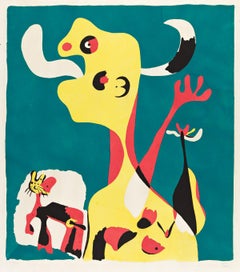
Femme et Chien devant la Lune
By Joan Miró
Located in New York, NY
A superb impression of this very scarce, early color pochoir. Signed, dated "1935" and numbered 58/60 in pencil by Miro. Published by Adlan, Barcelona. Ink stamp on the reverse indic...
Category

1930s Surrealist Max Ernst More Prints

Materials

Color, Stencil

Nara Girl Banging On A Drum With Limited Edition Sticker Set Pop Art Print
By Yoshitomo Nara
Located in Draper, UT
Banging the Drum DETAILS 27 x 17 inches (unframed), 2020 Offset lithograph 80# Classic Linen Solar White Cover
Category

2010s Pop Art Max Ernst More Prints

Materials

Lithograph

Invasion de l Espace - Lithograph by Man Ray - 1975
By Man Ray
Located in Roma, IT
Invasion de l'espace is a color lithograph by the American artist and exponent of Dadaism and Surrealism Man Ray (Philadelphia, 1890 - Paris, 1976). The workr was edited by the Fr...
Category

1970s Surrealist Max Ernst More Prints

Materials

Lithograph

Invasion de l
Espace - Lithograph by Man Ray - 1975
$499 Sale Price
30% Off
H 12.29 in W 9.14 in D 0.04 in
De l Origine des Espèces par Voie de Sélection Irrationelle: Visage
By Man Ray
Located in New York, NY
A very good impression of this color lithograph. Artist's proof, aside from the edition of 180. Signed and inscribed "EA" in pencil. Printed by Mourlot, Paris. Published by Leon Amie...
Category

1970s Surrealist Max Ernst More Prints

Materials

Color, Lithograph

"Juges" from the suite "Les Fleurs du Mal""
By Georges Rouault
Located in San Francisco, CA
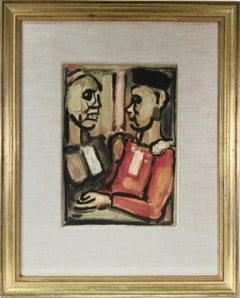
This artwork titled "Juges" from the suite "Les Fleurs du Mal" created in 1937/38, is an original color aquatint on Montval paper by renown French artist Georges Rouault, 1871-1958....
Category

Mid-20th Century Expressionist Max Ernst More Prints

Materials

Aquatint

Berggruen abstract lithographic poster by Wassily Kandinsky, 1972
By Wassily Kandinsky
Located in New York, NY
This colorful modern lithographic poster by Wassily Kandinsky was printed in 1972 at the Atelier Mourlot in Paris to promote an exhibition of his watercolors and drawings at the Gale...
Category

1970s Modern Max Ernst More Prints

Materials

Lithograph

Marc Chagall - The Ballet, Frontispiece
By Marc Chagall
Located in Collonge Bellerive, Geneve, CH
The Ballet, Frontispiece for the book “Daphnis and Chloe” Lithograph in colors, 1969. Unsigned and unnumbered, as issued from an edition of 10,000. Printed ...
Category

1960s Surrealist Max Ernst More Prints

Materials

Lithograph

Invasion de l Espace - Lithograph by Man Ray - 1975
By Man Ray
Located in Roma, IT
Invasion de l'espace  is a color lithograph by the American artist and exponent of Dadaism and Surrealism Man Ray  (Philadelphia, 1890 - Paris, 1976). The workr was edited by the Fr...
Category

1970s Surrealist Max Ernst More Prints

Materials

Lithograph

Previously Available Items
Untitled - Etching by Max Ernst - 1970
By Max Ernst
Located in Roma, IT
Untitled is an original contemporary artwork realized by Max Ernst in 1970 Etching, Aquatint and Carborundum. Hand signed on the lower right margin. Numbered on the lower left. Ed...
Category

1970s Surrealist Max Ernst More Prints

Materials

Etching

Logique Sans Peine (Lewis Carroll s Wunderhorn, Frontispiz) (S./L.135 I)
By Max Ernst
Located in Cotignac, FR
Colour lithograph, on Japon nacré paper, Logique Sans Peine (After Wunderhorn, Frontispiz of 1966) the illustration for the frontispiece of Lewis Carroll's 'Wunderhorn' signed in pen...
Category

1970s Surrealist Max Ernst More Prints

Materials

Ink, Handmade Paper

"Terre des nébuleuses" by Max Ernst, Blue, Fog, Surrealism
By Max Ernst
Located in Köln, DE
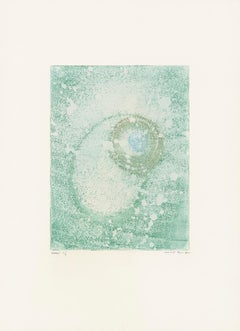
Etching and aquatint in colours (colour variation) by Max Ernst. "Terre des nébuleuses", 1965 38 x 27,5 cm Copy essai 1/1
Category

1960s Surrealist Max Ernst More Prints

Materials

Etching, Aquatint

Danseuses
By Max Ernst
Located in New York, NY
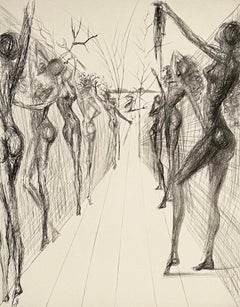
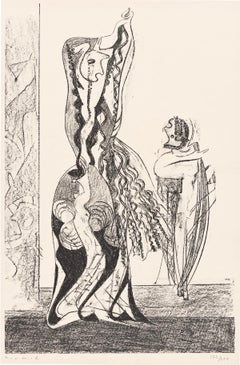
A very good, dark impression of this lithograph. Signed and numbered 172/200 in pencil by Ernst. Printed by Desjobert, Paris. Published by La Guilde de la Gravure, Paris and Geneva, ...
Category

1950s Surrealist Max Ernst More Prints

Materials

Lithograph

Danseuses
H 19.5 in W 12.75 in
Ohne Titel
By Max Ernst
Located in New York, NY
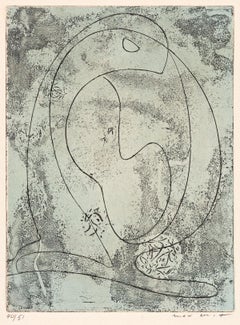
A very scarce color aquatint and etching by the prolific Dada and Surrealist master, Max Ernst. Signed and numbered 40/51 in pencil by Ernst.
Category

1960s Surrealist Max Ernst More Prints

Materials

Etching, Aquatint, Lithograph

Hibou - Lithograph by Max Ernst - 1955
By Max Ernst
Located in Roma, IT
Hand signed and numbered. Edition of 220 prints. Published by Guilde de la Gravure, Geneva and Paris. Ref. Cat. Brusberg n. 76. Very good conditions.
Category

1950s Surrealist Max Ernst More Prints

Materials

Lithograph

Plate 32, from: Lewis Carroll s Wunderhorn
By Max Ernst
Located in London, GB
MAX ERNST 1891-1976 Cologne 1891-1976 Paris (German) Title: Plate 32, from: Lewis Carroll's Wunderhorn, 1970 Technique: Original Hand Signed and Numbered Lithograph in Colours on ...
Category

1970s Surrealist Max Ernst More Prints

Materials

Lithograph

Danseuses - Lithograph by Max Ernst - 1950
By Max Ernst
Located in Roma, IT
Danseuses is an original hand-signed and numbered etching litograph realized by the Surrealist artist Max Ernst in 1950. This is the edition XV of LX, aside from the edition of 200 ...
Category

1950s Surrealist Max Ernst More Prints

Materials

Lithograph

Max Ernst more prints for sale on 1stDibs.

Find a wide variety of authentic Max Ernst more prints available for sale on 1stDibs. You can also browse by medium to find art by Max Ernst in aquatint, etching, lithograph and more. Much of the original work by this artist or collective was created during the 20th century and is mostly associated with the Surrealist style. Not every interior allows for large Max Ernst more prints, so small editions measuring 12 inches across are available. Customers who are interested in this artist might also find the work of Anatole Krasnyansky, Mayo (Antoine Malliarakis), and Marc Chagall. Max Ernst more prints prices can differ depending upon medium, time period and other attributes. On 1stDibs, the price for these items starts at $3,563 and tops out at $4,846, while the average work can sell for $4,271.
Questions About Max Ernst More Prints
  • 1stDibs ExpertApril 26, 2024
    Max Ernst lived in several places during his life. He was born in Brühl, Germany, in 1881 and later moved to Bonn to attend the university located there. Then he settled in Cologne, not far from his birthplace. In 1922, Ernst moved to France, where he soon became affiliated with Surrealism, the avant-garde art movement taking shape in Paris. Alongside Man Ray, Joan Miró and others, Ernst was among the first visual artists to experiment with imagery and techniques associated with Surrealism. When Germany occupied France during World War II, Ernst escaped to America with the help of patron and collector Peggy Guggenheim, whom he married in 1941. While living in New York, Ernst's work and techniques proved instrumental in inspiring the early development of Abstract Expressionism. He later moved to Sedona, Arizona, where he lived with his fourth wife, Dorothea Tanning, a fellow Surrealist and prolific visual artist and poet. While Ernst and Tanning are largely responsible for Sedona's reputation as an artist colony, they relocated to France in the 1950s and remained there until Ernst's death in Paris in 1976. On 1stDibs, shop a collection of Max Ernst art.
  • 1stDibs ExpertMarch 13, 2024
    You can see Max Ernst paintings in many places around the world. The Max Ernst Museum Brühl des LVR in Brühl, Germany, is home to one of the largest exhibitions of his work. Other museums that have Max Ernst paintings in their permanent collections include the Museum of Modern Art in New York, New York; the San Francisco Museum of Modern Art in San Francisco, California; the Art Institute of Chicago in Chicago, Illinois and the Detroit Institute of Arts in Detroit, Michigan. Explore a range of Max Ernst art on 1stDibs.
  • 1stDibs ExpertNovember 20, 2024
    Max Ernst contributed to Surrealism by pushing the boundaries of the movement with his unconventional methods of printmaking, drawing and collage. He invented frottage (French for “rubbing”), wherein an artist rubs a pencil or crayon over a paper atop a textured surface, and later grattage (French for “scraping”), where a similar technique is applied with paint. Both methods showcase Ernst’s fascination with the unconscious and serendipitous elements of artistic creation, a theme that resonated with the Dadaists and the Surrealists. Ernst had deep knowledge of psychoanalysis and Sigmund Freud’s dream theories, which were big influences on Surrealists. He was among the first Surrealists to use Freud’s work to examine his own creative impulses. He also published a series of books of his collages, all of which were deeply symbolic and often philosophical. Explore a selection of Max Ernst art on 1stDibs.
  • 1stDibs ExpertOctober 15, 2024
    Max Ernst used Surrealism to process the traumas he experienced during World War I. His early works consisted largely of collages, which allowed him to represent the shards, rubble and explosions from his wartime experience. In 1922, Ernst moved to France, where he soon became affiliated with Surrealism, the avant-garde art movement taking shape in Paris. Alongside Man Ray, Joan Miró and others, Ernst was among the first visual artists to experiment with the imagery and techniques that became associated with Surrealist art. Ernst’s greatest contribution to the Surrealist movement is often considered his invention of frottage, wherein an artist rubs a pencil or crayon over a paper atop a textured surface, and later grattage, where a similar technique is applied with paint. Both methods showcase Ernst’s fascination with the unconscious and serendipitous elements of artistic creation, a theme that connected the Dadaists and the Surrealists. Explore a range of Max Ernst art on 1stDibs.
  • 1stDibs ExpertOctober 30, 2024
    How much Max Ernst paintings are worth depends on their size, history, condition and other factors. In 2023, his oil-on-panel piece Taya's Sun sold for more than $304,000 at auction. Ernst was a pioneer in the Dada and Surrealist movements, pushing their boundaries with his unconventional methods of printmaking, drawing and collage. If you own an Ernst, consider having a certified appraiser or experienced art dealer evaluate it. Explore a selection of Max Ernst art on 1stDibs.

Recently Viewed

View All