Meissen Porcelain Ceramics

German

Meissen Porcelain (Staatliche Porzellan-Manufaktur Meissen) is one of the preeminent porcelain factories in Europe and was the first to produce true porcelain outside of Asia. It was established in 1710 under the auspices of King Augustus II “the Strong” of Saxony-Poland (1670–1733), a keen collector of Asian ceramics, particularly Ming porcelain.

In pursuing his passion, which he termed his “maladie de porcelaine,” Augustus spent vast sums, amassing some 20,000 pieces of Japanese and Chinese ceramics. These, along with examples of early Meissen, comprise the Porzellansammlung, or porcelain collection, of the Zwinger Palace, in Dresden.

The king was determined, however, to free the European market from its dependence on Asian imports and to give European artisans the freedom to create their own porcelain designs. To this end, he charged the scientist Ehrenfried Walther von Tschirnhaus and aspiring alchemist Johann Friedrich Böttger with the task of using local materials to produce true, hard-paste porcelain (as opposed to the soft-paste variety European ceramists in the Netherlands, Germany, France, Italy and Spain had been producing since the late Renaissance). In 1709, the pair succeeded in doing just that, employing kaolin, or “china clay.” A year later, the Meissen factory was born.

In its first decades, Meissen mostly looked to Asian models, producing wares based on Japanese Kakiemon ceramics and pieces with Chinese-inflected decorations called chinoiserie. During the 1720s its painters drew inspiration from the works of Watteau, and the scenes of courtly life, fruits and flowers that adorned fashionable textiles and wallpaper. It was in this period that Meissen introduced its famous cobalt-blue crossed swords logo — derived from the arms of the Elector of Saxony as Arch-Marshal of the Holy Roman Empire — to distinguish its products from those of competing factories that were beginning to spring up around Europe.

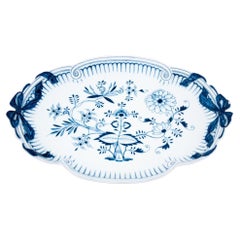
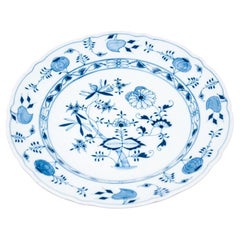
By the 1730s, Meissen’s modelers and decorators had mastered the style of Asian ceramics, and Augustus encouraged them to develop a new, original aesthetic. The factory’s director, Count Heinrich von Brühl, used Johann Wilhelm Weinmann’s botanical drawings as the basis for a new line of wares with European-style surface decoration. The Blue Onion pattern (Zwiebelmuster), first produced in 1739, melded Asian and European influences, closely following patterns used in Chinese underglaze-blue porcelain, but replacing exotic flora and fruits with Western varieties (likely peaches and pomegranates, not onions) along with peonies and asters.

During the same period, head modeler Joachim Kändler (1706–75) began crafting delicate porcelain figures derived from the Italian commedia dell’arte. Often used as centerpieces on banquet tables and decorated to reflect the latest fashions in courtly dress for men and women, these figurines were popular in their day, and are still considered among Meissen’s most iconic creations. Kändler also created the Swan Service, which, with its complex low-relief surface design and minimal decoration is considered a masterpiece of Baroque ceramics.

The rise of Neoclassicism in the latter half of the 18th century forced Meissen to change artistic direction and begin producing monumental vases, clocks, chandeliers and candelabra. In the 20th century, Meissen added to its 18th-century repertoire decidedly modern designs, including ones in the Art Nouveau style. The 1920s saw the introduction of numerous animal figures, such as the popular sea otter (Fischotter), which graced an East German postage stamp in the 1960s. Starting in 1933, artistic freedom was limited at the factory under the Nazi regime, and after World War II, when the region became part of East Germany, it struggled to reconcile its elite past with the values of the Communist government. In 1969, however, new artistic director Karl Petermann reintroduced the early designs and fostered a new degree of artistic license. Meissen became one of the few companies to prosper in East Germany.

Owned by the State of Saxony since reunification, in 1990, Meissen continues to produce its classic designs together with new ones developed collaboratively with artists from all over the world. In addition, through its artCAMPUS program, the factory has invited distinguished ceramic artists, such as Chris Antemann and Arlene Shechet, to work in its studios in collaboration with its skilled modelers and painters. The resulting works of contemporary sculpture are inspired by Meissen’s rich and complex legacy.

Find a collection of authentic Meissen Porcelain on 1stDibs.

to
2
15
6
9
1
1
15
14
1
9
6
14
14
1
1
1
15
15
15
316
290
187
168
124
Creator: Meissen Porcelain
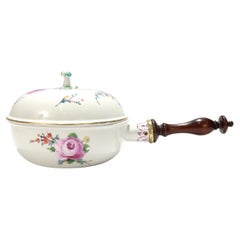
Antique Marcolini Period Meissen Porcelain Floral Bordeleau or Chamber Pot
By Meissen Porcelain
Located in Philadelphia, PA
A fine antique German porcelain bordeleau or chamber pot. By Meissen. Dating to the Marcolini period. Decorated throughout with cold-painted Streublumen floral sprays. The lid wit...
Category

Early 19th Century German Neoclassical Antique Meissen Porcelain Ceramics

Materials

Porcelain, Wood

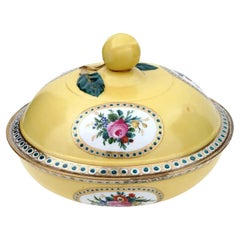
18th Century Meissen Marcolini Candy Bowl For Ottoman Market
By Meissen Porcelain
Located in Long Island City, NY
A German Meissen yellow porcelain candy bowl with a figural knob. The exterior of the bowl is delicately adorned with oval shaped medallions with images of bouquets of flowers, geome...
Category

18th Century German Antique Meissen Porcelain Ceramics

Materials

Porcelain

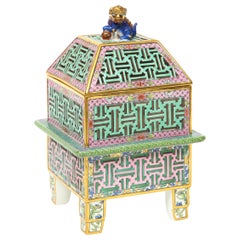
Rare Meissen Marcolini Porcelain Chinoiserie Incense Burner Vase and Cover
By Meissen Porcelain
Located in Queens, NY
A rare Meissen Marcolini Porcelain Chinoiserie incense burner vase and cover, made for the Chinese market, circa 1800, blue cross swords and star mark, Pressnummer 58 A Museum Quality Piece. Painted in the sought after famille rose palette with sprigs of indianische Blumen and enriched in gilding, the simulated pierced body supported by four feet painted with stylized dragons, the pierced cover with a Buddhist lion finial. 10" high x 6" wide x 6" deep The shape of this piece, which appears to be unrecorded in the literature, is inspired by similar Chinese porcelain censers from the Qing Dynasty, Kangxi Period (1654-1722). An example in the Palace Museum, Beijing, is illustrated by Li Yi-hua in Qing Porcelain of Kangxi, Yongzheng and Qianlong Periods from the Palace Museum Collection, Hong Kong, 1989, pl. 65. Another in the British Museum, London (museum no. PDF, A.812) is catalogued as a perfume-holder. These porcelain examples are in turn inspired by ancient Chinese bronzes from both the Shang (1600-1046 BC) and the Zhou (1046-246 BCE) dynasties, an example of which was sold anonymously by Christie's New York, 22 March 2019, lot 1601. This chain of inspiration tracking backwards from the 19th century to antiquity provides a clear example of how ceramics, and indeed other mediums, are able to influence and motivate the works of later generations. For a Meissen porcelain snuff...
Category

Late 18th Century German Chinoiserie Antique Meissen Porcelain Ceramics

Materials

Porcelain

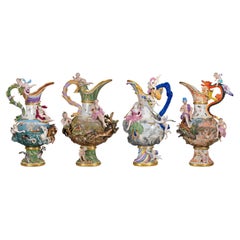
Complete Set of Four Meissen Elements Ewers
By Meissen Porcelain
Located in Tarzana, CA
This extremely important set of Meissen ewers represents the Four Elements: Earth, Air, Water and Fire. Impressive in both size and artistry, they are among the most famous and spectacular examples of Meissen porcelain ever made. Each vase is an incredible piece of artwork, interpreting one of the four elements into a stunning vase form of unsurpassed quality and execution. First introduced by Meissen artist Johann Joachim Kändler around 1735 the Four Elements represent that height of his achievements with fine porcelain creations. Water with a relief naval scene flanked by the figures of a galloping horses, mermaid and the god Neptune. The circular flaring base has decorations of spouting dolphins among bulrushes. Air is portrayed with flying birds and billowing clouds, all under the reign of Juno, the goddess who personifies air, and her peacock. Earth is represented by a detailed hunt scene and presided over by Pan, the Greek god of woods and fields. Fire is represented by a dragon-shaped handle, animals fleeing the burning forest and Vulcan, the god of fire. Each ewer is marked to the underside with Meissen blue crossed swords. They are first quality with no cancelation marks. Johann Joachim Kändler was a German sculptor who became the most important modeller of the Meissen porcelain manufactory, and arguably of all European porcelain. He worked at Meissen...
Category

19th Century German Antique Meissen Porcelain Ceramics

Materials

Porcelain

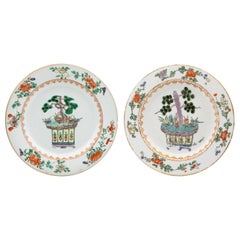
Pair of 18th Century Chinese Meissen Famille Verte Porcelain Plates
By Meissen Porcelain
Located in Fort Lauderdale, FL
A pair of famille verte porcelain plates, the left made in China during the Kangxi period (r. 1662–1722) and the right a copy by Meissen made circa 1740. Chinese porcelain has alw...
Category

Early 18th Century Chinese Chinese Export Antique Meissen Porcelain Ceramics

Materials

Porcelain

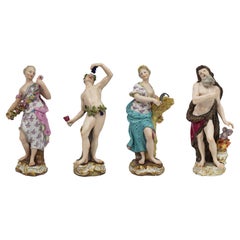
Set of 19th c. Meissen Four Seasons Figurines
By Meissen Porcelain
Located in Worcester, GB
19th Century Meissen Porcelain Figurines – Set of the Four Seasons A finely modelled set of four Meissen porcelain figures representing the Four Seasons, produced in the 19th centur...
Category

19th Century German Antique Meissen Porcelain Ceramics

Materials

Porcelain

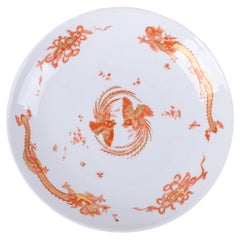
Meissen K.H.C. Royal Saxon Court Pantry Red Dragon Charger
By Meissen Porcelain
Located in Savannah, GA
Meissen K.H.C. Royal Saxon Court Pantry Red Dragon Charger A Meissen porcelain charger in the Red Dragon pattern marked with blue crossed swords for Me...
Category

Mid-18th Century German Antique Meissen Porcelain Ceramics

Materials

Porcelain

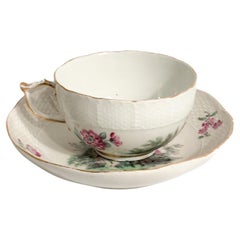
Meissen Porcelain Coffee Cup Painted with Classic Scenes from the 1800s
By Meissen Porcelain
Located in Milano, MI
Meissen porcelain coffee cup painted with classical scenes, made in the 19th Century Dish: Ø 14 cm Meissen porcelain is considered one of the earliest and finest examples of Europe...
Category

1850s German Classical Roman Antique Meissen Porcelain Ceramics

Materials

Porcelain

18th Century German Decorated Meissen Teapot
By Meissen Porcelain
Located in Charlottesville, VA
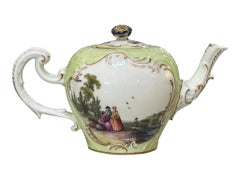
Meissen teapot decorated with countryside and riverside scenes populated by traveling figures and framed by raised and gilt foliage designs against a pastel green background embellished with floral motifs and raised foliage designs. Spout and handle feature gilt accents and foliage designs and the lid is finished with a floral design in high relief and two scenes of figures in the countryside. Marked on underside with blue crossed swords hallmark. Provenance: Collection of Martin and Helene Schwalberg, owners of The Meissen Shop founded on June 23, 1978, on Worth Ave...
Category

18th Century German Antique Meissen Porcelain Ceramics

Materials

Ceramic

Three Meissen Porcelain Plates Showing Old Master Paintings
By Meissen Porcelain
Located in London, GB
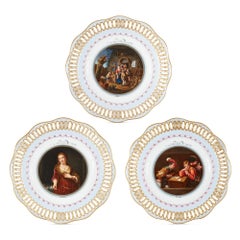
Three Meissen porcelain plates showing Old Master paintings German, c. 1880 Height 3.5cm, diameter 24cm Created by the renowned German porcelain ...
Category

Late 19th Century German Baroque Antique Meissen Porcelain Ceramics

Materials

Porcelain

Meissen Porcelain Winter and Spring Figural Group
By Meissen Porcelain
Located in New Orleans, LA
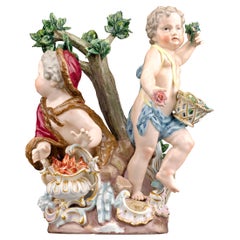
Entitled Winter and Spring this Meissen Porcelain figural group features a cloaked putto staying warm by a fire (Winter) and another gathering flowers (Spring). Part of the company's...
Category

Late 19th Century German Other Antique Meissen Porcelain Ceramics

Materials

Porcelain

Early Meissen Porcelain Teapot circa 1715 from the Arnhold Collection
By Meissen Porcelain
Located in Fort Lauderdale, FL
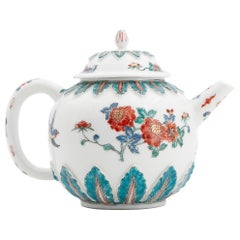
An early Meissen porcelain teapot made circa 1715, decorated by a Dutch hausmaler circa 1730-1740. The teapot is decorated in a Kakiemon pa...
Category

Early 18th Century German Other Antique Meissen Porcelain Ceramics

Materials

Porcelain

Meissen Porcelain Large Plate or Charger Hand Painted and Gilded, circa 1870
By Meissen Porcelain
Located in Lincoln, Lincolnshire
This is a beautiful large plate or charger, with a finely hand painted pattern by the Meissen factory in fine white porcelain and dating to the 19th century, circa 1870. The plate h...
Category

19th Century German Antique Meissen Porcelain Ceramics

Materials

Porcelain

Meissen, Cupid in Trouble, 19th Century
By Meissen Porcelain
Located in Brighton, Sussex
A very good quality 19th century Meissen porcelain group, depicting a cupid in trouble, crossed swords to the base.
Category

19th Century German Antique Meissen Porcelain Ceramics

Materials

Porcelain

19th Century Meissen Porcelain Group of Blind Man s Buff
By Meissen Porcelain
Located in Brighton, Sussex
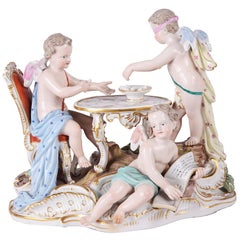
A good quality 19th century Meissen Porcelain group of three cherubs playing blind man’s buff. One blind folded, one seated on a chair the other reading on ...
Category

Late 19th Century German Antique Meissen Porcelain Ceramics

Materials

Porcelain

Related Items
Chinese Porcelain Plate From India Company 18th Century
Located in Beuzevillette, FR
Beautiful small white porcelain plate decorated with different flowers such as petunias and phlox. Leaves seem to fly. A small plum is hidden on the back of the plate. We discover a work of extreme finesse. The lines are very fine and delicate. The arrival of porcelain in Europe was linked to the development of shipping and international trade. Porcelain was very popular in Europe because of its lightness and durability. The importation from China is linked to the lack of mastery of this technique by the Europeans. The French, Dutch and British East India...
Category

Mid-18th Century Chinese Chinese Export Antique Meissen Porcelain Ceramics

Materials

Porcelain

Chinese Porcelain Plate From India Company 18th Century
$170 Sale Price
20% Off
H 1.19 in Dm 8.27 in
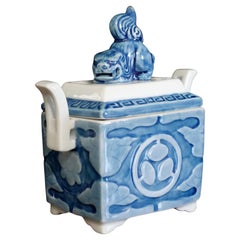
Old Japanese Porcelain Lidded Incense Burner in the Original Box
Located in Norton, MA
Old Japanese porcelain lidded incense burner in the original box The lid with the lion, two pierced handles on each side, and four feet at the four corners to stand. This is an old...
Category

Mid-20th Century Meissen Porcelain Ceramics

Materials

Porcelain

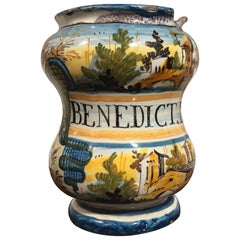
18th Century Italian Waisted Albarello
Located in Stamford, CT
An Italian Baroque Castelli albarllo, also known as a pharmacy or drug jar. It held 'Benedict Laxat' listed as far back as Aristotle as a medication used in by midwives. Beautifully decorated with buildings in landscapes in the free, almost impressionistic style typical of Castelli Maiolica...
Category

18th Century Italian Baroque Antique Meissen Porcelain Ceramics

Materials

Ceramic

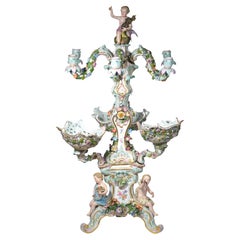
Monumental Meissen Porcelain Four Elements Centerpiece/Candelabra
By Meissen Porcelain
Located in New York, NY
A Monumental Meissen Porcelain Elemental Centerpiece/Candlabra with Bowls and Candelabra Arms. The centerpiece is composed of porcelain in a multipart structure integrating both bow...
Category

1860s German Rococo Antique Meissen Porcelain Ceramics

Materials

Porcelain

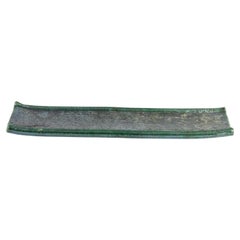
Japanese Modern Incenso Incense Holders Raku Ceramics Green Copper
By LAAB Milano
Located in monza, Monza and Brianza
An extraordinary addition to a contemporary decor for a stunning visual allure, this incense holder features a raw, porous shape deftly handcrafted and fire with the Raku Japanese...
Category

21st Century and Contemporary Italian Modern Meissen Porcelain Ceramics

Materials

Ceramic

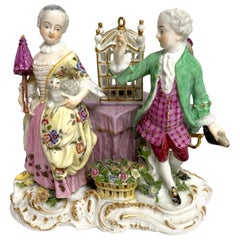
19th Century Meissen Birdcage Grouping
By Meissen Porcelain
Located in West Palm Beach, FL
19th Century Meissen Birdcage Grouping Germany Circa 1880 This enchanting 19th-century Meissen birdcage grouping, made in Germany circa 1880, is a re...
Category

Late 19th Century German Antique Meissen Porcelain Ceramics

Materials

Porcelain

19th Century Meissen Birdcage Grouping
$1,516 Sale Price
20% Off
H 5 in W 5.5 in D 4.5 in
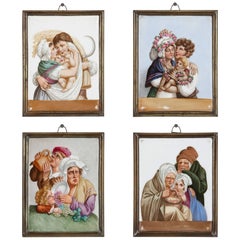
Four Meissen Porcelain Plaques Depicting the Four Seasons
By Meissen Porcelain
Located in London, GB
This delicately detailed set of four allegorical porcelain plaques portrays family scenes within the theme of the four seasons: Spring, Summer, Autumn and Winter. Spring can be ide...
Category

Early 19th Century German Folk Art Antique Meissen Porcelain Ceramics

Materials

Metal

Four Meissen Porcelain Plaques Depicting the Four Seasons
$10,258 / set
H 4.73 in W 3.94 in D 2.37 in
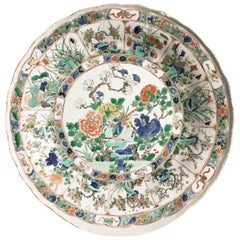
Kangxi Famille Verte Porcelain Large Dish, Qing Dynasty, 17th/18th c
Located in Austin, TX
A large and magnificent Chinese famille verte enameled porcelain large dish or charger, Qing Dynasty, Kangxi Period (1662 - 1722), circa 1700, China. The shallow, shaped dish of fo...
Category

Early 1700s Chinese Qing Antique Meissen Porcelain Ceramics

Materials

Enamel

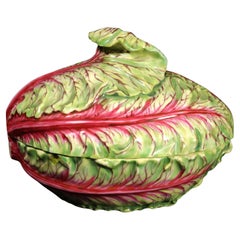
Marcolini Meissen Porcelain Red Cabbage Tureen and Cover
By Meissen Porcelain
Located in Downingtown, PA
Botanical Jewel: Rare Marcolini Meissen Porcelain Red Cabbage Tureen Origin: Meissen, Germany Period: Marcolini Era (Late 18th Century, c. 1774–1814) Material: Hard-Paste Porcelai...
Category

Late 18th Century German Rococo Antique Meissen Porcelain Ceramics

Materials

Ceramic, Porcelain

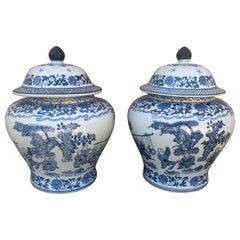
Chinoiserie Large Blue and White Porcelain Covered Jars, Pair
Located in Elkhart, IN
A stunning pair of blue & white porcelain Chinoiserie covered ginger jars China, 20th century Measures: 12"W x 12"D x 17"H. Very good vintage condition.
Category

20th Century Chinese Chinoiserie Meissen Porcelain Ceramics

Materials

Ceramic

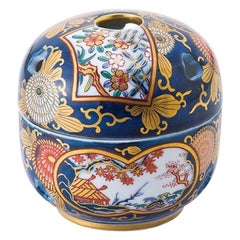
Japanese Contemporary Ko-Imari Gold Blue Porcelain Koro Incense Burner
Located in Takarazuka, JP
Stunning contemporary Japanese Ko-Imari style porcelain koro or incense burner or jewelry box, hand painted on a beautifully shaped round body in cobalt blue, red and green and gener...
Category

21st Century and Contemporary Japanese Meiji Meissen Porcelain Ceramics

Materials

Gold

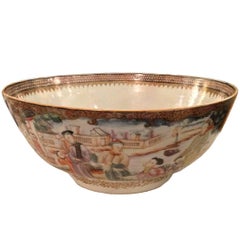
Chinese Export Qing Qianlong Famille Rose Medallion Porcelain Bowl
Located in Long Island City, NY
This finely decorated Qing-period rose medallion or rose mandarin bowl is beautifully hand-painted with four vignettes depicting courtly scenes.
Category

1770s Chinese Qing Antique Meissen Porcelain Ceramics

Materials

Porcelain

Previously Available Items
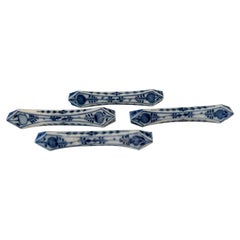
Set of 4, Antique Meissen Blue Onion Pattern Knife Rests Circa 19th century
By Meissen Porcelain
Located in Atlanta, GA
Meissen (German, founded 1710), circa late 19th century. A set of 4 antique Meissen blue onion pattern knife rests. Each marked appropriately.
Category

19th Century German Baroque Antique Meissen Porcelain Ceramics

Materials

Porcelain

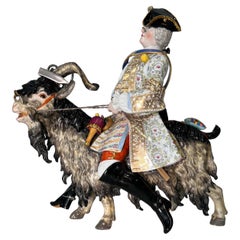
Large Meissen Porcelain Group of Count Bruhl s "Tailor on a Goat", 19th Century
By Meissen Porcelain
Located in Tarzana, CA
Meissen's “Count Brühl’s Tailor on a Goat” is widely regarded as one of the most iconic masterpieces produced by the renowned porcelain manufacture...
Category

Late 19th Century German Other Antique Meissen Porcelain Ceramics

Materials

Porcelain

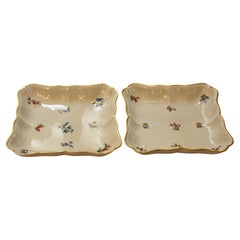
Pair of Meissen Square Sweetmeat Serving Dishes
By Meissen Porcelain
Located in Chapel Hill, NC
Pair of square serving dishes or sweetmeats with gilt shaped edges (minor wear), by Meissen in the scattered flowers or streublumen pattern. Crossed swords mark. c.1860-90. 8 1/4" sq...
Category

Late 19th Century German Antique Meissen Porcelain Ceramics

Materials

Ceramic

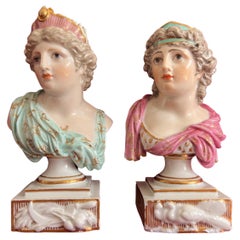
Pair of Meissen Porcelain Busts of Ceres Juno, circa 1800
By Meissen Porcelain
Located in Exeter, GB
A pair of Meissen porcelain busts circa 1800 Ceres and Juno. Very finely modelled, hand painted and gilded. Crossed swords mark to base and impressed model numbers. Condition: ...
Category

Early 19th Century German Antique Meissen Porcelain Ceramics

Materials

Porcelain

Porcelain Plate from Meissen, Germany, Late 19th Century
By Meissen Porcelain
Located in Chorzów, PL
Blue onion plate from Meissen Germany Signature from late 19th century Very good condition, small chip shown at the picture.
Category

Late 19th Century German Antique Meissen Porcelain Ceramics

Materials

Porcelain

Porcelain plate from Meissen, Germany, 1882-1929
By Meissen Porcelain
Located in Chorzów, PL
Blue onion plate from Meissen Germany. Signature from 1882-1929. Excellent condition. Diameter 33 cm.
Category

Early 20th Century German Meissen Porcelain Ceramics

Materials

Porcelain

Pair 19th Century Meissen Porcelain Cockatoos
By Meissen Porcelain
Located in Brighton, Sussex
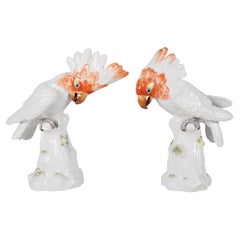
A fine quality pair of exotic late 19th Century Meissen Porcelain Cockatoos. Each perched on a tree trunk and with blue crossed Meissen marks to th...
Category

Late 19th Century German Antique Meissen Porcelain Ceramics

Materials

Porcelain

Pair 19th Century Meissen Porcelain Cockatoos
H 10.63 in W 7.88 in D 7.09 in
13 Pc Assorted Antique Gilded Blue Onion Meissen Tettau China Dinnerware
By Meissen Porcelain
Located in Dayton, OH
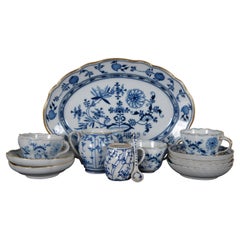
Lot of thirteen 19th century dinnerware pieces by Meissen and Königlich privilegierte Porzellanmanufaktur Tettau, Sontag & Maisel (1879–1902), featur...
Category

19th Century Victorian Antique Meissen Porcelain Ceramics

Materials

Ceramic

Pair Meissen Parrots, circa 1900
By Meissen Porcelain
Located in Brighton, Sussex
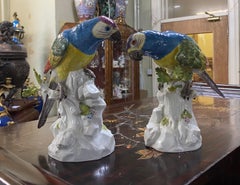
A beautiful pair of early 20th Century Meissen porcelain parrots, each perched on a rocky outcrop and tree trunk, with wonderful bold exotic colours.
Category

Early 20th Century German Meissen Porcelain Ceramics

Materials

Porcelain

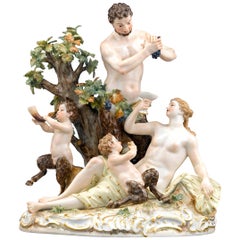
Meissen Porcelain Bacchanalian Group
By Meissen Porcelain
Located in New Orleans, LA
This large porcelain group by Meissen epitomizes that beloved firm's mastery of mythological themes. Capturing a bacchante, a follower of Bacchus, making merry with fauns and a satyr...
Category

19th Century German Greco Roman Antique Meissen Porcelain Ceramics

Materials

Porcelain

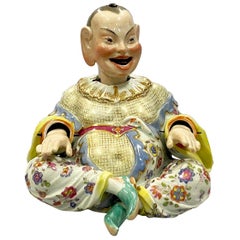
19th Century Meissen Nodding Pagoda
By Meissen Porcelain
Located in Brighton, Sussex
A very good quality late 19th century Meissen porcelain pagoda with nodding head and hands, having wonderful bold hand painted colors with gilded and floral decoration. Measures: 7.5...
Category

Late 19th Century German Antique Meissen Porcelain Ceramics

Materials

Porcelain

19th Century Meissen Nodding Pagoda
H 7.49 in W 7.09 in D 7.09 in
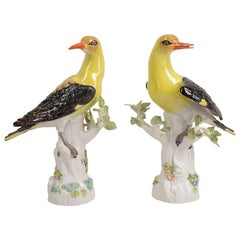
Pair of Late 19th Century Meissen Oriel Birds
By Meissen Porcelain
Located in Brighton, Sussex
A good quality pair of late 19th century Meissen Oriel birds, each with this wonderful yellow coloring, perched on tree trunks, having the blue crossed swords to the base.
Category

Late 19th Century German Antique Meissen Porcelain Ceramics

Materials

Porcelain

Pair of Late 19th Century Meissen Oriel Birds
H 10.24 in W 7.09 in D 5.12 in

Meissen Porcelain ceramics for sale on 1stDibs.

Meissen Porcelain ceramics are available for sale on 1stDibs. These distinctive items are frequently made of ceramic and are designed with extraordinary care. There are many options to choose from in our collection of Meissen Porcelain ceramics, although beige editions of this piece are particularly popular. Many of the original ceramics by Meissen Porcelain were created in the Baroque style in germany during the 19th century. Prices for Meissen Porcelain ceramics can differ depending upon size, time period and other attributes — on 1stDibs, these items begin at $223 and can go as high as $185,000, while a piece like these, on average, fetch $6,758.
Questions About Meissen Porcelain Ceramics
  • 1stDibs ExpertApril 5, 2022
    To spot a fake Meissen, first, check the maker’s mark, generally found on the bottom of the porcelain. Meissen used a simple mark, so if you spot one that appears too embellished, it may be a fake. Shop a collection of properly vetted Meissen porcelain from some of the world’s top dealers on 1stDibs.

Still Thinking About These?

All Recently Viewed