Natori Shunsen Art
to
2
Overall Width
to
Overall Height
to
2
1
1
2
2
2
10,222
2,785
2,504
1,384
2
Artist: Natori Shunsen
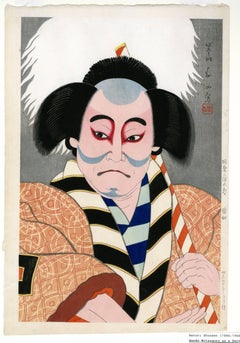
Bando Mitsugoro as a Servant with a Sword
By Natori Shunsen
Located in Fairlawn, OH
Bando Mitsugoro as a Servant with a Sword
Color woodcut, 1952
From The Series Shunsen Nigao-E Shu (Shunsen Portraits), Six Woodblock Prints
Publisher: Watanabe
Excellent condition
Im...
Category
1950s Other Art Style Natori Shunsen Art
Materials
Woodcut
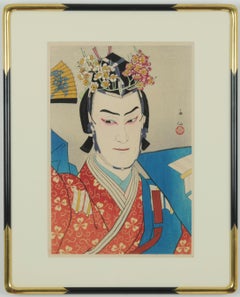
Morita Kanya XIII As Genta Kagesue in the play Genta Kando
By Natori Shunsen
Located in Fairlawn, OH
Morita Kanya XIII As Genta Kagesue in the play Genta Kando
Color woodcut, 1928
Signed and stamped middle right edge
Natori stamp lower left image edge
Series: Collection of Creative...
Category
1920s Showa Natori Shunsen Art
Materials
Woodcut
Related Items
"Enshoku Sanju-roku Kasen" (Thirty-six Enchanting Flowers) Woodblock on paper
By Toyohara Kunichika
Located in Soquel, CA
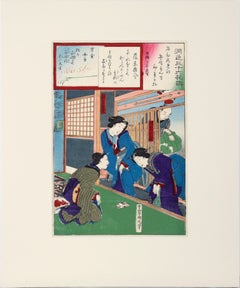
"Enshoku Sanju-roku Kasen" (Thirty-six Enchanting Flowers) Woodblock on paper
Elegant woodblock print by Toyohara Kunuchika (Japanese, 1835-1900). Three women are in talking with each other inside, while a man waits outside holding a bag of some kind. The colors in this piece are rich and saturated, primarily blues, greens, and purple.
Mat size: 16"H x 20"W
Paper size: 14.75"H x 9.88"W
Born in 1835, Toyohara Kunichika grew up in the Kyobashi district of Edo in the midst of merchants and artisans. In 1848, at age 13, he was accepted as an apprentice into the studio of Utagawa Kunisada I...
Category
1880s Edo Natori Shunsen Art
Materials
Ink, Rice Paper, Woodcut

$475
H 20 in W 16 in D 0.25 in
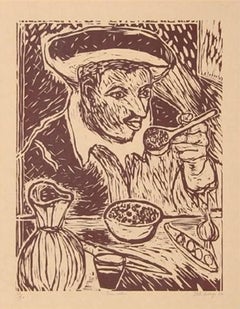
The Bean Eater
By Italo Scanga
Located in New York, NY
Italo Scanga was born in the Calabria region of Italy, and at 14 immigrated to the United States with his family after World War II. Living in Detroit, he worked on the General Motor...
Category
1980s Contemporary Natori Shunsen Art
Materials
Woodcut
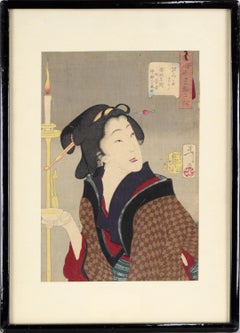
"Thirsty: the appearance of a town geisha in the Ansei era" - Woodblock on Paper
By Tsukioka Yoshitoshi
Located in Soquel, CA
"Thirsty: the appearance of a town geisha in the Ansei era" - Woodblock on Paper
From the series "Thirty-two Aspects of Customs and Manners" (Fuzoku sanjuniso)
Lively woodblock of a...
Category
1880s Edo Natori Shunsen Art
Materials
Paper, Ink, Woodcut
$950
H 20 in W 14 in D 0.75 in
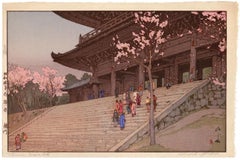
Chion-in Temple Gate
from
Eight Scenes of Cherry Blossoms
— Jizuri Seal
By Hiroshi Yoshida
Located in Myrtle Beach, SC
Hiroshi Yoshida, 'Chion-in Temple Gate (Sunset)' from the series 'Eight Scenes of Cherry Blossoms (Sakura hachi dai: Sakura mon)', color woodblock print, 1935. Signed in brush 'Yoshida' and in pencil 'Hiroshi Yoshida'. A superb, early impression, with fresh colors; the full sheet with margins, on cream Japan paper; an area of slight toning in the top right sheet corner, not affecting the image, otherwise in excellent condition. Marked with a jizuri (self-printed) seal, upper left margin. Self-published by the artist.
Image size 9 5/8 x 14 3/4 inches (444 x 375 mm); sheet size 10 7/8 x 16 inches (276 x 406 mm). Archivally sleeved, unmatted.
Provenance: M. Nakazawa, Tokyo.
Literature: Japanese Landscapes of the 20th Century (Hotei Publishing calendar), 2001, May.
Collections: Honolulu Museum of Art, Museum of Fine Arts, Boston.
ABOUT THE IMAGE
Located in Kyoto, Chionin is the main temple of the Jodo sect of Japanese Buddhism, one of the most popular Buddhist sects in Japan, having millions of followers. The Sanmon Gate, Chionin's entrance gate, standing 24 meters tall and 50 meters wide, it is the largest wooden temple gate in Japan and dates back to the early 1600s. Behind the gate, a broad set of stairs leads to the main temple grounds.
ABOUT THE ARTIST
Painter and printmaker Yoshida Hiroshi (1876-1950) is regarded as one of the greatest artists of the Japanese 'shin hanga' (New Print) movement.
Yoshida was born as the second son of Ueda Tsukane in Kurume, Fukuoka Prefecture, a schoolteacher from an old samurai family. In 1891 he was adopted by his art teacher Yoshida Kasaburo in Fukuoka and took his surname. In 1893 he went to Kyoto to study painting, and the following year to Tokyo to join Koyama Shotaro's Fudosha private school; he also became a member of the Meiji Fine Arts Society. These institutions taught and advocated Western-style painting, greatly influencing Yoshida’s artistic development.
In 1899 Yoshida had his first American exhibition at Detroit Museum of Art (now Detroit Institute of Art), making the first of many visits to the US and Europe. In 1902 he helped reorganize the Meiji Fine Arts Society, renaming it the Taiheiyo-Gakai (Pacific Painting...
Category
1930s Showa Natori Shunsen Art
Materials
Woodcut
$3,600
H 9.63 in Dm 14.75 in
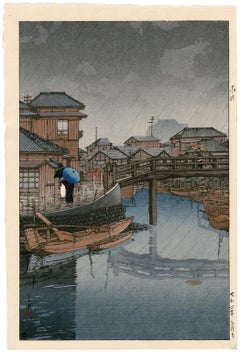
Rain at Shinagawa, Ryoshimachi
— Showa-era Woodblock Print
By Kawase Hasui
Located in Myrtle Beach, SC
Kawase Hasui, 'Rain at Shinagawa, Ryoshimachi' from the series 'Selection of Views of the Tokaido', woodblock print, 1931. A very fine, atmospheric impression, with fresh colors; the...
Category
1930s Showa Natori Shunsen Art
Materials
Woodcut
$2,250
H 14.25 in W 9.38 in
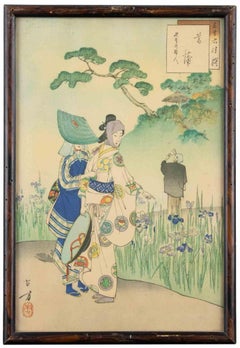
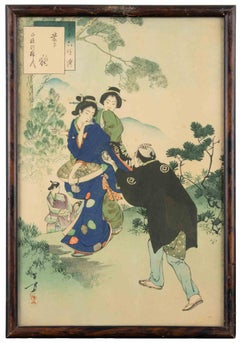
Sanjûroku Kasen ... - Woodcut by Mizuno Toshikata - 1893
By Mizuno Toshikata
Located in Roma, IT
Nishiki-e (woodcut print), in vertical oban format (31x20.5) realized by Mizuno Toshikata in 1893 (Meiji 26).
Belongs to the Series "Sanjûroku Kasen" (Thirty-Six Beauties in Compari...
Category
1890s Modern Natori Shunsen Art
Materials
Woodcut
$379
H 12.21 in W 8.08 in D 0.04 in
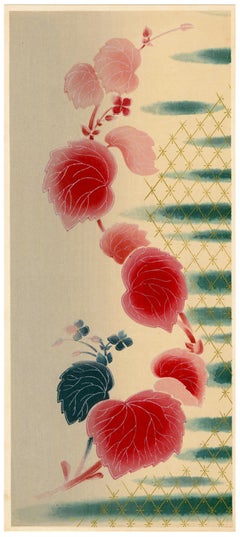
Japanese Kimono Fabric Design — Vintage Color Woodblock Print
Located in Myrtle Beach, SC
Anonymous, Japanese Kimono Fabric Design, color woodcut, c. 1930. A superb impression, with fresh colors, fine graduations, and metallic gold motifs, on ...
Category
Early 1900s Showa Natori Shunsen Art
Materials
Woodcut
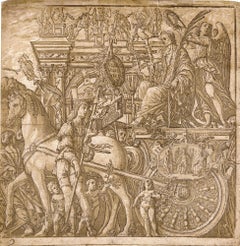
The Triumph of Caesar: Plate IV of IX
By Andrea Mantegna
Located in Middletown, NY
Andreani, Andrea, after Andrea Mantegna
The Triumph of Caesar: Plate IV of IX
1599. Chiaroscuro woodcut in colors printed from four blocks on laid paper in dark brown, grey, and thr...
Category
16th Century Old Masters Natori Shunsen Art
Materials
Handmade Paper, Laid Paper, Ink, Woodcut
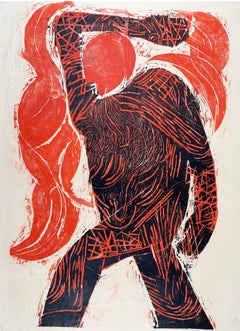
Prometheus — Mythological Figure in Expressive Red and Black by William Wolff
By William Wolff
Located in Palm Springs, CA
Wolff’s woodcut of the mythological figure of Prometheus is carved and printed in only two strong colors—black and a fiery red-orange—yet the impact is monumental. The central figure...
Category
1990s Contemporary Natori Shunsen Art
Materials
Woodcut
$450 Sale Price
25% Off
H 30.25 in W 21 in
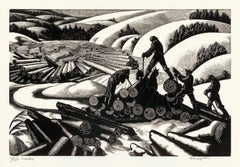
Landing
from the
Lumber Camp
series — American Modernism
By Clare Leighton
Located in Myrtle Beach, SC
Clare Leighton, 'Landing' from the series 'Lumber Camp', wood engraving, edition 100, 1931. Signed, titled, and numbered 75/100 in pencil. A fine, richly-inked impression, on off-whi...
Category
1930s American Modern Natori Shunsen Art
Materials
Woodcut
$3,000
H 8.25 in W 12.38 in
Sanjûroku Kasen... - Woodcut by Mizuno Toshikata - 1893
By Mizuno Toshikata
Located in Roma, IT
Nishiki-e (woodcut print), in vertical oban format (31x20.5) realized by Mizuno Toshikata in 1893 (Meiji 26).
Belongs to the Series "Sanjûroku Kasen" (Thirty-Six Beauties in Compari...
Category
1890s Modern Natori Shunsen Art
Materials
Woodcut
$355
H 12.21 in W 8.08 in D 0.04 in
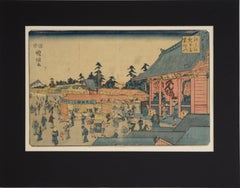
"The Kaminarimon at the Kanseon Temple in Asakusa" - Original Japanese Print
Located in Soquel, CA
"The Kaminarimon at the Kanseon Temple in Asakusa" - Original Japanese Print
Japanese Print "The Kaminarimon at the Kanseon Temple in Asakusa", from the series "Famous Places in Ed...
Category
1850s Showa Natori Shunsen Art
Materials
Rice Paper, Woodcut
$850
H 14 in W 18 in D 1 in
Previously Available Items
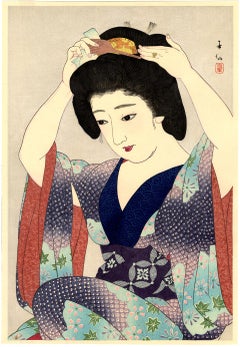
Beauty Before the Mirror
By Natori Shunsen
Located in Burbank, CA
A young Japanese beauty adjusts her hair comb, gazing left into an unseen mirror. The elaborate patterns on the kimono have been precisely printed, and the work features a light silv...
Category
Early 20th Century Showa Natori Shunsen Art
Materials
Mulberry Paper, Woodcut
Natori Shunsen art for sale on 1stDibs.
Find a wide variety of authentic Natori Shunsen art available for sale on 1stDibs. You can also browse by medium to find art by Natori Shunsen in woodcut print and more. Not every interior allows for large Natori Shunsen art, so small editions measuring 10 inches across are available. Customers who are interested in this artist might also find the work of Ohara Koson, and Kawase Hasui. Natori Shunsen art prices can differ depending upon medium, time period and other attributes. On 1stDibs, the price for these items starts at $2,000 and tops out at $2,250, while the average work can sell for $2,125.