Nura Ulreich Landscape Prints
American, 1899-1950
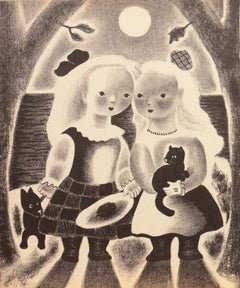
Nora Woodson Ulreich was born in 1899 in Kansas City, Missouri, and was known professionally as “Nura.” She was a painter, printmaker, author, and illustrator, particularly of children’s books. Ulreich studied at the Kansas City Art Institute, the Chicago Academy of Fine Arts, and the Art Students League in New York. She also studied in Paris where she met her Hungarian-born husband, fellow artist Eduard Buk Ulreich, and first exhibited at the Théâtre des Champs Elysées in 1926. Her style was a studied but naïve form of modernism and she often portrayed seemingly innocent views of children and their pets. Nura was a strong believer in Christian Science and sometimes included spiritual motifs in her whimsical pieces with an Art Deco-inspired palette. Nura frequently collaborated with Edward and their combined works often use the moniker “Bukannura.” In 1927, their work was exhibited at the Dudensing Gallery on 57th Street in New York. Eduard was also a muralist who completed commissions for the Treasury Department’s Section of Fine Arts between 1937 and 1940. Both Nura and Eduard are listed in Who Was Who in American Art and all other standard references.to
2
Overall Width
to
Overall Height
to
21
188
169
156
147
2
2
2
2
2
2
Artist: Nura Ulreich
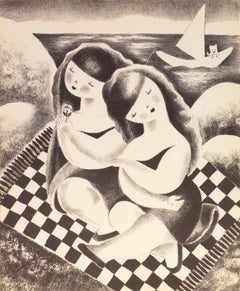
Mimi and Bemi
, Art Student
s League, Salon d
Automne, Paris, Art Deco, Surreal
By Nura Ulreich
Located in Santa Cruz, CA
A mid-century, stone lithograph titled 'Mimi and Bemi' by Nura Woodson Ulreich (American, 1899-1950), created in 1943 and with certification of authenticity stamped verso. Accompanie...
Category
1940s Nura Ulreich Landscape Prints
Materials
Paper, Lithograph
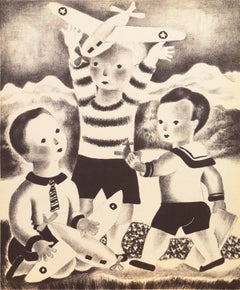
David, Walter
Blake
, Woman Artist, Art Deco, Children, Walker Art Center
By Nura Ulreich
Located in Santa Cruz, CA
A stone lithograph titled 'David, Walter and Blake' by Nura Woodson Ulreich (American, 1899-1950), created in 1943 and with certification of authenticity stamped verso. A crisp and f...
Category
1940s Nura Ulreich Landscape Prints
Materials
Paper, Lithograph
Related Items
Museum-Published Lt
d Ed. 60
s Litho Set of
As I Opened Fire
By (after) Roy Lichtenstein
Located in New Orleans, LA
This is a lithographically printed reproduction of a sensationally fun Lichtenstein triptych he painted in 1964, produced by the Stedelijk Museum...
Category
1960s Pop Art Nura Ulreich Landscape Prints
Materials
Archival Paper, Lithograph

$2,240 Sale Price
20% Off
H 25 in W 20.5 in
ABOVE THE CLOUDS
Located in Aventura, FL
Lithograph on paper. Hand signed, titled and numbered by the artist. Edition of 350.
Artwork is in excellent condition. Certificate of Authenticity is included. All reasonable o...
Category
1990s Realist Nura Ulreich Landscape Prints
Materials
Paper, Lithograph
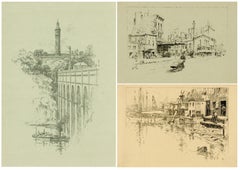
Ten of views of Manhattan (10).
By Charles Frederick William Mielatz
Located in Middletown, NY
The Society of Iconophiles (New York, 1894–1936), 1898. Each a lithograph printed on grayish-green, or white wove paper each sheet 10 3/4 x 7 1/2 inches (274 x 190 mm), each with ful...
Category
Early 20th Century American Modern Nura Ulreich Landscape Prints
Materials
Handmade Paper, Lithograph
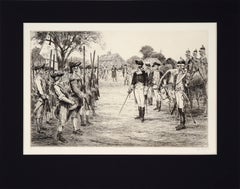
Washington Assumes Command - Etching on Paper
Located in Soquel, CA
Washington Assumes Command - Etching in Ink on Paper
Historical engraving by Ralph Ludwig Boyer (American, 1879-1952). George Washington is shown holding a sword, with an army stand...
Category
1930s Impressionist Nura Ulreich Landscape Prints
Materials
Paper, Drypoint, Lithograph
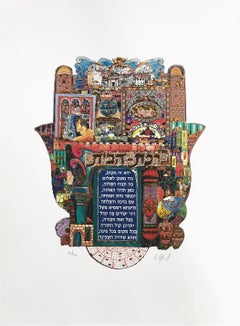
BLESSING OF THE HOUSE (JUDAICA ART)
By Amram Ebgi
Located in Aventura, FL
Lithograph with foil stamping on paper. Hand signed and numbered by the artist. From the edition of 350.
Artwork is in excellent condition. Certificate of authenticity included. A...
Category
Late 20th Century Contemporary Nura Ulreich Landscape Prints
Materials
Foil
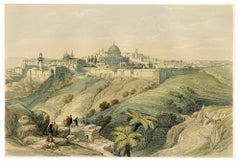
Jerusalem – The Church of the Purification
By David Roberts
Located in Middletown, NY
An image of Jerusalem from the first comprehensive collection of documentary images of the Holy Land.
London: Cassell, Petter & Galpin, circa 1850.
Lithograph with hand coloring an...
Category
Mid-19th Century English School Nura Ulreich Landscape Prints
Materials
Watercolor, Handmade Paper, Lithograph
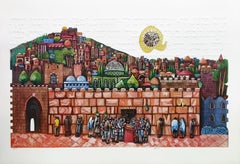
BAR MITZVAH AT THE WESTERN WALL (JUDAICA ART)
By Amram Ebgi
Located in Aventura, FL
Lithograph with foil stamping and embossing on paper. Hand signed and numbered by the artist. From the edition of 200.
Artwork is in excellent condition. Certificate of authenticit...
Category
Late 20th Century Contemporary Nura Ulreich Landscape Prints
Materials
Foil
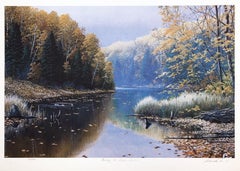
AMONG THE FALLEN LEAVES
Located in Aventura, FL
Lithograph on paper. Hand signed, titled and numbered by the artist. Edition of 350.
Artwork is in excellent condition. Certificate of Authenticity is included. All reasonable o...
Category
1990s Realist Nura Ulreich Landscape Prints
Materials
Paper, Lithograph
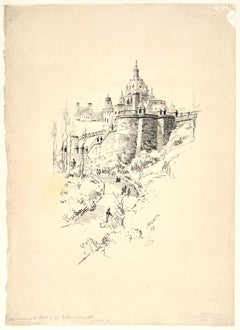
Morningside Park and St. Luke
s Hospital
By Charles Frederick William Mielatz
Located in Middletown, NY
A bucolic late 19th century image of upper Manhattan.
New York: 1898.
Lithograph on tissue-thin Japon paper with a deckle edge, 14 1/8 x 10 inches (357 x 252 mm), the full sheet. Tit...
Category
Late 19th Century American Modern Nura Ulreich Landscape Prints
Materials
Lithograph, Handmade Paper
$300
H 14.06 in W 9.93 in
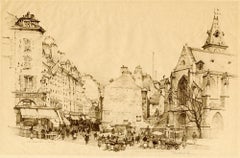
Rue Moufftard, Paris
By Samuel Chamberlain
Located in Middletown, NY
Lithograph in brown ink on lightweight, cream laid Japon paper with a deckle edge, 10 3/4 x 17 inches (274 x 432 mm), full margins. Signed and numbered 9/35 in pencil in the lower ma...
Category
Early 20th Century Realist Nura Ulreich Landscape Prints
Materials
Handmade Paper, Lithograph
CHILDREN
S PLAYHOUSE (JUDAICA ART)
By Amram Ebgi
Located in Aventura, FL
Lithograph in colors on paper. Hand signed and numbered by the artist. From the edition of 450.
Artwork is in excellent condition. Certificate of authenticity included. All reason...
Category
Late 20th Century Contemporary Nura Ulreich Landscape Prints
Materials
Paper, Lithograph

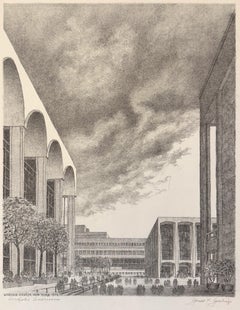
Acropolis Americana - Lincoln Center, New York 1975
By Gerald Geerlings
Located in Middletown, NY
Zinc lithograph on cream wove paper, 12 3/4 x 10 inches (272 x 253 mm), full margins. Signed and titled in pencil, lower margin. One work from the series titled "Salute to New York,"...
Category
20th Century American Modern Nura Ulreich Landscape Prints
Materials
Handmade Paper, Lithograph
Previously Available Items
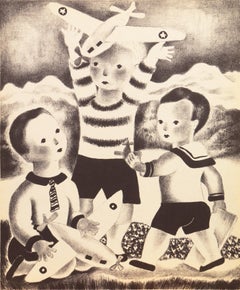
Bert, Bob and Betsy
, Paris, Salon d
Automne, New York, ASL, Corcoran, PAFA
By Nura Ulreich
Located in Santa Cruz, CA
A stone lithograph titled 'Bert, Bob and Betsy' by Nura Woodson Ulreich (American, 1899-1950), created in 1943 and with certification of authentic...
Category
1940s Art Deco Nura Ulreich Landscape Prints
Materials
Paper, Lithograph
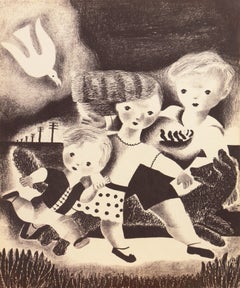
David, Walter
Blake
, Woman Artist, Art Deco, children, Walker Art Center
By Nura Ulreich
Located in Santa Cruz, CA
A stone lithograph titled 'David, Walter and Blake' by Nura Woodson Ulreich (American, 1899-1950), created in 1943 and with certification of authenticity stamped verso. Accompanied by the artist's poem.
This notable woman painter, illustrator, muralist, lithographer, author and poet first studied at the Kansas City Art Institute before attending the Chicago Academy of Fine Arts and the Art Students League in New York. Nura Woodson then studied under John French Sloan and, later, with Frederic Gruger. She subsequently moved to Paris where she lived and painted for several years and where she met and married her husband, the Hungarian-American artist Buk Ulreich. While in France, she exhibited with success, including at the Salon d'Automne, and began to paint under the brush name, 'Nura'.
After returning to the United States, Ulreich continued to exhibit widely, including at the Art Institute of Chicago, the Corcoran Galleries Biennials (1928-39), the Salons of America, the Society of Independent Artists (1928, 1941) and the Pennsylvania Academy of Fine Arts (1929-1931). Nura Ulreich...
Category
1940s Art Deco Nura Ulreich Landscape Prints
Materials
Paper, Lithograph
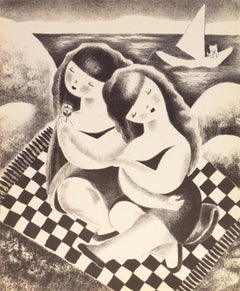
Mimi and Bemi
, Art Student
s League, Salon d
Automne, Paris, Art Deco
By Nura Ulreich
Located in Santa Cruz, CA
A mid-century, stone lithograph titled 'Mimi and Bemi' by Nura Woodson Ulreich (American, 1899-1950), created in 1943 and with certification of authenticity stamped verso. Accompanied by the artist's poem.
This notable woman painter, illustrator, muralist, lithographer, author and poet first studied at the Kansas City Art Institute before attending the Chicago Academy of Fine Arts and the Art Students League in New York. Nura Woodson then studied under John French Sloan and, later, with Frederic Gruger. She subsequently moved to Paris where she lived and painted for several years and where she met and married her husband, the Hungarian-American artist Buk Ulreich. While in France, she both studied and exhibited with success, including at the Salon d'Automne in Paris where she began to paint under the brush name, 'Nura'.
After returning to the United States, Ulreich continued to exhibit widely, including at the Art Institute of Chicago, the Corcoran Galleries Biennials (1928-39), the Salons of America, the Society of Independent Artists (1928, 1941) and the Pennsylvania Academy of Fine Arts (1929-1931). Nura Ulreich...
Category
1940s Art Deco Nura Ulreich Landscape Prints
Materials
Paper, Lithograph
Peggy and Dot
, Chicago Academy of Fine Arts, Art Students League, Smithsonian
By Nura Ulreich
Located in Santa Cruz, CA
A stone lithograph titled 'Peggy and Dot' by Nura Woodson Ulreich (American, 1899-1950), created in 1943 and with certification of authenticity stamped ve...
Category
1940s Art Deco Nura Ulreich Landscape Prints
Materials
Paper, Lithograph
Nura Ulreich landscape prints for sale on 1stDibs.
Find a wide variety of authentic Nura Ulreich landscape prints available for sale on 1stDibs. You can also browse by medium to find art by Nura Ulreich in lithograph, paper and more. Much of the original work by this artist or collective was created during the 1930s and is mostly associated with the Art Deco style. Not every interior allows for large Nura Ulreich landscape prints, so small editions measuring 9 inches across are available. Customers who are interested in this artist might also find the work of and Robin Morris. Nura Ulreich landscape prints prices can differ depending upon medium, time period and other attributes. On 1stDibs, the price for these items starts at $750 and tops out at $750, while the average work can sell for $750.