Otto Wretling Console Tables

Otto Leonard Wretling, born June 26, 1876, in the city ​​of Umeå, was a Swedish visual artist, designer, painter and furniture manufacturer. Otto Wretling is best known for the Ideal Table, patented in 1936. Together with his brother Wilhelm (1871–1951), Otto Wretling took over his father's painting company in 1897. The business was expanded in 1905 with furniture carpentry. The brother later withdrew, but Otto Wretling continued - first on his own and then with the help of the children - to run the company Otto Wretling for modern room art, which had a studio and workshops in central Umeå. The company was active until 1969. In addition to being a manufacturer, Otto Wretling was the company's first designer. The company designed its furniture but also placed orders.

to
Height
to
Width
to
Depth
to
1
1
1
1
1
1
1
1
1
1
1
1
1
1
1
1
1
8
190
79
78
78
Creator: Otto Wretling
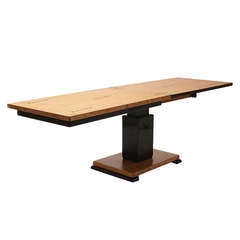
Otto Bo Wretling Table Model Ideal Produced by Otto Wretling in Sweden
By Otto Wretling
Located in Limhamn, Skåne län
Rare Ideal table designed by Otto Wretling and his son Bo Wretling. Produced by Otto Wretling in Sweden. Height adjustable (7 steps). Dimensions W 112 cm / 224 cm D 68 cm H 60...
Category

1930s Swedish Scandinavian Modern Vintage Otto Wretling Console Tables

Materials

Steel

Related Items
Console Table "Sportstugemöbel" by Carl Malmsten, Sweden, 1950s
By Carl Malmsten
Located in Hägersten, SE
Console or dining table designed by Carl Malmsten in 1953 model "Visingsö", This early example from the Beginning of the 1950s without the added screws on the short ends and visible ...
Category

1950s Swedish Scandinavian Modern Vintage Otto Wretling Console Tables

Materials

Pine

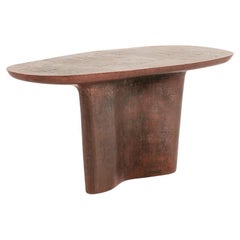
NRC Dining Table Sculptured Liquid Oxidized Copper Oval Table
By Privatiselectionem
Located in Sofia, BG
Cast liquid copper powder, the NRC Dining black oxidized copper could be easily associated with a sculpture and an art object. Rough, authentic, and strong - an accidental discovery of a curious archaeologist investigating unexplored territories. Its raw beauty is translated to the human eye by its solidified volcanic structure, revealing the deepest layers of the earth. Where the remnants of time beckon to live a new life of their own. An endless life covered...
Category

21st Century and Contemporary European Modern Otto Wretling Console Tables

Materials

Copper, Other

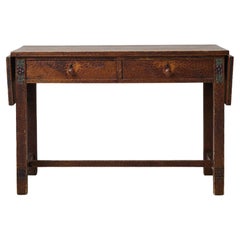
Antique Swedish Grace Desk by Otto Wretling in Pine with Hand Carved Decor
Located in Kramfors, SE
Antique Swedish Grace desk by Otto Wretling made in northern Sweden around 1915. The desk has a frame in pine with a hand carved decor which makes the surface animated and unique. Tw...
Category

Early 20th Century Swedish Scandinavian Modern Otto Wretling Console Tables

Materials

Pine

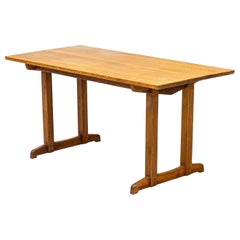
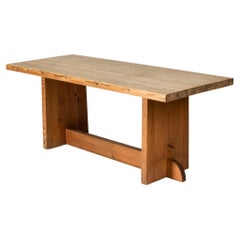
Swedish pine dining table by Bo Fjaestad for Arvika Konsthantverk, 1930s
By Axel Einar Hjorth
Located in Eskilstuna, SE
Rare dining table designed by Bo Fjaestad for Arvika Konsthantverk, Sweden, 1930s. Crafted in pine with a beautiful original patina, this table reflects a distinctly brutalist expre...
Category

Mid-20th Century Swedish Scandinavian Modern Otto Wretling Console Tables

Materials

Pine

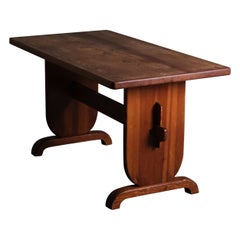
"Lovö" Dining Table by Axel Einar Hjorth for Nordiska Kompaniet, Sweden, 1930s
By NK (Nordiska Kompaniet), Axel Einar Hjorth
Located in Stockholm, SE
Lovö” dining table by Axel Einar Hjorth, made from solid pine in a clean, rustic design. Beautiful woodgrain. “Lovö” is one of the series of furniture included in NK:s “Sporstugemöb...
Category

1930s Swedish Scandinavian Modern Vintage Otto Wretling Console Tables

Materials

Pine

Niels Otto Moller model 15 dining table in rosewood Denmark 1960
By Niels Otto Møller, J.L. Møllers Møbelfabrik
Located in Etten-Leur, NL
Beautiful model 15 dining table designed by Niels Otto Møller for JL Møllers Møbelfabrik, Denmark 1960. A superb example of Danish modern craftsmanship, this piece embodies the refin...
Category

Mid-20th Century Danish Scandinavian Modern Otto Wretling Console Tables

Materials

Rosewood

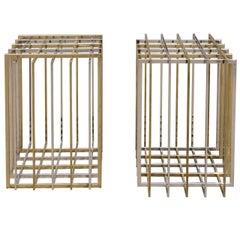
Glamorous Pair of Dining Table or Console Bases by Pierre Cardin
By Pierre Cardin
Located in Atlanta, GA
A beautiful pair of cage style table bases by Pierre Cardin, circa 1970s. Comprised of alternating flat bar squares in nickel and brass. The grid will form a square or diamond shape....
Category

1970s Unknown Mid-Century Modern Vintage Otto Wretling Console Tables

Materials

Brass, Nickel

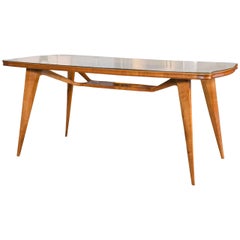
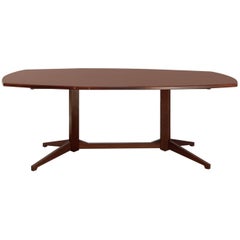
Italian Modernist Console Table in the Style of Carlo di Carli
By Carlo di Carli
Located in Stamford, CT
An extremely interesting ash and bleached walnut console table with a free-form cut-out in the tabletop revealing a unique stretcher syst...
Category

Mid-20th Century Italian Modern Otto Wretling Console Tables

Materials

Wood, Glass

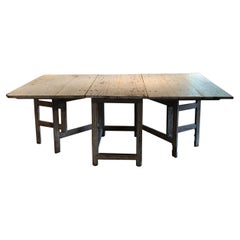
19th Century Swedish Gustavian Drop Leaf Table
Located in San Angelo, TX
A beautiful 19th century Gustavian drop leaf table with a gate leg that has been dry scrapped. This piece is truly a piece in a...
Category

Early 19th Century Swedish Gustavian Antique Otto Wretling Console Tables

Materials

Wood, Paint

19th Century Swedish Gustavian Drop Leaf Table
$7,500
H 31 in W 24 in D 43.5 in
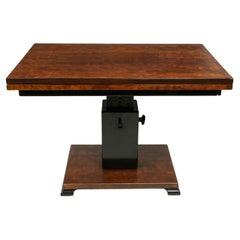
Otto Wretling "Ideal" Table
By Otto Wretling
Located in New York, NY
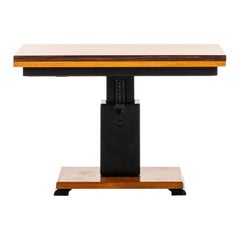
Ingeniously designed to extend in length and height so it can function as a console, dining and coffee table. The stained birch hinged rectangular top opens to dining table length; s...
Category

1930s Swedish Modern Vintage Otto Wretling Console Tables

Materials

Metal

Otto Wretling "Ideal" Table
$7,200
H 30 in W 44 in D 27 in
Franco Albini Mahogany mid-centry Italian Table Model TL-22 produced by Poggi
By Franco Albini
Located in Barcelona, ES
Franco Albini & Franca Helg. Dining table model no. TL22. Manufactured by Poggi, Italy, 1958. Mahogany. Measurements: 180.3 cm x 104.1 cm x 73 H cm. 70.98 in x 40.98 in x 28.74 in. Literature: Giuliana Gramigna, Repertorio 1950/1980, Milan, 1985, p. 123. Franco Albini, was born in 1905 and died in 1977. He spent his childhood and part of his youth in Robbiate in Brianza, where he was born. Albini, as an adolescent moved with his family to Milan. Here he enrolled in the Faculty of Architecture of the Polytechnic and graduated in 1929. He started his professional activity in the studio of Gio Ponti and Emilio Lancia, with whom he collaborated for three years. At the 1929 International Exhibition in Barcelona (where Gio Ponti curated the Italian pavilion and Mies van der Rohe realized that of Germany) and in Paris where, as Franca Helg recounted, he had the opportunity to visit the studio by Le Corbusier. In those three years, the works he carried out are admittedly of the twentieth century imprint. It is the meeting with Edoardo Persico that marked a clear turning point towards rationalism and the approach to the group of editors of "Casabella". The partly ironic and partly very harsh comments of the Neapolitan critic to a series of drawings, made by Albini for the design of some office furniture, caused him a great disturbance. “I spent days of real anguish - Albini recalls - I had to answer all the questions. I also had a fever, a large and long fever. " The meted provoked Albini to openen a professional studio in via Panizza with Renato Camus and Giancarlo Palanti. The group of architects began to deal with public housing by participating in the competition for the Baracca district in San Siro in 1932 and then building the IFACP neighborhoods: Fabio Filzi (1936/38), Gabriele D'Annunzio and Ettore Ponti (1939). During this period, Albini also worked on his first villa (Pestarini), which Giuseppe Pagano, architect and critic of the time, presented as follows: “This coherence, which the superficial rhetoric of fashionable jugglers calls intransigence, and which is instead the basis of understood between the fantasy of art and the reality of the craft, in Franco Albini, it is so rooted that it transforms theory into a moral attitude ". But it is above all in the context of the exhibitions that the Milanese master experienced his compromise between that "rigor and poetic fantasy" of which Pagano speaks, coining the elements that became a recurring theme in his . The opening in 1933 of the new Triennale headquarters in Milan, in the Palazzo dell'Arte, was an important opportunity to express the strong innovative character of rationalist thinking, a gym in which to freely experiment with new materials and new solutions, but above all a "method". "Cultivated as a communication laboratory, the art of setting up was for the rationalists of the first generation what the perspective had been for the architects of humanism: the field open to a hypothesis of space that needed profound reflections before landing the concreteness of the construction site ". Together with Giancarlo Palanti, Albini on the occasion of the V Triennale di Milano set up the steel structure house (with R. Camus, G. Mazzoleni, G. Minoletti and with the coordination of G. Pagano), for which he also designed the 'furniture. At the following Triennale of 1936, Persico dided, together with a group of young designers gathered by Pagano in the previous edition of 1933, Franco Albini took care of the preparations of the home exhibition. The setting up of Stanza per un uomo, at that same Triennale, allows us to understand the acute and ironic approach of Albini, as a man and as a designer: "Celebrating the beauty of mechanics was the imperative to which, for example, the surprising displays by Franco Albini who managed, in the subtle way of a refined and rarefied style, to sublimate their practical content in the metaphysics of daring still lifes: flying objects which marked in the void refined frames and metal intricacies the nodes of a fantastic cartography where industry finally became art free from purpose ". That same year Albini and Romano designed the exhibition of the Ancient Italian Goldsmithery: vertical uprights, simple linear rods, designed the space. A theme, of the "flagpole", seemed to be the center of the evolution of production and the creative process. The concept is reworked over time, with the technique of decomposition and recomposition typical of Albinian design: in the preparation of the Scipione Exhibition and contemporary drawings (1941) the tapered flagpoles, on which the paintings and display cases were hung, are supported by a grid of steel cables; in the Vanzetti stand (1942) they take the V-shape; in the Olivetti shop in Paris (1956) the polished mahogany uprights support the shelves for the display of typewriters and calculators. The flagpole is found, however, also in other areas. In the apartments he designed, it is used as a pivot on which the paintings can be suspended and rotated to allow different points of view, but at the same time as an element capable of dividing the spaces. The Veliero bookcase...
Category

Mid-20th Century Italian Mid-Century Modern Otto Wretling Console Tables

Materials

Mahogany

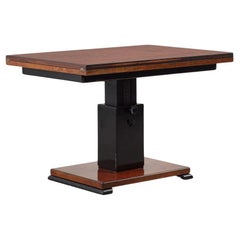
Otto Wretling Ideal table - Sweden, 1936
By Otto Wretling
Located in London, GB
An extendable rise and fall table in rosewood with wonderful presence by Swedish designer, maker and architect Otto Wretling. When opened it reveals a generous burr-veneered surface...
Category

1930s Swedish Art Deco Vintage Otto Wretling Console Tables

Materials

Burl

Otto Wretling 
Ideal
 table - Sweden,  1936
Otto Wretling 
Ideal
 table - Sweden,  1936
$8,336
H 23.63 in W 44.1 in D 26.78 in
Previously Available Items
Swedish 30 s Console / Flexi Use Idealbordet Table by Otto Wretling
By Otto Wretling
Located in New York, NY
Early Swedish Mid-Century Flexi-Use Table by Otto Wretling incorporating Modern style and technology with Neoclassical decoration appropriately named the 'Idealbordet' (Ideal Table)....
Category

1930s Swedish Scandinavian Modern Vintage Otto Wretling Console Tables

Materials

Steel

Otto Wretling console tables for sale on 1stDibs.

Otto Wretling console tables are available for sale on 1stDibs. These distinctive items are frequently made of wood and are designed with extraordinary care. There are many options to choose from in our collection of Otto Wretling console tables, although brown editions of this piece are particularly popular. Many of the original console tables by Otto Wretling were created in the Scandinavian Modern style in sweden during the 1930s. If you’re looking for additional options, many customers also consider console tables by and Axel Einar Hjorth. Prices for Otto Wretling console tables can differ depending upon size, time period and other attributes — on 1stDibs, these items begin at $8,213 and can go as high as $14,000, while a piece like these, on average, fetch $11,106.

Still Thinking About These?

All Recently Viewed