Paul Laszlo Dining Room Sets

American, Hungarian, 1900-1993

The suave architect and interior designer Paul Laszlo made his reputation in Hollywood, where his clients included Barbara Stanwyck, Cary Grant and Elizabeth Taylor. He was aligned to no artistic or design movements, relying on his own carefully honed instincts to create his celebrated lounge chairs, tables, dressers and other furnishings. From the late 1930s to the 1960s, Laszlo’s name was a byword for sumptuous modernity among members of the smart set.

Born in Hungary in 1900, Laszlo learned about quality from his father, a prosperous furniture manufacturer. He studied design in Vienna and had his technical training in Stuttgart, Germany, where, at age 27, he established an upscale design business that gained an international reputation. Nine years later, with the Nazis in power, Laszlo, a Jew, left Germany for the United States and made his way to Los Angeles. There, he established an interior design office in Beverly Hills and was pleased to find that his Stuttgart credentials carried weight.

While he took many commercial assignments for American department stores, custom residential work was Laszlo’s stock in trade. He turned his hand to every element in a room, “down to the last ashtray,” Time magazine once wrote. Like his clients, Laszlo appreciated luxury — not the luxury of rare and precious materials, but the luxury of rich colors and textures, and deep comforts. He had a contemporary élan, exemplified by spaces that were bright, airy, uncluttered and up-to-date.

The classic earmarks of Laszlo’s furnishings are generous proportions and, in the case of his Paddle and Plank armchairs, namesake armrests that are flat and wide, the perfect spot to rest a cocktail. His case goods, tables and dining chairs have clean, elegant lines; they are simply formed yet warm, with interesting details such as woven veneer door fronts.

In recent years, Laszlo’s designs have found a new audience among fans of his easygoing modernism. Prices are in the neighborhood of $5,000 for his vintage cabinets, and from $8,000 to upwards of $20,000 for seating pieces, which are generally found in pairs or groups of six or more.

There was a reason that Laszlo’s work was so admired in the mid-20th century: every design contributes to an environment that is comfortable and elegant — at once robust and relaxed.

Find vintage Paul Laszlo furniture on 1stDibs.

to
1
Height
to
Width
to
Depth
to
1
1
1
1
1
1
1
1
1
1
1
1
1
47
30
17
14
12
Creator: Paul Laszlo
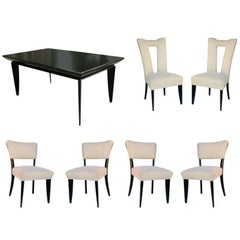
Paul Laszlo Black Lacquer Knife-Leg Dining Set for Brown Saltman
By Paul Laszlo, Brown Saltman
Located in Van Nuys, CA
This midcentury Knife-Leg dining set by Paul Laszlo for Brown Saltman featuring a sleek black lacquer wood table with a 15" leaf, along with six matching dining chairs. There are two high back end chairs in addition to four low back dining chairs...
Category

1950s American Mid-Century Modern Vintage Paul Laszlo Dining Room Sets

Materials

Oak

Related Items
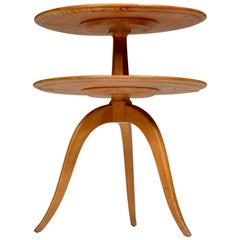
Paul Frankl Two-Tier Side Table for Brown Saltman
By Paul Frankl, Brown Saltman
Located in Los Angeles, CA
Paul Frankl two-tiered occasional table by Brown Saltman of California, circa 1950. Solidly crafted and elegantly designed. Signed and marked. We have not refinished or restore...
Category

1950s American Mid-Century Modern Vintage Paul Laszlo Dining Room Sets

Materials

Maple

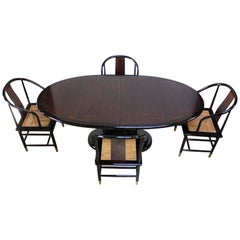
Vintage Henredon Black Lacquer and Burl Dining Set
By Henredon
Located in Brooklyn, NY
Chinoiserie-style burl and black lacquer dining set by Henredon of Morganton, NC, USA circa 1980. Oval table is composed of a burl inset surfa...
Category

1980s American Chinoiserie Vintage Paul Laszlo Dining Room Sets

Materials

Burl, Cane, Wood

Vintage Henredon Black Lacquer and Burl Dining Set
$3,600 / set
H 29.5 in W 79.5 in D 44 in
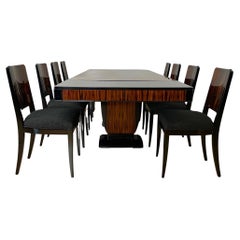
Art Deco Extending Dining Room Set, Macassar, Black Lacquer, France circa 1930
Located in Regensburg, DE
Stunning Art Deco dining room set with expandable table and eight chairs in Makassar Veneer and Black Lacquer. Extendable dining table with top and apron veneered in bright Macassar...
Category

1920s French Art Deco Vintage Paul Laszlo Dining Room Sets

Materials

Fabric, Lacquer, Macassar, Hardwood

Art Deco Extending Dining Room Set, Macassar, Black Lacquer, France circa 1930
$20,921 Sale Price / set
30% Off
H 29.53 in W 99.22 in D 39.38 in
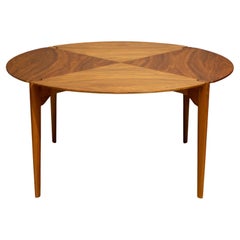
John Keal Sculpted Walnut Dining Table for Brown Saltman c.1960
By John Keal, Brown Saltman
Located in San Francisco, CA
ABOUT This original John Keal designed dining table for Brown Saltman is a prime example of California Modernism, noted for its sculpted walnut tabletop and functional design suitab...
Category

Mid-20th Century American Mid-Century Modern Paul Laszlo Dining Room Sets

Materials

Walnut

John Keal Sculpted Walnut Dining Table for Brown Saltman c.1960
$2,875 Sale Price
20% Off
H 27.25 in Dm 54 in
Paul Frankl for Brown Saltman Black Lacquered Coffee Table, Newly Refinished
By Brown Saltman, Paul Frankl
Located in South Bend, IN
A gorgeous Mid-Century Modern Hollywood Regency black lacquered oak coffee table By Paul Frankl for Brown Saltman USA, 1940s Measures: 47.75"W x 21"D x 16.5"H. Newly refi...
Category

1940s American Mid-Century Modern Vintage Paul Laszlo Dining Room Sets

Materials

Oak, Lacquer

Paul McCobb for Calvin Dining Table
By Paul McCobb
Located in Atlanta, GA
Elegant Mid Century Dining Table, designed by Paul McCobb for Calvin Furniture's Directional Line, American, circa 1960s. The table expands from a 48" round to a 68" width oval with ...
Category

1950s American Mid-Century Modern Vintage Paul Laszlo Dining Room Sets

Materials

Metal

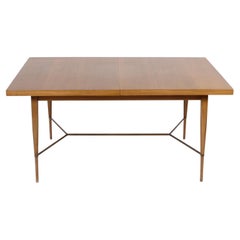
Paul McCobb Dining Table in Your Color Choice
By Paul McCobb
Located in Atlanta, GA
Paul McCobb dining table for Calvin, American, circa 1950s. Elegant design with brass stretcher. This table is currently being refinished and can be completed in your choice of color...
Category

1950s American Mid-Century Modern Vintage Paul Laszlo Dining Room Sets

Materials

Metal, Brass

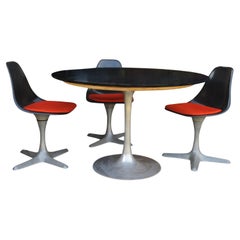
An Original Rare Black Ash Aluminium Arkana Circular Dining Table Set
By Maurice Burke, Arkana Furniture
Located in Reading, Berkshire
An Original & Rare Black Ash & Aluminium Arkana Circular Dining Table With Three Black & Orange Matching Tulip Model 115 Dining Chairs Engraved with mak...
Category

1960s British Mid-Century Modern Vintage Paul Laszlo Dining Room Sets

Materials

Chrome

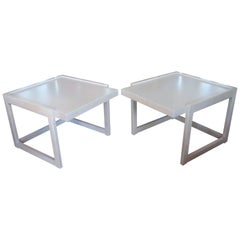
Pair of End Tables by Paul Laszlo for Brown Saltman
By Paul Laszlo
Located in St.Petersburg, FL
A pair of Classic end tables by Paul Laszlo for Brown Saltman, signed. White wash finish.
Category

1950s American Mid-Century Modern Vintage Paul Laszlo Dining Room Sets

Materials

Wood

Pair of End Tables by Paul Laszlo for Brown Saltman
$3,800 / set
H 19 in W 24 in D 26 in
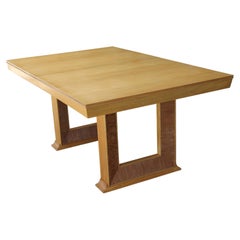
Paul Frankl for Brown Saltman Expandable Dining Table
By Brown Saltman, Paul Frankl
Located in Palm Springs, CA
Paul Frankl for Brown Saltman expandable dining table. The rectangular top having (2) 15" wide leaves, above two supports having ribbed details, with branded mark to underside. Table...
Category

1950s American Mid-Century Modern Vintage Paul Laszlo Dining Room Sets

Materials

Wood

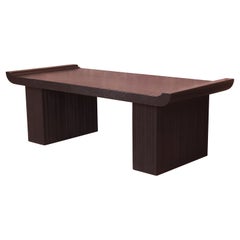
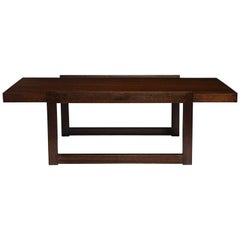
Paul Laszlo Cocktail Table
By Paul Laszlo, Brown Saltman
Located in New York, NY
Architectural cocktail table by Paul Laszlo for Brown Saltman. Dark stained mahogany top floating on two rectangular side supports. Recently refinished and signed on underside.
Category

1950s American Mid-Century Modern Vintage Paul Laszlo Dining Room Sets

Materials

Mahogany

Paul Laszlo Cocktail Table
$6,800
H 15.5 in W 48 in D 26 in
Carlo Scarpa Cognac Leather “Kentucky” Dining Chair for Bernini, 1977, Set of 5
By Carlo Scarpa, Bernini
Located in Vicenza, IT
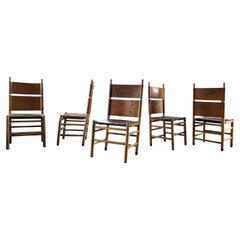
Set of 5 mod. 783 “Kentucky” dining chairs, designed by Carlo Scarpa for the Italian manufacturer Bernini in 1977. Structure made from oak and walnut timber. Seats and backrest made from cognac leather. Excellent vintage condition. Carlo Scarpa designed this chair for the “Scuderia” series., the last project he made for Bernini. The architect took inspiration from the “shaker” movement. He designed the chair slightly inclined at the front. This feature allows you to swing backward (until you lean on a wall) and remain in balance. Born in Venice on June 2nd, 1906, Carlo Scarpa began working at a very early age. A year after he had first qualified as an architect in 1926, he began working for the Murano glassmakers Cappellin & Co. in a consultative capacity. From 1927, Carlo Scarpa began to experiment with the Murano glass, and this research not only gave him excellent results here but would also inform his progress for many years to come. Between 1935 and 1937, as he entered his thirties, Carlo Scarpa accepted his first important commission, the renovation of Venice’s Cà Foscari. He adapted the spaces of this stately University building that stands on the Grand Canal banks, creating rooms for the Dean’s offices and a new hall for academic ceremonies; Mario Sironi and Mario De Luigi were charged with doing the restoration work on the frescos. After 1945, Carlo Scarpa found himself constantly busy with new commissions, including various furnishings and designs for the renovation of Venice’s Hotel Bauer and designing a tall building in Padua and a residential area in Feltre, all worth mentioning. One of his key works, despite its relatively modest diminished proportions, was the [bookshop known as the] Padiglione del Libro, which stands in Venice’s Giardini di Castello and clearly shows Scarpa’s passion for the works of Frank Lloyd Wright. In the years which were to follow, after he had met the American architect, Scarpa repeated similar experiments on other occasions, as can be seen, in particular, in the sketches he drew up in 1953 for villa Zoppas in Conegliano, which show some of his most promising work. However, this work unfortunately never came to fruition. Carlo Scarpa later created three museum layouts to prove pivotal in terms of how twentieth-century museums were set up from then on. Between 1955 and 1957, he completed extension work on Treviso’s Gipsoteca Canoviana [the museum that houses Canova’s sculptures] in Possagno, taking a similar experimental approach to the one he used for the Venezuelan Pavilion at [Venice’s] Giardini di Castello which he was building at the same time (1954-56). In Possagno Carlo Scarpa was to create one of his most significant ever works, which inevitably bears comparison with two other museum layouts that he was working on over the same period, those of: – Galleria Nazionale di Sicilia, housed in the Palazzo Abatellis in Palermo (1953-55) – Castelvecchio in Verona (1957- 1974), all of which were highly acclaimed, adding to his growing fame. Two other buildings, which are beautifully arranged in spatial terms, can be added to this long list of key works that were started and, in some cases, even completed during the nineteen fifties. After winning the Olivetti award for architecture in 1956, Scarpa began work in Venice’s Piazza San Marco on an area destined to house products made by the Industrial manufacturers Ivrea. Over the same period (1959-1963), he also worked on the renovation and restoration of the gardens and ground floor of the Fondazione Querini Stampalia in Venice, which many consider one of his greatest works. While he busied himself working on-site at the Fondazione Querini Stampalia, Carlo Scarpa also began work building a villa in Udine for the Veritti family. To shed some light on the extent to which his work evolved over the years, it may perhaps be useful to compare this work with that of his very last building, villa Ottolenghi Bardolino, which was near to completion at the time of his sudden death in 1978. Upon completion of villa Veritti over the next ten years, without ever letting up on his work on renovation and layouts, Scarpa accepted some highly challenging commissions, working on the Carlo Felice Theatre in Genoa and another theatre in Vicenza. Towards the end of this decade, in 1969, Rina Brion commissioned Carlo Scarpa to build the Brion Mausoleum in San Vito d’Altivole (Treviso), a piece he continued to work on right up until the moment of his death. Nevertheless, even though he was totally absorbed by work on this mausoleum, there are plenty of other episodes which can offer some insight into the final years of his career. As work on the San Vito d’Altivole Mausoleum began to lessen from 1973, Carlo Scarpa started building the new headquarters for the Banca Popolare di Verona. He drew up plans that were surprisingly different from the work he was carrying out at the same time on the villa Ottolenghi. However, the plans Carlo Scarpa drew up, at different times, for a monument in Brescia’s Piazza della Loggia commemorating victims of the terrorist attack on May 28th, 1974, make a sharp contrast to the work he carried out in Verona, almost as if there is a certain hesitation after so many mannered excesses. The same Pietas that informs his designs for the Piazza Della Loggia can also be seen in the presence of the water that flows through the Brion Mausoleum, almost as if to give a concrete manifestation of pity in this twentieth-century work of art. Carlo Scarpa has put together a highly sophisticated collection of structures, occupying the mausoleum’s L-shaped space stretching across both sides of the old San Vito d’Altivole cemetery. A myriad of different forms and an equally large number of different pieces, all of which are separate and yet inextricably linked to form a chain that seems to offer no promise of continuity, rising up out of these are those whose only justification for being there is to bear the warning “si vis vitam, para mortem,” [if you wish to experience life prepare for death] as if to tell a tale that suggests the circle of time, joining together the commemoration of the dead with a celebration of life. At the entrance of the Brion Mausoleum stand the “propylaea” followed by a cloister which ends by a small chapel, with an arcosolium bearing the family sarcophagi, the main pavilion, held in place on broken cast iron supports, stands over a mirror-shaped stretch of water and occupies one end of the family’s burial space. The musical sound of the walkways teamed with the luminosity of these harmoniously blended spaces shows how, in keeping with his strong sense of vision, Carlo Scarpa could make the most of all of his many skills to come up with this truly magnificent space. As well as a great commitment to architectural work, with the many projects which we have already seen punctuating his career, Carlo Scarpa also made many equally important forays into the world of applied arts. Between 1926 and 1931, he worked for the Murano glassmakers Cappellin, later taking what he had learned with him when he went to work for the glassmakers Venini from 1933 until the 1950s. The story of how he came to work on furniture design is different, however, and began with the furniture he designed to replace lost furnishings during his renovation of Cà Foscari. The later mass-produced furniture started differently, given that many pieces were originally one-off designs “made to measure.” Industrial manufacturing using these designs as prototypes came into being thanks to the continuity afforded him by Dino Gavina, who, as well as this, also invited Carlo Scarpa to become president of the company Gavina SpA, later to become SIMON, a company Gavina founded eight years on, in partnership with Maria Simoncini (whose own name accounts for the choice of company name). Carlo Scarpa and Gavina forged a strong bond in 1968 as they began to put various models of his into production for Simon, such as the “Doge” table, which also formed the basis for the “Sarpi” and “Florian” tables. In the early seventies, other tables that followed included “Valmarana,” “Quatour,” and “Orseolo.” While in 1974, they added couch and armchair “Cornaro” to the collection and the “Toledo” bed...
Category

1970s Italian Mid-Century Modern Vintage Paul Laszlo Dining Room Sets

Materials

Walnut, Leather, Plastic

Previously Available Items
Iron Dining Set by Paul Laszlo for Pacific Iron
By Pacific Iron, Paul Laszlo
Located in San Juan Capistrano, CA
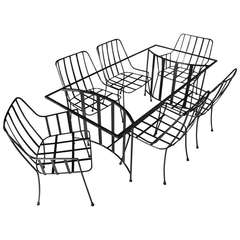
Iron Dining Table and Chairs by Paul Laszlo for Pacific Iron.
Category

1950s American Mid-Century Modern Vintage Paul Laszlo Dining Room Sets

Stunning Dining Table with 8 Chairs by Paul Laszlo
By Paul Laszlo
Located in Los Angeles, CA
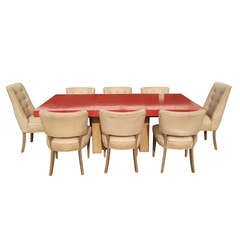
Stunning dining table and 8 chairs designed by Paul Laszlo in the 1940's. The table comes with two leaves, the base has wonderful architectural ...
Category

1940s American Mid-Century Modern Vintage Paul Laszlo Dining Room Sets

Materials

Wood

Paul Laszlo Dining Set for Brown Saltman
By Paul Laszlo
Located in Van Nuys, CA
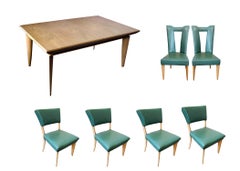
This mid-century dining set by Paul Laszlo for Brown Saltman features a sleek blond wood table with a 15" leaf, along with six dining chairs. There are two high back end chairs in addition to four low back dining chairs...
Category

1950s American Mid-Century Modern Vintage Paul Laszlo Dining Room Sets

Materials

Ash, PVC

Paul Laszlo dining room sets for sale on 1stDibs.

Paul Laszlo dining room sets are available for sale on 1stDibs. These distinctive items are frequently made of wood and are designed with extraordinary care. There are many options to choose from in our collection of Paul Laszlo dining room sets, although brown editions of this piece are particularly popular. Many of the original dining room sets by Paul Laszlo were created in the mid-century modern style in united states during the 1950s. If you’re looking for additional options, many customers also consider dining room sets by Widdicomb Furniture Co., T.H. Robsjohn-Gibbings, and Paul McCobb. Prices for Paul Laszlo dining room sets can differ depending upon size, time period and other attributes — on 1stDibs, these items begin at $6,500 and can go as high as $6,500, while a piece like these, on average, fetch $6,500.

Still Thinking About These?

All Recently Viewed