Philippe Visson Art
to
1
Overall Width
to
Overall Height
to
1
1
1
1
1
1
1
1
9,962
2,752
1,376
1,373
1
Artist: Philippe Visson
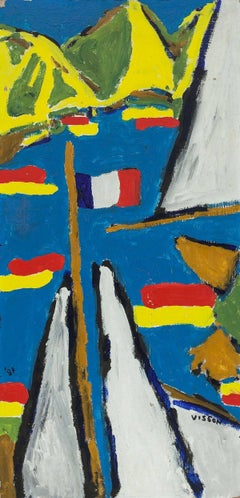
Liberte, Egalite, Fraternite, Modernist Painting
By Philippe Visson
Located in Surfside, FL
Philippe Visson, (1942-2008), whose parents were both of Russian origin, was born in New York in 1942.
His mother, a Parisian art historian, was the Editor of La Gazette des Beaux-Arts from 1930 to 1960, and had always frequented the international artistic milieu. His father was a major political journalist for The Washington Post and Roving Editor for The Reader’s Digest. Philippe Visson therefore was raised in a cosmopolitan milieu between the United States and Europe. At the Vissons, one devours; one spends beyond one’s means; one falls, but only to land on one’s feet.
Visson is a painter to whom it is difficult to assign a particular movement in art history; and that, principally for two reasons: firstly, his origins,his education and his way of life have produced a personality without any true roots, but rather a citizen of the world, who carries with him all cultures, from pre-Revolutionary Russia to the black ghetto of Washington, D.C.
Secondly, he is self-taught, and can work in complete solitude, as well as before a large audience. His art is therefore uniquely his own, and certainly not that of an Art Brut ‘author’. His faces, his anti-portraits, reveal a continuum of humanity’s facets: from Christ to the demon, from the child to the aged, from the Caucasion to the African.
Biography
Philippe Visson, whose parents were both of Russian origin, was born in New York in 1942. His mother, a Parisian art historian, was the Editor of “The Gazette des Beaux-Arts” and had always frequented the international artistic milieu. His father was a major American political journalist for “The Washington Post” and “The Readers Digest”. Philippe Visson therefore was raised in a cosmopolitan milieu between the United States and Europe.
He starts to paint in the bathroom of Parisian luxury hotel at the age of 16, working in a frenzy and without art lessons. He’s immediately confronted with the scrutiny of professional experts that surround his parents. He has instant success when he shows at the Craven Gallery in Paris in December, 1958, quickly offered to him; then in New York in the Milch Galleries in May, 1959; followed by shows in Monte Carlo, Geneva and New York again. It was too much, too soon. Visson falls into drinking.
Returning to Washington, D.C. on 1960, the period 1963-1979 is differentiated by a life that is sometimes social, sometimes reclusive, which continues when his family settles in a large villa in Switzerland (Epalinges above Lausanne) in the mid-sixties. Visson has stopped drinking. He paints in one of the rooms of his parents’ house and inundates all the empty rooms with his productions that remain hidden from the public, allowing them to be seen only by personalities such as Marcel Brion and René Huyghe, both of the Académie Française; or Jean Leymarie, Director of the Museum of Modern Art in Paris.
It’s only at the start of the seventies that he once again opens his work to the public. He meets several important cultural figures of the time, such as René Berger, Director of the State Fine Arts Museum of Lausanne; and Michel Thévoz, future Director of the Art brut Museum.
After the death of his father in 1973, he settles without money with his mother in a luxury hotel in Paris. It’s only after a year and a half of perpetual and colorful adventures that they return to Washington, D.C., where he resumes painting and produces a unique period of abstracts.
Returning to Switzerland at the death of his mother in the beginning of the eighties, Visson meets with blatant success in Switzerland, where institutions exhibit and purchase his paintings (Aarau State Fine Arts Museum, the Federal Office of Culture in Bern). His fury for painting takes the form of an explosion while remaining focused (he always keeps what he considers the best paintings for himself).
After the life of a hermit in the Paccots, Visson comes down from his mountain to settle in Montreux on the Swiss Riveria. This moving is marked by a sort of return to social life, despite the fact that he paints in a cellar. A period of public projects with charitable goals is launched. Visson thrives on this contact with the public.
This changes somewhat when he receives a working studio in The Montreux Palace in the late nineties. This emerging from the cellars denotes a new era for the artist. He starts an intense period of painting, and moves six thousand of his paintings to the Palace. He continues his public projects, including the acquisition against paintings of a Stradivarius violin...
Category
Late 20th Century Modern Philippe Visson Art
Materials
Acrylic, Board
Related Items
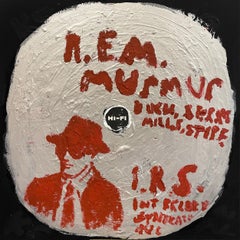
R.E.M. - Murmur (Grammy, Album Art, Iconic, Rock and Roll, Pop, Legendary)
By Kerry Smith
Located in Kansas City, MO
Kerry Smith
R.E.M. - Murmur
Mixed Media on Crescent board
Year: 2022
Size: 21x20in
Signed, dated by hand
COA provided
Ref.: 924802-1633
*Black frame with a mirror-gloss finish avail...
Category
2010s American Modern Philippe Visson Art
Materials
Mixed Media, Acrylic, Gouache, Board

$888 Sale Price
25% Off
H 21 in W 22 in D 1 in
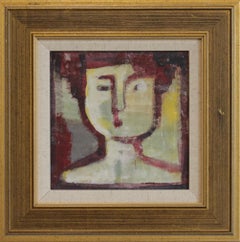
Echoes of the Atelier XVII
Located in London, GB
Echoes of the Atelier XVII, acrylic on canvas mounted on board, Florentine School (circa 1980s-90s). This gallery has acquired a number of paintings through an intermediary of an age...
Category
1980s Modern Philippe Visson Art
Materials
Canvas, Acrylic, Board
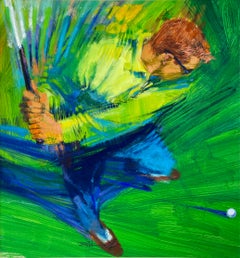
Golfer Swinging, Vintage 7 Up Ad "Get Real Action" in Green and Yellow - Golf
By Bob Peak
Located in Miami, FL
This strobe-like dynamic composition with bright and bold colors reflects the energetic taste of the 7 Up brand. It lies somewhere between abstraction and figuration. Peaks' use of b...
Category
1960s American Modern Philippe Visson Art
Materials
Acrylic, Illustration Board
$15,000
H 23.25 in W 21.25 in
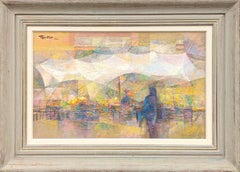
"Market Tents" Modern Abstract Pastel Toned Cubist Style Street Scene
By Romeo Tabuena
Located in Houston, TX
Modern abstract pastel toned street scene by Philippine-born artist Romeo Tabuena. The work features a street scene with shadow figures browsing under a white tarp. Signed and dated in the front upper left corner. Currently hung in a grey toned frame.
Dimensions Without Frame: H 19.75 in. x W 31.75 in.
Artist Biography: Romeo Tabuena is a Philippine-born painter rooted in Eastern sensibility. He has been a resident of Mexico for more than four decades.
Born in Lloilo in 1921, he studied architecture at the Mapua Institute of Technology and a fine arts course, majoring in painting, at the University of the Philippines. He also studied at the Art Students League in New York and at the Academie de la Grande Chaumiere in Paris.
Tabuena decided to settle in Mexico and to make it the base of his painting career. But he has maintained links with his native country through participation in its major art projects, and despite his long residence in Mexico, he has retained his Philippine citizenship.
One of his major works since 1957 is a government-commissioned mural, Filipiniana, at the Philippine Embassy in Washington D.C. His other exhibits include a ten-year retrospective show in 1959 at the Philippine Art Gallery in Manila. In 1962, his successful one-man show, which was sponsored by the Philippine Government at the International Salon of the Palace of Fine Arts in Mexico City, "further elevated the status of Philippine painting...
Category
1970s Modern Philippe Visson Art
Materials
Acrylic, Board
$8,000 Sale Price
33% Off
H 30.25 in W 42.38 in D 2 in
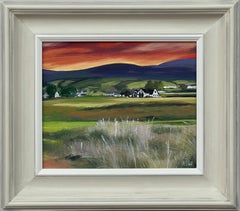
Sunset at Brora Golf Course in the Scottish Highlands by Contemporary Artist
By Angela Wakefield
Located in Preston, GB
Sunset at Brora Golf Course in the Scottish Highlands by Contemporary British Artist, Angela Wakefield. This unique original depicts a deep red orange sunset on the east coast of Sco...
Category
2010s Contemporary Philippe Visson Art
Materials
Canvas, Paint, Cotton Canvas, Acrylic, Board
$3,754 Sale Price
20% Off
H 16 in W 18 in D 2 in
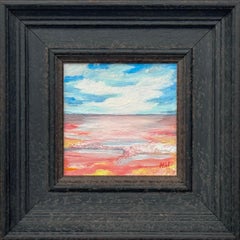
Blush Horizon - Small Square Abstract Canvas Art Study by Contemporary Artist
By Angela Wakefield
Located in Preston, GB
Blush Horizon - Small Square Abstract Landscape Canvas Art Study by Contemporary Artist, Angela Wakefield
Art measures 6 x 6 inches
Frame measures 11 x 11 inches
Title: Blush Horiz...
Category
2010s Contemporary Philippe Visson Art
Materials
Canvas, Paint, Cotton Canvas, Acrylic, Board
$979 Sale Price
20% Off
H 11 in W 11 in D 2 in
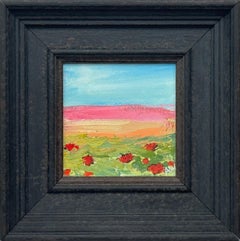
Small Square Abstract Canvas Art Study of Red Poppy Field by Contemporary Artist
By Angela Wakefield
Located in Preston, GB
Small Square Abstract Landscape Canvas Art Study of Red Poppy Field by Contemporary Artist, Angela Wakefield
Art measures 6 x 6 inches
Frame measures 11 x 11 inches
Angela Wakefiel...
Category
2010s Contemporary Philippe Visson Art
Materials
Canvas, Paint, Cotton Canvas, Acrylic, Board
$979 Sale Price
20% Off
H 11 in W 11 in D 2 in
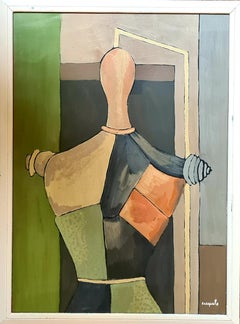
French Cubist Oil and Acrylic on Board, Le Mannequin, After Giorgio de Chirico
Located in Cotignac, FR
Cubist acrylic and oil on board in the modern form of a stylised mannequin figure portrait by French artist Créqule. The painting is influenced by the paintings of Giorgio de Chirico...
Category
Late 20th Century Modern Philippe Visson Art
Materials
Oil, Acrylic, Board
$1,664
H 27.17 in W 20.08 in D 0.6 in
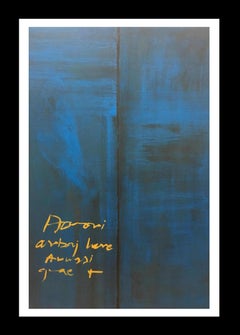
Ruz. Vertical Blue original abstract acrylic painting
By Rafael Ruz
Located in CORAL GABLES - MIAMI, FL
Ruz blue - original abstract acrylic painting. virtual frame
Original work of the artist RUZ
Acrylic on paper
Perfect state
While contemplating the painting of Ruz, we are ...
Category
21st Century and Contemporary Abstract Philippe Visson Art
Materials
Acrylic, Cardboard
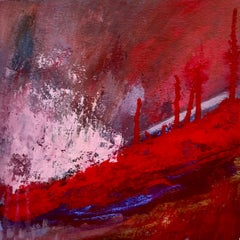
Override
Located in Santa Monica, CA
Acrylic on board
Category
2010s Contemporary Philippe Visson Art
Materials
Acrylic, Board
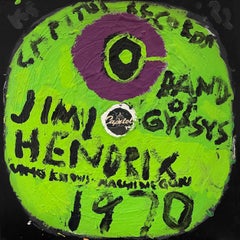
B.B. King - The Thrill Is Gone (Grammy, Album Art, Iconic, Rock
Roll, Guitar)
By Kerry Smith
Located in Kansas City, MO
Kerry Smith
Jimi Hendrix - Band Of Gypsys
Mixed Media on Crescent board
Year: 2022
Size: 21x20in
Signed, dated by hand
COA provided
Ref.: 924802-1640
*Black frame with a mirror-glos...
Category
2010s Modern Philippe Visson Art
Materials
Mixed Media, Acrylic, Gouache, Board
$888 Sale Price
25% Off
H 21 in W 22 in D 1 in
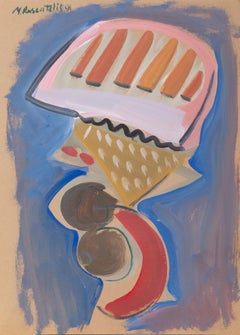
Abstract Still Life, Acrylic Painting on Board by Moshe Rosentalis
By Moshe Rosenthalis
Located in Long Island City, NY
Artist: Moshe Rosentalis, Lithuanian (1922 - 2008)
Title: Abstract Still Life
Year: 1991
Medium: Gouache on Board, signed and dated
Size: 27.5 x 20 inches
Category
1990s Modern Philippe Visson Art
Materials
Acrylic, Board
$2,000
H 27.5 in W 19.5 in
Previously Available Items
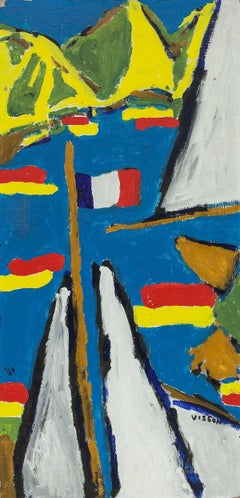
Liberte, Egalite, Fraternite, Modernist Painting
By Philippe Visson
Located in Surfside, FL
Philippe Visson, (1942-2008), whose parents were both of Russian origin, was born in New York in 1942.
His mother, a Parisian art historian, was the Editor of La Gazette des Beaux-Arts from 1930 to 1960, and had always frequented the international artistic milieu. His father was a major political journalist for The Washington Post and Roving Editor for The Reader’s Digest. Philippe Visson therefore was raised in a cosmopolitan milieu between the United States and Europe. At the Vissons, one devours; one spends beyond one’s means; one falls, but only to land on one’s feet.
Visson is a painter to whom it is difficult to assign a particular movement in art history; and that, principally for two reasons: firstly, his origins,his education and his way of life have produced a personality without any true roots, but rather a citizen of the world, who carries with him all cultures, from pre-Revolutionary Russia to the black ghetto of Washington, D.C.
Secondly, he is self-taught, and can work in complete solitude, as well as before a large audience. His art is therefore uniquely his own, and certainly not that of an Art Brut ‘author’. His faces, his anti-portraits, reveal a continuum of humanity’s facets: from Christ to the demon, from the child to the aged, from the Caucasion to the African.
Biography
Philippe Visson, whose parents were both of Russian origin, was born in New York in 1942. His mother, a Parisian art historian, was the Editor of “The Gazette des Beaux-Arts” and had always frequented the international artistic milieu. His father was a major American political journalist for “The Washington Post” and “The Readers Digest”. Philippe Visson therefore was raised in a cosmopolitan milieu between the United States and Europe.
He starts to paint in the bathroom of Parisian luxury hotel at the age of 16, working in a frenzy and without art lessons. He’s immediately confronted with the scrutiny of professional experts that surround his parents. He has instant success when he shows at the Craven Gallery in Paris in December, 1958, quickly offered to him; then in New York in the Milch Galleries in May, 1959; followed by shows in Monte Carlo, Geneva and New York again. It was too much, too soon. Visson falls into drinking.
Returning to Washington, D.C. on 1960, the period 1963-1979 is differentiated by a life that is sometimes social, sometimes reclusive, which continues when his family settles in a large villa in Switzerland (Epalinges above Lausanne) in the mid-sixties. Visson has stopped drinking. He paints in one of the rooms of his parents’ house and inundates all the empty rooms with his productions that remain hidden from the public, allowing them to be seen only by personalities such as Marcel Brion and René Huyghe, both of the Académie Française; or Jean Leymarie, Director of the Museum of Modern Art in Paris.
It’s only at the start of the seventies that he once again opens his work to the public. He meets several important cultural figures of the time, such as René Berger, Director of the State Fine Arts Museum of Lausanne; and Michel Thévoz, future Director of the Art brut Museum.
After the death of his father in 1973, he settles without money with his mother in a luxury hotel in Paris. It’s only after a year and a half of perpetual and colorful adventures that they return to Washington, D.C., where he resumes painting and produces a unique period of abstracts.
Returning to Switzerland at the death of his mother in the beginning of the eighties, Visson meets with blatant success in Switzerland, where institutions exhibit and purchase his paintings (Aarau State Fine Arts Museum, the Federal Office of Culture in Bern). His fury for painting takes the form of an explosion while remaining focused (he always keeps what he considers the best paintings for himself).
After the life of a hermit in the Paccots, Visson comes down from his mountain to settle in Montreux on the Swiss Riveria. This moving is marked by a sort of return to social life, despite the fact that he paints in a cellar. A period of public projects with charitable goals is launched. Visson thrives on this contact with the public.
This changes somewhat when he receives a working studio in The Montreux Palace in the late nineties. This emerging from the cellars denotes a new era for the artist. He starts an intense period of painting, and moves six thousand of his paintings to the Palace. He continues his public projects, including the acquisition against paintings of a Stradivarius violin...
Category
Late 20th Century Modern Philippe Visson Art
Materials
Acrylic, Board
Philippe Visson art for sale on 1stDibs.
Find a wide variety of authentic Philippe Visson art available for sale on 1stDibs. You can also browse by medium to find art by Philippe Visson in acrylic paint, board, paint and more. Much of the original work by this artist or collective was created during the 20th century and is mostly associated with the modern style. Not every interior allows for large Philippe Visson art, so small editions measuring 13 inches across are available. Customers who are interested in this artist might also find the work of Wes Olmsted, Virginia Dehn, and Charles Pebworth. Philippe Visson art prices can differ depending upon medium, time period and other attributes. On 1stDibs, the price for these items starts at $2,200 and tops out at $2,200, while the average work can sell for $2,200.