Pierre Alechinsky Figurative Prints
Belgian, b. 1927
Pierre Alechinsky is a belgian painter born in 1927 in Brussels.
Attracted by painting, Pierre Alechinsky begins aged 17 in the Ecole Nationale Supérieure d'Architecture et des Arts Décoratifs de la Cambre in Brussels. He was involved in the Cobra artistic movement with Karel Appel and Asger Jorn and organised exhibitions. In the early fifties, he learnt the art of engraving with Stanley William Hayter and also Japanese calligraphy. He met Giacometti, Bram Van Velde, and Victor Brauner.
In 1955, he signs for his first exhibition at the Palais des Beaux-Arts de Bruxelles, then at the Institute of Contemporary Arts of London. His artworks, prints, lithographies, engravings and books illustrations can also be found in the USA, in France, in the Netherlands, Denmark and Germany.
On and after 1965, fascinated by the Oriental calligraphy, he uses acrylic painting, ink, different types of paper as bills, and gets carried away by action painting technique.
During the eighties, he became for four years a teacher of plastic arts at the Ecole Nationale Supérieure des Beaux Arts.
Also a writer, Pierre Alechinsky published many books including «Titres et pains perdus », « Baluchon et ricochets », and in 2004 «Des deux mains ».
He lives and works in France.to
1
3
2
Overall Width
to
Overall Height
to
3
1
106
890
385
373
310
5
2
2
1
5
1
1
1
1
1
1
1
1
1
4
1
1
4
1
Artist: Pierre Alechinsky
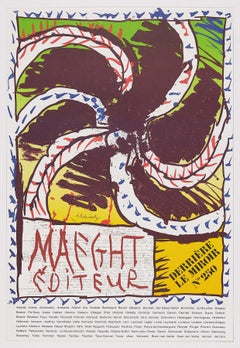
Pierre Alechinsky Derriere le Miroir original poster lithograph Maeght Editeur
By Pierre Alechinsky
Located in Miami, FL
"Pierre Alechinsky (Belgium, 1927)
'Derriere le Miroir, Maeght Editeur',
lithograph on paper
34.7 x 23.7 in. (88 x 60 cm.)
Unframed
Ref: ALE100-201
Pierre Alechinsky
Born in the im...
Category
1970s Abstract Pierre Alechinsky Figurative Prints
Materials
Lithograph
original lithograph
By Pierre Alechinsky
Located in Henderson, NV
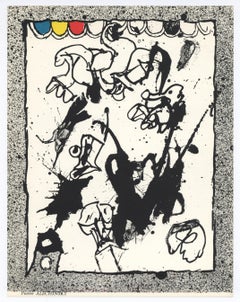
Medium: original lithograph. Printed in Paris in 1967 by Clot, Bramsen et Georges and issued in an edition of 2500 for "Les Temps Situationistes" (The Situationist Times -- a radical...
Category
1960s Pierre Alechinsky Figurative Prints
Materials
Lithograph
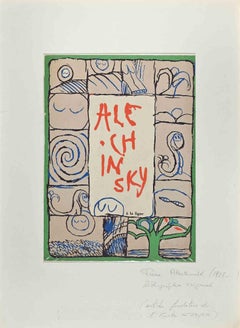
La Ligne - Lithograph by Pierre Alechinsky - 1970s
By Pierre Alechinsky
Located in Roma, IT
La Ligne is a lithograph realized by Pierre Alechinsky in the 1970s.
Good conditions, not signed.
The artwork is depicted through soft strokes in a well-balanced composition.
Category
1970s Abstract Pierre Alechinsky Figurative Prints
Materials
Linocut
Pierre Alechinsky, Untitled, from XXe Siecle, 1960
By Pierre Alechinsky
Located in Southampton, NY
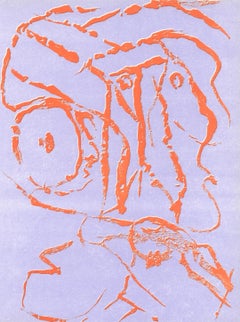
This exquisite lithograph by Pierre Alechinsky (born 1927), titled Sans titre (Untitled), from the album XXe Siecle, Nouvelle serie, XXIIe Annee, N°14, Juin 1960, originates from the...
Category
1960s Modern Pierre Alechinsky Figurative Prints
Materials
Lithograph

$716 Sale Price
20% Off
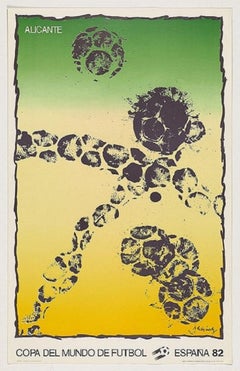
Pierre Alechinsky Belgian 1982 Original FIFA Soccer World Cup Poster lithograph
By Pierre Alechinsky
Located in Miami, FL
"Pierre Alechinsky (Belgium, 1927)
'Dribbling (Alicante)', 1982
Original poster from 1982 FIFA Soccer World Cup
lithograph on paper
37.5 x 23.7 in. (9...
Category
1980s Abstract Pierre Alechinsky Figurative Prints
Materials
Lithograph
Related Items
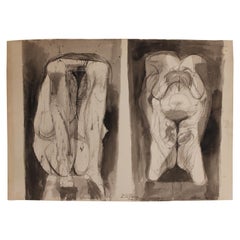
Abstract Figurative Lithograph
By Rico Lebrun
Located in Houston, TX
Black and white figurative abstract lithograph of two naked, crouching figures by California artist "Rico Lebrun," titled "Crouching Figures" and dated 1961. Additional writing on th...
Category
1960s Abstract Pierre Alechinsky Figurative Prints
Materials
Lithograph
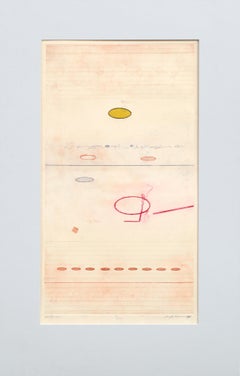
"Orange Row", Abstract Geometric Minimalist Composition w Ovals, Limited Edition
By Geoffrey Bowman
Located in Soquel, CA
"Orange Row", Abstract Geometric Minimalist Composition w Ovals, Limited Edition
Delicate and perfect ovals in orange, yellow, red, and blue are purposefully arranged on lined paper...
Category
1990s Abstract Geometric Pierre Alechinsky Figurative Prints
Materials
Paper, Ink, Lithograph, Etching
$556 Sale Price
20% Off
H 32 in W 20 in D 0.25 in
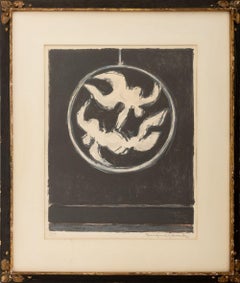
The Ring
By Manfred Schwartz
Located in Astoria, NY
Manfred Schwartz (American, b. Poland, 1909-1970), The Ring, Abstract Figural Composition, Lithograph on Paper, mid 20th century, two nude figures in dangling hoop, numbered edition ...
Category
Mid-20th Century Modern Pierre Alechinsky Figurative Prints
Materials
Paper, Lithograph
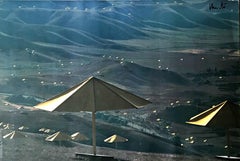
The Umbrellas, Japan - USA Offset lithograph poster (Hand Signed by Christo)
By Christo and Jeanne-Claude
Located in New York, NY
Christo and Jeanne-Claude
The Umbrellas, Japan - USA (Hand Signed), 1991
Offset lithograph poster
Boldly signed by Christo upper right
25 × 38 inches
Unframed
This rare vintage poster was published by Christo and Jeanne-Claude to promote and raise funds for Christo's famous Umbrellas Japan-USA project in the early 1990s. It is hand signed boldly in black marker "Christo" on the recto - upper right corner. This work was acquired from the Estate of Jacob and Aviva Baal-Teshuva, collectors, curators, authors, early supporters and good friends of Christo. Authenticity unconditionally guaranteed.
ABOUT THE UMBRELLAS JAPAN-USA PROJECT:
At sunrise, on October 9, 1991, Christo and Jeanne-Claude's 1,880 workers began to open the 3,100 umbrellas in Ibaraki and California, in the presence of the artists at both sites. This Japan-USA temporary work of art reflected the similarities and differences in the ways of life and the use of the land in two inland valleys, one 12 miles (19 kilometers) long in Japan, and the other 18 miles (29 kilometers) long in the USA.
In Japan, the valley is located north of Hitachiota and south of Satomi, 75 miles (120 kilometers) north of Tokyo, around Route 349 and the Sato River, in the Prefecture of Ibaraki, on the properties of 459 private landowners and governmental agencies. In the USA, the valley is located 60 miles (96.5 kilometers) north of Los Angeles, along Interstate 5...
Category
1990s Pop Art Pierre Alechinsky Figurative Prints
Materials
Lithograph, Offset
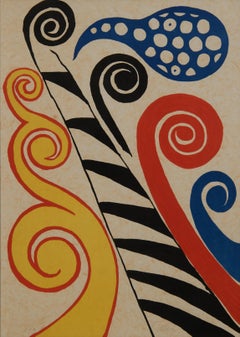
Fiesta, c. 1973, red, yellow
blue figurative abstract lithograph
By Alexander Calder
Located in Beachwood, OH
Alexander Calder (American, 1898-1976)
Fiesta, c. 1973
Lithograph in colors
Signed lower right
Edition: E. A.
20 x 28 inches
35.5 x 37.75 inches, framed
One of America's best known ...
Category
1970s Modern Pierre Alechinsky Figurative Prints
Materials
Lithograph
$3,200 Sale Price
20% Off
H 20 in W 28 in
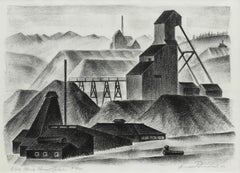
Arnold Ronnebeck Lithograph "Silver Mine, Russell Gulch" Colorado Scene
By Arnold Rönnebeck
Located in Denver, CO
"Silver Mine, Russell Gulch (12/25)" is a striking black-and-white lithograph by German-born American Modernist Arnold Ronnebeck (1885–1947). This rare print depicts a historic minin...
Category
1930s American Modern Pierre Alechinsky Figurative Prints
Materials
Lithograph
$2,750
H 20.5 in W 26.5 in D 0.5 in
Cultural Institutions, Abstract Expressionist Lithograph by Robert Motherwell
By Robert Motherwell
Located in Long Island City, NY
This print by Robert Motherwell is part of an 8-piece portfolio published by The New York Graphic Society in 1983 and includes works from Red Grooms, Robert Indiana, Alex Katz, R.B. ...
Category
1980s Abstract Expressionist Pierre Alechinsky Figurative Prints
Materials
Lithograph
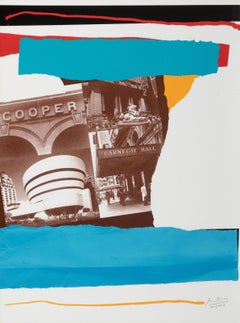
Robert MotherwellCultural Institutions, Abstract Expressionist Lithograph by Robert Motherwell, 1983
$2,800 Sale Price
20% Off
H 30 in W 22.5 in
abstract composition
By Marie Raymond
Located in Belgrade, MT
This color lithograph is part of my private collection since the 1970's. Marie Raymond was a pioneer post WWII painter of her generation. She was a lyrical abstractionist of her time...
Category
Mid-20th Century Abstract Expressionist Pierre Alechinsky Figurative Prints
Materials
Color, Lithograph
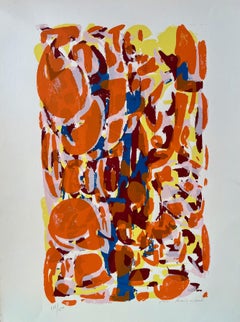
Pablo Picasso Estate Hand Signed Fauvist Lithograph Woman Portrait Marie Therese
By Pablo Picasso
Located in Surfside, FL
Pablo Picasso (after)
"Portrait de Marie Therese"
limited edition print on Arches paper,
Hand signed by Marina Picasso lower right and numbered 274/500 lower left
From the estate of...
Category
20th Century Modern Pierre Alechinsky Figurative Prints
Materials
Lithograph

$3,600
H 28 in W 20.75 in
Litografia Original II
By Joan Miró
Located in Kansas City, MO
Joan Miró
Litografia Original II
Color Lithograph
Year: 1975
Size: 12.5 × 9.6 inches
Catalogue Raisonné: Queneau, Miro Lithographe II, 1952-1963, p.35
Publisher: Maeght Editeur, Pari...
Category
1970s Abstract Expressionist Pierre Alechinsky Figurative Prints
Materials
Lithograph

Seven Sculptural Ideas - Lithograph by Henry Moore - 1973
By Henry Moore
Located in Roma, IT
Hand signed, numbered and dated. Edition of 65 prints. Very good condition.
Category
1970s Contemporary Pierre Alechinsky Figurative Prints
Materials
Lithograph

$2,610
H 25.79 in W 19.69 in D 0.04 in
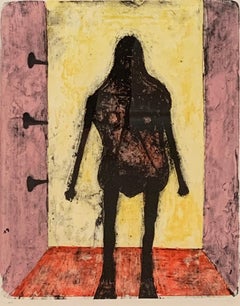
"Venus Noire", Rufino Tamayo, Figurative Abstraction, Etching, 30x22 in.
By Rufino Tamayo
Located in Dallas, TX
"Venus Noire" by Rufino Tamayo is a Figurative Abstraction lithograph limited edition measuring 30x22 in. The piece is framed beautifully with a white mat in a gold and black frame u...
Category
1960s Abstract Expressionist Pierre Alechinsky Figurative Prints
Materials
Lithograph
$4,850
H 30 in W 22 in D 1 in
Previously Available Items
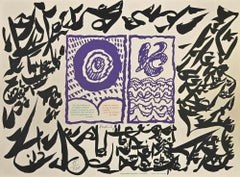
Linolog I et Linolog II - Linocut by Pierre Alechinsky - 1970s
By Pierre Alechinsky
Located in Roma, IT
Linolog I et Linolog II is a Linocut print realized by the Artists Pierre Alechinsky and Christian Dotremont in 1972.
Hand signed "Alechinsky" and Monogrammed on the right margin "Logogramme marginal: Dotremont", "Lino"Alechinsky". Numbered on the left corner es. 85/300. Edition from Jacques Putman pour Prisunic, Paris 1972
The artwork is depicted in a well-balanced composition.
Good conditions.
Pierre Alechinsky (1927) is a Belgian Contemporary Artist . In 1945, Alechinsky discovered the work of Michaux, Dubuffet, surrealists and became friend with the art critic Jacques Putman. His first personal exhibition is organized in 1947. He met Dotremont in 1949 and adhered to the movement CoBrA this same year (Asger Jorn, Karel Appel); he was one of the most active members until the CoBrA's dissolution in 1951. Alechinsky participated in the first International Exhibition of CoBrA at the Stedjelijk Museum in Amsterdam. In the 50’s the artist stayed in The Far East, then in The United States; he was interested in the Japanese calligraphy and in the Action Painting. In 1983, Alechinsky becomes a painting teacher in Paris at the Ecole Supérieure des Beaux Arts de Paris. Since The 80’s , the artist goes on his graphic art on a big variety of supports. Exhibition and International retrospectives celebrate him, all over the world museums and galleries welcome his work.
Christian Dotremont (1922-1979) is a Belgian painter and poet and was a founding member of the Revolutionary Surrealist Group (1946). He became involved with the Surrealist movement with the aim to reveal the many facets of art. He was also one of the founders of CoBrA together with Danish artist Asger Jorn. Dotremont caused the most important scandal to hit CoBrA; at the group’s exhibition at the Stedelijk Museum in Amsterdam he hijacked the attention by making a lengthy political speech...
Category
1970s Abstract Pierre Alechinsky Figurative Prints
Materials
Linocut
H 19.1 in W 25.6 in D 0.04 in
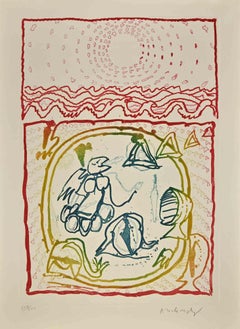
Le Soleil - Woodcut Print by Pierre Alechinsky - 1970s
By Pierre Alechinsky
Located in Roma, IT
Le Soleil is an Etching realized by Pierre Alechinsky in the 1970s.
Hand signed on the right margin and numbered on the left corner es. 200/300
The artwork is depicted in a well-ba...
Category
1970s Modern Pierre Alechinsky Figurative Prints
Materials
Woodcut
H 25.6 in W 18.9 in D 0.04 in
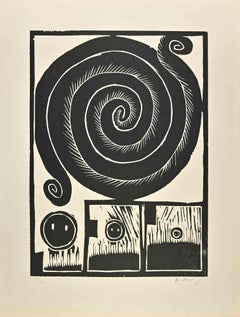
Untitled - Woodcut by Pierre Alechinsky - 1970
By Pierre Alechinsky
Located in Roma, IT
Untitled is an Woodcut print realized by Pierre Alechinsky in 1970.
Hand signed on the right margin and numbered on the left corner es. 102/300
The artwork is depicted through stro...
Category
1970s Abstract Pierre Alechinsky Figurative Prints
Materials
Woodcut
H 25.99 in W 19.69 in D 0.04 in
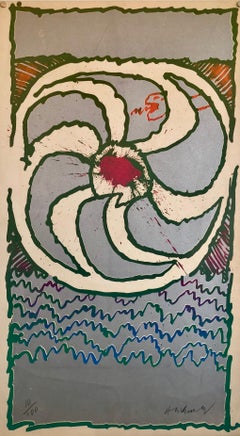
Metallic Lithograph Abstract Print Signed Ltd Ed Belgian Cobra Group Artist
By Pierre Alechinsky
Located in Surfside, FL
Pierre Alechinsky (born 1927) Belgian artist. (painting and graphic print-making) He has lived and worked in France since 1951. His work is related to Tachisme, Abstract expressioni...
Category
20th Century Abstract Expressionist Pierre Alechinsky Figurative Prints
Materials
Lithograph
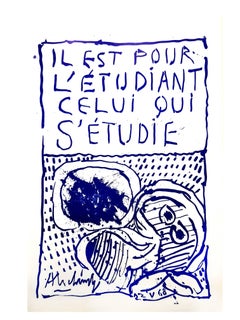
Pierre Alechinsky, - Mai 68 Original French Poster - Mai 68
By Pierre Alechinsky
Located in Collonge Bellerive, Geneve, CH
Pierre Alechinsky - Mai 68 Original French Poster - Mai 68
Tchou Editions, Paris, printed in 1968.
Dimensions: 48 x 32.5 cm
Paris, May 1968: The revolution that never was
Even without retrieving that bundle of yellowing French newspapers from the top shelf in a closet, it is easy to remember the night of May 10, 1968, in Paris. It is far less easy, 40 years later, to discern what it was all about. Adolescent hormones, the death of communism, the death of capitalism or, as André Malraux suggested at the time, the death of God?
Malraux, the writer and politician and the French culture minister at the time, may have been alone in invoking God's death as an explanation, but no one doubted that May 10 provoked an entire society to a rare assessment - call it an examination of conscience, if you will - of its fundamental values.
A week earlier, the police had been called in to occupy the Sorbonne, and Paris began to witness daily student marches, usually culminating in skirmishes between students throwing stones and the police firing tear gas.
By May 10, the number of student demonstrators was estimated at 20,000. At every street leading to the Sorbonne, they found their way blocked by vans and ranks of riot police. This time, the students did not disperse. As darkness fell, they began prying up cobblestones, ransacking building sites and turning over parked cars to construct their own barricades facing the police ones.
For hours, the silent inner ring of police barricades stretching around much of the Latin Quarter stood surrounded by a noisy outer ring of student barricades. At 2:15 a.m., the police got the order to assault the student barricades. As the interior minister said, "The streets have to be clear for traffic."
Continue reading the main story
It took three hours of brutal fighting to do that: clouds of tear gas, Molotov cocktails, exploding automobile gas tanks, cobblestones hurled at the police, students chased down and beaten, more than 300 people injured but fortunately no gunfire - and no deaths.
When the radio reported a fire on Rue Gay-Lussac that fire trucks could not reach because of the street fighting and barricades, two young Americans living nearby began deciding what to take with them in case of urban conflagration: 1) the 2-year-old daughter; 2) passports and money; 3) the notes for the dissertation. After that, it didn't matter.
France woke up shocked. So, presumably, did President Charles de Gaulle, who had gone to bed early. Events accelerated. The left mounted a huge march of solidarity with the students, who reoccupied the Sorbonne. Workers began occupying their factories. Within another week, France was closed down by the general strike that revolutionaries had always dreamed of.
The story, of course, did not end in revolution, for which few people over 30 really had any stomach anyway. On May 30, de Gaulle put his foot down.
He addressed the nation briefly on the radio. He announced new elections and hinted at using military means to restore order. A deftly prepared demonstration immediately flooded the Champs-Élysées with hundreds of thousands of citizens previously maintaining a low profile.
Newsletter Sign UpContinue reading the main story
The Interpreter Newsletter
Understand the world with sharp insight and commentary on the major news stories of the week.
You agree to receive occasional updates and special offers for The New York Times's products and services.
May passed into June. Workers and students won some changes. The elections swept de Gaulle and his supporters back into power. Was it all merely a spring rainstorm? Hardly. For two astonishing weeks in May, an entire nation had been caught up in a frenzy of self-examination. Committees were formed to restructure secondary schooling, the university, the film industry, the theater, the news media. Everyone was a talking head.
What the talking heads were talking about were ideas spawned by a crazy array of leftist groups: revisionist socialists, Trotskyists, Maoists, anarchists, surrealists and Marxists. They were anticommunist as much as anticapitalist. Some appeared anti-industrial, anti-institutional, even anti-rational.
Three positive objectives and one great fear dominated their views. The objectives were self-management by workers, a decentralization of economic and political power and participatory democracy at the grass roots. The great fear was that contemporary capitalism was capable of absorbing any and all critical ideas or movements and bending them to its own advantage. Hence, the need for provocative shock tactics. "Be realistic: Demand the impossible!" was one of the May movement's slogans.
To many critics, all this was only the final twitch of a quasi-religious socialist utopianism that had long inspired workers and intellectuals rebelling against the pains of industrialization.
Other critics preferred psychological explanations: May 1968 was a Freudian fling of adolescent revolt against Mom and Dad. Or it was a nostalgic bout of playacting, a childish re-enactment of the storming of the Bastille and other Greatest Hits of France's Revolutions. Or it was, paradoxically, an unwitting reinforcement of the individualist consumer capitalism that it claimed to oppose.
On the other side, the anti-authoritarian spirit of 1968 was eventually seen as a wellspring of the successful rebellion against Soviet-bloc communism in 1989. The link was made graphically by book jackets rotating 68 to read 89. After all, Prague Spring...
Category
1960s Pierre Alechinsky Figurative Prints
H 18.9 in W 12.8 in D 0.04 in
Volturno II - Original Lithograph Handsigned
By Pierre Alechinsky
Located in Paris, IDF
Pierre ALECHINSKY
Volturno II
Original lithograph, 1989
Handsigned in pencil
Unnumbered proof (edition of 99 copies)
On Arches paper, size 90 x 60 cm. (c. 35,4 x 23,6 in)
Exellent ...
Category
1980s Pierre Alechinsky Figurative Prints
Materials
Lithograph
Pierre Alechinsky figurative prints for sale on 1stDibs.
Find a wide variety of authentic Pierre Alechinsky figurative prints available for sale on 1stDibs. You can also browse by medium to find art by Pierre Alechinsky in lithograph, linocut, woodcut print and more. Much of the original work by this artist or collective was created during the 20th century and is mostly associated with the abstract style. Not every interior allows for large Pierre Alechinsky figurative prints, so small editions measuring 9 inches across are available. Customers who are interested in this artist might also find the work of Jean-Paul Riopelle, George Stauch, and Robert Israel. Pierre Alechinsky figurative prints prices can differ depending upon medium, time period and other attributes. On 1stDibs, the price for these items starts at $200 and tops out at $2,800, while the average work can sell for $662.