Pierre Mortier Art
Dutch, 1661-1711
Pierre Mortier, also referred to as Pieter Mortier, was a Dutch designer. He was known for his activity as a bird's eye map illustrator.
to
1
1
2
Overall Width
to
Overall Height
to
4
1
1
4
2
1
1
1
1
1
1
1
1
1
2
2
5
10,222
2,785
2,504
1,384
2
2
Artist: Pierre Mortier
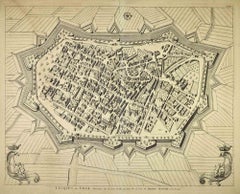
Map of Lucca - Etching by Pierre Mortier - Early 18th Century
By Pierre Mortier
Located in Roma, IT
Map of Lucca is an etching realized by Pierre Mortier in the early 18th Century
Good condition.
Category
Early 18th Century Modern Pierre Mortier Art
Materials
Etching
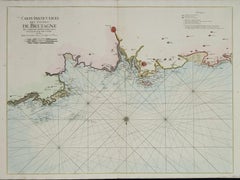
Carte Particuliere Des Coste De Bretagne qui Comprend Morlaix
By Pierre Mortier
Located in Paonia, CO
Carte Particuliere Des Costes De Bretagne qui Comprend Morlaix, Saint Paul de Leon, les Sept Isles, et L’Isle. Faite par ordre Exprez Du Roy de France is from the collection of ch...
Category
1690s Pierre Mortier Art
Materials
Engraving
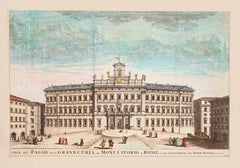
Grande Curia Palace - Original Etching by Pierre Mortier - 17th Century
By Pierre Mortier
Located in Roma, IT
Grande Curia Palace is an original hand-colored print realized by the Dutch artist Pierre Mortier in the second half of the XVII century.
Original etching on paper.
Signed on the p...
Category
17th Century Pierre Mortier Art
Materials
Etching
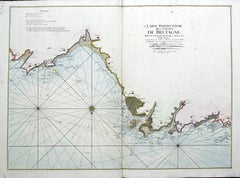
Carte Particular Des Costes De Bretagne Depuis le Cap de Frehel, Jusques a Perros
By Pierre Mortier
Located in Paonia, CO
Carte Particulaire Des Costes De Bretagne Depuis Le Cap de Frehel, Jusques a Perros, & L’Isle Tome. This large sea scale chart shows part of the northwestern co...
Category
1690s Pierre Mortier Art
Materials
Engraving
Related Items
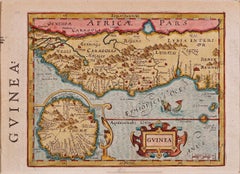
West Africa: A 17th Century Hand-Colored Map by Mercator/Hondius
By Gerard Mercator
Located in Alamo, CA
A 17th century hand-colored map entitled "Guineae Nova Descriptio" by Gerard Mercator and Jodocus Hondius, published in their 'Atlas Minor' in Amsterdam in 1635. It is focused on the...
Category
1630s Pierre Mortier Art
Materials
Engraving
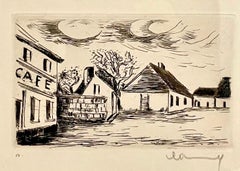
Hand Signed in Pencil Etching Cafe de Paris Visage de Maisons Maurice Vlaminck
By Maurice Vlaminck
Located in Surfside, FL
Maurice Vlaminck
Le Cafe de Paris, Pl. X, from Visage des Maisons, c. 1927 (Walterskirchen 132)
Etching on Van Gelder laid paper, signed in pencil, trial proof with the blindstamp o...
Category
1920s Modern Pierre Mortier Art
Materials
Etching
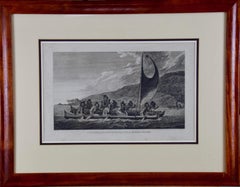
Sandwich Islands Canoe (Hawaii): Framed 18th C. Engraving Captain Cook
s Journal
By John Webber
Located in Alamo, CA
"A Canoe of the Sandwich Islands, the Rowers Masked" is an engraving created by Charles Grignion, from a drawing by John Webber (1752-1793), who was the artist on Captain James Cook's 3rd and final voyage of discovery. It is Plate 65 in the atlas of "A Voyage to the Pacific Ocean Undertaken by the Command of His Majesty, for Making Discoveries in the Northern Hemisphere", the official British Admiralty sanctioned journal published upon completion of the voyage in London in 1784 by Strahan & Cadell.
This famous image of ten Hawaiian rowers transporting a priest who is carrying a feather-covered image of Kukailimoku, the Hawaiian god of war. The priests and paddlers are all wearing gourd masks in their double-hulled canoe with an upright lateen woven sail. Each hull was shaped from a single large Koa log harvested from island rainforests, where they were carved before being transported to the coast.
This engraving is presented in a Koa wood frame and a white mat. There are occasional faint spots, but the print is otherwise in very good condition. Koa is the same wood as was used to make the canoe. Koa wood is legendary in Hawaii. Not only is this amazing wood native to Hawaii, but it is known for the deep rich colors and varied grain pattern. Koa has an honored heritage in Hawaii and is highly revered and sacred. The word “koa” means “warrior” in Hawaiian. The warriors of King Kamehameha the Great, created canoes and weapons from a wood plentiful on the Big Island of Hawaii. This wood became synonymous with the warriors themselves, and it became known as koa. The frame measures 20.75" high, 26.75" wide and 0.88" deep.
There are three other engravings listed from the official journal of Captain Cook's 3rd voyage available that are presented in identical Koa wood frames and mat (LU117324682022, LU117324684052, LU117324684062). They would make a wonderful grouping for a display of 2, 3 or 4 prints. A discount is available for a grouping depending on the number of items included.
Hawaii was discovered by Captain Cook (1728-1779) during this voyage. Hawaii was originally called The Sandwich Islands in honor of The Earl of Sandwich...
Category
1780s Pierre Mortier Art
Materials
Engraving

$2,575
H 20.75 in W 26.75 in D 0.88 in
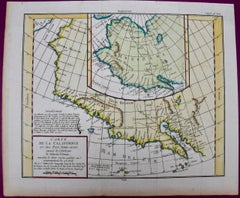
California: 18th Century Hand-colored Map by de Vaugondy
By Didier Robert de Vaugondy
Located in Alamo, CA
This is an 18th century hand-colored map of the western portions of North America entitled "Carte de la Californie et des Pays Nord-Ouest separés de l'Asie par le détroit d'Anian, ex...
Category
1770s Pierre Mortier Art
Materials
Engraving
$875
H 13.75 in W 16.63 in
Captain Cook
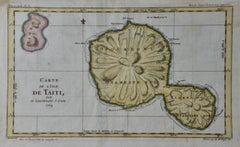
s Exploration of Tahiti: 18th C. Hand-colored Map by Bellin
By Jacques-Nicolas Bellin
Located in Alamo, CA
This beautiful 18th century hand-colored copper plate engraved map is entitled "Carte de l'Isle de Taiti, par le Lieutenant J. Cook" was created by Jacques Nicolas Bellin and publish...
Category
Late 18th Century Pierre Mortier Art
Materials
Engraving
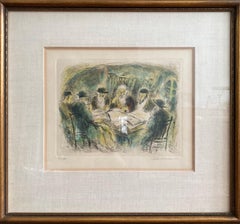
Reading the Torah, Modern Hand Colored Etching by Ira Moskowitz
By Ira Moskowitz
Located in Long Island City, NY
Ira Moskowitz, Polish/American (1912 - 2001) - Reading the Torah, Medium: Hand Colored Etching, signed and numbered, Edition: 5/120, Size: 11 x 13.5 in. (27.94 x 34.29 cm), Frame S...
Category
1960s Modern Pierre Mortier Art
Materials
Etching
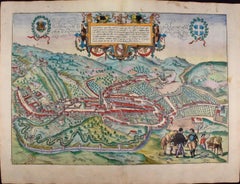
View of Seravalle, Italy: A 16th Century Hand-colored Map by Braun
Hogenberg
By Franz Hogenberg
Located in Alamo, CA
This is an original 16th century copperplate originally hand-colored engraved map of View of Seravalle, Italy entitled "Seravallum Celeberrimum Marchiae Tarvisiniae in Agro Foro Juliensi Opp. - Seravalli, quam vides, Spectator, iconem, operi huic nostro suis sumptib. . . ." by Georg Braun & Franz Hogenberg, from their famous city atlas "Civitates Orbis Terrarum", published in Augsberg, Germany in 1575.
The map depicts a view of Seravalle, now Vittorio Veneto, in San Marino, Italy, north of Venice, in a topographically accurate bird's-eye view from the south. A water-filled moat is seen to the south of the city walls and farmland to the east. Two men are depicted standing on a hill in the lower right in conversation next to grain sacks and a grazing horse, while a younger man behind them to the right herds a mule carrying presumably pigs. A very colorful and ornate title cartouche is in the upper center and coat-of-arms are in the right and left upper corners. Serravalle lies in an idyllic setting in the foothills and surrounded by orchards. St Mary's Cathedral with its tall bell tower is prominent in the center of the town. The marketplace and town hall with a bell tower in the square are depicted. Houses and shops are around the main square. Serravalle's importance as an agricultural centre is emphasized by the figures in the foreground. In 1337 Serravalle was conquered by the Republic of Venice. In 1866 the town was united with neighbouring Ceneda to form the town of Vittorio Veneto.
The following is an English translation of an excerpt from the French description of the city on the back of the map: "Serravalle, a market town renowned for cloth, wine and grain, is in such a beautiful situation that the number of its inhabitants, attracted by the loveliness of the place, has grown so much at times that the wall encircling it has had to be enlarged for the third time. The city with the surrounding town once belonged to the Church in Ceneda as an imperial fief. It subsequently became the seat of the Da Camino family (a princely house that at that time was one of the five most noble in all Italy). Now the city is under the sway of the Venetians but is prudently governed by them. For they send only one city councillor with instructions to ensure that justice prevails and to collect duties. In all else, power lies in the hands of the noble families."
This is a translation of the Latin in the title cartouche on the front: "The picture of the town of Serravalle, which you see, viewer, has been contributed to our work entirely at his own expense by Minutius, son of Hieronymus Minutius, a noble gentleman and one renowned for the far-reaching competence of his jurisdiction. We saw him sojourning in Cologne, where he was on business for Gregory XIII; while our good wishes accompany him, we should also like to accompany him on his way with this remembrance, even though it might be against his will, so that even those who have not seen him may learn of his excellence. However, those who do not yet know him will also see his excellence if God the Almighthy does not summon erring souls too soon back to the eternal seat of the Blessed."
References: Van der Krogt 4, 4728, State 1; Taschen, Braun and Hogenberg, p.331; Fauser, #14960
This striking hand-colored city view is printed on laid, chain-linked paper with wide margins. The sheet measures 16" high by 21" wide. There is a central vertical fold as issued and French text on the verso, with Latin on the front. There is some discoloration in the upper and right margins which may represent some watercolor paint from the time of the original hand-coloring of the map. There is a small hole to the right of the upper portion of the vertical fold, which is only visible when held up to light and an area of reinforcement on the verso of the lower vertical fold. The map is otherwise in very good to excellent condition.
Braun and Hogenberg's 'The Civitates Orbis Terrarum' was the second atlas of maps ever published and the first atlas of cities and towns of the world. It is one of the most important books published in the 16th century. Most of the maps in the atlas were engraved by Franz Hogenberg and the text, with its descriptions of the history and additional factual information of the cities, was written by a team of writers and edited by Georg Braun. The work contained 546 bird-eye views and map views of cities and towns from all over the world. It gave graphic representation of the main features of the illustrated cities and towns, including the buildings and streets. Although the ordinary buildings are stylized, the principal buildings are reproduced from actual drawings created on location. The principal landmarks and streets can still be recognized today. In addition, the maps often include the heraldic arms of the city, the nature of the surrounding countryside, the important rivers, streams and harbors, even depicting stone bridges, wooden pontoons, flat-bottomed ferries, ships and working boats, wharves and jetties, as well as land-based activities, including horsemen, pedestrians, wagons, coaches, and palanquins. Small vignettes are often included which illustrate the trade, occupations and habits of the local inhabitants, such as agriculture, paper-making and textiles, as well as local forms of punishment, such as gibbets, wheels, floggings etc. Large figures dressed in their local costume are often presented out of proportion in the foreground. The aim of the authors was to give as much information as possible in a pleasing visual form. They succeeded in creating maps that were both informative and decorative works of art. The atlas is a wonderful glimpse of life in medieval Europe.
Georg Braun (1541-1622) was German Catholic...
Category
16th Century Old Masters Pierre Mortier Art
Materials
Engraving
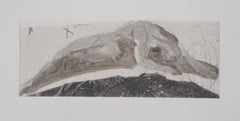
Attached to the Rock - Etching, 1897
By (after) Auguste Rodin
Located in Paris, IDF
Auguste RODIN (after)
Attached to the rock, 1897
Etching enhanced with watercolor
On vellum 31 x 42.5 cm (c. 12.2 x 16.7 inches)
Edition limited to 125 copies, send with the certifi...
Category
1890s Modern Pierre Mortier Art
Materials
Etching
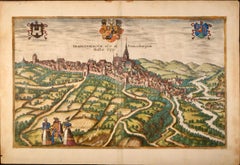
Frankfort, Germany: A 16th Century Hand-colored Map by Braun
Hogenberg
By Franz Hogenberg
Located in Alamo, CA
This is a 16th century original hand-colored copperplate engraved map of Frankfort, Germany entitled "Francenbergum, vel ut alij Francoburgum Hassiae Opp" by Georg Braun & Franz Hogenberg, from their famous city atlas "Civitates Orbis Terrarum", published in Cologne, Germany in 1595.
This is an English translation of an excerpt from the original text in the atlas:
"Frankenberg or, according to others, Francoburgum, a town in Hesse. Charlemagne vested the town of Frankenberg with many freedoms and privileges, which it still enjoys to this day, and on account of its valiant and victorious soldiers awarded a signet, upon which there formerly appeared a golden castle with a tower, together with the letter F and a golden crown.
Frankenberg, seen here from the northeast, lies on a hill above the River Eder. The hillside is covered with fields neatly separated by bushes and fences. Soaring above the town is the massive Liebfrauenkirche, which was modelled on St Elizabeth's church in Marburg. The New Town was founded in 1335 at the foot of the hill (right) and merged with the Old Town as late as 1556. Frankenberg was founded by Conrad of Thuringia in 1233/34 to prevent the archbishops of Mainz from expanding their sphere of influence...
Category
16th Century Old Masters Pierre Mortier Art
Materials
Engraving
$975
H 14.75 in W 21.75 in
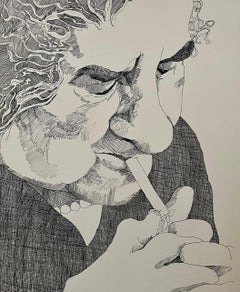
Golda Meir Israeli Woman Prime Minister Smoking Cigarette Ink Line Etching Print
Located in Surfside, FL
Golda Meir, Israeli Zionist leader, Prime Minister and feminist icon, smoking a cigarette.
Nancy Drosd is a painter working in New York City. Since 2001 s...
Category
1970s American Modern Pierre Mortier Art
Materials
Etching
$450
H 25.5 in W 20.25 in D 1 in
Dante - Etching, 1897
By (after) Auguste Rodin
Located in Paris, IDF
Auguste RODIN (after)
Dante, 1897
Etching enhanced with watercolor
On vellum 42.5 x 31 cm (c. 16.7 x 12.2 inches)
Edition limited to 125 copies, send with the certificate of authent...
Category
1890s Modern Pierre Mortier Art
Materials
Etching
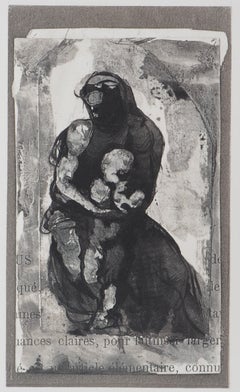
Lovers - Etching, 1897
By (after) Auguste Rodin
Located in Paris, IDF
Auguste RODIN (after)
Lovers, 1897
Etching enhanced with watercolor
On vellum 42.5 x 31 cm (c. 16.7 x 12.2 inches)
Edition limited to 125 copies, send with the certificate of authen...
Category
1890s Modern Pierre Mortier Art
Materials
Etching

Previously Available Items
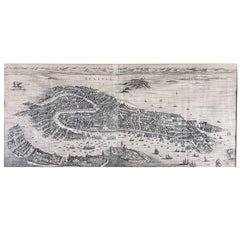
View of Venice Antique Print Engraved on Copper Etching 1724 Pierre Mortier
By Pierre Mortier
Located in Milano, IT
Venice Antique Print Engraved Etching 1724 Mortier. This Venetian view is one of the most striking and fascinating perspective plans of the city of Venice, etched on copper, belongi...
Category
1720s Flemish School Pierre Mortier Art
Materials
Etching
H 28.35 in W 51.58 in D 1.19 in
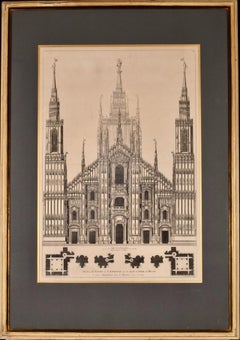
Milan Cathedral: A Framed 1704 Architectural Rendering by Mortier after Blaeu
By Pierre Mortier
Located in Alamo, CA
This is an architectural engraving depicting the front of the famous cathedral in Milan (Duomo di Milano), Italy entitled "Face de L'Eglise de St. Ambriose qu'on Appelle le Dome de Milan" by Pierre Mortier (1661-1711) in 1704 after a 17th century engraving by Joan Blaeu (1596-1673), from Blaeu's publication "Nouveau Théâtre D'Italie, Ou Description Exacte De Ses Villes, Palais, Églises, Principaux Édifices" (New Theater or Townbooks of Italy).
In 1672 Blaeu's printing house was destroyed by fire, and Mortier took over what was left of Blaeu's plates. New plates were engraved, and Mortier re-issued Blaeu's Townbooks of Italy with a mixture of the old and the new panoramas of Italian towns and cities.
This engraving is presented in an antiqued bleached wood...
Category
Early 18th Century Old Masters Pierre Mortier Art
Materials
Engraving
H 33.75 in W 23.63 in D 1.25 in
St. Peter
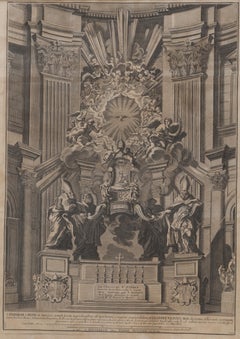
s Chair - Original Etching by P. Mortier - 17th Century
By Pierre Mortier
Located in Roma, IT
St. Peter's Chair is an original artwork realized by the Dutch artist Pierre Mortier in the second half of the XVII Century.
Original etching on paper.
Molded frame in natural wood, from the 18th century included.
Good conditions.
Very beautiful artwork representing the Chair of St. Peter in Vatican with a monumental tabernacle with Corinthial elements and decorations over the big chair...
Category
17th Century Pierre Mortier Art
Materials
Etching
H 29.93 in W 20.08 in D 0.04 in
Pierre Mortier art for sale on 1stDibs.
Find a wide variety of authentic Pierre Mortier art available for sale on 1stDibs. You can also browse by medium to find art by Pierre Mortier in engraving, etching and more. Much of the original work by this artist or collective was created during the 18th century and earlier and is mostly associated with the Old Masters style. Not every interior allows for large Pierre Mortier art, so small editions measuring 24 inches across are available. Customers who are interested in this artist might also find the work of Johann Baptist Homann, Karel Dujardin, and Crispin de Passe II. Pierre Mortier art prices can differ depending upon medium, time period and other attributes. On 1stDibs, the price for these items starts at $1,069 and tops out at $1,420, while the average work can sell for $1,350.