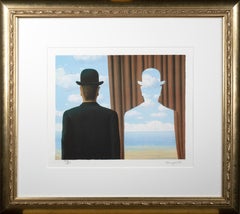
René Magritte Figurative Prints

Belgian, 1898-1967

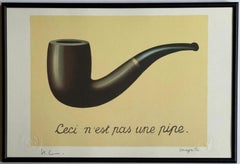
René Magritte is celebrated today as one of Surrealism’s most talented artists, and, alongside Salvador Dalí, the cheeky, subversive Belgian painter and author is the movement’s best-known representative, having cemented his legacy with what may be the most iconic five words in all of art history: “Ceci n’est pas une pipe” (This is not a pipe).

Magritte’s success, though, hardly came overnight. Born in 1898 in Lessines to a wealthy manufacturer, he studied at the Académie Royale des Beaux-Arts in Brussels from 1916 to 1918 but quit before graduation. His early artistic work wavered between Cubism and semi-abstraction, and he found work as a graphic designer while experimenting with his own creative oeuvre. In the mid-1920s, he began to experiment with Surrealism, then a relatively nascent movement that had grown out of the absurdist Dada. Led by André Breton, Surrealism endeavored to record elements of the subconscious and present contradictory, sometimes even nonsensical, narratives that challenged the notion of an absolute reality.

Magritte’s first widely recognized work within this genre was 1927’s The Menaced Assassin, now in the collection of the Museum of Modern Art in New York. Shortly after completing this work, Magritte relocated to Paris, to be closer to Breton and the center of the Surrealist movement. This decision would prove critical in his life — and in the trajectory of Surrealist art history. The three years Magritte spent in Paris were his most prolific, and by the close of the 1920s he had completed some of his best-known work, including the seminal 1929 The Treachery of Images, a simple picture of what appears to be a pipe, with the words “Ceci n’est pas une pipe” in neat script below it.

Magritte returned to Brussels in the early 1930s but continued experimenting with work that wavered between dreamlike and nonsensical. His influences throughout this part of his career ranged from Breton to Giorgio de Chirico and Dalí. While living in German-occupied Belgium beginning in the early 1940s, Magritte entered what is often called his Renoir period or what he labeled “Sunlit Surrealism.” He worked in comparatively brighter, more vibrant colors and produced oil paintings and gouaches that were overrun with light and the type of brushstrokes that are usually associated with Impressionist art.

Like many artists during and after the war, Magritte thought deeply about art’s role in answering big existential questions and broke with Surrealism as a result. His Impressionistic The Fifth Season in 1943 resembled little of what he’d painted in years past. His so-called Vache period that followed would represent another stylistic shift that owed to German Expressionism. Not everything changed, however; Magritte would go on to revisit his earliest creative impulses, in some cases appropriating elements from fellow artists in his own depictions, as with his Perspective II: Manet’s Balcony in 1950, a playful and probing reinterpretation of Edouard Manet’s The Balcony. Later in his career, the artist dabbled in sculpture, before dying in 1967.

Find original René Magritte prints and other art on 1stDibs.

to
1
3
4
1
Overall Width
to
Overall Height
to
8
31
859
382
367
310
4
4
1
1
5
3
3
2
1
1
1
1
1
1
1
1
8
4
2
6
2
Artist: René Magritte
La Grande Guerre - 20th Century, Surrealist, Lithograph, Figurative Print
By René Magritte
Located in Sint-Truiden, BE
Color lithograph after the 1954 oil on canvas by René Magritte, plate-signed by Magritte and numbered from the edition of 300. The lithograph features the dry stamps of the Magritte...
Category

20th Century Surrealist René Magritte Figurative Prints

Materials

Lithograph

Rene Magritte, The Indiscreet Jewels, from XXe Siecle, 1963
By René Magritte
Located in Southampton, NY
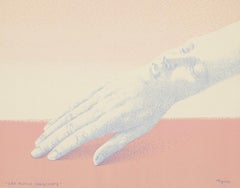
This exquisite lithograph by Rene Magritte (1898–1967), titled Les Bijoux indiscrets (The Indiscreet Jewels), from the album XXe Siecle, Nouvelle serie, XXVe Annee N°22, Noel 1963, o...
Category

1960s Surrealist René Magritte Figurative Prints

Materials

Lithograph

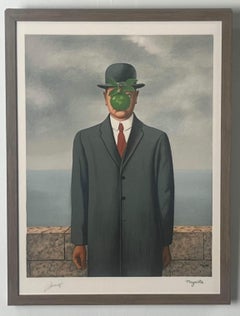
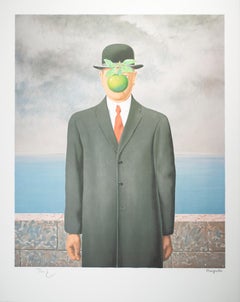
Rene Magritte Le Fils de L homme Lithograph, Signed in a Pate, Stamped Framed
By René Magritte
Located in Plainview, NY
Rene Magritte Le Fils de L'homme Lithograph, Signed in a Pate, Stamped & Framed One of Magritte’s ( Belgian 1898- 1967) most iconic and enigma...
Category

20th Century Surrealist René Magritte Figurative Prints

Materials

Lithograph

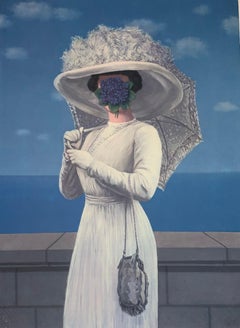
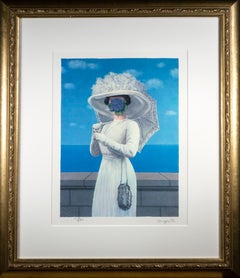
"La Grande Guerre (The Great War), " Color Lithograph after Rene Magritte
By René Magritte
Located in Milwaukee, WI
"La Grande Guerre (The Great War)" is a color lithograph after the 1964 painting by Rene Magritte. A Victorian lady stands in white facing the viewer. A bouq...
Category

2010s Surrealist René Magritte Figurative Prints

Materials

Lithograph

Indiscrete Jewels (Les Bijoux Indiscrets) - Original lithograph [Catalog #3]
By René Magritte
Located in Paris, IDF
René MAGRITTE Les bijoux indiscrets (Indiscrete jewels), 1975 Original lithograph (Printed in Mourlot Workshop) Printed signature in the plate Unnumbered as usual (limited edition o...
Category

1970s Surrealist René Magritte Figurative Prints

Materials

Lithograph

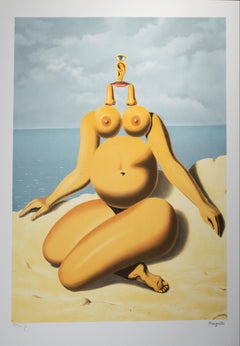
"La race blanche (The White Race), " Lithograph after Painting by Rene Magritte
By René Magritte
Located in Milwaukee, WI
"La race blanche (The White Race)" is a color lithograph after the original 1937 painting by Rene Magritte. A female figure is made out of a mix of body parts. An eye sits on top of an ear, which is on top of a mouth, then two noses. Two breasts lying on a stomach; two arms come from the breasts. Legs are tucked under the stomach. This figure is on a sand dune next to the ocean. Art: 26.5 x 19.63 in Frame: 40.88 x 33.88 in René-François-Ghislain Magritte was born November 21, 1898, in Lessines, Belgium and died on August 15, 1967 in Brussels. He is one of the most important surrealist artists. Through his art, Magritte creates humor and mystery with juxtapositions and shocking irregularities. Some of his hallmark motifs include the bourgeois “little man,” bowler hats, apples, hidden faces, and contradictory texts. René Magritte’s father was a tailor and his mother was a miller. Tragedy struck Magritte’s life when his mother committed suicide when he was only fourteen. Magritte and his two brothers were thereafter raised by their grandmother. Magritte studied at the Brussels Academy of Fine Arts from 1916 to 1918. After graduating he worked as a wallpaper designer and in advertisement. It was during this period that he married Georgette Berger, whom he had known since they were teenagers. In 1926, René Magritte signed...
Category

Early 2000s Surrealist René Magritte Figurative Prints

Materials

Lithograph

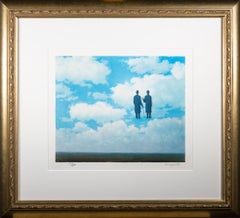
"La Reconnaissance Infinie (The Infinite Recognition)" Litho after Rene Magritte
By René Magritte
Located in Milwaukee, WI
"La Reconnaissance Infinie (The Infinite Recognition)" is a color lithograph after the 1963 painting by Rene Magritte. Two of Magritte's bourgeois "littl...
Category

2010s Surrealist René Magritte Figurative Prints

Materials

Lithograph

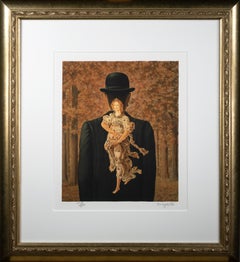
"Le Bouquet tout fait (The Ready-made Bouquet), " Lithograph after Rene Magritte
By René Magritte
Located in Milwaukee, WI
"Le Bouquet tout fait (The Ready-made Bouquet)" is a color lithograph after a 1954 original painting by Rene Magritte. A bourgeois "little man" faces away from the viewer looking towards a fall forest. Flora, the goddess of flowers and season of spring, from Sandro Botticelli's "Primavera" is painted on the back of the man. This juxtaposes fall and spring. Art: 12 x 9.75 in Frame: 22.38 x 20.38 in René-François-Ghislain Magritte was born November 21, 1898, in Lessines, Belgium and died on August 15, 1967 in Brussels. He is one of the most important surrealist artists. Through his art, Magritte creates humor and mystery with juxtapositions and shocking irregularities. Some of his hallmark motifs include the bourgeois “little man,” bowler hats, apples, hidden faces, and contradictory texts. René Magritte’s father was a tailor and his mother was a miller. Tragedy struck Magritte’s life when his mother committed suicide when he was only fourteen. Magritte and his two brothers were thereafter raised by their grandmother. Magritte studied at the Brussels Academy of Fine Arts from 1916 to 1918. After graduating he worked as a wallpaper designer and in advertisement. It was during this period that he married Georgette Berger, whom he had known since they were teenagers. In 1926, René Magritte signed a contract with the Brussels Art Gallery, which allowed him to quit his other jobs and focus completely on creating art. A year later he had his first solo show at the Galerie la Centaurie in Brussels. At this show Magritte exhibited what is today thought of as his first surrealist piece, The Lost Jockey, painted in 1926. In this work a jockey and his steed run across a theater stage, curtains parted on either side. Throughout the scene, there are trees with trunks shaped somewhat like chess pawns with musical scores running vertically up their sides and branches sticking out from all angles. Critics did not enjoy this style of art; it was new, different, and took critical thought to understand, but The Lost Jockey was only the first of many surrealist artworks Magritte would paint. Because of the bad press in Brussels, René and Georgette moved to Paris in 1927, with the hope that this center of avant-garde art would bring him success and recognition. In Paris, he was able to become friends with many other surrealists, including André Breton and Paul Éluard. They were able to learn from and inspire one another, pushing the Surrealist movement further forward. It was also in Paris that Magritte decided to add text to some of his pieces, which was one of the elements that made his artwork stand out. In 1929, he painted one of his most famous oil works: The Treachery of Images. This is the eye-catching piece centered on a pipe. Below the pipe is written “Ceci n’est pas un pipe,” which translates to “This is not a pipe.” This simple sentence upset many critics of the time, for of course it was a pipe. Magritte replied that it was not a pipe, but a representation of a pipe. One could not use this oil on canvas as a pipe, to fill it with tobacco and smoke it. Thus, it was not a pipe. In 1930, Magritte and Georgette moved back to Brussels. Though they would travel to his exhibitions elsewhere, their home going forward would always be in Brussels. Magritte had his first American exhibition at the Julien Levy Gallery in New York City in 1936 and his first show in England two years later in 1938 at The London...
Category

2010s Surrealist René Magritte Figurative Prints

Materials

Lithograph

Related Items
Ladder
By Fanny Brennan
Located in New York, NY
Created by Surrealist Fanny Brennan from 1992-96, Ladder is a lithograph in colors on wove paper. Hand-monogrammed in pencil and numbered from the edition of 250, the artwork measure...
Category

Late 20th Century Surrealist René Magritte Figurative Prints

Materials

Lithograph

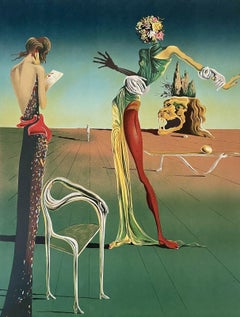
Dali, Femme à tete de Roses (after)
By Salvador Dalí­
Located in Fairfield, CT
Artist: Salvador Dali (1904-1989) Title: Femme à tete de Roses Year: 2004 Medium: Lithograph on wove paper Size: 30.25 x 22 inches Condition: Excellent Inscription: Unsigned and unnu...
Category

Early 2000s Surrealist René Magritte Figurative Prints

Materials

Lithograph

Dali, Femme à tete de Roses (after)
$2,360 Sale Price
20% Off
H 30.25 in W 22 in
Couple et Poisson (Couple and Fish), From Nice and the Cote d’Azur, 1967
By Marc Chagall
Located in Palo Alto, CA
Marc Chagall Couple et Poisson (Couple and Fish), From Nice and the Cote d’Azur, 1967 is a romantic scene on the shores of Nice. Composed of predominately warm tones of blues and gre...
Category

1960s Surrealist René Magritte Figurative Prints

Materials

Lithograph

Love Letters
By Fanny Brennan
Located in Greenwich, CT
Love Letters is a lithograph on paper with an image size of 2.25 x 2.25 inches, initialed 'FMB' lower right and annotated lower left, framed in a contemporary silver and dark gray fr...
Category

20th Century Surrealist René Magritte Figurative Prints

Materials

Paper, Lithograph

Love Letters
Love Letters
$495
H 14.75 in W 15 in
Boy and puppy
Located in Belgrade, MT
Madeline Luka (French 1894-1989) was a self taught painter known for her landscapes, portraits, nudes and still lifes. She typically portrayed her family and close friends set within...
Category

Mid-20th Century Surrealist René Magritte Figurative Prints

Materials

Lithograph

Boy and puppy
$220 Sale Price
20% Off
H 17.5 in W 14 in
GLOWING HANDS Signed Lithograph, Spiritual Inspiration, Yellow Light, Blue Sky
By De Es Schwertberger
Located in Union City, NJ
GLOWING HANDS is a hand drawn original lithograph printed using hand lithography techniques on archival Arches printmaking paper 100% acid free. GLOWING HANDS is a highly detailed sp...
Category

1970s Surrealist René Magritte Figurative Prints

Materials

Lithograph

Day Room
By Fanny Brennan
Located in Greenwich, CT
Day Room is a lithograph on paper with an image size of 2.25 x 3.5 inches, initialed 'FMB' lower right and annotated lower left, framed in a contemporary silver and dark gray frame. ...
Category

20th Century Surrealist René Magritte Figurative Prints

Materials

Paper, Lithograph

Day Room
Day Room
$395
H 15 in W 16 in
Flights of Fancy original lithograph by Michel Pellus 1977
By Michel Pellus 1
Located in Paonia, CO
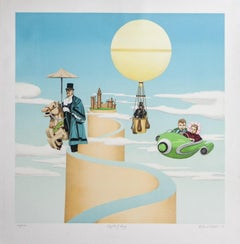
Flights of Fancy is an original signed limited edition (060/250 ) lithograph by Michel Pellus showing a man in a top hat floating in the sky in a hot a...
Category

1970s Surrealist René Magritte Figurative Prints

Materials

Lithograph

Reclining Female (Surreal, Colorful, Vibrant, Modern) (25% OFF LIST PRICE)
Located in Kansas City, MO
Franz Graw Reclining Female (Surreal, Colorful, Vibrant, Modern) Color Offset Lithograph Year: 2021 Size: 16.53 x 11.73 inches (42 x 29.8 cm) Edition: 100 Signed and numbered in penc...
Category

2010s Surrealist René Magritte Figurative Prints

Materials

Lithograph, Offset

The Absolute Real - Lithograph by Man Ray - 1964
By Man Ray
Located in Roma, IT
The Absolute Real is a lithograph realized by Man Ray in 1964. Hand-singed in pencil by the Artist. Lithograph in Red Ink, 1964. Published by Schwarz, the lithograph is part of th...
Category

1960s Surrealist René Magritte Figurative Prints

Materials

Paper, Lithograph

The Absolute Real - Lithograph by Man Ray - 1964
$927 Sale Price
35% Off
H 13.39 in W 11.23 in D 0.04 in
Ancient View of Lago Maggiore - Lithograph on Paper - Mid-19th Century
Located in Roma, IT
Ancient View of Lago Maggiore is an original modern artwork realized in Italy in the first half of the 19th Century. Original Lithograph on Ivory Paper...
Category

1850s Surrealist René Magritte Figurative Prints

Materials

Lithograph

RECEIVING HAND Signed Lithograph, Fantastic Realism, Stone, Healing Art
By De Es Schwertberger
Located in Union City, NJ
RECEIVING HAND is a hand drawn original lithograph printed using hand lithography techniques on archival Arches printmaking paper 100% acid free. RECEIVING HAND a finely detailed hand drawn example of Fantastic Realism...
Category

1970s Surrealist René Magritte Figurative Prints

Materials

Lithograph

Previously Available Items
Le Trahison des Images: Ceci N Est Pas Une Pipe, Lithograph on Arches BFK Rives
By René Magritte
Located in New York, NY
René Magritte Le Trahison des Images: Ceci N'Est Pas Une Pipe, 2010 (posthumous) Lithograph on Arches BFK Rives paper Plate signed by Magritte and numbered HC (Hors Commerce), 1 of 1...
Category

2010s Surrealist René Magritte Figurative Prints

Materials

Lithograph

Untitled - Etching by René Magritte - 1968
By René Magritte
Located in Roma, IT
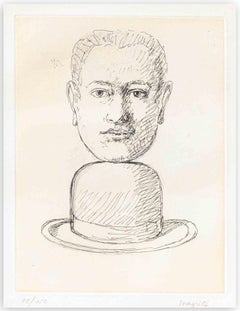
Untitled is an artwork realized by René Magritte, in 1968. Etching in black and white. Illustration for the volume "Le Lien de Paille", by Louis Scutenaire. Stamp Signed lower ri...
Category

1960s Surrealist René Magritte Figurative Prints

Materials

Etching

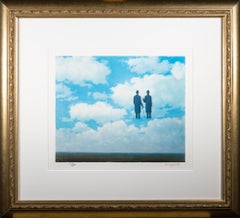
"La Reconnaissance Infinie (The Infinite Recognition)" Litho after Rene Magritte
By René Magritte
Located in Milwaukee, WI
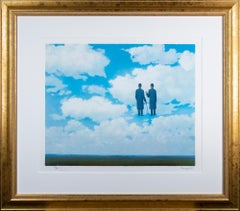
"La Reconnaissance Infinie (The Infinite Recognition)" is a color lithograph after the 1963 painting by Rene Magritte. Two of Magritte's bourgeois "little men" stand in the sky. Both look away from the viewer talking to each other in the typical outfit of Magritte's men, black trench coats and bowler hats. Art: 9.75 x 12.63 in Frame: 20.38 x 22.63 in René-François-Ghislain Magritte was born November 21, 1898, in Lessines, Belgium and died on August 15, 1967 in Brussels. He is one of the most important surrealist artists. Through his art, Magritte creates humor and mystery with juxtapositions and shocking irregularities. Some of his hallmark motifs include the bourgeois “little man,” bowler hats, apples, hidden faces, and contradictory texts. René Magritte’s father was a tailor and his mother was a miller. Tragedy struck Magritte’s life when his mother committed suicide when he was only fourteen. Magritte and his two brothers were thereafter raised by their grandmother. Magritte studied at the Brussels Academy of Fine Arts from 1916 to 1918. After graduating he worked as a wallpaper designer and in advertisement. It was during this period that he married Georgette Berger, whom he had known since they were teenagers. In 1926, René Magritte signed a contract with the Brussels Art Gallery, which allowed him to quit his other jobs and focus completely on creating art. A year later he had his first solo show at the Galerie la Centaurie in Brussels. At this show Magritte exhibited what is today thought of as his first surrealist piece, The Lost Jockey, painted in 1926. In this work a jockey and his steed run across a theater stage, curtains parted on either side. Throughout the scene, there are trees with trunks shaped somewhat like chess pawns with musical scores running vertically up their sides and branches sticking out from all angles. Critics did not enjoy this style of art; it was new, different, and took critical thought to understand, but The Lost Jockey was only the first of many surrealist artworks Magritte would paint. Because of the bad press in Brussels, René and Georgette moved to Paris in 1927, with the hope that this center of avant-garde art would bring him success and recognition. In Paris, he was able to become friends with many other surrealists, including André Breton and Paul Éluard. They were able to learn from and inspire one another, pushing the Surrealist movement further forward. It was also in Paris that Magritte decided to add text to some of his pieces, which was one of the elements that made his artwork stand out. In 1929, he painted one of his most famous oil works: The Treachery of Images. This is the eye-catching piece centered on a pipe. Below the pipe is written “Ceci n’est pas un pipe,” which translates to “This is not a pipe.” This simple sentence upset many critics of the time, for of course it was a pipe. Magritte replied that it was not a pipe, but a representation of a pipe. One could not use this oil on canvas as a pipe, to fill it with tobacco and smoke it. Thus, it was not a pipe. In 1930, Magritte and Georgette moved back to Brussels. Though they would travel to his exhibitions elsewhere, their home going forward would always be in Brussels. Magritte had his first American exhibition at the Julien Levy Gallery in New York City in 1936 and his first show in England two years later in 1938 at The London Gallery...
Category

2010s Surrealist René Magritte Figurative Prints

Materials

Lithograph

"La Reconnaissance Infinie (The Infinite Recognition)" Litho after Rene Magritte
By René Magritte
Located in Milwaukee, WI
"La Reconnaissance Infinie (The Infinite Recognition)" is a color lithograph after the 1963 painting by Rene Magritte. Two of Magritte's bourgeois "little men" stand in the sky. Both look away from the viewer talking to each other in the typical outfit of Magritte's men, black trench coats and bowler hats. Art: 15 x 18.25 in Frame: 26.25 x 29.88 in René-François-Ghislain Magritte was born November 21, 1898, in Lessines, Belgium and died on August 15, 1967 in Brussels. He is one of the most important surrealist artists. Through his art, Magritte creates humor and mystery with juxtapositions and shocking irregularities. Some of his hallmark motifs include the bourgeois “little man,” bowler hats, apples, hidden faces, and contradictory texts. René Magritte’s father was a tailor and his mother was a miller. Tragedy struck Magritte’s life when his mother committed suicide when he was only fourteen. Magritte and his two brothers were thereafter raised by their grandmother. Magritte studied at the Brussels Academy of Fine Arts from 1916 to 1918. After graduating he worked as a wallpaper designer and in advertisement. It was during this period that he married Georgette Berger, whom he had known since they were teenagers. In 1926, René Magritte signed a contract with the Brussels Art Gallery, which allowed him to quit his other jobs and focus completely on creating art. A year later he had his first solo show at the Galerie la Centaurie in Brussels. At this show Magritte exhibited what is today thought of as his first surrealist piece, The Lost Jockey, painted in 1926. In this work a jockey and his steed run across a theater stage, curtains parted on either side. Throughout the scene, there are trees with trunks shaped somewhat like chess pawns with musical scores running vertically up their sides and branches sticking out from all angles. Critics did not enjoy this style of art; it was new, different, and took critical thought to understand, but The Lost Jockey was only the first of many surrealist artworks Magritte would paint. Because of the bad press in Brussels, René and Georgette moved to Paris in 1927, with the hope that this center of avant-garde art would bring him success and recognition. In Paris, he was able to become friends with many other surrealists, including André Breton and Paul Éluard. They were able to learn from and inspire one another, pushing the Surrealist movement further forward. It was also in Paris that Magritte decided to add text to some of his pieces, which was one of the elements that made his artwork stand out. In 1929, he painted one of his most famous oil works: The Treachery of Images. This is the eye-catching piece centered on a pipe. Below the pipe is written “Ceci n’est pas un pipe,” which translates to “This is not a pipe.” This simple sentence upset many critics of the time, for of course it was a pipe. Magritte replied that it was not a pipe, but a representation of a pipe. One could not use this oil on canvas as a pipe, to fill it with tobacco and smoke it. Thus, it was not a pipe. In 1930, Magritte and Georgette moved back to Brussels. Though they would travel to his exhibitions elsewhere, their home going forward would always be in Brussels. Magritte had his first American exhibition at the Julien Levy Gallery in New York City in 1936 and his first show in England two years later in 1938 at The London Gallery...
Category

2010s Surrealist René Magritte Figurative Prints

Materials

Lithograph

La Folie almayer
By René Magritte
Located in New York, NY
A very good impression of this color etching. Numbered 88/150 in pencil by Magritte. Printed and published by Georges Visat, Paris. From "Lien de Paille."
Category

1960s Surrealist René Magritte Figurative Prints

Materials

Color, Etching

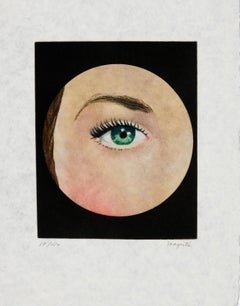
L Oeil
By René Magritte
Located in New York, NY
A very good impression of this color aquatint and etching on Japon nacré. With the artist's ink stamp signature and blind stamp, and numbered 88/150. Printed and published by Georges...
Category

1960s Dada René Magritte Figurative Prints

Materials

Color, Etching, Aquatint

L
Oeil
H 6.88 in W 5.63 in
La Comtesse de Monte Cristo - Original Etching by Renè Magritte - 1966
By René Magritte
Located in Roma, IT
La Comtesse de Monte Cristo is a modern artwork realized by Renè Magritte in 1966. Original Etching on Richard de Bas Paper. The artwork belongs to the ...
Category

1960s Surrealist René Magritte Figurative Prints

Materials

Paper, Etching

Indiscrete Jewels (Les Bijoux Indiscrets) - Original lithograph [Catalog #3]
By René Magritte
Located in Paris, IDF
René MAGRITTE Les bijoux indiscrets (Indiscrete jewels), 1975 Original lithograph (Printed in Mourlot Workshop) Printed signature in the plate Unnumbered as usual (limited edition o...
Category

1970s Surrealist René Magritte Figurative Prints

Materials

Lithograph

Les Moyens d Existence
By René Magritte
Located in New York, NY
A very good impression of this etching with strong colors. With the artist's signature ink stamp and numbered 80/150 in pencil by Magritte. Printed and published by Georges Visat, Pa...
Category

1960s Surrealist René Magritte Figurative Prints

Materials

Color, Etching

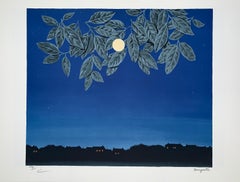
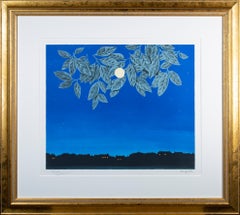
"La Page Blanche (The White Page)" lithograph after painting by Rene Magritte
By René Magritte
Located in Milwaukee, WI
"La Page Blanche," or in English "The White Page," is an original color lithograph executed after the original painting from 1967 by the Belgian Surrealist...
Category

2010s Surrealist René Magritte Figurative Prints

Materials

Lithograph

"Le Fils de l Homme (The Son of Man), " Litho after Painting by Rene Magritte
By René Magritte
Located in Milwaukee, WI
"Le Fils de l'Homme (The Son of Man)" is a color lithograph after the original 1964 painting by Rene Magritte. This is one of Magritte's most recognizab...
Category

Early 2000s Surrealist René Magritte Figurative Prints

Materials

Lithograph

"Decalcomanie (Decalcomania), " Lithograph after 1966 Painting by Rene Magritte
By René Magritte
Located in Milwaukee, WI
"Decalcomani (Decalcomania)" is a color lithograph after 1966 painting by Rene Magritte. Decalcomania is often shortened today to decal. A bourgeois "little man" is standing looking ...
Category

2010s Surrealist René Magritte Figurative Prints

Materials

Lithograph

René Magritte figurative prints for sale on 1stDibs.

Find a wide variety of authentic René Magritte figurative prints available for sale on 1stDibs. You can also browse by medium to find art by René Magritte in lithograph, etching and more. Much of the original work by this artist or collective was created during the 21st century and contemporary and is mostly associated with the Surrealist style. Not every interior allows for large René Magritte figurative prints, so small editions measuring 7 inches across are available. Customers who are interested in this artist might also find the work of Maurice Pasternak, Paul Delvaux, and James Ensor. René Magritte figurative prints prices can differ depending upon medium, time period and other attributes. On 1stDibs, the price for these items starts at $495 and tops out at $4,860, while the average work can sell for $3,000.

Recently Viewed

View All