Robert Adams Sculptures

to
1
1
1
Overall Width
to
Overall Height
to
3
1
2
2
1
1
4
214
209
160
132
2
2
1
Artist: Robert Adams
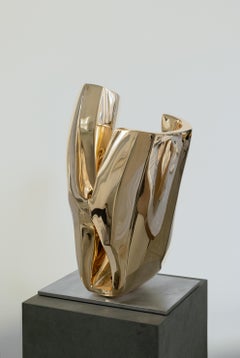
Untitled
By Robert Adams
Located in Palm Desert, CA
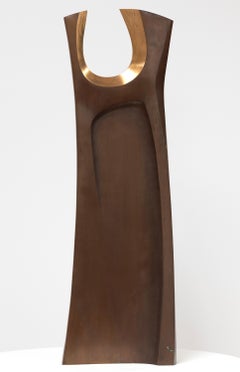
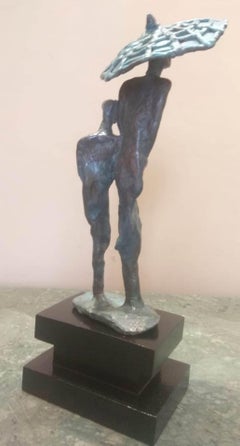
"Untitled" is a bronze sculpture made by Robert Adams in 1979. The work is number 3 from an edition of 6. The artwork size is 29 1/2 x 9 3/4 x 3 1/2 inche...
Category

Late 20th Century Abstract Robert Adams Sculptures

Materials

Bronze

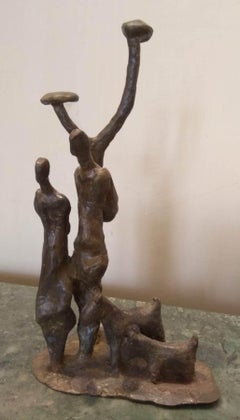
1960s Bronze Sculpture, Female Standing Nude, Figurative
By Robert Adams
Located in Kingsclere, GB
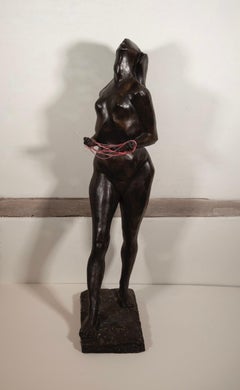
Woman With a Skein, Michael Ayrton, 1963 Additional information: Medium: Bronze Height 87 cm (34 1/4 in) Signed and numbered on base Provenance acquired by the present owner in 201...
Category

20th Century Robert Adams Sculptures

Materials

Bronze
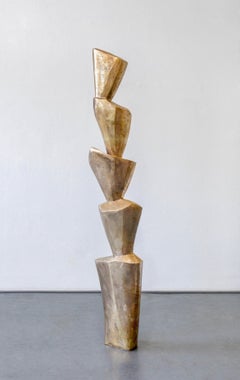
Divided Column Sculpture of Birch by Robert Adams, 1952
By Robert Adams
Located in Kingsclere, GB
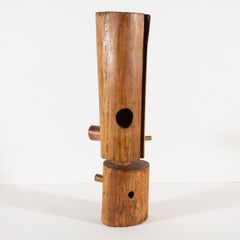
Divided Column Sculpture of Birch by Robert Adams, 1952 Additional information: Medium: Birch Height, 57 cm (22 1/2 in) Titled and inscribed with medium...
Category

20th Century Robert Adams Sculptures

Materials

Birch

Related Items
Reclining Figure (woman)
By William King (b.1925)
Located in Wilton Manors, FL
William King (1925-2015). Reclining figure, ca. 1965. Cast and welded bronze, 7 x 9.5 x 5 inches. Unsigned. William King, a sculptor in a variety of materials whose human figures traced social attitudes through the last half of the 20th century, often poking sly and poignant fun at human follies and foibles, died on March 4 at his home in East Hampton, N.Y. He was 90. His death was confirmed by Scott Chaskey, who is married to Mr. King's stepdaughter, Megan Chaskey. Mr. King worked in clay, wood, bronze, vinyl, burlap and aluminum. He worked both big and small, from busts and toylike figures to large public art pieces depicting familiar human poses -- a seated, cross-legged man reading; a Western couple (he in a cowboy hat, she in a long dress) holding hands; a tall man reaching down to tug along a recalcitrant little boy; a crowd of robotic-looking men walking in lock step. But for all its variation, what unified his work was a wry observer's arched eyebrow, the pointed humor and witty rue of a fatalist. His figurative sculptures, often with long, spidery legs and an outlandishly skewed ratio of torso to appendages, use gestures and posture to suggest attitude and illustrate his own amusement with the unwieldiness of human physical equipment. His subjects included tennis players and gymnasts, dancers and musicians, and he managed to show appreciation of their physical gifts and comic delight at their contortions and costumery. His suit-wearing businessmen often appeared haughty or pompous; his other men could seem timid or perplexed or awkward. Oddly, or perhaps tellingly, he tended to depict women more reverentially, though in his portrayals of couples the fragility and tender comedy inherent in couplehood settled equally on both partners. Mr. King's work is in the collections of the Metropolitan Museum of Art and the Museum of Modern Art in New York and the Smithsonian American Art Museum in Washington, among other places, and he had dozens of solo gallery shows in New York and elsewhere. But the comic element of his work probably caused his reputation to suffer. Reviews of his exhibitions frequently began with the caveat that even though the work was funny, it was also serious, displaying superior technical skills, imaginative vision and the bolstering weight of a range of influences, from the ancient Etruscans to American folk art to 20th-century artists including Giacometti, Calder. and Elie Nadelman. The critic Hilton Kramer, one of Mr. King's most ardent advocates, wrote in a 1970 essay accompanying a New York gallery exhibit that he was, "among other things, an amusing artist, and nowadays this can, at times, be almost as much a liability as an asset." A "preoccupation with gesture is the focus of King's sculptural imagination," Mr. Kramer wrote. "Everything that one admires in his work - the virtuoso carving, the deft handling of a wide variety of materials, the shrewd observation and resourceful invention - all this is secondary to the concentration on gesture. The physical stance of the human animal as it negotiates the social arena, the unconscious gait that the body assumes in making its way in the social medium, the emotion traced by the course of a limb, a torso, a head, the features of a face, a coiffure or a costume - from a keen observation of these materials King has garnered a large stock of sculptural images notable for their wit, empathy, simplicity and psychological precision." William Dickey King...
Category

Mid-20th Century Abstract Robert Adams Sculptures

Materials

Bronze
Reclining Figure (woman)
$2,800 Sale Price
30% Off
H 7 in W 9.5 in D 5 in
Close to Heart 1 2 - Wood sculpture by Zlata Kornilova
Located in Paris, FR
Sculpture Close to Heart 1 & 2 Limited edition of 12 (each sculpture) Dimensions: - Close to heart 1 (black): H. 73. x D. 34 cm - Close to heart 2 (natural): H. 82. x D. 22 cm Medi...
Category

21st Century and Contemporary Abstract Robert Adams Sculptures

Materials

Steel

Arnaldo Pomodoro ( 1926 ) - Rotazione Ascensoriale - Bronze Sculpture - 1993
By Arnaldo Pomodoro
Located in Varese, IT
Rotazione Ascensoriale I , 1993 bronze sculpture h15 x 12.5 x 8 cm approx , ( including base ) , diameter Ø approx 13.5 cm limited edition , numbered: 15/70 signed dated and numbered...
Category

1920s Abstract Geometric Robert Adams Sculptures

Materials

Bronze

Bronze Sculpture Bolas IV by Carola Eggeling, Bronze Patina
By Carola Eggeling
Located in Paris, FR
Bronze Sculpture 'Bolas IV' by Carola Eggeling Abstract sculpture with beautiful curved lines. German bronze sculpture Bronze Patina Certific...
Category

21st Century and Contemporary Abstract Robert Adams Sculptures

Materials

Bronze
Lapin bijou sonnette, Sandoz, Ring, Rabbit, Bronze, animal, sculpture, 1920 s
By Edouard-Marcel Sandoz
Located in Geneva, CH
Lapin bijou, sonnette, circa 1920-1930 Fondry Susse, Ed. 1748 pcs Bronze with a brown patina H. 6.5 cm Signed on the side of the base : Ed.m.Sandoz Sandoz : Sculpteur Figuriste et An...
Category

1920s Modern Robert Adams Sculptures

Materials

Bronze
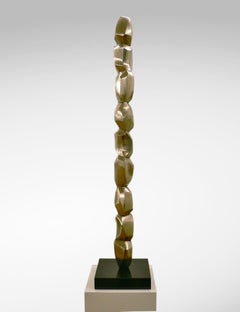
Three Piece Reclining Figure
By Henry Moore
Located in Toronto, Ontario
Henry Moore, Three Piece Reclining Figure Bronze Conceived 1963, cast 1977 Stamped with signature and edition to base Edition 5/9 Dominion Gallery placard to underside Henry Moore F...
Category

1970s Abstract Robert Adams Sculptures

Materials

Bronze
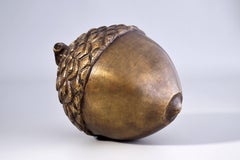
Three Piece Reclining Figure
$98,000
H 4.5 in W 8.75 in D 4.75 in
Eduardo Chavez Mid-Century Modern Bronze Sculpture on Stand “Chama” 1966
By Edward Arcenio Chavez
Located in Denver, CO
This exceptional Mid-Century Modern bronze sculpture, titled “Chama” (circa 1966), was created by acclaimed American artist Eduardo Arcenio Chavez (1917–1995). Resting on its origina...
Category

1960s Abstract Robert Adams Sculptures

Materials

Bronze
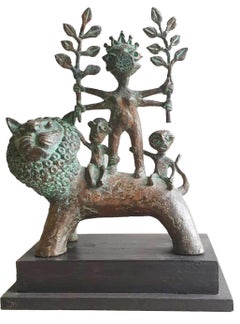
Bronze Sculpture Bolas II by Carola Eggeling, Bronze Polished
By Carola Eggeling
Located in Paris, FR
Bronze Sculpture 'Bolas II' by Carola Eggeling Abstract sculpture with beautiful curved lines. German bronze sculpture Bronze Polished Certificate of authenticity Numbered and sign...
Category

21st Century and Contemporary Abstract Robert Adams Sculptures

Materials

Bronze
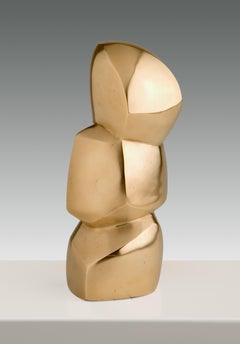
Florentine singer / - The Renaissance of the Renaissance -
By Paul Dubois
Located in Berlin, DE
Paul Dubois (1829 Nogent-sur-Seine - 1905 Paris), Florentine singer, 1865. Light brown patinated bronze with cast round plinth mounted on a square marble base (3.5 cm high). Total height 53 cm. Bronze dimensions: 49.5 cm (height) x 20 cm (length) x 10 cm (width), weight 5.6 kg. Inscribed on the plinth "P.[aul] DUBOIS", dated "1865", with the foundry's mark "F. BARBEDIENNE FONDEUR" and the signet "REDUCTION MECANIQUE A. COLLAS". - Patina very occasionally darkened, lute with loss of one tuning peg, otherwise in excellent condition. - The renaissance of the Renaissance - The bronze is a precisely executed and masterfully cast contemporary reduction of Paul Dubois 155 cm tall masterpiece "Florentine Singer", which is exhibited in the Musée d'Orsay and for which the artist was awarded the Medal of Honor at the Paris Salon in 1865. The work acted as a beacon, and was followed by a plethora of depictions of juveniles. Inspired by Donatello and Luca della Robbia, but also by painters such as Piero della Francesca, Benozzo Gozzoli, and Pinturicchio, the "Florentine Singer" is not an epigonal work that pays homage to a vanished era, but a successful attempt to draw vitality from the art of the past and thus give it new life. The effect of vitality is the core of Italian Renaissance art theory. In order to fulfill itself as art, art had to appear like nature. This naturalism also characterizes the "Florentine Singer". The young man appears to have been taken from life, which is reinforced by the momentary nature of his action. He has just struck a now fading chord. In addition, the natural appearance is enhanced by the detailed shaping of the figurative details, such as the laces with the slightly curved leather of the shoes, the belt buckle, or the ornamentation on the body of the lute. Even the fingernails are clearly defined. Unlike the Renaissance, however, the effect of liveliness here is not based on the "discovery" of nature and the human body, but primarily on the rediscovery of the art of the Quattrocento. The liveliness of the artwork is therefore at the same time a revitalization of this art, so that we can speak of a Renaissance of the Renaissance, just as the Pre-Raphaelites in England at the same time transferred the Quattrocento to contemporary art. Dubois takes on the most difficult of all subjects, the depiction of singing through silent sculpture. He was preceded in this by Luca della Robbia and Donatello with their pulpits of singers created in the 1430s in the Museo dell'Opera del Duomo in Florence. Compared to these works, the physiognomy of Dubois singer is far less animated, yet he also depicts singing in a convincing manner. He uses the whole body. He takes the ancient contrapposto, which was essential to Renaissance sculpture, and transforms the standing leg-playing posture into a late medieval S-swing, giving the body an elegant beauty and at the same time setting it in melodic motion. In the equally elegant finger position, the music is expressed in a much more literal way with the beating of the lute. Finally, the musicality of the sculpture culminates in the face with the mouth open to sing. Through the act of singing, which is a great challenge to the artistic will to depict perfect beauty, the gracefulness of the classical face is not diminished, but enhanced. Starting from the face with the singing mouth and the gaze absorbed by the sounds, the inner vitality spreads, giving the bronze sculpture an intense aura, enhanced by the music. Dubois transfers the beauty of the Renaissance to the musical, sublimating the visible sculpture to the invisible of music. He took up the challenge of transcending the Renaissance with the Renaissance, thus responding to the Querelle des Anciens et des Modernes, which arose at the end of the 17th century around the French Academy and remained virulent into the 19th century, in which antiquity was regarded either as an unattainable ideal or as a standard to be surpassed. With his work, Dubois proved that the Renaissance, which had championed the art of the ancients, could lead to a new renaissance of art. About the artist Paul Dubois' great-uncle was the famous French Baroque sculptor Jean-Baptiste Pigalle, in whose footsteps the talented great-nephew followed. When he debuted at the Paris Salon in 1858, he signed his work "Dubois-Pigalle". At his father's request, however, he first studied law before devoting himself to sculpture under the tutelage of François Christophe Armand Toussaint in 1856 and entering the École des Beaux-Arts in 1858. From 1859 to 1863, he lived in Rome and traveled to Naples and Florence. Inspired by Florentine art of the quattrocento, Dubois initiated a school-forming neo-Florentine style that combined the elegantly simple forms of youthful grace with a precise wealth of detail.Two purchases by the French state (“envois de Rome”) were made during his stay in Rome, which brought him recognition in Paris. After his return there, he quickly became an internationally sought-after artist. Dubois was also active as a creator of monuments. His most famous work is the equestrian statue of Joan of Arc (1896) on the forecourt of Reims Cathedral. He was also a sought-after portraitist who produced around 50 busts and - Dubois was also a passionate painter - around 100 portraits in oil. From 1873 to 1878 he was curator of the Museum du Luxembourg, in 1876 he became a member of the Institut de France and from 1878 to 1905 he was director of the École des Beaux-Arts. In 1865, Dubois was awarded the Paris Salon Medal of Honor for his “Florentine Singer”. In 1867 he became Chevalier, in 1874 Officier, in 1886 Commandeur of the Légion d'honneur, which awarded Dubois the Grande Croix in 1896. Selected Bibliography Stole, Elmar: Paul Dubois. In: Saur. Allgemeines Künstlerlexikon, vol. 30, Munich - Leipzig 2001, pp. 677-678. GERMAN VERSION Paul Dubois (1829 Nogent-sur-Seine - 1905 Paris), Florentinischer Sänger, 1865. Hellbraun patinierte Bronze mit gegossener runder Plinthe auf quadratischem Marmorsockel montiert (3,5 cm Höhe). Gesamthöhe 53 cm. Maße der Bronze: 49,5 cm (Höhe) x 20 cm (Länge) x 10 cm (Breite), Gewicht 5,6 kg. Auf der Plinthe mit „P.[aul] DUBOIS“ bezeichnet, auf „1865“ datiert, mit dem Gießereistempel „F. BARBEDIENNE FONDEUR“ und dem Signet „REDUCTION MECANIQUE A. COLLAS“ versehen. - Patina sehr vereinzelt nachgedunkelt, Laute mit Verlust eines Stimmwirbels, ansonsten ausgezeichnet erhalten. - Die Renaissance...
Category

1860s Realist Robert Adams Sculptures

Materials

Bronze
Florentine singer / - The Renaissance of the Renaissance -
$4,276 Sale Price
20% Off
H 20.87 in W 7.88 in D 3.94 in
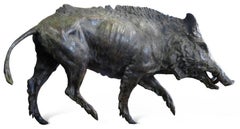
Cobra, Unknown, 20th century, Bronze, Animal, Snake, Design, art deco, Cast
Located in Geneva, CH
Cobra, Unknown, 20th century, Bronze, Animal, Snake, Design, art deco, Cast
Category

20th Century Art Deco Robert Adams Sculptures

Materials

Bronze
Garden Torch on Oak Column - "Ammon" - handmade unique art object decoration
By Stefan Traloc
Located in Winterswijk, NL
Ammon on oak stele natural 15x15x110cm. Customization possible and designed in 2010. Also available to order in stainless steel. The included burner already contains individual lava...
Category

21st Century and Contemporary Art Deco Robert Adams Sculptures

Materials

Steel

Lapin assis, tête tournée, Sandoz, 1910 s, bronze, animal, rabbits, rare proof
By Edouard-Marcel Sandoz
Located in Geneva, CH
Lapin assis, tête tournée, circa 1919-1921 Fondry Susse, Ed. 3/5 pcs circa 1919-1921 Rare bronze proof with a brown patina 8.5 x 5.5 x 6.5 cm Certificate of authenticity issued by th...
Category

1910s Modern Robert Adams Sculptures

Materials

Bronze
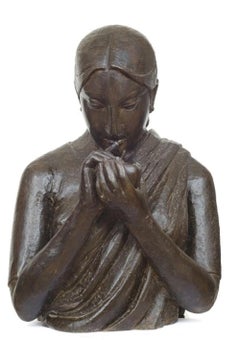
Robert Adams sculptures for sale on 1stDibs.

Find a wide variety of authentic Robert Adams sculptures available for sale on 1stDibs. You can also browse by medium to find art by Robert Adams in wood, ceramic, paint and more. Much of the original work by this artist or collective was created during the 21st century and contemporary and is mostly associated with the contemporary style. Not every interior allows for large Robert Adams sculptures, so small editions measuring 9 inches across are available. Customers who are interested in this artist might also find the work of Katharine Morling, Daniel Fiorda, and Helle Rask Crawford. Robert Adams sculptures prices can differ depending upon medium, time period and other attributes. On 1stDibs, the price for these items starts at $2,400 and tops out at $3,200, while the average work can sell for $2,600.

Recently Viewed

View All