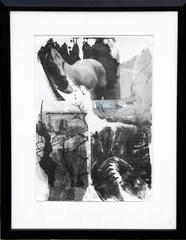
Robert Rauschenberg Animal Prints

American, 1925-2008

Robert Rauschenberg was one of the preeminent American artists of the 20th century, occupying a singular position that straddled the Abstract Expressionist and Pop art movements, drawing on key elements of each. An artistic polymath equally adept at painting, collage and silkscreening, Rauschenberg is best known for for the complex assemblages of found objects he termed “combines.”

Rauschenberg was born in Port Arthur, Texas, in 1925. He first began to seriously consider a career in art in 1947, while serving in the U.S. Marines. After leaving the service, he briefly studied art in Paris with support from the G.I. Bill, then moved to North Carolina to attend Black Mountain College, home to a flourishing cross-disciplinary art community. Among his peers there were choreographer Merce Cunningham and composer John Cage, both of whom became friends and artistic collaborators.

Relocating to New York in the mid-1950s, Rauschenberg was initially put off by what he perceived as the self-seriousness of the adherents of Abstract Expressionism, then the dominant movement in the New York art world. Like Andy Warhol and Roy Lichtenstein, Rauschenberg was drawn to the visual landscape of popular culture and mined its imagery for inspiration. He used unorthodox materials like house paint and tried novel techniques in his studio like running paper over with a car whose wheels he had inked. Shortly after his inaugural solo exhibition at Leo Castelli Gallery, which featured paintings and drawings, he pivoted to a new format, creating his first found-object combines, which became his signature. The most famous of these is the 1959 Monogram in which a taxidermied goat is surrounded by a car tire, recalling the way a person’s initials are interwoven in the design referred to by the title.

Later in the 1960s, Rauschenberg turned his attention to silkscreening, creating prints that feature iconic figures of the day, very much in line with the style and content of Pop art. One such work, 1965's Core, which was created to commemorate the Congress of Racial Equality, combines photographs of President Kennedy, an unidentified Native American man, and a statue of a Civil War soldier with images of highways, amusement parks, street signs, and other features of the built environment. A circular color-test wheel sits at the composition’s formal core, reflecting the work’s commentary on race and ethnicity.

Throughout the 1960s and ‘70s, Rauschenberg experimented with printing on unusual materials, such as Plexiglas, clothing and aluminum. Venturing even further afield, he created performance works, such as his 1963 choreographed piece “Pelican” and the 1966 film Open Score. In 1998, the Guggenheim Museum presented a large and comprehensive retrospective of Rauschenberg’s work, highlighting his influence on American art in the second half of the 20th century.

Find original Robert Rauschenberg art for sale on 1stDibs.

to
1
1
Overall Width
to
Overall Height
to
1
94
192
158
115
99
2
1
2
1
1
1
1
1
1
1
1
1
1
1
2
1
2
Artist: Robert Rauschenberg
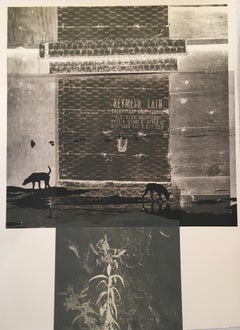
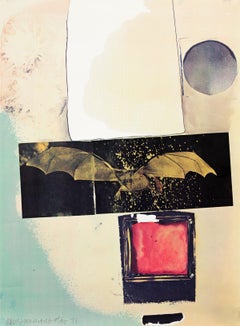
Lily Scent
By Robert Rauschenberg
Located in New York, NY
Robert Rauschenberg Lily Scent, 1981 Lithograph 32 x 24 inches SPIII Signed
Category

1980s Abstract Expressionist Robert Rauschenberg Animal Prints

Materials

Lithograph

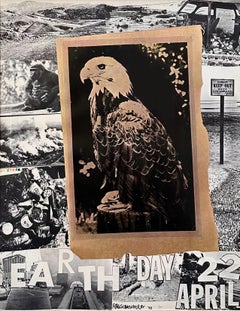
Earth Day
By Robert Rauschenberg
Located in Naples, Florida
In response to a massive oil spill off the coast of Southern California in 1969, Wisconsin Senator Gaylord Nelson initiated the idea of the first annual Earth Day on April 22, 1970, ...
Category

Late 20th Century Robert Rauschenberg Animal Prints

Materials

Lithograph

Related Items
Original "The Ships Are Coming" vintage American poster with an Eagle.
By James Henry Daugherty
Located in Spokane, WA
Original: THE SHIPS ARE COMING vintage poster. Artist: James H. Daugherty (1889-1974) Publisher: U.S. Shipping Board, Emergency Fleet Corporation, Publication Section, Philadelphia, 1917. Poster showing a giant eagle...
Category

1910s American Modern Robert Rauschenberg Animal Prints

Materials

Lithograph

Original Italian Emidio di Nola Italian Macaroni original vintage food poster
Located in Spokane, WA
Emidio di Nola, original Italian pasta poster. Size 19" x 25.5". Professional acid-free archival linen-backed; in excellent condition; ready to frame....
Category

1950s Aesthetic Movement Robert Rauschenberg Animal Prints

Materials

Lithograph

Snail in a Bowl (Artist Proof inscribed to Fritz Eichenberg)
Located in New Orleans, LA
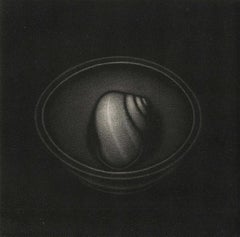
Leonard Merchant's mezzotint, "Snail in Cup" is inscribed for fellow artist, Fritz Eichenberg. While a student at the Central School for Arts and Crafts in London, a young Leonard Marchant found an engraving rocker in a cupboard and proceeded to turn himself into a master of the painstaking art of mezzotinting. Marchant, who has died in Shrewsbury aged 70, grew up in Simonstown, the Royal Navy's enclave in South Africa. Though his first job was as a parliamentary messenger, he taught himself to paint and, aged 19, was given a one-man show in Cape Town. Fired by this success, he left for England to study painting and, he claimed, to escape the stifling home atmosphere created by his Catholic mother and aunts. (His father was killed in the second world war.) Without contacts in London, he phoned Jacob Epstein, whose recommendation resulted in a grant to study briefly at the Central School. It was later, when studying full-time at the Central, that he saw the mezzotints of the Japanese master, Yozo Hamaguchi, in a London gallery. He was hooked. Creating a mezzotint is tedious in the extreme. The copper plate must first be prepared with a "rocker" which roughens the surface. A plate may be "rocked" 30 or 40 times. The rough texture is then reduced with a burnisher and a scraper, allowing the print a range of tones from velvety black through the greys to white. Marchant's plates could be months in the making. But the technical demands were the least of his worries. In its 18th- and 19th-century heyday, mezzotint was solely a reproductive medium, for copying masters such as Reynolds and Turner. The development of photography rendered it unfashionable, and by the 1960s the technique, known as la manière anglaise, was a bygone medium. Marchant, by now a teacher in printmaking at the Central, began to create original mezzotints with a colleague, Radavan Kraguly. A perfectionist, he seemed to revel in the straitjacket procedure. Perhaps it was the metaphor of bringing darkness out of light that appealed to this straight-talking, sometimes sombre, man, who would suddenly relax and light up like a gleaming hue on one of his prints. His work was of squares and triangles with the occasional cat, black and ominous, and carefully arranged still lifes, featuring plants, a seed pod, a pot he might have bought at auction to celebrate the sale of a print. There were one-man shows, notably at the Bankside Gallery. He sold well at the Royal Academy summer exhibition, was a Florence Biennale prizewinner, spent a fellowship year at the British School in Rome, and was elected a Fellow of the Royal Society of Painter-Printmakers. But making mezzotints was not a paying job. Marchant and his South African wife...
Category

1980s Modern Robert Rauschenberg Animal Prints

Materials

Mezzotint

A Los Toros Avec Picasso (Set of Three Unframed)
By Pablo Picasso
Located in Washington, DC
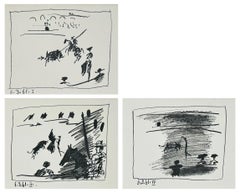
Artist: Pablo Picasso Title: La Pique (I), Jeu de la Cape (III), Les Banderilles (IV) Portfolio: A Los Toros Avec Picasso Medium: Set of three transfer lithographs Date: 1961 Edition...
Category

1960s Robert Rauschenberg Animal Prints

Materials

Lithograph

Echidna and Platypus, Australian animal monotreme antique engraving print
Located in Melbourne, Victoria
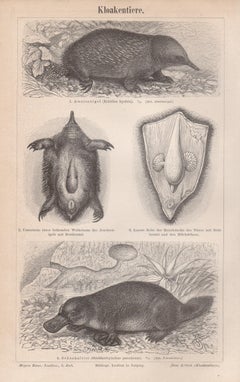
'Kloakentiere' (Monotremes - echidna and platypus)) German wood-engraving, circa 1895. 240mm by 155mm (sheet)
Category

Late 19th Century Naturalistic Robert Rauschenberg Animal Prints

Materials

Engraving

Three Deer, Pop Art Screenprint by Hunt Slonem
By Hunt Slonem
Located in Long Island City, NY
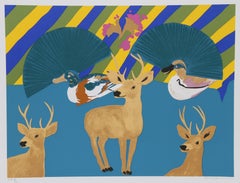
Artist: Hunt Slonem, American (1951 - ) Title: Three Deer Year: 1980 Medium: Screenprint, signed and numbered in pencil Edition: AP 30 Image Size: 24 x 32 inches Size: 26 in. ...
Category

1980s Pop Art Robert Rauschenberg Animal Prints

Materials

Screen

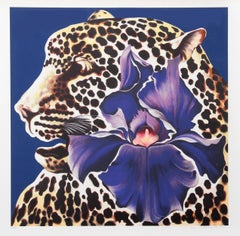
Spotted Leopard and Iris, Photorealist Screenprint by Lowell Nesbitt
By Lowell Nesbitt
Located in Long Island City, NY
Photorealist flower screenprint by American artist Lowell Blair Nesbitt, signed and numbered in pencil. Title: Spotted Leopard and Iris Year: 1981 Medium: Serigraph, signed and num...
Category

1980s American Realist Robert Rauschenberg Animal Prints

Materials

Screen

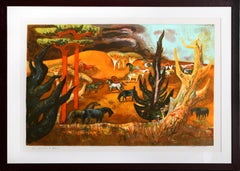
Summer Gold, American Modern Lithograph by Millard Sheets
By Millard Sheets
Located in Long Island City, NY
Artist: Millard Owen Sheets, American (1907 - 1989) Title: Summer Gold Medium: Lithograph, signed and numbered in pencil Edition: 250, 5 HC Image S...
Category

1970s American Modern Robert Rauschenberg Animal Prints

Materials

Lithograph

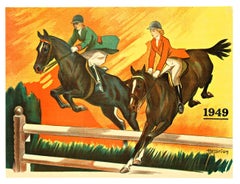
Original Horse Jumping Steeple Chase 1949 Equestrian vintage poster
Located in Spokane, WA
Original linen backed 1949 International Jumping Steeple Chase Van Gent poster. The events were held at the Royal Cercle Equestre Gent; at the Feestpaleis The Royal Cercle Eque...
Category

1940s American Realist Robert Rauschenberg Animal Prints

Materials

Lithograph

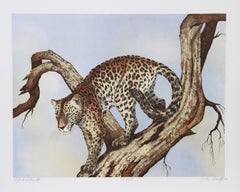
Leopard Silhouette, Lithograph by Caroline Schultz
Located in Long Island City, NY
Leopard Silhouette Caroline Schultz, American (1936–2004) Date: 1979 Lithograph, signed and numbered in pencil Edition of AP 50 Image Size: 18 x 24 inches Size: 23 in. x 28 in. (58.4...
Category

1970s Robert Rauschenberg Animal Prints

Materials

Lithograph

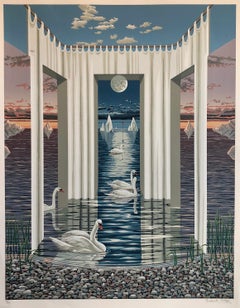
Large Surrealist Photo Realist Silkscreen Lithograph Print Swan Dreams
Located in Surfside, FL
Born in Stoke-on-Trent in 1953, Frederick Phillips studied Fine Art at Burslem College of Art when Arthur Berry was Head of the Fine Art (Painting) ...
Category

1990s Surrealist Robert Rauschenberg Animal Prints

Materials

Lithograph, Screen

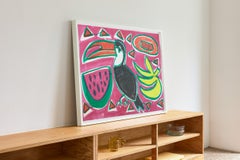
Merengue -- Print, Lithograph, Tropical, Decorative by Katherine Bernhardt
By Katherine Bernhardt
Located in London, GB
Merengue, 2017 Katherine Bernhardt Lithograph in colours, on Somerset Velvet Signed, dated and numbered from the edition of 100 Produced by Paupers Press, London Sheet: 70.5 × 97 c...
Category

2010s Contemporary Robert Rauschenberg Animal Prints

Materials

Lithograph

Previously Available Items
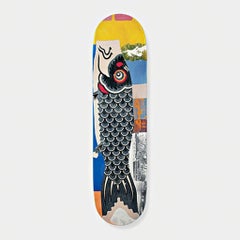
Double Luck Skateboard
By Robert Rauschenberg
Located in New York, NY
Robert Rauschenberg Limited Edition Double Luck Skate board, 2016 Mixed Media Silkscreen on 7-Ply 100% Canadian Maplewood Skate Board 31 × 8 inches Edition of 300 Signed on the...
Category

2010s Pop Art Robert Rauschenberg Animal Prints

Materials

Wood, Screen

Rays
By Robert Rauschenberg
Located in New York, NY
A very good impression of this color screen print and offset lithograph on white wove paper, Signed, dated and numbered 34/95 in pencil by Rauschenberg...
Category

1970s Contemporary Robert Rauschenberg Animal Prints

Materials

Color, Lithograph, Offset, Screen

Horse Silk from the Night Sights Series
By Robert Rauschenberg
Located in Long Island City, NY
Artist: Robert Rauschenberg, American (1925 - 2008) Title: Horse Silk from the Night Sights Series Year: 1993 Medium: Screenprint and Offset Lithograph, ...
Category

1990s Conceptual Robert Rauschenberg Animal Prints

Materials

Screen

Robert Rauschenberg animal prints for sale on 1stDibs.

Find a wide variety of authentic Robert Rauschenberg animal prints available for sale on 1stDibs. You can also browse by medium to find art by Robert Rauschenberg in lithograph, offset print, screen print and more. Much of the original work by this artist or collective was created during the 20th century and is mostly associated with the Pop Art style. Not every interior allows for large Robert Rauschenberg animal prints, so small editions measuring 8 inches across are available. Customers who are interested in this artist might also find the work of Larry Rivers, Tom Everhart, and Michael Knigin. Robert Rauschenberg animal prints prices can differ depending upon medium, time period and other attributes. On 1stDibs, the price for these items starts at $2,000 and tops out at $5,000, while the average work can sell for $2,000.
Questions About Robert Rauschenberg Animal Prints
  • 1stDibs ExpertMarch 22, 2022
    Robert Rauschenberg was most famous for his combines. To produce these abstract compositions, the American artist combined a variety of found materials into complex collages. Rauschenberg also worked as a silkscreener and painter. Find a range of Robert Rauschenberg art on 1stDibs.
  • 1stDibs ExpertMarch 22, 2022
    Robert Rauschenberg was a part of the Neo-Dada art movement. He is known for pushing the definition of what classifies as art through his paintings, sculptures, graphic designs and performances. Some of his most famous works include White Painting, Monogram, Collection and Canyon. On 1stDibs, find a selection of Robert Rauschenberg art.
  • 1stDibs ExpertAugust 8, 2024
    What was unique about Robert Rauschenberg's art was that it incorporated everyday objects and straddled the line between painting and sculpture. The American artist is best known for the complex assemblages of found objects he termed “combines.” Rauschenberg was drawn to the visual landscape of popular culture and mined its imagery for inspiration. Early in his career during the 1950s, he used unorthodox materials like house paint and tried novel techniques in his studio, like running paper over with a car after inking its wheels. In the 1960s, Rauschenberg turned his attention to silkscreening, creating prints that feature iconic figures of the day, very much in line with the style and content of Pop art. One such work, 1965's CORE, which was created to commemorate the Congress of Racial Equality, combines photographs of President Kennedy, an unidentified Native American man and a statue of a Civil War soldier with images of highways, amusement parks, street signs and other features of the built environment. Throughout the 1960s and ’70s, Rauschenberg experimented with printing on unusual materials, such as Plexiglas, clothing and aluminum. Shop a range of Robert Rauschenberg art on 1stDibs.
  • 1stDibs ExpertSeptember 23, 2024
    The non-traditional artworks of Robert Rauschenberg were called Combines. During the 1950s, he pivoted to this new body of work, which became his signature. The most famous of these is the 1959 Monogram, in which a taxidermied goat is surrounded by a car tire, recalling how a person’s initials are interwoven in the design referred to by the title. On 1stDibs, shop a selection of Robert Rauschenberg art.