Robert Swain Gifford Landscape Drawings and Watercolors
American, 1840-1905
Robert Swain Gifford (1840–1905) Robert Swain Gifford was an American landscape painter best known for his evocative coastal scenes and atmospheric landscapes. He was born on July 23, 1840, on Naushon Island, part of the Elizabeth Islands in Massachusetts.
Early Life and Training Gifford moved with his family to New Bedford, Massachusetts, where he developed an early interest in art. He began formal training with Dutch artist Albert van Beest, who had a significant influence on his style, particularly in marine subjects.
Travel and Influence Gifford’s artistic development was deeply shaped by extensive travel:
In the 1860s, he visited California, painting its rugged coastlines.
He also traveled to Europe, North Africa, and the Middle East, producing works inspired by exotic and arid landscapes, which set him apart from many of his contemporaries.
Style and Legacy Gifford’s work blends luminism and tonalism, focusing on mood, light, and atmosphere rather than intricate detail. He painted in both oil and watercolor, often capturing tranquil, meditative scenes of marshes, harbors, and deserts.
His art reflects a fascination with natural light and subtle tonal variation, and he was especially adept at portraying foggy seascapes and remote coastal views.
Career Highlights Elected full academician at the National Academy of Design in 1867.
Exhibited regularly at major institutions, including the Boston Art Club, the Pennsylvania Academy of the Fine Arts, and the Metropolitan Museum of Art.
Received a medal at the 1889 Paris Exposition Universelle.
Death and Recognition Gifford died in 1905 in New York. Today, his works are held in prestigious collections including:
The Metropolitan Museum of Art The Smithsonian American Art Museum
The Museum of Fine Arts, Bostonto
1
Overall Width
to
Overall Height
to
1
1
1
1
1
1
1
1
1
1
1
1
8
331
140
123
66
1
1
Artist: Robert Swain Gifford
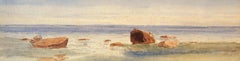
Rocks and Sea
By Robert Swain Gifford
Located in Bryn Mawr, PA
Born on a small island near Martha's Vineyard, R. Swain Gifford and his family moved to the New Bedford, Massachusetts, area when he was two years old. The Dutch marine painter Alber...
Category
Late 19th Century American Impressionist Robert Swain Gifford Landscape Drawings and Watercolors
Materials
Paper, Watercolor
Related Items
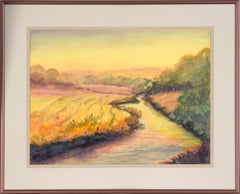
Golden Hour at the River - Watercolor Landscape on Paper
Located in Soquel, CA
Golden Hour at the River - Watercolor Landscape on Paper
Glowing sunset landscape by Rosalind O'Neal (American, b. 1927). A river winds winds towards the viewer, reflecting the glowing sunset. On the left bank, there are rows of crops in yellow and orange. On the right side, trees and shrubs line the bank. In the distance green and golden hills meet the sky.
Signed "Rosalind O'Neal" in the lower right corner.
Presented in a copper colored frame with a double mat.
Frame size: 17"H x 21"W
Image size: 12"H x 16"W
Rosalind O’Neal (American, b. 1927) was a longtime Ukiah, CA resident and a member of the Mendocino County Art Association. O’Neal was primarily a watercolor artist, focusing on portraits and landscapes, but has also worked in acrylic at times.
1997 - Ukiah Main Office Savings Bank of Mendocino County, Ukiah, CA
2003 - Savings Bank of Mendocino, Ukiah, CA
2004 - Mendocino County Art Association’s Golden Anniversary...
Category
21st Century and Contemporary American Impressionist Robert Swain Gifford Landscape Drawings and Watercolors
Materials
Watercolor, Laid Paper

$500 Sale Price
20% Off
H 17 in W 21 in D 1 in
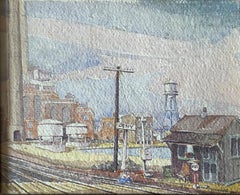
"Train Station, " Max Kuehne, Industrial City Scene, American Impressionism
By Max Kuehne
Located in New York, NY
Max Kuehne (1880 - 1968)
Train Station, circa 1910
Watercolor on paper
8 1/4 x 10 1/4 inches
Signed lower right
Provenance:
Private Collection, Illinois
Max Kuehne was born in Halle, Germany on November 7, 1880. During his adolescence the family immigrated to America and settled in Flushing, New York. As a young man, Max was active in rowing events, bicycle racing, swimming and sailing. After experimenting with various occupations, Kuehne decided to study art, which led him to William Merritt Chase's famous school in New York; he was trained by Chase himself, then by Kenneth Hayes Miller. Chase was at the peak of his career, and his portraits were especially in demand. Kuehne would have profited from Chase's invaluable lessons in technique, as well as his inspirational personality. Miller, only four years older than Kuehne, was another of the many artists to benefit from Chase's teachings. Even though Miller still would have been under the spell of Chase upon Kuehne's arrival, he was already experimenting with an aestheticism that went beyond Chase's realism and virtuosity of the brush. Later Miller developed a style dependent upon volumetric figures that recall Italian Renaissance prototypes.
Kuehne moved from Miller to Robert Henri in 1909. Rockwell Kent, who also studied under Chase, Miller, and Henri, expressed what he felt were their respective contributions: "As Chase had taught us to use our eyes, and Henri to enlist our hearts, Miller called on us to use our heads." (Rockwell Kent, It's Me O Lord: The Autobiography of Rockwell Kent. New York: Dodd, Mead and Co., 1955, p. 83). Henri prompted Kuehne to search out the unvarnished realities of urban living; a notable portion of Henri's stylistic formula was incorporated into his work.
Having received such a thorough foundation in art, Kuehne spent a year in Europe's major art museums to study techniques of the old masters. His son Richard named Ernest Lawson as one of Max Kuehne's European traveling companions. In 1911 Kuehne moved to New York where he maintained a studio and painted everyday scenes around him, using the rather Manet-like, dark palette of Henri.
A trip to Gloucester during the following summer engendered a brighter palette. In the words of Gallatin (1924, p. 60), during that summer Kuehne "executed some of his most successful pictures, paintings full of sunlight . . . revealing the fact that he was becoming a colorist of considerable distinction." Kuehne was away in England the year of the Armory Show (1913), where he worked on powerful, painterly seascapes on the rocky shores of Cornwall. Possibly inspired by Henri - who had discovered Madrid in 1900 then took classes there in 1906, 1908 and 1912 - Kuehne visited Spain in 1914; in all, he would spend three years there, maintaining a studio in Granada. He developed his own impressionism and a greater simplicity while in Spain, under the influence of the brilliant Mediterranean light. George Bellows convinced Kuehne to spend the summer of 1919 in Rockport, Maine (near Camden). The influence of Bellows was more than casual; he would have intensified Kuehne's commitment to paint life "in the raw" around him.
After another brief trip to Spain in 1920, Kuehne went to the other Rockport (Cape Ann, Massachusetts) where he was accepted as a member of the vigorous art colony, spearheaded by Aldro T. Hibbard. Rockport's picturesque ambiance fulfilled the needs of an artist-sailor: as a writer in the Gloucester Daily Times explained, "Max Kuehne came to Rockport to paint, but he stayed to sail." The 1920s was a boom decade for Cape Ann, as it was for the rest of the nation. Kuehne's studio in Rockport was formerly occupied by Jonas Lie.
Kuehne spent the summer of 1923 in Paris, where in July, André Breton started a brawl as the curtain went up on a play by his rival Tristan Tzara; the event signified the demise of the Dada movement. Kuehne could not relate to this avant-garde art but was apparently influenced by more traditional painters — the Fauves, Nabis, and painters such as Bonnard. Gallatin perceived a looser handling and more brilliant color in the pictures Kuehne brought back to the States in the fall. In 1926, Kuehne won the First Honorable Mention at the Carnegie Institute, and he re-exhibited there, for example, in 1937 (Before the Wind). Besides painting, Kuehne did sculpture, decorative screens, and furniture work with carved and gilded molding. In addition, he designed and carved his own frames, and John Taylor Adams encouraged Kuehne to execute etchings. Through his talents in all these media he was able to survive the Depression, and during the 1940s and 1950s these activities almost eclipsed his easel painting. In later years, Kuehne's landscapes and still-lifes show the influence of Cézanne and Bonnard, and his style changed radically.
Max Kuehne died in 1968. He exhibited his work at the National Academy of Design, the Art Institute of Chicago, the Carnegie Institute in Pittsburgh, the Memorial Art Gallery of the University of Rochester, and in various New York City galleries. Kuehne's works are in the following public collections: the Detroit Institute of Arts (Marine Headland), the Whitney Museum (Diamond Hill...
Category
1910s American Impressionist Robert Swain Gifford Landscape Drawings and Watercolors
Materials
Paper, Watercolor
$2,800 Sale Price
20% Off
H 13.5 in W 15.5 in
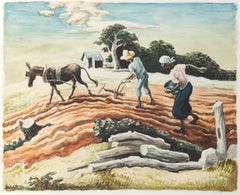
Planting (Spring Plowing) - Watercolor Landscape Painting with Figures, c. 1939
By Thomas Hart Benton
Located in Palm Desert, CA
"Planting (Spring Plowing)", a vibrant watercolor and graphite on paper by Thomas Hart Benton, circa 1939-40, embodies the artist's signature Regionalist style. The work depicts a ru...
Category
Mid-20th Century American Impressionist Robert Swain Gifford Landscape Drawings and Watercolors
Materials
Paper, Watercolor, Graphite
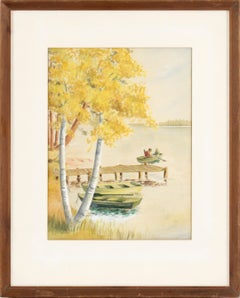
Rowboat Outing - Fall Landscape with Rowboats in Watercolor on Paper
Located in Soquel, CA
Rowboat Outing - Fall Landscape with Rowboats in Watercolor on Paper
Serene lakeside landscape by an unknown artist (20th Century). Two birch trees with bright yellow leaves are gro...
Category
Mid-20th Century American Impressionist Robert Swain Gifford Landscape Drawings and Watercolors
Materials
Paper, Watercolor
$396 Sale Price
20% Off
H 29.5 in W 23.5 in D 0.75 in
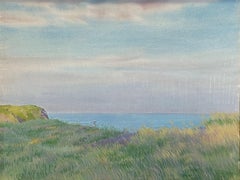
"Monhegan Island, Maine, " Edward Dufner, American Impressionism Landscape View
By Edward Dufner
Located in New York, NY
Edward Dufner (1872 - 1957)
Monhegan Island, Maine
Watercolor on paper
Sight 16 x 20 inches
Signed lower right
With a long-time career as an art teacher and painter of both 'light' and 'dark', Edward Dufner was one of the first students of the Buffalo Fine Arts Academy to earn an Albright Scholarship to study painting in New York. In Buffalo, he had exchanged odd job work for drawing lessons from architect Charles Sumner. He also earned money as an illustrator of a German-language newspaper, and in 1890 took lessons from George Bridgman at the Buffalo Fine Arts Academy.
In 1893, using his scholarship, Dufner moved to Manhattan and enrolled at the Art Students League where he studied with Henry Siddons Mowbray, figure painter and muralist. He also did illustration work for Life, Harper's and Scribner's magazines.
Five years later, in 1898, Dufner went to Paris where he studied at the Academy Julian with Jean-Paul Laurens and privately with James McNeill Whistler. Verification of this relationship, which has been debated by art scholars, comes from researcher Nancy Turk who located at the Smithsonian Institution two 1927 interviews given by Dufner. Turk wrote that Dufner "talks in detail about Whistler, about how he prepared his canvasas and about numerous pieces he painted. . . A great read, the interview puts to bed" the ongoing confusion about whether or not he studied with Whistler.
During his time in France, Dufner summered in the south at Le Pouleu with artists Richard Emil Miller...
Category
Early 20th Century American Impressionist Robert Swain Gifford Landscape Drawings and Watercolors
Materials
Paper, Watercolor
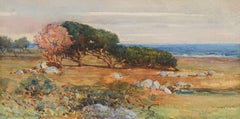
Moss Beach, Monterey, California
, Pacific Coastal Landscape, ASL NYC, Benezit
By Elmer Wachtel
Located in Santa Cruz, CA
An early-20th-century, landscape showing a view of the coastline at Moss Beach in Monterey County with slate-blue skies overhead and a view towards a stand of windswept Monterey Cypress with a view of the cobalt blue ocean beyond. A particularly fresh and bright example, kept until recently in a portfolio.
Monogrammed lower right, "EW", dated "X-mas 1909", signed verso, "Elmer Wachtel", and inscribed lower left, "Moss Beach, Monterey County, California".
A prominent California landscape painter of the late 19th and early 20th-century, Elmer Wachtel specialized in panoramic coastal scenes and desert and mountain landscapes using impressionist brushstrokes. His early works were tonalist in mood, and his later paintings were more decorative and light hearted.
Elmer Wachtel was an American artist who holds a high place in the early California school of Impressionism. He was born in Baltimore, Maryland on January 21, 1864 -- he received his artistic training at the Art Students' League of New York under William Merritt Chase, and the Art School in London 1901-02. While in California he resided and maintained studios in Los Angeles and Pasadena.
In 1904 Elmer Wachtel married the artist Marion Kavanaugh (1876-1954) in Chicago. Husband and wife were frequently seen painting the Southern California landscape -- they were known to have traveled by horseback over the San Marcos Pass to the Santa Inez Valley -- they traversed and painted the coastline between Gaviota and Conception Lighthouse (just north of Santa Barbara, California), the Cooper Ranch (north of Santa Barbara), Matilija Canyon and Ojai, California. Venturing south the couple made it to the San Luis Rey River (near present day Oceanside) and the Cerisa Loma Ranch (near San Diego). In 1908 they trekked to the arid deserts of Arizona and New Mexico painting...
Category
Early 1900s American Impressionist Robert Swain Gifford Landscape Drawings and Watercolors
Materials
Paper, Watercolor, Gouache
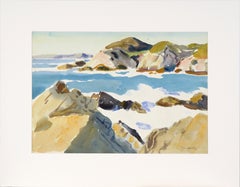
Big Sur Coast Landscape in Watercolor on Paper
By Paul Dougherty
Located in Soquel, CA
Big Sur Coast Landscape in Watercolor on Paper
Serene coastal landscape by notable artist Paul Dougherty (American, 1877-1947). The viewer looks out ov...
Category
Early 20th Century American Impressionist Robert Swain Gifford Landscape Drawings and Watercolors
Materials
Paper, Watercolor
$1,480 Sale Price
20% Off
H 20.75 in W 26.5 in D 0.25 in
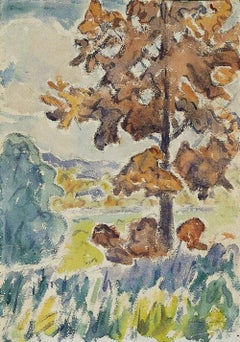
Watercolor of the Oak Tree by Allen Tucker
By Allen Tucker
Located in Hudson, NY
Landscape watercolor by Allen Tucker of an oak tree. This piece, along with several others, was gifted to Una Brage, a friend of the artist in the 1930s.
More about this artist:
Allen Tucker, was an architect and painter so influenced by Vincent Van Gogh that he was called "Vincent in America". (Gerdts 291) Robert Henri and Maurice Prendergast were also credited as having an influence on Tucker's brushwork and compositions, the latter decisively. However, as his painting evolved, he did not fit into any tidy slot for description and was known as an individualist not easily categorized in American art history.
Tucker was born in Brooklyn in 1866 and graduated from the School of Mines of Columbia University with a degree in architecture and took a job as an architectural draftsman in the architectural firm of McIvaine and Tucker, his fathers business. During that time, he studied painting at the Art Students League with Impressionist John H. Twachtman, but it was not until around 1904, when he was 38, that Tucker became a full-time painter, leaving architecture behind. Many of his early canvases were classically Impressionistic with poplar trees resembling those of Van Gogh and haystacks and corn shocks...
Category
Early 20th Century American Impressionist Robert Swain Gifford Landscape Drawings and Watercolors
Materials
Paper, Watercolor
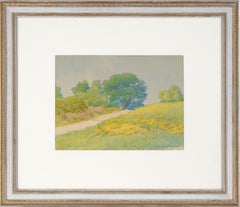
California Golden Poppies and Blue Oaks - Rural Landscape in Watercolor on Paper
Located in Soquel, CA
Golden Flowers and Blue Oaks - California Rural Landscape in Watercolor on Paper
Vibrant landscape by listed California artist Marie Williams (American, 1878-1969). Yellow flowers c...
Category
1920s American Impressionist Robert Swain Gifford Landscape Drawings and Watercolors
Materials
Paper, Watercolor
$1,320 Sale Price
20% Off
H 20.5 in W 24.25 in D 1.25 in
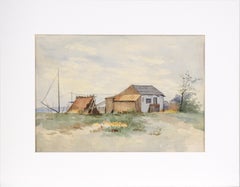
Whalers Shack on the Northern California Coast - Watercolor Seascape
Located in Soquel, CA
Serene depiction of a Whaling shack circa 1900 near Davenport, California attributed to Lillian Josephine (Dake) Heath (19th century). Monogram on Verso "J. H. 1900".
Dated and initialed on verso "J. H. Feb. 1900"
Presented in a new white mat with foam core backing.
Mat size: 14"H x 18"W
Paper size: 9.25"H x 13.25"W
Lillian Heath was one of the Jolly Daubers at the turn of the 19th-century and as a young student, married the senior artist and instructor, Frank Heath...
Category
Early 1900s American Impressionist Robert Swain Gifford Landscape Drawings and Watercolors
Materials
Watercolor, Archival Paper
$920 Sale Price
20% Off
H 14 in W 18 in D 0.25 in
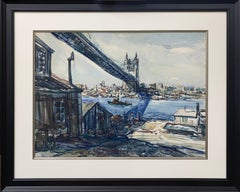
59th Street Bridge, Pennsylvania Impressionist Watercolor Cityscape
By Walter Emerson Baum
Located in Doylestown, PA
"59th Street Bridge" is a 22" x 30" watercolor on paper cityscape of the Brooklyn Bridge and city skyline, painted by Pennsylvania Impressionist and...
Category
1940s American Impressionist Robert Swain Gifford Landscape Drawings and Watercolors
Materials
Watercolor, Archival Paper
$7,500
H 33 in W 41 in D 2 in
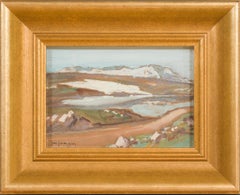
An Old Military Road, The Road over Dovrefjell, Norway
By Carl Oscar Borg
Located in Stockholm, SE
Carl Oscar Borg (1879–1947)
An Old Military Road, The Road over Dovrefjell, Norway
gouache on paper, ca. 1900
signed
sheet 12.5 cm x 17.5 (4.9 x 6.9 in)
framed 23 × 28 cm (9 × 11...
Category
1890s American Impressionist Robert Swain Gifford Landscape Drawings and Watercolors
Materials
Paper, Gouache
$2,884
H 9.06 in W 11.03 in
Robert Swain Gifford landscape drawings and watercolors for sale on 1stDibs.
Find a wide variety of authentic Robert Swain Gifford landscape drawings and watercolors available for sale on 1stDibs. You can also browse by medium to find art by Robert Swain Gifford in paint, paper, watercolor and more. Not every interior allows for large Robert Swain Gifford landscape drawings and watercolors, so small editions measuring 14 inches across are available. Customers who are interested in this artist might also find the work of Patricia Smith, Reginald K. Gee, and Victoria Ryan. Robert Swain Gifford landscape drawings and watercolors prices can differ depending upon medium, time period and other attributes. On 1stDibs, the price for these items starts at $3,500 and tops out at $3,500, while the average work can sell for $3,500.