Roger Medearis Art

American, 1920-2001

Though he came of age after Regionalism’s heyday in the 1930s, Roger Medearis is a direct connection to the Regionalism of Thomas Hart Benton. Born in Fayette, Missouri, Medearis went to Kansas City at the age of eighteen to study at the Kansas City Art Institute, with the hopes of becoming a commercial illustrator in the manner of Norman Rockwell. Shortly after his arrival, Medearis learned that Benton was an instructor at the Institute, and he soon was a regular in Benton’s classroom. In very short order, Meadearis absorbed every tenet of Benton’s pedagogical exhortations to study the masters of the Renaissance, with particular emphasis on formulating a strong overall design using repeated formal patterns as a structural principle for each painting. Meadearis also absorbed many of Benton’s own techniques as well, producing multi-figure Regionalist works in tempera and oil akin to the works of his master.

Medearis’s ascent in the art world was swift. After two years of schooling under Benton, in the summer of 1940, at the age of twenty, Medearis attempted his first major painting, Breaking Ground at Bethel (formerly in the collection of Himan Brown, New York), a genre painting featuring over twenty figures that depicted the groundbreaking of a country church. Benton was so impressed with this painting that he quickly had it added to an upcoming exhibition of the work of his more senior students to be held at the venerable Associated American Artists gallery in New York. What followed was a decade-long period of activity and sales in the New York art world, and the beginning of a lifelong friendship with Benton. (Medearis later penned a short and charming memoir of his relationship with Benton; see Roger Medearis, “Student of Thomas Hart Benton,” Smithsonian Studies in American Art 4 [Summer–Autumn 1990], pp. 47–61.)

Now under Benton’s wing, Medearis painted a number of striking Regionalist paintings, oftentimes using Benton’s studio. With Benton’s art world connections, Medearis found easy entry into New York galleries (Associated American Artists before World War II, Kende Galleries afterward), where he enjoyed a growing reputation as a notable exponent of Regionalism. When Benton was fired by the Kansas City Art Institute in the spring of 1941 for impertinent remarks about museum administrations, he and Medearis continued to enjoy a happy master-student relationship, with Medearis regularly bringing his paintings to Benton for critiques. After the outbreak of World War II, Medearis left Kansas City for New York in 1942, but he remained close with Benton, the two men keeping in close correspondence and visiting each other regularly. By 1950, however, with abstraction achieving a dominant position in the contemporary art world, Medearis decided to leave behind his career as an artist, and instead became a salesman for Container Corporation of America. Though he was successful in the business world, at Benton’s behest Medearis eventually returned to painting in 1966, though without the same vigor or incisive perception of Midwestern life as he had in his youth.

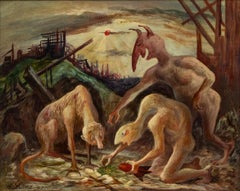
The subject of Saying Grace, a humorous work that dates from the artist’s student days in Kansas City, is very much in line with the oftentimes cheeky humor of Regionalist painters, who gently send up the lifestyles of their Midwestern subjects for consumption among New York collectors. A review of a 1949 exhibition of Medearis’s work at Kende Galleries, New York, aptly sums up his art:

In condensed form, the prankish scenes of Roger Medearis, on view at the Kende Galleries, are reminiscent of Bruegel, Koerner, and his teacher Thomas Hart Benton. His egg tempera travesties are peopled with good and bad mannered creatures in the best natured sense. They wallow in imagined luxuries or sit straight-jacketed in newly-wedded blisslessness. There seems no end to paintable ideas, no dearth of amusement or lack of straight-forward characterization. Landscapes, houses, folks and animals are all alive in a jolly and luminous world (“Condensed Americana,” The Art Digest 23, April 15, 1949).

Saying Grace is an iconic work by one of Regionalism’s most interesting artists, who until recently was little known because his best works were in private hands. Now that works like this one are coming back into circulation, Roger Medearis’s reputation will likely return to the level he had achieved in the 1940s.

(Biography provided by Hirschl Adler)

to
1
Overall Width
to
Overall Height
to
1
1
1
1
1
1
1
1
1
1
1
1
1
9,962
2,752
1,376
1,373
1
1
Artist: Roger Medearis
Rabbit Hunters
By Roger Medearis
Located in Los Angeles, CA
Rabbit Hunters, egg tempera on Masonite, 12 x 9 inches, 1947, signed and dated lower left, signed, titled and dated verso “Rabbit Hunters Egg Tempera Roger Medearis 1947,” exhibited at Medearis' solo show at Kende Galleries, New York, in 1949 (Medearis’ record book, a copy of which is held by Vose Galleries in Boston, MA, indicates this is painting “No. 23” and that is was completed in 1947 and sold via Kende Galleries (at Gimbel Brothers...
Category

1940s American Modern Roger Medearis Art

Materials

Tempera, Board

Related Items
Frederick Shane “Twilight of History” 1947 Surrealist Oil Painting, Signed
By Frederick Shane
Located in Denver, CO
"Twilight of History" is a powerful and evocative original oil painting on board by renowned American artist Frederick Shane (1906–1992), created in 1947. This deeply symbolic work e...
Category

1940s American Modern Roger Medearis Art

Materials

Oil, Board

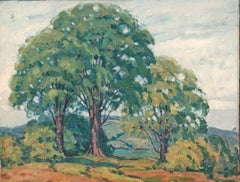
"Woodstock Landscape" Albert Heckman, American Modernist, Atmospheric Valley
By Albert Heckman
Located in New York, NY
Albert Heckman Woodstock Landscape Oil on board 10 x 8 inches Albert Heckman was born in Meadville, Western Pennsylvania, 1893. He went to New York City to try his hand at the art ...
Category

1940s American Modern Roger Medearis Art

Materials

Oil, Board

Cityscape Mid-20th Century Modern Social Realism American Scene Regionalism WPA
Located in New York, NY
Cityscape Mid-20th Century Modern Social Realism American Scene Regionalism WPA Samuel Thal (1903 to 1964) "Cityscene" 12 x 16 inches Oil on board, c. 1940s Signed verso Framed: 19...
Category

1940s American Modern Roger Medearis Art

Materials

Oil, Board

American West Mountainscape by Gunnar Anderson
Located in New York, NY
Gunnar Donald Anderson (American, 1927-2022) Untitled, c. 20th Century Oil on board Sight: 11 1/2 x 15 3/4 in. Framed: 20 1/2 x 24 1/2 x 1 1/4 i...
Category

20th Century American Modern Roger Medearis Art

Materials

Oil, Board

"Woodstock Landscape" Albert Heckman, WPA, Modernist, Farm, Barn, Rural Scene
By Albert Heckman
Located in New York, NY
Albert Heckman Woodstock Landscape Oil on board 12 x 16 inches Albert Heckman was born in Meadville, Western Pennsylvania, 1893. He went to New York City to try his hand at the art...
Category

1940s American Modern Roger Medearis Art

Materials

Oil, Board

"Woodstock Landscape" Albert Heckman, Modernist, Rich Green Vegetation, WPA
By Albert Heckman
Located in New York, NY
Albert Heckman Woodstock Landscape Oil on board 8 x 10 inches Albert Heckman was born in Meadville, Western Pennsylvania, 1893. He went to New York City to try his hand at the art ...
Category

1940s American Modern Roger Medearis Art

Materials

Oil, Board

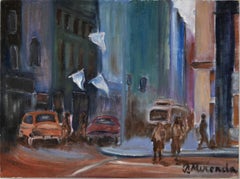
Night Life in the City - Figurative Cityscape
Located in Soquel, CA
Night Life in the City - Figurative Cityscape Mid 1960s cityscape by an unknown artist. Oil on artists board. Image, 16"H x 20"W
Category

1960s American Modern Roger Medearis Art

Materials

Canvas, Oil, Illustration Board

Night Life in the City - Figurative Cityscape
$600 Sale Price
20% Off
H 16 in W 20 in D 0.13 in
"Woodstock Landscape" Albert Heckman, Modernist, Bright Landscape
By Albert Heckman
Located in New York, NY
Albert Heckman Woodstock Landscape Oil on board 8 1/2 x 10 1/2 inches Albert Heckman was born in Meadville, Western Pennsylvania, 1893. He went to New York City to try his hand at ...
Category

1940s American Modern Roger Medearis Art

Materials

Oil, Board

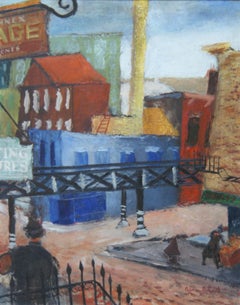
"Industrial Cityscape, Chicago" WPA Modernism Mid-Century Cityscape 20th Century
By Aaron Bohrod
Located in New York, NY
"Industrial Cityscape, Chicago" WPA Modernism Mid-Century Cityscape 20th Century Aaron Bohrod (American 1907 – 1992) Industrial Cityscape 20 x 16 inches Oil on board Signed lower ri...
Category

1930s American Modern Roger Medearis Art

Materials

Oil, Board

"Woodstock Landscape" Albert Heckman, American Modernist Bright Landscape
By Albert Heckman
Located in New York, NY
Albert Heckman Woodstock Landscape Oil on board 12 x 16 inches Albert Heckman was born in Meadville, Western Pennsylvania, 1893. He went to New York City to try his hand at the art...
Category

1940s American Modern Roger Medearis Art

Materials

Oil, Board

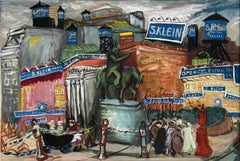
"Union Square" NYC American Scene Social Realism Modernism WPA Mid-20th Century
By Agnes Hart
Located in New York, NY
"Union Square" NYC American Scene Social Realism Modernism WPA Mid-20th Century Agnes Hart (American, 1912-1979) "Union Square, New York City" Sight: 14 1/2 x 21 1/2 inches Gouache...
Category

1940s American Modern Roger Medearis Art

Materials

Gouache, Board

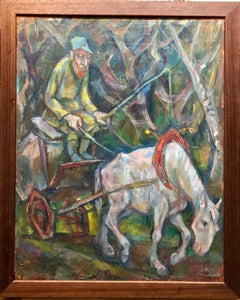
Large Modernist Oil Painting 1940s, Judaica Hasidic Shtetl Wagon Driver WPA Era
By Emanuel Glicenstein Romano
Located in Surfside, FL
Genre: Modern Subject: Landscape with figure of horse, driver and wagon Medium: Oil Surface: wood Board Hand signed lower middle E.Romano EMANUEL ROMANO Rome, Italy, b. 1897, d. 1984 Emanuel Glicen Romano was born in Rome, September 23, 1897. His father Henryk Glicenstein was a sculptor and was living in Rome with his wife Helena (born Hirszenberg) when Emanuel was born. His father obtained Italian citizenship and adopted the name Enrico. Emanuel was brought up in Italy, Switzerland, Germany, England and Poland. In 1926 Emanuel Glicenstein Romano and his father sailed for New York. They briefly visited Chicago. Romano's sister, Beatrice, and mother only joined them in New York years later. Romano changed his name on his arrival to America and some have erroneously speculated that this was to avoid antisemitic discrimination. In truth, as the son of a highly-regarded artist, Romano changed his name to ensure that any success or recognition he would later attain, would be the result of nothing other than his own merit as an artist, and not on account of his father's fame. In 1936 Romano was worked for the WPA Federal Art Project creating murals. ( there were many jewish artists active with in the WPA period. notably Chaim Gross, Ben Shahn, Isaac and Moses Soyer, Abraham Rattner and many others. During and immediately after World War II, Romano created a series of allegorical works depicting graphic holocaust images that were held closely by the family until after his passing. One of these works is now on permanent display in the Florida Holocaust Museum in St. Petersburg Florida. Emanuel's father died in 1942 in a car accident before they could realize their shared dream of visiting Israel. In 1944 Romano, having completed his degree at the Pennsylvania Academy of Fine Arts and the Art Institute of Chicago, began teaching at the City College of New York. Romano moved to Safed, Israel in 1953 and established an art museum in his father's memory, the Glicenstein Museum. COLLECTIONS Indianapolis Museum of Art Metropolitan Museum of Art Boston Fine Arts Museum Fogg Museum Musée Nacional de France Recently his work has been added to the Florida Holocaust Museum collection. His notable works include his holocaust themed allegorical paintings as well as portraits of Marianne Moore, his father and William Carlos Williams...
Category

1930s American Modern Roger Medearis Art

Materials

Oil, Board

Previously Available Items
"California Farm Landscape with Horse, " Roger Medearis, American Regionalism
By Roger Medearis
Located in New York, NY
Roger Medearis (1920 - 2001) California Farm Landscape with Woman and Horse, circa 1990 Oil on panel 8 1/2 x 12 3/4 inches Provenance: The artist Betty Medearis (the artist's wife), by descent Thomas Medearis (the artist's son), by descent Kiechel Fine Art, Lincoln, Nebraska Examples of Medearis’ accomplishments in various media, including paintings, prints, drawings, and sculpture, along with letters and photographs, trace the artist’s career, from his beginnings as a student of Thomas Hart Benton at the Kansas City Art Institute through the development of his own distinctive style in California later in life. The son of a Baptist minister, Roger Norman Medearis was born in Fayette, Mo., and moved with his family to Oklahoma in 1928. He was interested in drawings as a child and, inspired by the work of Norman Rockwell, decided to become an illustrator while still in his early teens. Medearis arrived at Kansas City’s Art Institute at the age of 18, when Benton was already a national celebrity, having been on the cover of Time magazine in 1934. Along with Grant Wood and John Steuart Curry, Benton was a partisan of Regionalism, an American artistic moment in the 1930s and ’40s that rejected European abstraction, took subjects from everyday rural life, and aspired to bring art to a wide audience through public art commissions and low-cost reproductions. For Medearis, this translated to painting what he knew—the farms and people of rural Missouri. Medearis once remarked, “I am a slow painter and devote to each painting all the time it seems to require. The whole purpose of art is excellence, and one good painting is better than 10,000 bad ones.” He became a master of the labor-intensive medium of egg tempera, concocted by mixing dry pigment with egg yolk thinned with water on a glass palette...
Category

1990s American Modern Roger Medearis Art

Materials

Oil, Panel

Summer Hay
By Roger Medearis
Located in New Orleans, LA
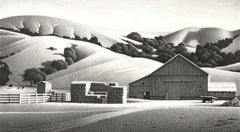
Summer Hay is a black and white lithograph by Roger Medearis. Medearis was a student of Thomas Hart Benton who worked as an American Realist painter and printmaker. Late in life he lived in San Marino, CA and recorded the flora and fauna of that area. Medearis was a student of Thomas Hart Benton while at the Kansas City Art Institute in the late 1930s and took up the technique of egg tempera painting, a rediscovered medium popular with Regionalists. Benton introduced Medearis to the Associated American Artists Gallery in New York City, from which he sold a portrait of his grandmother, "Godly Susan", now in the collection of the Smithsonian Museum of American Art. After World War II, Regionalist art...
Category

1990s American Realist Roger Medearis Art

Materials

Lithograph

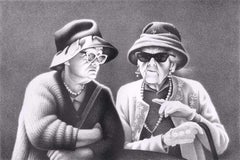
The Secret (Two nicely dressed elderly ladies share the latest juicy gossip)
By Roger Medearis
Located in New Orleans, LA
Medearis created this lithograph in an edition of 90 in 1978. Vital information must be shared between these two older women. They're on a mission and intent on passing on whatever t...
Category

1970s American Modern Roger Medearis Art

Materials

Lithograph

Roger Medearis art for sale on 1stDibs.

Find a wide variety of authentic Roger Medearis art available for sale on 1stDibs. You can also browse by medium to find art by Roger Medearis in paint, tempera, board and more. Much of the original work by this artist or collective was created during the 20th century and is mostly associated with the modern style. Not every interior allows for large Roger Medearis art, so small editions measuring 12 inches across are available. Customers who are interested in this artist might also find the work of Luigi Lucioni, Philip Evergood, and Paul Sample. Roger Medearis art prices can differ depending upon medium, time period and other attributes. On 1stDibs, the price for these items starts at $28,000 and tops out at $45,000, while the average work can sell for $36,500.

Artists Similar to Roger Medearis

Recently Viewed

View All