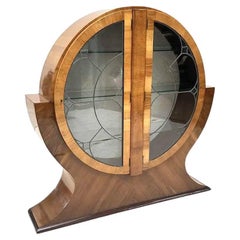
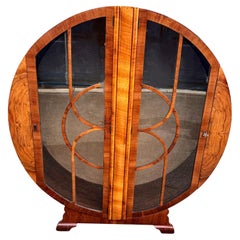
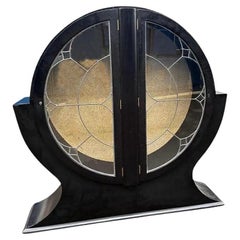
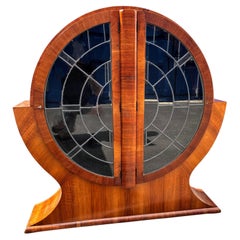
Romweber Furniture Co. Vitrines

American

Some vintage Romweber Furniture Company designs may strike the young as passé. But for fans of a certain age, the American brand never went out of style.

The Romweber story began in the late 1800s, with the launch of American Furniture Company, which made bedroom furniture, Batesville Cabinet Company, a dining-room-set manufacturer, and Batesville Coffin Company. The three companies eventually merged to become a large and reputable manufacturer of case goods, furniture and more.

Not unlike many American companies, production at Romweber suffered during the Great Depression. The brand managed to stay afloat by making a rather strange pivot — to selling five-pound fruitcake boxes. During the Second World War, Romweber pivoted again, this time to the production of ammunition boxes and pontoons for American troops and, naturally, furniture for officers’ quarters.

While Romweber furniture (spelled “RomWeber” in vintage advertisements), dating back to the early 20th century, had designers working in the French Rococo and Chippendale styles, the brand is best known for its mid-century modern pieces. In the postwar years, Romweber manufactured walnut case pieces and storage cabinets that featured decorative olive-ash and burl-wood inlays with brass hardware as well as solid oak credenzas and dining tables designed by the likes of Harold Schwartz. For collectors of sophisticated 1950s furniture, the company’s sturdy Viking Oak line is particularly popular.

“It’s not uncommon for customers to say, ‘My parents had this Romweber Viking set,’” says Adam Cramer of collectors who visit Liberty 33rd, the gallery he owns with his wife in South Bend, Indiana, about three hours north of Romweber’s birthplace in small-town Batesville. “It’s solid oak,” Cramer tells 1stDibs of the line of tables, chairs, desks and more.

Solid oak is the product of slow-growing deciduous trees. Solid oak furniture is durable, desirable and an investment that is usually associated with a hefty price. In solid oak furnishings, such as those that make up the covetable Romweber Viking Oak line, which launched in 1935, there aren’t any scraps of other components in the construction.

Inspired by Scandinavian folk design, Romweber’s Viking Oak is said to have enjoyed one of the longest runs for a commercial furniture line in history. The collection went out of production in the late 1980s, and mid-century editions remain highly prized for their exceptional quality and hand-carved details.

Find vintage Romweber furniture on 1stDibs.

to
Height
to
Width
to
Depth
to
1
1
1
1
1
1
1
1
1
1
1
1
1
1
50
30
21
10
9
Creator: Romweber Furniture Co.
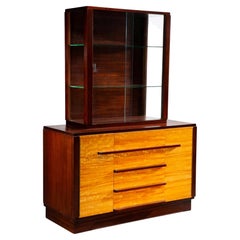
Art Deco Signed Wolfgang Hoffmann for Romweber World s Fair Display Cabinet
By Romweber Furniture Co., Wolfgang Hoffmann
Located in Forney, TX
A rare and important Art Deco period Century of Progress Display Cabinet designed by Wolfgang Hoffmann (Austrian, 1900-1969) for Romweber Company, Batesville, Indiana, United States of America. circa 1933-1936 Created for the 1933 Chicago World's Fair, one piece design, having a rectangular showcase top with glass panel sides and a pair of sliding glass doors, over solid wood chest fitted with four drawers affixed with horizontal pulls, flanked by cabinet doors, opening to shelved interior. Rosewood, mahogany, richly figured blonde - golden birch or primavera, and glass. Signed, original label to drawer interior, featuring 1933 World's Fair mark impressed. **Please note, at the time of writing this, a matching sideboard - buffet (shown in last photo) is currently available separately** Provenance / Acquisition: Property from the important and iconic collection of Mr. James I. Rafftesaeth Jr., Dallas, Texas Acquired from highly reputable auction house, Heritage Auctions, Dallas, Texas. 2022 Design Signature Auction catalog #8091 History: Wolfgang Hoffmann was born in Vienna, Austria in 1900. He is the son of famous architect, pedagogue and Wiener Werkstatte cofounder, Joseph Hoffmann (1870-1956). Early on, following his father’s s interests, he was trained in the decorative arts and design. Wolfgang Hoffmann once reminisced, “I spent eight years at the Realschule, then three years went to a special architectural school, where I perfected my technical knowledge of architecture and general construction. From this school, I was graduated to the Kunstgewerbeschule [Studying under Oskar Strnad and Josef Frank in Vienna]. After finishing this school, I had one and a half years of practical in a well known architect’s office. Thereafter I worked in my Father’s office for two years”. Hoffmann met his future wife, Polish immigrant Pola (1902-1984) when they were both studying at the Kunstgewerbeschule. Joseph Urban (1872-1933) was needing an assistant for his architectural business in New York and contacted his friend and colleague, Joseph Hoffmann in Vienna. Hoffmann recommended his son Wolfgang. Urban hired him and sent a first class passage ticket to Vienna for Wolfgang to travel to New York. Wolfgang married Pola and traded his ticket for two tickets to America in steerage, arriving in New York City in December of 1925. Leaving the Urban office after nine months, Wolfgang and Pola formed an independent design practice with offices on Madison Avenue in Manhattan with the purpose of creating contemporary interiors and industrial designs. Early work included theaters, stores, and apartments mostly in New York City. During the late 1920’s and early 1930’s the Hoffmanns designed custom furniture for private clients. Some of these examples were shown in the February 1929 issue of House and Garden. Curiously, the examples’ design was attributed to Urban and the production to Pola Hoffmann, Inc. Established in the fall of 1928, the American Designers’ Gallery was “devoted exclusively to showing objects and interiors for practical use… by fourteen American architects and designers”. Its members included the Hoffmans and Urban as well as ceramist Henry Varnum Poor (1888-1971), architect Raymond Hood (1881-1934), artist designer Winold Reiss (1886-1953), graphic designer Lucien Bernhard (1896-1981), decorator Donald Deskey (1894-1989), and architect Ely Jacques Kahn (1884-1972). The Hoffmanns’ work was included in the American Designers’ Gallery’s two showcase events, its 1928 and 1929 exhibitions. Their dining alcove at the 1929 event featured a bench with a dinette table and two chairs in American walnut designed by Wolfgang and a rug by Pola. Lucien Bernhard, fellow Austrian immigrant who settled in New York a year before the Hoffmanns, operated the gallery and decorating service Contempora with Munich resident Bruno Paul (1874-1968). The Hoffmanns, occasionally participating with Contempora, designed a number of outstanding interiors, including the constructivist living room of 1930 for Mrs. O.R. Sommerich at 40 East 66th street. In 1934, Donald Deskey commissioned Wolfgang to design birchwood furnishings for the eclectic apartment at 625 Park Avenue belonging to Helena Rubinstein. In 1931, Wolfgang exhibited his work at the Pennsylvania Art Museum and the Museum of Modern Art in New York City. The same year, with Kem Weber (1889-1963) he organized the second and final exhibition of AUDAC- “Modern Industrial and Decorative Arts”- at the Brooklyn Museum. At this event, the Hoffmanns showed the dining room previously included in the American Designer’s Gallery’s 1929 exhibition in the Chase Bank Building lobby at 145 West 57th Street in Manhattan. In 1932 Wolfgang was asked to assist Urban in developing the color scheme for the 1933-34 Chicago World’s Fair “A Century of Progress”. He was also commissioned to design the interior and furniture for the fair’s lumber industries house. There he executed its living and dining rooms furnished by Kroehler Manufacturing Company of Chicago; the boys’ room by Shower Brothers...
Category

Early 20th Century American Art Deco Romweber Furniture Co. Vitrines

Materials

Glass, Mahogany, Rosewood

Related Items
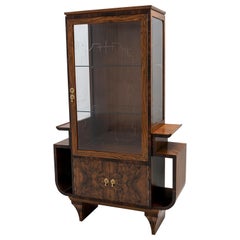
Art Dèco Italian Walnut Vitrines or Bar Display Cabinet, 1925
Located in Puglia, Puglia
Art Dèco vitrines or display cabinet, Italian production of the 1920s, in walnut and walnut briar, screen-printed glass with grinding around. The showcase has been restored and polis...
Category

1920s Italian Art Deco Vintage Romweber Furniture Co. Vitrines
Materials

Crystal

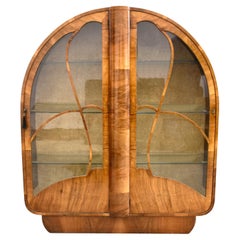
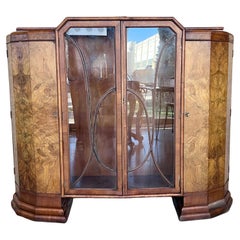
Art Deco Stylish Display Vitrine Cabinet in Walnut, English, 1930s
Located in Devon, England
Beautiful and original 1930s Art Deco English walnut display cabinet. A lovely piece of furniture that's veneered in figured mid tone walnut. Still retains its original silk interior...
Category

Mid-20th Century English Art Deco Romweber Furniture Co. Vitrines

Materials

Glass, Walnut

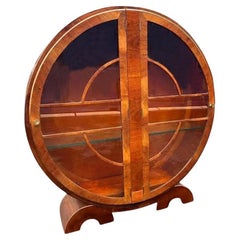
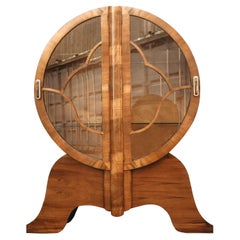
Art Deco Walnut Circular Vitrine Display Cabinet, English, c1930
Located in Devon, England
A wonderful 1930's Art Deco circular display cabinet of high quality, with ample storage on 3 glass shelves and lovely bakelite handles all sat on superb double circular feet. In gre...
Category

Mid-20th Century English Art Deco Romweber Furniture Co. Vitrines

Materials

Bakelite, Glass, Walnut

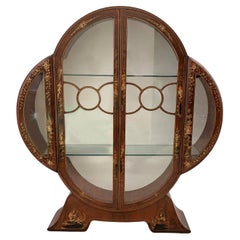
Art Deco Spectacular Display Cabinet Vitrine, English, circa 1930
Located in Devon, England
Impressively wacky shaped and genuinely rare design is this superb 1930's English Art Deco Display cabinet. This beautiful cabinet is veneered in a lightly figured walnut veneer which has the most glorious patterning to the grain and retains a mid tone in colouring. The interior features a generously sized display area for your collection. There are three internal glass shelves . The beautiful astragal glass...
Category

Mid-20th Century English Art Deco Romweber Furniture Co. Vitrines

Materials

Glass, Walnut, Plywood, Bentwood

Art Deco Cathedral Display Cabinet with Ebonized Base, Vitrine, circa 1930
Located in Miami, FL
Superb 1930s Art Deco walnut cathedral display cabinet. Gorgeous mid to light tone walnut veneers, still with original working key and two glass shelves. Generously spaced interior, ...
Category

Early 20th Century Italian Art Deco Romweber Furniture Co. Vitrines

Materials

Walnut

Art Deco Spectacular Clove Display Vitrine Cabinet, English, c1930s
Located in Devon, England
Fabulous, original 1930s Art Deco display vitrine cabinet. Very unusual shape of which we haven't had before. This cabinet features a generous...
Category

Mid-20th Century English Art Deco Romweber Furniture Co. Vitrines

Materials

Glass, Walnut

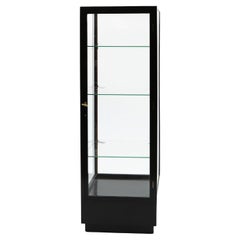
French Art Deco Ebonized Glass Display Cabinet
Located in Kastrup, DK
French Art Deco display cabinet in ebonized (black-polished) wood, featuring glass on all four sides. The cabinet includes a full-height glass door with a brass handle. Inside, it h...
Category

Early 20th Century French Art Deco Romweber Furniture Co. Vitrines

Materials

Brass

French Art Deco Ebonized Glass Display Cabinet
$4,726
H 75.99 in W 23.86 in D 23.82 in
Art Deco Spectacular Clove Display Vitrine Cabinet, English, c1930s
Located in Devon, England
Fabulous, original 1930s Art Deco display vitrine cabinet. Very unusual shape of which we haven't had before. This cabinet features a generously sized interior display area for your ...
Category

Mid-20th Century English Art Deco Romweber Furniture Co. Vitrines

Materials

Lead

Art Deco Beautiful Walnut Circular Display Vitrine Cabinet, c1930
Located in Devon, England
Fabulous, original 1930s Art Deco display cabinet. This lovely figured walnut veneered mid-tone cabinet features a generously sized interior display area for your 'collections'. Beau...
Category

Mid-20th Century English Art Deco Romweber Furniture Co. Vitrines

Materials

Glass, Walnut

Spectacular Art Deco Ebonized Glass Display Cabinet, Vitrine, English, C1930
Located in Devon, England
This is a superb example of an English made Art Deco display cabinet, dating to the 1930''s and very popular at the time for displaying your best ''china'' usually displayed in what ...
Category

Mid-20th Century English Art Deco Romweber Furniture Co. Vitrines

Materials

Lead

Art Deco Impressive Walnut Display Cabinet Vitrine, English, circa 1930
Located in Devon, England
This is a superb example of an English made Art Deco display cabinet, dating to the 1930s and very popular at the time for displaying your best 'china' usually displayed in what was ...
Category

Mid-20th Century English Art Deco Romweber Furniture Co. Vitrines

Materials

Lead

French Art Deco Vitrine, Display Cabinet
Located in North Bergen, NJ
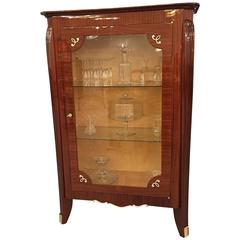
This incredible French Art Deco vitrine has a large glass front with glass shelves inside. Gold hardware to accent the wood beautifully. Can be...
Category

1930s Art Deco Vintage Romweber Furniture Co. Vitrines

French Art Deco Vitrine, Display Cabinet
$4,500
H 62.5 in W 40 in D 18 in

Romweber Furniture Co. vitrines for sale on 1stDibs.

Romweber Furniture Co. vitrines are available for sale on 1stDibs. These distinctive items are frequently made of wood and are designed with extraordinary care. There are many options to choose from in our collection of Romweber Furniture Co. vitrines, although brown editions of this piece are particularly popular. Many of the original vitrines by Romweber Furniture Co. were created in the Art Deco style in united states during the early 20th century. Prices for Romweber Furniture Co. vitrines can differ depending upon size, time period and other attributes — on 1stDibs, these items begin at $9,500 and can go as high as $9,500, while a piece like these, on average, fetch $9,500.
Questions About Romweber Furniture Co. Vitrines
  • 1stDibs ExpertFebruary 7, 2024
    Romweber Furniture was an American furniture manufacturer. It began in the late 1800s with the launch of American Furniture Company, which made bedroom furniture; Batesville Cabinet Company, a dining-room set manufacturer and Batesville Coffin Company. The three companies eventually merged to become a large manufacturer of case goods, furniture and more. While Romweber Furniture had earlier designers working in the French Rococo and Chippendale styles, the brand is best known for its mid-century modern pieces. This includes walnut case pieces and storage cabinets that feature decorative olive-ash and burl-wood inlays with brass hardware, as well as solid oak credenzas and dining tables designed by Harold Schwartz. For collectors of sophisticated 1950s furniture, the company’s sturdy Viking Oak line is particularly popular. On 1stDibs, find a selection of Romweber furniture.

Still Thinking About These?

All Recently Viewed