Rudolf Ernst Art

Austrian, 1854-1932

Rudolf Ernst had a lifelong fascination with Islamic and Moorish art, which informed his richly colored orientalist paintings. These demonstrate the Austrian artist’s extraordinary attention to detail and his mastery of texture and form.

Ernst was born in 1854 in Vienna. His father, Leopold Ernst, was a painter and architect. Encouraged by his father to pursue his interest in the arts, Ernst entered the Academy of Fine Arts at age 15. There, he studied academic art under Austrian painter and muralist August Eisenmenger and German classicist painter Anselm Feuerbach

In 1874, Ernst left the Academy to study the Old Masters in Rome. After two years in Italy, he moved to Paris, where he met Turkish painter Osman Hamdi Bey, who inspired him to paint orientalist subjects. 

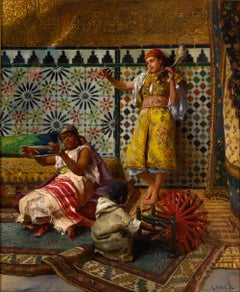
In the following years, Ernst traveled extensively throughout Turkey, Morocco, Egypt and Moorish Spain, where he was enamored with Islamic art and culture. By 1885, his oeuvre consisted mainly of orientalist themes. Ernst’s favorite subjects included the harem — as shown in his figurative painting Spinning Yarn in the Harem (1886) — Hindu temples, Nubian guards and scenes of Islamic daily life, such as his watercolor portrait Man Smoking in Doorway.

In 1890, Ernst was introduced to the art of ceramic tile decorating while visiting Constantinople (today’s Istanbul). Back in Paris, he continued learning about ceramic art from ceramicist and glassmaker Léon Fargue. During his later years, Ernst constructed a ceramic studio where he made orientalist faience tiles. He also continued painting resplendent Eastern scenes from his Ottoman-style studio, often wearing a tarboosh hat while he worked. 

Ernst participated in several notable exhibitions, including the Exposition Universelle held in Paris in 1889 and 1900. He won a bronze medal at the 1889 Exposition. He died in 1932. 

Today, Ernst’s paintings can be found in the collections of the Fine Arts Museums of San Francisco and the Dahesh Museum of Art in New York City.

On 1stDibs, discover a range of Rudolf Ernst’s paintings.

to
1
1
Overall Width
to
Overall Height
to
2
1
1
1
2
1
1
1
1
2
2
2
1
2
9,962
2,753
1,376
1,373
2
2
Artist: Rudolf Ernst
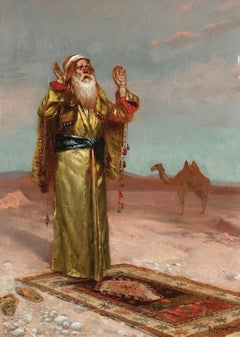
Praying in the Desert by Rudolf Ernst, 19th Century Oil on Panel
By Rudolf Ernst
Located in Jacksonville, FL
Rudolph Ernst’s Praying in the Desert is a masterful example of Orientalist art, showcasing the artist's profound ability to blend intricate detail with an atmosphere of serene spiri...
Category

19th Century Academic Rudolf Ernst Art

Materials

Oil, Panel

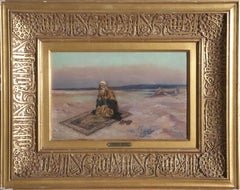
Bedouin at Prayer, Orientalist Oil Painting on Panel by Rudolf Ernst
By Rudolf Ernst
Located in Long Island City, NY
This painting by Orientalist artist Rudolf Ernst depicts a Muslim man in quiet contemplation during prayer. He kneels in solitude in the vast desert as the light fades around him. Ma...
Category

1890s Old Masters Rudolf Ernst Art

Materials

Oil, Wood Panel

Related Items
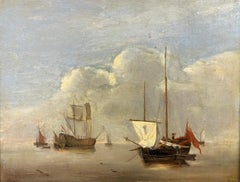
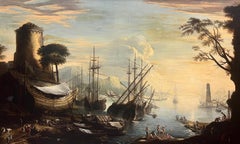
Shipping in Calm Waters, 18th Century Dutch Oil on Wood Panel, Man o War
Located in Cirencester, Gloucestershire
Shipping in Calm Waters Dutch School, 18th century oil painting on wood panel panel: 10 x 12.75 inches framed: 14 x 17 inches condition: very good, minor evidenc...
Category

18th Century Old Masters Rudolf Ernst Art

Materials

Oil, Wood Panel

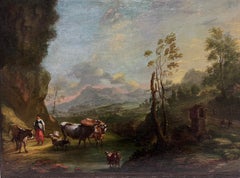
Fine 1800 s Italian Grand Tour Oil Painting Figures before Classical Buildings
Located in Cirencester, Gloucestershire
The Arcadian View Italian School, circa 1800 Grand Tour subject oil on canvas, unframed canvas : 12 x 16 inches provenance: private collection, UK condition: very good and sound cond...
Category

Early 1800s Old Masters Rudolf Ernst Art

Materials

Oil

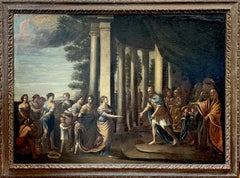
Martyrdom of Saint Stephen- Painting attr. to Vincent Adriaenssen- 17th Century
Located in Roma, IT
Landscape with martyrdom of Saint Stephen is an old master artwork realized in 17th century. Mixed colored oil painting on canvas. Includes coeval gilded frame cm. 148x196. The artwork is attributed to Vincent Adriaenssen called il Manciola (Antwerp, 1595 - Roma, 1675) Among the painters who worked in the first half of the seventeenth century it is possible to indicate only the Neapolitan Scipione Compagno (1624-1680) as the author of scenes of martyrs set within a landscape or a view such as, for example, the Martyrdom of Saint Stefano recently hesitated at the Ansorena in Madrid on June 16, 2021. It should be noted, however, that the landscape represented in the painting examined here, characterized by luxuriant vegetation, meticulously represented "in the Flemish style", shows differences with the typical settings of the paintings di Compagno, characterized above all by urban views, visionary architectures or rather arid vegetation. Even the refined figures, so elongated and lanky, represented in our painting, in particular the group of knights in the foreground on the right, are not reflected in the production of the Neapolitan painter. These elements, to which we add the depiction of the Eternal Father amidst the clouds and the detail of the dog in profile in the foreground, instead recall a painter mainly known as a battle soldier, but who was also the author of many works depicting episodes from ancient Rome set within luxuriant landscapes, or rather Vincent Adriaenssen known as Manciola, a painter from Antwerp whose figure has been shed light thanks to recent studies. The group of horsemen represented to the right of the examined painting is, in fact, comparable with other groups on horseback present in numerous works by Manciola such as, for example, in the Triumph of Caesar (Rome, Babuino, 23-03-2010; formerly Florence, Collection Privata, 2006), while similar elongated and somewhat lanky figures, dressed in red, yellow, blue and white, can be found in the three paintings conserved at the Cassa di Risparmio di Pesaro, which in the past were erroneously attributed to the Umbrian painter Francesco Allegrini...
Category

17th Century Old Masters Rudolf Ernst Art

Materials

Oil

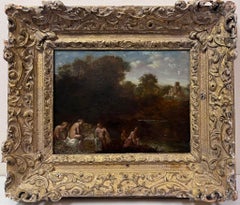
17th Century Classical Oil Painting - Diana With Her Attendants in a Grotto
By Abraham van Cuylenborch
Located in London, GB
Abraham van CUYLENBROCH (1620-1658) Diana With Her Attendants in a Grotto 1651 signed oil on panel 12.2 in x 15.7 inches, inc. frame; 31 x 40 cm Provenance: Sale of Sotheby's Lo...
Category

17th Century Old Masters Rudolf Ernst Art

Materials

Oil

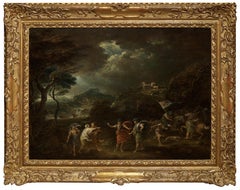
Macbeth and the Three Witches a Painting on Panel by Francesco Zuccarelli
By Francesco Zuccarelli
Located in PARIS, FR
This painting, created during Zuccarelli's stay in England, represents the decisive moment when Macbeth, together with Banquo, meets the three witches who announce that he will be Ki...
Category

1760s Old Masters Rudolf Ernst Art

Materials

Oil, Wood Panel

18th century English marine Battle scene between Dutch and British warships
By Francis Swaine
Located in Woodbury, CT
Attributed to Francis Swaine (British, 1725–1782) Naval Engagement at Sea, 18th century Oil on panel In this evocative seascape, a cluster of ships—flags raised, cannons fired—conve...
Category

1760s Old Masters Rudolf Ernst Art

Materials

Oil, Wood Panel

17th century Flemish seascape - Stormy Sea with Merchant Vessels and dolphins
By Bonaventura Peeters the Elder
Located in Aartselaar, BE
Bonaventura Peeters the Elder (1614–1652) attr., Stormy Coastal Scene with Merchant Vessels, Galliot, and Dolphins Framed by rugged cliffs and illuminated under a dark, swirling sk...
Category

17th Century Old Masters Rudolf Ernst Art

Materials

Oil, Panel

Landscape with Gentleman on Horseback and Peasant Woman Receiving Alms
By Philips Wouwerman
Located in Stockholm, SE
Workshop / Circle of Philips Wouwerman (1619-1668) Landscape with Gentleman on Horseback and Peasant Woman Receiving Alms oil on oak panel 12.40 x 14.17 inches (31.5 x 36 cm) wit...
Category

17th Century Old Masters Rudolf Ernst Art

Materials

Oak, Oil, Wood Panel

Fine 17th Century Dutch Old Master Oil on Panel Angelic Visitation to Figures
By Rembrandt van Rijn
Located in Cirencester, Gloucestershire
The Angelic Visitation Dutch School, mid 17th century circle of Rembrandt (Dutch 1606-1669) oil on wooden panel, framed in faux tortoiseshell style frame. framed: 25 x 28.75 painting...
Category

17th Century Old Masters Rudolf Ernst Art

Materials

Oil, Wood Panel

Antique English 19th century marine scene
By William Anderson
Located in Woodbury, CT
Outstanding English late 18th / early 19th century marine scene by one of Britain's best known and sought after painters. William (or Wiliam) Anderson (1757 – 27 May 1837) was a Scottish artist specializing in maritime and patriotic themes. He was well-regarded for his detailed and accurate portraits of ships under sail, exhibiting his works annually in London between 1787 and 1811 and then occasionally until 1834. Anderson influenced other artists, notably John Ward and others of the Hull school. Anderson's early life is obscure, but he is known to have trained as a shipwright before moving to London to become a maritime painter when he was about 30. His training served him well as a painter, providing "a practical nautical knowledge" of his subjects. He earned a reputation for "accuracy and refinement of detail" and was admired for his bright, clear colours. He worked in both oils and watercolours. He based his style on that of well-known Dutch maritime...
Category

1810s Old Masters Rudolf Ernst Art

Materials

Oil, Wood Panel

The peace of your nights descends into their thoughts
Located in Genève, GE
Work on paper mounted on wood 35.5 x 45.5 x 2 cm
Category

Late 18th Century Old Masters Rudolf Ernst Art

Materials

Oil

The peace of your nights descends into their thoughts
$1,485
H 11.42 in W 15.16 in D 0.12 in
Flemish 17th c., Allegory of war and peace, circa 1630, by Adriaen van Stalbemt
Located in PARIS, FR
Adriaen van Stalbemt (Antwerp, 1580-1662) Allegory of Peace and War, circa 1620-1630 Oil on oak panel: h. 49.5 cm, l. 73.2cm (19.29 x 28.74 in) Giltwood ...
Category

Early 17th Century Old Masters Rudolf Ernst Art

Materials

Oil, Panel

Previously Available Items
Spinning Yarn in the Harem by Rudolf Ernst
By Rudolf Ernst
Located in New Orleans, LA
Rudolf Ernst 1854-1932 Austrian Spinning Yarn Signed and dated “R. Ernst 86” (lower right) Oil on panel Austro-French Orientalist painter Rudolf Ernst showcases his aptitude for the genre in this skillfully executed oil on panel. In it, two exotically dressed...
Category

19th Century Academic Rudolf Ernst Art

Materials

Oil, Panel

La Fileuse
By Rudolf Ernst
Located in New York, NY
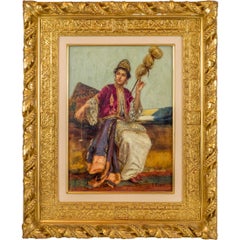
RUDOLF ERNST Austrian, 1854-1932 La Fileuse Signed 'R. Ernst' Oil on panel 13 x 9 1/2 inches Framed: 20.25 in. x 16.50 inches
Category

1890s Rudolf Ernst Art

Materials

Oil, Panel

Large Oil Painting of A Dervish Man Rudolf Ernst
By Rudolf Ernst
Located in New York, NY
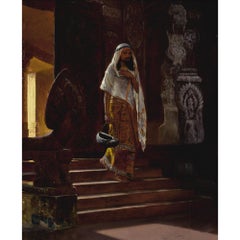
Rudolf Ernst Austrian 1854 - 1932 A Dervish signed R. Ernst lower left oil on panel Unframed: 55 by 45cm., 21¾ by 17¾in. Framed: 90.8 by 81.5cm., 35¾ by 32in. Dervishes in Islam were members of a Sufi fraternity, religious mendicants who chose or accepted material poverty. Their lives were dedicated to the universal values of love and service, and on the renunciation of ego to reach God, and the alms they received were not for their own good but to help others in need. In most Sufi orders, a dervish was known to practice the ritual prayer of dhikr through dance or religious practices to attain the ecstatic trance to reach God. Their most popular practice was Sama, which is associated with the thirteenth-century mystic Rumi. In folklore, dervishes are often credited with the ability to perform miracles, including healing powers. In the present work, a dervish descends stairs carrying a kashkul, or beggar’s bowl. Considered to be the most emblematic accoutrement of the wandering dervish, kashkuls were primarily used to collect alms and occasionally as drinking vessels. In later centuries, many functioned as decorative objects since a devoted dervish would be unlikely to carry an elaborately carved kashkul as it would contradict his belief in the renunciation of worldly goods. BIOGRAPHY Rudolf Ernst was born in Vienna in 1854 and joined the Academy of Fine Arts at the age of 15. Ernst also studied in the studios of Eisenmenger and Feuerbach at the Viennese Academy. After a sojourn to Rome in 1874, he settled in Paris in 1876 where he would exhibit at the Salon des Artistes Francais for the following six decades, befriending Ludwig Deutsch...
Category

Late 19th Century Rudolf Ernst Art

Materials

Oil, Panel

Rudolf Ernst (1854-1932) Signed French-Austrian Oil, Bishop and Monk in Interior
By Rudolf Ernst
Located in Corsham, GB
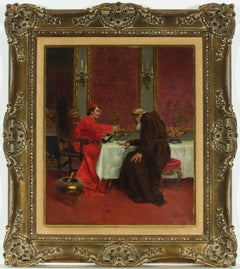
A truly exquisite signed late 19th/early 20th century interior oil painting on canvas by the renowned French-Austrian artist Rudolf Ernst (1854-1932). The painting depicting two figu...
Category

Late 19th Century Victorian Rudolf Ernst Art

Materials

Canvas, Oil

Rudolf Ernst art for sale on 1stDibs.

Find a wide variety of authentic Rudolf Ernst art available for sale on 1stDibs. You can also browse by medium to find art by Rudolf Ernst in oil paint, paint, panel and more. Not every interior allows for large Rudolf Ernst art, so small editions measuring 31 inches across are available. Customers who are interested in this artist might also find the work of Charles Zacharie Landelle, Ferdinand Victor Leon Roybet , and Emile Godchaux. Rudolf Ernst art prices can differ depending upon medium, time period and other attributes. On 1stDibs, the price for these items starts at $595,000 and tops out at $595,000, while the average work can sell for $595,000.

Artists Similar to Rudolf Ernst

Recently Viewed

View All