Ruth Leaf Figurative Prints

American, 1923-2015

Ruth Leaf was an American artist and a pioneer in the discipline of printmaking. While also fluent in the methods of linoleum, monotype, collagraph and collage, she is most known for her viscosity etchings and woodcuts. She authored the book, Etching, Engraving and Other Intaglio Printmaking Techniques (Watson-Guptill Publications) in 1976 while teaching at her namesake studio in Long Island and it remains the textbook used today in many schools. She was born in New York City in 1923, she studied at the New School for Social Research, Art Students League and Brooklyn College and at Atelier 17 with the groundbreaking printmaker Stanley William Hayter. She exhibited her work throughout the United States and abroad and has work in many collections, including the Library of Congress, the U.S. Information Agency, the Butler Institute of American Art and numerous university museums. Leaf has been a member of the Society of American Graphic Artists, the American Color Print Society and regional printmaking groups.

to
1
4
Overall Width
to
Overall Height
to
5
36
859
382
367
310
5
3
2
3
2
2
2
1
1
3
2
2
1
5
Artist: Ruth Leaf
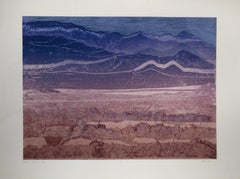
Desert Series B
By Ruth Leaf
Located in San Francisco, CA
This artwork titled "Desert Series B" c.1990, is an original colors monoprint aquatint on Wove paper by noted American artist Ruth Leaf, 1923-2015. It is hand signed, titled and numb...
Category

Late 20th Century Abstract Expressionist Ruth Leaf Figurative Prints

Materials

Aquatint, Monoprint

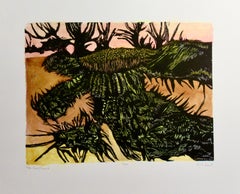
The Sun Flower
By Ruth Leaf
Located in San Francisco, CA
This artwork titled "The Sun Flower" c.1990, is an original colors woodcut on Wove paper by noted American artist Ruth Leaf, 1923-2015. It is hand signed, titled and numbered 9/20 in...
Category

Late 20th Century Abstract Expressionist Ruth Leaf Figurative Prints

Materials

Woodcut

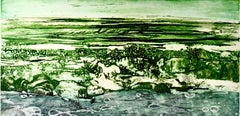
Arcadia
By Ruth Leaf
Located in San Francisco, CA
This artwork titled "Arcadia" c.1990, is an original colors etching with aquatint on Wove paper by noted American artist Ruth Leaf, 1923-2015. It is hand signed, titled and numbered ...
Category

Late 20th Century Abstract Expressionist Ruth Leaf Figurative Prints

Materials

Etching, Aquatint

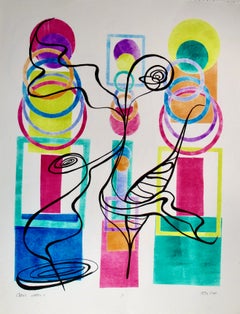
Circus Series C
By Ruth Leaf
Located in San Francisco, CA
This artwork titled "Circus Series C" c.1990, is an original woodcut monoprint on Wove paper by noted American artist Ruth Leaf, 1923-2015. It is hand signed, titled and numbered 1/1...
Category

Late 20th Century Abstract Expressionist Ruth Leaf Figurative Prints

Materials

Monoprint

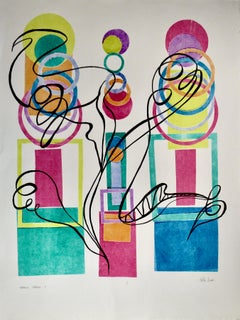
Circus Series C
By Ruth Leaf
Located in San Francisco, CA
This artwork titled "Circus Series C" c.1990, is an original monoprint on Wove paper by noted American artist Ruth Leaf, 1923-2015. It is hand signed, titled and numbered 1/1 in penc...
Category

Late 20th Century Abstract Expressionist Ruth Leaf Figurative Prints

Materials

Monoprint

Related Items
Composition - Original Etching by Leo Guida - 1970s
By Leo Guida
Located in Roma, IT
Composition is an original etching realized by Leo Guida in 1970s. Good condition. Mounted on a white cardboard passpartout (50x35). Not signed and not dated. Leo Guida (1992 - ...
Category

1970s Abstract Ruth Leaf Figurative Prints

Materials

Etching

Composition - Original Etching by Leo Guida - 1970s
$178 Sale Price
25% Off
H 19.69 in W 13.78 in D 0.04 in
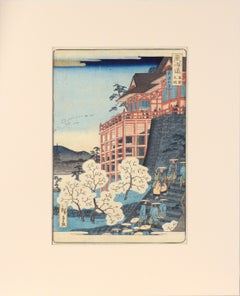
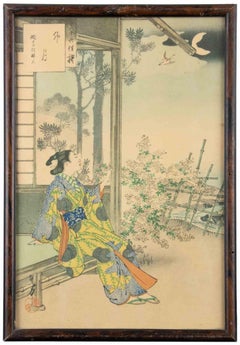
One Hundred Aspects of the Moon, Mt Otawa Moon - Bright God Tamura
By Tsukioka Yoshitoshi
Located in Soquel, CA
"Mount Otawa Moon: Bright God Tamura" - Woodblock on Paper by Tsukioka Yoshitoshi From the series "One Hundred Aspects of the Moon" This piece depicts the general Sakanoe no Tamura...
Category

1880s Edo Ruth Leaf Figurative Prints

Materials

Paper, Ink, Woodcut

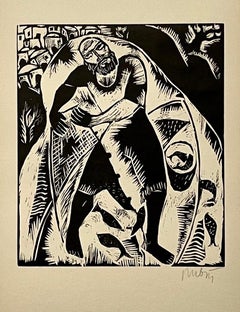
Rare 1923 Cubist Reuven Rubin Woodcut Woodblock Print Israeli Hasidic Judaica
By Reuven Rubin
Located in Surfside, FL
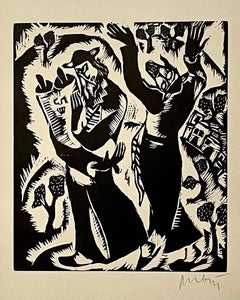
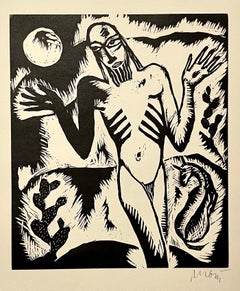
This is from the original first edition 1923 printing. there was a much later edition done after these originals. These are individually hand signed in pencil by artist as issued. This listing is for the one print. the other documentation is included here for provenance and is not included in this listing. The various images inspired by the Jewish Mysticism and rabbis and mystics of jerusalem and Kabbalah is holy, dramatic and optimistic Rubin succeeded to evoke the spirit of life in Israel in those early days. They are done in a modern art style influenced by German Expressionism, particularly, Ernst Barlach, Ernst Ludwig Kirchner, and Franz Marc, as introduced to Israel by Jakob Steinhardt, Hermann Struck and Joseph Budko. Reuven Rubin 1893 -1974 was a Romanian-born Israeli painter and Israel's first ambassador to Romania. Rubin Zelicovich (later Reuven Rubin) was born in Galati to a poor Romanian Jewish Hasidic family. He was the eighth of 13 children. In 1912, he left for Ottoman-ruled Palestine to study art at Bezalel Academy of Art and Design in Jerusalem. Finding himself at odds with the artistic views of the Academy's teachers, he left for Paris, France, in 1913 to pursue his studies at the École Nationale Supérieure des Beaux-Arts. He was of the well known Jewish artists in Paris along with Marc Chagall and Chaim Soutine, At the outbreak of World War I, he was returned to Romania, where he spent the war years. In 1921, he traveled to the United States with his friend and fellow artist, Arthur Kolnik. In New York City, the two met artist Alfred Stieglitz, who was instrumental in organizing their first American show at the Anderson Gallery. Following the exhibition, in 1922, they both returned to Europe. In 1923, Rubin emigrated to Mandate Palestine. Rubin met his wife, Esther, in 1928, aboard a passenger ship to Palestine on his return from a show in New York. She was a Bronx girl who had won a trip to Palestine in a Young Judaea competition. He died in 1974. Part of the early generation of artists in Israel, Joseph Zaritsky, Arieh Lubin, Reuven Rubin, Sionah Tagger, Pinchas Litvinovsky, Mordecai Ardon, Yitzhak Katz, and Baruch Agadati; These painters depicted the country’s landscapes in the 1920s rebelled against the Bezalel school of Boris Schatz. They sought current styles in Europe that would help portray their own country’s landscape, in keeping with the spirit of the time. Rubin’s Cezannesque landscapes from the 1920s were defined by both a modern and a naive style, portraying the landscape and inhabitants of Israel in a sensitive fashion. His landscape paintings in particular paid special detail to a spiritual, translucent light. His early work bore the influences of Futurism, Vorticism, Cubism and Surrealism. In Palestine, he became one of the founders of the new Eretz-Yisrael style. Recurring themes in his work were the bible, the prophet, the biblical landscape, folklore and folk art, people, including Yemenite, Hasidic Jews and Arabs. Many of his paintings are sun-bathed depictions of Jerusalem and the Galilee. Rubin might have been influenced by the work of Henri Rousseau whose naice style combined with Eastern nuances, as well as with the neo-Byzantine art to which Rubin had been exposed in his native Romania. In accordance with his integrative style, he signed his works with his first name in Hebrew and his surname in Roman letters. In 1924, he was the first artist to hold a solo exhibition at the Tower of David, in Jerusalem (later exhibited in Tel Aviv at Gymnasia Herzliya). That year he was elected chairman of the Association of Painters and Sculptors of Palestine. From the 1930s onwards, Rubin designed backdrops for Habima Theater, the Ohel Theater and other theaters. His biography, published in 1969, is titled My Life - My Art. He died in Tel Aviv in October 1974, after having bequeathed his home on 14 Bialik Street and a core collection of his paintings to the city of Tel Aviv. The Rubin Museum opened in 1983. The director and curator of the museum is his daughter-in-law, Carmela Rubin. Rubin's paintings are now increasingly sought after. At a Sotheby's auction in New York in 2007, his work accounted for six of the ten top lots. Along with Yaacov Agam and Menashe Kadishman he is among Israel's best known artists internationally. Education 1912 Bezalel Academy of Arts and Design, Jerusalem 1913-14 École des Beaux Arts, Paris and Académie Colarossi, Paris Select Group Exhibitions Eged - Palestine Painters Group Eged - Palestine Painters Group, Allenby Street, Tel Aviv 1929 Artists: Chana Orloff, Abraham Melnikoff, Rubin, Reuven Nahum Gutman, Sionah Tagger,Arieh Allweil, Jewish Artists Association, Levant Fair, Tel Aviv, 1929 Artists: Ludwig Blum,Eliyahu Sigad, Shmuel Ovadyahu, Itzhak Frenel Frenkel,Ozer Shabat, Menahem Shemi...
Category

1920s Abstract Ruth Leaf Figurative Prints

Materials

Woodcut

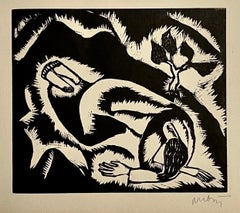
Rare 1923 Cubist Reuven Rubin Woodcut Woodblock Kabbalah Print Israeli Judaica
By Reuven Rubin
Located in Surfside, FL
This is from the original first edition 1923 printing. there was a much later edition done after these originals. These are individually hand signed in pencil by artist as issued. This listing is for the one print. the other documentation is included here for provenance and is not included in this listing. The various images inspired by the Jewish Mysticism and rabbis and mystics of jerusalem and Kabbalah is holy, dramatic and optimistic Rubin succeeded to evoke the spirit of life in Israel in those early days. They are done in a modern art style influenced by German Expressionism, particularly, Ernst Barlach, Ernst Ludwig Kirchner, and Franz Marc, as introduced to Israel by Jakob Steinhardt, Hermann Struck and Joseph Budko. Reuven Rubin 1893 -1974 was a Romanian-born Israeli painter and Israel's first ambassador to Romania. Rubin Zelicovich (later Reuven Rubin) was born in Galati to a poor Romanian Jewish Hasidic family. He was the eighth of 13 children. In 1912, he left for Ottoman-ruled Palestine to study art at Bezalel Academy of Art and Design in Jerusalem. Finding himself at odds with the artistic views of the Academy's teachers, he left for Paris, France, in 1913 to pursue his studies at the École Nationale Supérieure des Beaux-Arts. He was of the well known Jewish artists in Paris along with Marc Chagall and Chaim Soutine, At the outbreak of World War I, he was returned to Romania, where he spent the war years. In 1921, he traveled to the United States with his friend and fellow artist, Arthur Kolnik. In New York City, the two met artist Alfred Stieglitz, who was instrumental in organizing their first American show at the Anderson Gallery. Following the exhibition, in 1922, they both returned to Europe. In 1923, Rubin emigrated to Mandate Palestine. Rubin met his wife, Esther, in 1928, aboard a passenger ship to Palestine on his return from a show in New York. She was a Bronx girl who had won a trip to Palestine in a Young Judaea competition. He died in 1974. Part of the early generation of artists in Israel, Joseph Zaritsky, Arieh Lubin, Reuven Rubin, Sionah Tagger, Pinchas Litvinovsky, Mordecai Ardon, Yitzhak Katz, and Baruch Agadati; These painters depicted the country’s landscapes in the 1920s rebelled against the Bezalel school of Boris Schatz. They sought current styles in Europe that would help portray their own country’s landscape, in keeping with the spirit of the time. Rubin’s Cezannesque landscapes from the 1920s were defined by both a modern and a naive style, portraying the landscape and inhabitants of Israel in a sensitive fashion. His landscape paintings in particular paid special detail to a spiritual, translucent light. His early work bore the influences of Futurism, Vorticism, Cubism and Surrealism. In Palestine, he became one of the founders of the new Eretz-Yisrael style. Recurring themes in his work were the bible, the prophet, the biblical landscape, folklore and folk art, people, including Yemenite, Hasidic Jews and Arabs. Many of his paintings are sun-bathed depictions of Jerusalem and the Galilee. Rubin might have been influenced by the work of Henri Rousseau whose naice style combined with Eastern nuances, as well as with the neo-Byzantine art to which Rubin had been exposed in his native Romania. In accordance with his integrative style, he signed his works with his first name in Hebrew and his surname in Roman letters. In 1924, he was the first artist to hold a solo exhibition at the Tower of David, in Jerusalem (later exhibited in Tel Aviv at Gymnasia Herzliya). That year he was elected chairman of the Association of Painters and Sculptors of Palestine. From the 1930s onwards, Rubin designed backdrops for Habima Theater, the Ohel Theater and other theaters. His biography, published in 1969, is titled My Life - My Art. He died in Tel Aviv in October 1974, after having bequeathed his home on 14 Bialik Street and a core collection of his paintings to the city of Tel Aviv. The Rubin Museum opened in 1983. The director and curator of the museum is his daughter-in-law, Carmela Rubin. Rubin's paintings are now increasingly sought after. At a Sotheby's auction in New York in 2007, his work accounted for six of the ten top lots. Along with Yaacov Agam and Menashe Kadishman he is among Israel's best known artists internationally. Education 1912 Bezalel Academy of Arts and Design, Jerusalem 1913-14 École des Beaux Arts, Paris and Académie Colarossi, Paris Select Group Exhibitions Eged - Palestine Painters Group Eged - Palestine Painters Group, Allenby Street, Tel Aviv 1929 Artists: Chana Orloff, Abraham Melnikoff, Rubin, Reuven Nahum Gutman, Sionah Tagger,Arieh Allweil, Jewish Artists Association, Levant Fair, Tel Aviv, 1929 Artists: Ludwig Blum,Eliyahu Sigad, Shmuel Ovadyahu, Itzhak Frenel Frenkel,Ozer Shabat, Menahem Shemi...
Category

1920s Abstract Ruth Leaf Figurative Prints

Materials

Woodcut

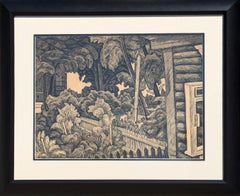
Modern Black and White Abstract Tropical Village Landscape Woodcut Print
Located in Houston, TX
Modern black and white abstract woodcut print. The piece features lush trees and foliage growing in a yard behind a house. There are three central figures standing next to a pole and...
Category

20th Century Abstract Ruth Leaf Figurative Prints

Materials

Woodcut

"When Day is Done, " an Original Etching signed by John Edward Costigan
By John Edward Costigan
Located in Milwaukee, WI
"When Day is Done" is an original etching and aquatint signed lower right in pencil by the artist John Edward Costigan. It depicts a man and a woman with their young child at the end...
Category

1930s Post-Impressionist Ruth Leaf Figurative Prints

Materials

Etching, Aquatint

19th century woodcut engraving print figurative American forest trees scene
By Winslow Homer
Located in Milwaukee, WI
The present woodcut engraving is an original print designed by Winslow Homer, originally published in Harper's Weekly on April 30, 1859. It is an excellent example of the many prints Homer produced of fashionable people engaged in leisurely activities, in this case along a picturesque countryside lane. The sign reading 'Belmont' on the left indicates this is probably near his home in Belmont Massachusetts. The image presents multiple figures, both men and women, riding horseback: Some in the distance gallop away, toward a town marked by a church steeple beyond. Three others in the foreground, including two equestrian women, gather around a group of children who have been gathering flowers and trapping birds...
Category

1850s Victorian Ruth Leaf Figurative Prints

Materials

Woodcut, Engraving

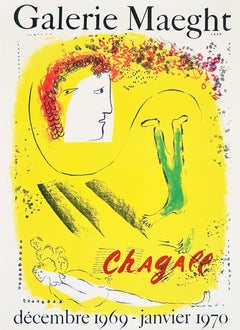
The Yellow Background
By (after) Marc Chagall
Located in Washington, DC
Artist: Marc Chagall (after) Medium: Original lithograph Title: The Yellow Background Year: 1964 Edition: 3,000 Sheet Size: 30 1/2" x 22 1/2" Reference: Chagall's Posters, pg. 56 Sig...
Category

1960s Abstract Impressionist Ruth Leaf Figurative Prints

Materials

Lithograph

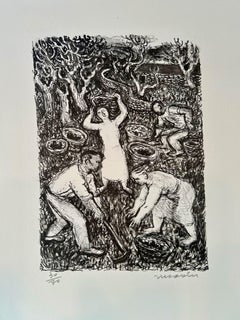
Nature Morte Harvest scene
By Maurice Savin
Located in Belgrade, MT
This lithograph is part of my private collection. It is original and pencil signed an numbered by the artist. It is one of a kind in black and white.
Category

Mid-20th Century Abstract Expressionist Ruth Leaf Figurative Prints

Materials

Engraving, Lithograph

Nature Morte Harvest scene
$320 Sale Price
28% Off
H 10.5 in W 7.5 in
Original Grece (Greece) vintage Greek Tourist Board vintage travel poster
Located in Spokane, WA
Original 1963 Greece Vintage Travel Poster – Greek National Tourist Board – Linen Backed, Grade A- Bring home a piece of mid-century Mediterranean charm with this striking original 1963 Greece vintage travel poster, commissioned by the Greek National Tourist Board. This authentic The artifact captures the sun-drenched beauty of the Greek isles and the enduring charm of traditional Greek seafaring life. This rare poster showcases a beautifully detailed illustration of a classic Greek boat, known as a kaiki (or caique)—a traditional wooden vessel that has sailed the Aegean and Ionian Seas for generations. Featuring its rounded hull, vibrant colors, and billowing sail, the kaiki was a staple of Greek fishing and local trade, embodying the spirit of the archipelago’s maritime culture. Collector Features: • Genuine vintage, not a reproduction • Superb display condition; colors remain vivid and fresh • Linen backing ensures durability and preserves value • A rare example of Greek mid...
Category

1960s Abstract Ruth Leaf Figurative Prints

Materials

Lithograph

Rare 1923 Cubist Reuven Rubin Woodcut Woodblock Print Israeli Hasidic Judaica
By Reuven Rubin
Located in Surfside, FL
This is from the original first edition 1923 printing. there was a much later edition done after these originals. These are individually hand signed in pencil by artist as issued. This listing is for the one print. the other documentation is included here for provenance and is not included in this listing. The various images inspired by the Jewish Mysticism and rabbis and mystics of jerusalem and Kabbalah is holy, dramatic and optimistic Rubin succeeded to evoke the spirit of life in Israel in those early days. They are done in a modern art style influenced by German Expressionism, particularly, Ernst Barlach, Ernst Ludwig Kirchner, and Franz Marc, as introduced to Israel by Jakob Steinhardt, Hermann Struck and Joseph Budko. Reuven Rubin 1893 -1974 was a Romanian-born Israeli painter and Israel's first ambassador to Romania. Rubin Zelicovich (later Reuven Rubin) was born in Galati to a poor Romanian Jewish Hasidic family. He was the eighth of 13 children. In 1912, he left for Ottoman-ruled Palestine to study art at Bezalel Academy of Art and Design in Jerusalem. Finding himself at odds with the artistic views of the Academy's teachers, he left for Paris, France, in 1913 to pursue his studies at the École Nationale Supérieure des Beaux-Arts. He was of the well known Jewish artists in Paris along with Marc Chagall and Chaim Soutine, At the outbreak of World War I, he was returned to Romania, where he spent the war years. In 1921, he traveled to the United States with his friend and fellow artist, Arthur Kolnik. In New York City, the two met artist Alfred Stieglitz, who was instrumental in organizing their first American show at the Anderson Gallery. Following the exhibition, in 1922, they both returned to Europe. In 1923, Rubin emigrated to Mandate Palestine. Rubin met his wife, Esther, in 1928, aboard a passenger ship to Palestine on his return from a show in New York. She was a Bronx girl who had won a trip to Palestine in a Young Judaea competition. He died in 1974. Part of the early generation of artists in Israel, Joseph Zaritsky, Arieh Lubin, Reuven Rubin, Sionah Tagger, Pinchas Litvinovsky, Mordecai Ardon, Yitzhak Katz, and Baruch Agadati; These painters depicted the country’s landscapes in the 1920s rebelled against the Bezalel school of Boris Schatz. They sought current styles in Europe that would help portray their own country’s landscape, in keeping with the spirit of the time. Rubin’s Cezannesque landscapes from the 1920s were defined by both a modern and a naive style, portraying the landscape and inhabitants of Israel in a sensitive fashion. His landscape paintings in particular paid special detail to a spiritual, translucent light. His early work bore the influences of Futurism, Vorticism, Cubism and Surrealism. In Palestine, he became one of the founders of the new Eretz-Yisrael style. Recurring themes in his work were the bible, the prophet, the biblical landscape, folklore and folk art, people, including Yemenite, Hasidic Jews and Arabs. Many of his paintings are sun-bathed depictions of Jerusalem and the Galilee. Rubin might have been influenced by the work of Henri Rousseau whose naice style combined with Eastern nuances, as well as with the neo-Byzantine art to which Rubin had been exposed in his native Romania. In accordance with his integrative style, he signed his works with his first name in Hebrew and his surname in Roman letters. In 1924, he was the first artist to hold a solo exhibition at the Tower of David, in Jerusalem (later exhibited in Tel Aviv at Gymnasia Herzliya). That year he was elected chairman of the Association of Painters and Sculptors of Palestine. From the 1930s onwards, Rubin designed backdrops for Habima Theater, the Ohel Theater and other theaters. His biography, published in 1969, is titled My Life - My Art. He died in Tel Aviv in October 1974, after having bequeathed his home on 14 Bialik Street and a core collection of his paintings to the city of Tel Aviv. The Rubin Museum opened in 1983. The director and curator of the museum is his daughter-in-law, Carmela Rubin. Rubin's paintings are now increasingly sought after. At a Sotheby's auction in New York in 2007, his work accounted for six of the ten top lots. Along with Yaacov Agam and Menashe Kadishman he is among Israel's best known artists internationally. Education 1912 Bezalel Academy of Arts and Design, Jerusalem 1913-14 École des Beaux Arts, Paris and Académie Colarossi, Paris Select Group Exhibitions Eged - Palestine Painters Group Eged - Palestine Painters Group, Allenby Street, Tel Aviv 1929 Artists: Chana Orloff, Abraham Melnikoff, Rubin, Reuven Nahum Gutman, Sionah Tagger,Arieh Allweil, Jewish Artists Association, Levant Fair, Tel Aviv, 1929 Artists: Ludwig Blum,Eliyahu Sigad, Shmuel Ovadyahu, Itzhak Frenel Frenkel,Ozer Shabat, Menahem Shemi, First Exhibition of ''Hever Omanim'' First Exhibition of ''Hever Omanim'' Steimatzky Gallery, Jerusalem 1936 Artists: Gutman, Nachum Holzman, Shimshon Mokady, Moshe Sima, Miron Rubin, Reuven Steinhardt, Jakob Ben Zvi, Zeev Ziffer, Moshe Allweil, Arieh Group Exhibition Group Exhibition Katz Art Gallery, Tel Aviv 1939 Artists: Avni, Aharon Holzman, Shimshon Gliksberg, Haim Gutman, Nachum Ovadyahu, Shmuel Shorr, Zvi Schwartz, Chaya Streichman, Yehezkel Tagger, Sionah Rubin, Reuven A Collection of Works by Artists of the Land of Israel A Collection of Works by Artists of the Land of Israel The Bezalel National Museum, Jerusalem 1940 Artists: Shemi, Menahem Rubin, Reuven Avni, Aharon Mokady, Moshe Jonas, Ludwig Steinhardt, Jakob Ticho, Anna Krakauer, Leopold Gutman, Nachum Budko, Joseph Ardon, Mordecai Sima, Miron Castel, Moshe Pann, Abel Struck, Hermann Gur Arie, Meir Ben Zvi, Zeev Litvinovsky, Pinchas Artists in Israel for the Defense, Tel Aviv Museum of Art, Helena Rubinstein Pavilion, Tel Aviv 1967 Artists: Avraham Binder, Motke Blum, (Mordechai) Samuel Bak, Yosl Bergner, Nahum Gilboa, Jean David, Marcel Janco, Lea Nikel, Jacob Pins, Esther Peretz...
Category

1920s Abstract Ruth Leaf Figurative Prints

Materials

Woodcut

San Marco [Venice].
By William Walcot R. E. Hon. R. I. B. A.
Located in Storrs, CT
William Walcot. R.E., R.I.B.A. San Marco. Etching with drypoint and aquatint. Dickins 66, Harvey-Lee 91. 3 7/8 x 5 7/8 (sheet 9 1/4 x 12 1/8). Venice set, # 2. Edition 415. A rich impression printed on cream wove paper. Fold in the margin, well outside the image; otherwise good condition. Signed in pencil. Housed in a 16 x 20-inch archival mat. Soon after Walcot's arrival in England, the Fine Art Society sponsored a trip sent to Italy. This scene is one of four small drypoints that resulted from the artist’s stay in Venice. When he was seventeen, he began to study architecture under Louis Benois at the Imperial Academy of Art in Saint Petersburg. He went to Paris where he continued his studies at the Ecole des Beaux-Arts and the Atelier Redon. He practiced as an architect briefly in Moscow, designing the Hotel Metropole...
Category

Early 20th Century Modern Ruth Leaf Figurative Prints

Materials

Drypoint, Etching, Aquatint

Previously Available Items
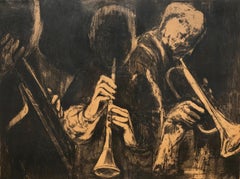
“Trio”
By Ruth Leaf
Located in Southampton, NY
Artist proof intaglio print of a trio of Jazz players by the American printmaker and author, Ruth Leaf. Signed, dated and titled in pencil. Condition: Very good. Provenance: Art-O-Rama, 1965. The artwork is matted and in its original thick mahogany frame with brass front edge. Overall framed 25 by 31.25 inches. Not examined out of frame. Ruth Leaf (1923 - 2015) Ruth Leaf was an American artist and a pioneer in the discipline of printmaking. While also fluent in the methods of linoleum, monotype, collagraph and collage, she is most known for her viscosity etchings...
Category

1960s Post-Modern Ruth Leaf Figurative Prints

Materials

Intaglio, Archival Paper

“Trio”
“Trio”
H 18.5 in W 24.25 in D 2 in
FASCISM and CULTURE
By Ruth Leaf
Located in Santa Monica, CA
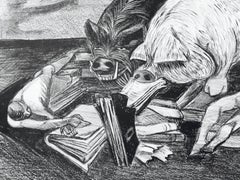
RUTH LEAF (1923 - 2015) FASCISM and CULTURE c. 1950 Lithograph titled and signed in pencil. Unknown edition. 10 3/4 x 15 3/8. Strong polItical print...
Category

1950s American Realist Ruth Leaf Figurative Prints

Materials

Lithograph

Ruth Leaf figurative prints for sale on 1stDibs.

Find a wide variety of authentic Ruth Leaf figurative prints available for sale on 1stDibs. You can also browse by medium to find art by Ruth Leaf in archival paper, intaglio, paper and more. Not every interior allows for large Ruth Leaf figurative prints, so small editions measuring 25 inches across are available. Customers who are interested in this artist might also find the work of James Groleau, Valerio Adami, and Seyed M. S. Edalatpour. Ruth Leaf figurative prints prices can differ depending upon medium, time period and other attributes. On 1stDibs, the price for these items starts at $650 and tops out at $650, while the average work can sell for $650.

Recently Viewed

View All