Sadao Watanabe. Abstract Prints
Japanese, 1913-1998
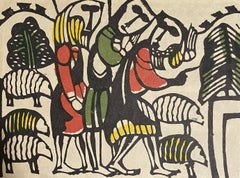
Sadao Watanabe, born in Tokyo in 1913, used the medium called kappazuri ("stencil printing"), a technique related to 'katazome' ("stencil dyeing"). 'Katazome' is said to have originated in Okinawa (the method there was called 'bingata'). The paper most widely used in Japan for stencil printing is called 'shibugami', made from several layers of 'kozo' paper laminated with persimmon tannin. The sheets are dried and smoke-cured to strengthen them and make them flexible and waterproof. Once the artist makes a drawing, it is fixed to the 'shibugami' with a thin adhesive. The basic pattern is then carved into a "key impression" stencil (the equivalent to the keyblock in woodblock printing) called the 'omogata'. If colors will also be used for the final design, separate stencils are sometimes cut for each color. If the stencil pattern has thin lines they can be reinforced with silk gauze, which still allow for uniform printing of colors. The first stage of the printing process involves the application and drying of a dye-resist paste to cover all the portions of the design to be left unprinted by the design. The patterns and colors can then be brushed over the stencil while affecting only those areas without resist paste. Typically the first colors printed are the lighter areas so that darker colors can be overprinted. After all the colors are printed and dried, the key impression stencil is finally used to print the key design over all the previous colors. The dye resist paste is then washed off (called 'mizumoto', "to wash by water") and the paper is dried on a wood board. Watanabe typically printed on a colored ground, so he would first apply a color to the paper.
Watanabe, who was baptized a Christian in 1930, based his designs exclusively on Biblical subjects, though his Christian stories and figures are interpreted through a filter of traditional Japanese techniques and even some older Buddhist figure prints. The folk-art movement in Japan began in the 1930s as an attempt to keep alive various traditional arts, among them stencil printing. Watanabe was an early member of a small but important group of artists who dedicated themselves to learning and preserving these arts. Watanabe's emotioonally moving Biblical prints are have been popular throughout the world, and have been hung in the Vatican, the White House, in museums and in private collections.to
1
1
Overall Width
to
Overall Height
to
1
8
676
213
165
158
1
1
1
1
Artist: Sadao Watanabe.
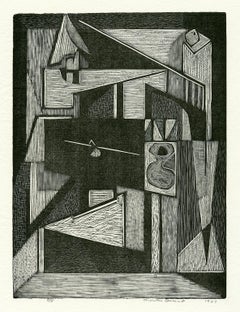
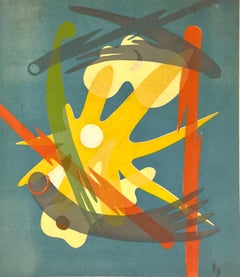
Surreal Composit - Woodcut by Sadao Watanabe - 20th Century
By Sadao Watanabe
Located in Roma, IT
Surreal Composit is an original woodcut, hand colored, on paper realized by Sadao Watanabe for College Women's Association of Japan Student Travel grant fund.
Specially woodcut wit...
Category
20th Century Modern Sadao Watanabe. Abstract Prints
Materials
Woodcut

$498 Sale Price
30% Off
Related Items
Still Life — Mid-century Modern
By Charles Quest
Located in Myrtle Beach, SC
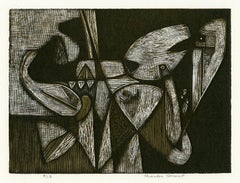
Charles Quest, 'Still Life', 1947, wood engraving, edition 8. Signed, dated, and numbered '3/8' in pencil. Titled and annotated 'wood engraving' in the bottom left margin. A fine impression, on off-white wove paper, with full margins (1 to 2 inches), in excellent condition. Scarce. Matted to museum standards, unframed.
ABOUT THE ARTIST
Charles Quest, painter, printmaker, and fine art instructor, worked in various mediums, including mosaic, stained glass, mural painting, and sculpture. Quest grew up in St. Louis, his talent evident as a teenager when he began copying the works of masters such as Michelangelo on his bedroom walls. He studied at the Washington University School of Fine Arts, where he later taught from 1944 to 1971. He traveled to Europe after his graduation in 1929 and studied at La Grande Chaumière and Academie Colarossi, Paris, continuing to draw inspiration from the works of the Old Masters.
After returning to St. Louis, Quest received several commissions to paint murals in public buildings, schools, and churches, including one from Joseph Cardinal Ritter, to paint a replica of Velasquez's Crucifixion over the main altar of the Old Cathedral in St. Louis. Quest soon became interested in the woodcut medium, which he learned through his study of J. J. Lankes' A Woodcut Manual (1932) and Paul Landacre's articles in American Artist magazine ‘since no artists in St. Louis were working in wood’ at that time. Quest also revealed that for him, wood cutting and engraving were ‘more enjoyable than any other means of expression.’
In the late 1940s, his graphic works began attracting critical attention—several of his woodcuts won prizes and were acquired by major American and European museums. His wood engraving entitled ‘Lovers’ was included in the American Federation of Art's traveling print exhibition in 1947. Two years later, Quest's two prize-winning prints, ‘Still Life with Grindstone’ and ‘Break Forth into Singing’, were exhibited in major American museums in a traveling show organized by the Philadelphia Print Club. His work was included in the Chicago Art Institute's exhibition, ‘Woodcut Through Six Centuries’, and the print ‘Still Life with Vise’ was purchased by the Museum of Modern Art in New York.
In 1951 he was invited by artist-Curator Jacob Kainen to exhibit thirty wood engravings and color woodcuts in a one-person show at the Smithsonian's National Museum (now known as the American History Museum). Kainen's press release praised the ‘technical refinement’ of Quest's work: ‘He obtains a great variety of textural effects through the use of the graver, and these dense or transparent grays are set off against whites or blacks to achieve sparkling results. His work has the handsome qualities characteristic of the craftsman and designer.’
At the time of the Smithsonian exhibition, Quest's work was represented by three New York galleries in addition to one in his home town. He had won 38 prizes, and his prints were in the collections of the Library of Congress, the Chicago Art Institute, the Metropolitan Museum, and the Philadelphia Museum of Art. In cooperation with the Art in Embassies program, his color woodcuts were displayed at the American Embassy in Paris in 1951.
Recognition at home came in 1955 with his first solo exhibition in St. Louis. Press coverage of the show heralded the ‘growth of graphic arts toward rivaling painting and sculpture as a major independent medium’.
An exhibition of his prints at the Bethesda Art Gallery in 1983 attracted Curator Emeritus Joseph A. Haller, S.J., who began purchasing his work for Georgetown University's collection. In 1990 Georgetown University Library's Special Collections Division was the recipient of a large body of Quest's work, including prints, drawings, paintings, sculpture, stained glass, and his archive of correspondence and professional memorabilia. These extensive holdings, including some 260 of his fine prints, provide a rich opportunity for further study and appreciation of this versatile and not-to-be-forgotten mid-Western American artist...
Category
1940s American Modern Sadao Watanabe. Abstract Prints
Materials
Woodcut
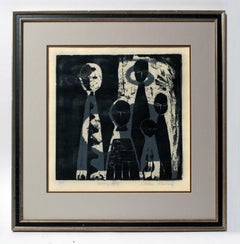
Wedding Party
Located in Buffalo, NY
An original mid century modern woodblock print.
This work is hand signed illegibly and titled "Wedding Party".
Category
1960s Modern Sadao Watanabe. Abstract Prints
Materials
Paper, Woodcut
Underwater — Mid-century Modern
By Charles Quest
Located in Myrtle Beach, SC
Charles Quest, 'Underwater', 1948, chiaroscuro wood engraving, edition 12. Signed, titled, dated and numbered '3/12' in pencil. A fine, richly-inked impression, in dark brown and warm black, on off-white wove paper, with full margins (5/8 to 1 1/2 inch), in excellent condition. Scarce.
ABOUT THE ARTIST
Charles Quest, painter, printmaker, and fine art instructor, worked in various mediums, including mosaic, stained glass, mural painting, and sculpture. Quest grew up in St. Louis, his talent evident as a teenager when he began copying the works of masters such as Michelangelo on his bedroom walls. He studied at the Washington University School of Fine Arts, where he later taught from 1944 to 1971. He traveled to Europe after his graduation in 1929 and studied at La Grande Chaumière and Academie Colarossi, Paris, continuing to draw inspiration from the works of the Old Masters.
After returning to St. Louis, Quest received several commissions to paint murals in public buildings, schools, and churches, including one from Joseph Cardinal Ritter, to paint a replica of Velasquez's Crucifixion over the main altar of the Old Cathedral in St. Louis. Quest soon became interested in the woodcut medium, which he learned through his study of J. J. Lankes' A Woodcut Manual (1932) and Paul Landacre's articles in American Artist magazine ‘since no artists in St. Louis were working in wood’ at that time. Quest also revealed that for him, wood cutting and engraving were ‘more enjoyable than any other means of expression.’
In the late 1940s, his graphic works began attracting critical attention—several of his woodcuts won prizes and were acquired by major American and European museums. His wood engraving entitled ‘Lovers’ was included in the American Federation of Art's traveling print exhibition in 1947. Two years later, Quest's two prize-winning prints, ‘Still Life with Grindstone’ and ‘Break Forth into Singing’, were exhibited in major American museums in a traveling show organized by the Philadelphia Print Club. His work was included in the Chicago Art Institute's exhibition, ‘Woodcut Through Six Centuries’, and the print ‘Still Life with Vise’ was purchased by the Museum of Modern Art in New York.
In 1951 he was invited by artist-Curator Jacob Kainen to exhibit thirty wood engravings and color woodcuts in a one-person show at the Smithsonian's National Museum (now known as the American History Museum). Kainen's press release praised the ‘technical refinement’ of Quest's work: ‘He obtains a great variety of textural effects through the use of the graver, and these dense or transparent grays are set off against whites or blacks to achieve sparkling results. His work has the handsome qualities characteristic of the craftsman and designer.’
At the time of the Smithsonian exhibition, Quest's work was represented by three New York galleries in addition to one in his home town. He had won 38 prizes, and his prints were in the collections of the Library of Congress, the Chicago Art Institute, the Metropolitan Museum, and the Philadelphia Museum of Art. In cooperation with the Art in Embassies program, his color woodcuts were displayed at the American Embassy in Paris in 1951.
Recognition at home came in 1955 with his first solo exhibition in St. Louis. Press coverage of the show heralded the ‘growth of graphic arts toward rivaling painting and sculpture as a major independent medium’.
An exhibition of his prints at the Bethesda Art Gallery in 1983 attracted Curator Emeritus Joseph A. Haller, S.J., who began purchasing his work for Georgetown University's collection. In 1990 Georgetown University Library's Special Collections Division was the recipient of a large body of Quest's work, including prints, drawings, paintings, sculpture, stained glass, and his archive of correspondence and professional memorabilia. These extensive holdings, including some 260 of his fine prints, provide a rich opportunity for further study and appreciation of this versatile and not-to-be-forgotten mid-Western American artist...
Category
1940s American Modern Sadao Watanabe. Abstract Prints
Materials
Woodcut
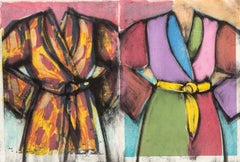
Winter on Cruise
By Jim Dine
Located in New York, NY
A very good impression of this color woodcut and lithograph diptych. Signed and dated in pencil by Dine. From a limited edition of 12.
Category
Early 2000s Modern Sadao Watanabe. Abstract Prints
Materials
Color, Lithograph, Woodcut
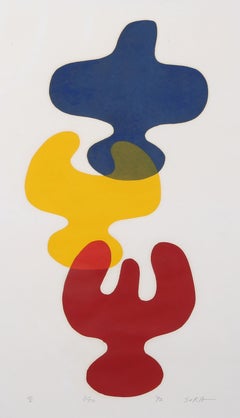
Three Birds, Modern Woodcut by Mitsuaki Sora
By Mitsuaki Sora
Located in Long Island City, NY
Mitsuaki Sora, Japanese (1933 - ) - Three Birds, Year: 1972, Medium: Woodcut, signed, dated and numbered in pencil, Edition: 3/50, Image Size: 30 x 15 inches, Size: 37 x 25 in. ...
Category
1970s Modern Sadao Watanabe. Abstract Prints
Materials
Woodcut
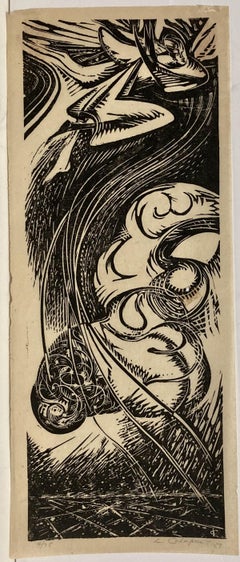
Letterio Calapai, (Sky Abstraction), 1957, mid-century wood engraving
By Letterio Calapai
Located in New York, NY
Letterio Calapai is widely recognized as a major American artist of the twentieth century. He is widely respected as a printmaker, especially for engravings and wood engravings, and ...
Category
1950s American Modern Sadao Watanabe. Abstract Prints
Materials
Woodcut
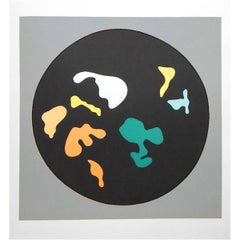
Soleil Recercle
By Hans (Jean) Arp
Located in Missouri, MO
Soleil Recercle
Color woodcut, 1966, on wove,
Signed and Numbered ed. 50
Cat. Rais. Arntz
Sheet Size: approx. 22 x 17.5 inches
Framed Size: approx. 24 x 20 inches
Jean Arp was a p...
Category
1960s Modern Sadao Watanabe. Abstract Prints
Materials
Woodcut
(Abstraction) by DD
Located in New York, NY
This image is an extravaganza of modernist motifs. The monogram 'D.D.' is at the lower right.
Category
Mid-20th Century American Modern Sadao Watanabe. Abstract Prints
Materials
Woodcut
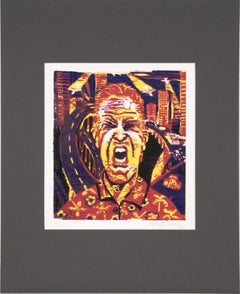
Portrait of Modern Man - Multilayer Woodblock in Ink on Paper
Located in Soquel, CA
Portrait of Anger - Multilayer Woodblock in Ink on Paper
Bold and saturated woodblock print of a screaming man by Michael Dow (American, 20th Century). The man is centered in this m...
Category
1990s American Modern Sadao Watanabe. Abstract Prints
Materials
Paper, Ink, Woodcut
$675
H 20 in W 16 in D 0.25 in
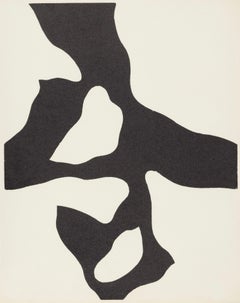
Composition (Arntz 148-175; Hagenbach A 25; Bolliger 54), Dreams and Projects
By Jean Arp
Located in Southampton, NY
Woodcut on vélin d’Arches paper. Inscription: Unsigned and unnumbered, as issued. Good condition. Notes: From the folio, Jean Arp, Dreams and Projects, 1951-1952. Published by Curt V...
Category
1950s Modern Sadao Watanabe. Abstract Prints
Materials
Woodcut
$5,996 Sale Price
20% Off
H 11.25 in W 8.875 in
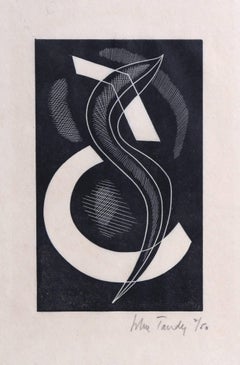
Modern Abstract Minimalist Woodcut Print by John Tandy
By John Tandy
Located in Long Island City, NY
John Tandy, painter and stage designer, studied at the Architectural Association before becoming a student at Leon Underwood's Brook Green school and later studying at the Grosvenor ...
Category
1930s Modern Sadao Watanabe. Abstract Prints
Materials
Woodcut
$760 Sale Price
20% Off
H 11 in W 8 in
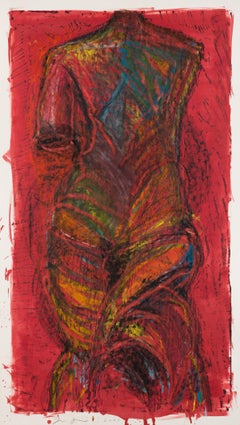
Singing and Printing XIII
By Jim Dine
Located in New York, NY
JIM DINE
Singing and Printing XIII.
Unique color woodblock relief print with hand coloring in oil, acrylic, and charcoal and mechanical abrasion on cream wove paper, 2001.
69 3/4 x ...
Category
Early 2000s Modern Sadao Watanabe. Abstract Prints
Materials
Charcoal, Oil, Acrylic, Color, Woodcut
Previously Available Items
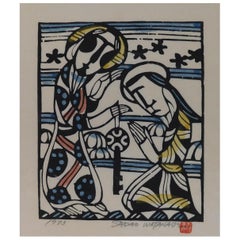
Sadao Watanabe Stencil Print, 1973 - St. Peter and the Key of the Kingdom
By Sadao Watanabe
Located in Phoenix, AZ
Stencil Print by Sadao Watanabe, hand colored on hand-made washi paper.
This image depicts the words in Mathew 16:19 when Christ gives great authority
to Peter saying: I will give yo...
Category
Late 20th Century Sadao Watanabe. Abstract Prints
Materials
Paper
H 13 in W 9 in D 0.07 in
Sadao Watanabe. abstract prints for sale on 1stDibs.
Find a wide variety of authentic Sadao Watanabe. abstract prints available for sale on 1stDibs. You can also browse by medium to find art by Sadao Watanabe. in woodcut print and more. Much of the original work by this artist or collective was created during the 20th century and is mostly associated with the modern style. Not every interior allows for large Sadao Watanabe. abstract prints, so small editions measuring 8 inches across are available. Customers who are interested in this artist might also find the work of Dennis Ray Beall, Terry Leftrook, and Antonio Recalcati. Sadao Watanabe. abstract prints prices can differ depending upon medium, time period and other attributes. On 1stDibs, the price for these items starts at $501 and tops out at $501, while the average work can sell for $501.