Satsuma Antiquities
to
1
1
1
1
1
1
1
19
10
6
4
3
Creator: Satsuma
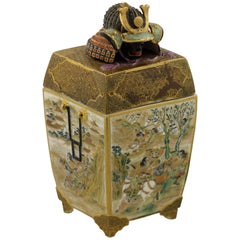
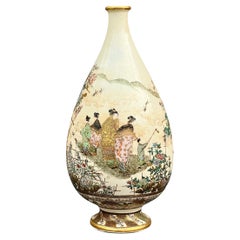
Satsuma Earthenware Vase and Cover, Japanese, Meiji Period
By Satsuma
Located in West Palm Beach, FL
A Satsuma Earthenware vase and cover,
Japanese, Meiji period, (1868-1912)
decorated in polychrome enamels and gilt over a clear, crackled glaze, delicately painted with samurai on ...
Category
1890s Antique Satsuma Antiquities
Materials
Ceramic
Related Items
Japanese Meiji Period (1868-1912) Satsuma Earthenware Vase Taizan for Hattori
Located in Newark, England
Meiji Period (1868-1912)
From our Japanese collection, we are delighted to offer Japanese Meiji Period Satsuma Vases. The Satsuma Vase of hexagonal form with a slight waisted neck and tight rounded rim is extensively decorated with multiple figures to two large scenes. The first scene features a beach with waves to the background and a plethora of figures including multiple geisha holding traditional Japanese wagasa’s. The second scene follows on from the first with a large building in the foreground holding figures on a large platform under a pagoda roof with a pagoda building in the background and further figures in the foreground. The scenes are framed by a full detailed border with gilt shapes, flowers amongst pink shaded backgrounds and butterflies around the neck. The Satsuma Vase is unusually signed Fine Art, Satsuma Ware, Dai Nippon (Great Japan), Hattori Made, Gosuido Works, Taizan Painted. 美術, サツマヤキ(薩摩焼), 大日本, 服部造, 五スイ堂工, 對山画 and dates to the Meiji Period (1868-1912) and the turn of the 20th century circa 1905.
Satsuma ware is a type of earthenware pottery originating from the Satsuma province in Southern Kyushu, Japan’s third largest island.
Wagasa are traditional Japanese umbrellas made of washi paper attached to a bamboo frame and treated to ensure it is waterproof.
Meiji Period was an era of Japanese history that spanned from 1868 to 1912. It was the first half of the Empire of Japan, when the Japanese people began to build a paradigm of a modern, industrialised nation state and emergent great power, influenced by Western countries and aesthetics. As a result of radically different ideas, the changes to Japan were profound and it affected the social structure, politics, economy, military, and foreign relations across the board. The period corresponded to the reign of Emperor Meiji and was preceded by the Keio era and was succeeded by the Taisho era.
Cultural Art during the Meiji Period was of particular interest to the government and they overhauled the art export market which in turn promoted Japanese arts via various world’s fairs, beginning in Vienna at the world fair in 1873. The government heavily funded the fairs and took an active role organising how Japan’s culture was presented to the world including creating a semi-public company named Kiritsu Kosho Kaisha (First Industrial Manufacturing Company). The Kiritsu Kosho Kaisha was used to promote and commercialise exports of Japanese art and established the Hakurankai Jimukyoku (Exhibition Bureau) to maintain quality standards. For the 1876 Centennial International Exhibition in Philadelphia, the Japanese government created a Centennial Office and sent a special envoy to secure space for the 30,000 items that would be displayed. The Imperial Household also took an active interest in arts and crafts, commissioning works by select artists to be given as gifts for foreign dignitaries further emphasising the high quality and importance of Japanese art. Just before the end of the 19th century in 1890, the Teishitsu Gigeiin (Artist to the Imperial Household) system was created to recognise distinguished artists. These artists were selected for their exceptionally high quality wares and talent in their own industry. Over a period of 54 years Seventy artists were appointed, amongst these were ceramicist Makuzu Kozan and cloisonné enamel artist...
Category
Early 1900s Japanese Meiji Antique Satsuma Antiquities
Materials
Earthenware, Pottery


$3,143
H 4.63 in W 2.17 in D 2.37 in
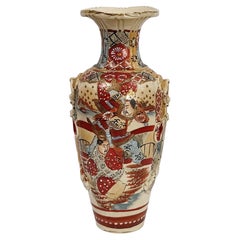
Antique Japanese Satsuma Vase, Hand-Painted Warrior Scene, Meiji-Era Masterpiece
By Satsuma
Located in Bochum, NRW
Antique Japanese Satsuma Vase – Hand-Painted Warrior Scene, Meiji-Era Masterpiece.
Japanese Satsuma ceramic vase with polychrome decorations of Japanese men and soldiers in armor. Go...
Category
1930s Japanese Meiji Vintage Satsuma Antiquities
Materials
Porcelain
$726 Sale Price
20% Off
H 14.57 in Dm 6.3 in
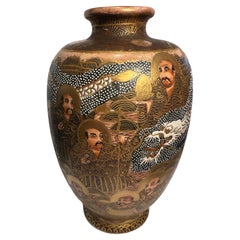
Antique Satsuma One Thousand Faces and Dragon Meiji Period Baluster Shaped Vase
By Satsuma
Located in Tustin, CA
A very exquisite and elaborately detailed collectible antique hand made "A Thousand Faces" Japanese Satsuma earthenware pottery baluster shaped vase features intricately hand painted...
Category
19th Century Japanese Meiji Antique Satsuma Antiquities
Materials
Earthenware, Pottery
$1,595
H 7.25 in Dm 14 in
Japanese Meiji Period (1868-1912) Satsuma Vase by Kinkozan
By Kinkozan
Located in Newark, England
JAPANESE SATSUMA PROCESSIONAL VASE
From our Japanese collection, we are delighted to introduce to the market this Japanese Satsuma Vase by Kinkozan. The vase with a compressed body ...
Category
Late 19th Century Japanese Meiji Antique Satsuma Antiquities
Materials
Ceramic, Earthenware, Pottery

Japanese Meiji Period Satsuma Vase by Ryokuzan
Located in Newark, England
From our Japanese Satsuma Collection, we are delighted to offer this Japanese Satsuma Vase by Ryokuzan 緑山. The Satsuma vase of ovoid shape with a tapered body, circular foot rim, wai...
Category
Early 1900s Japanese Meiji Antique Satsuma Antiquities
Materials
Ceramic, Earthenware, Pottery

Antique Japanese Satsuma Vase – Hand-Painted Meiji-Era Masterpiece
By Satsuma
Located in Bochum, NRW
Antique Japanese Satsuma Vase – Hand-Painted Meiji-Era Masterpiece
Japanese Satsuma ceramic vase with polychrome decorations of Japanese men and soldiers in armor. Golden details. Ja...
Category
1930s Japanese Meiji Vintage Satsuma Antiquities
Materials
Porcelain
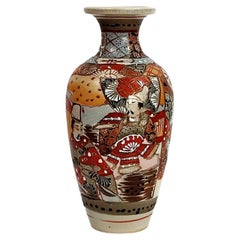
Antique Japanese Meiji Period Satsuma Vase by Ryozan
Located in Newark, England
MEIJI PERIOD 1868-1912
From our Japanese collection, we are delighted to offer this Japanese Satsuma Vase by Ryozan. The vase of tapered form with tightly pinched neck and flared to...
Category
Late 19th Century Japanese Meiji Antique Satsuma Antiquities
Materials
Ceramic, Earthenware, Pottery
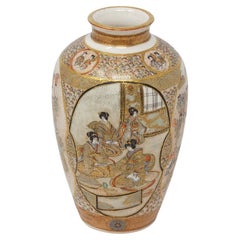
Japanese Meiji Period Satsuma Tripod Censer
Located in New York, NY
Very fine quality Japanese Meiji period Satsuma tripod censer with a foo dog finial.
wonderful painting quality.
Category
Late 19th Century Japanese Meiji Antique Satsuma Antiquities
Materials
Ceramic
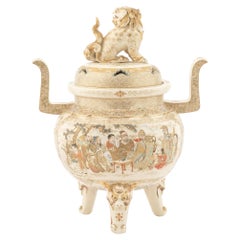
Japanese Antique Earthenware Satsuma Vase by Kinkozan Meiji Period
By Kinkozan
Located in Newark, England
FREE WORLDWIDE SHIPPING
MEIJI PERIOD (1868-1912)
From our Japanese Satsuma collection, we are delighted to present this exceptional Meiji period Satsuma vase by Kinkozan
This tal...
Category
Late 19th Century Japanese Meiji Antique Satsuma Antiquities
Materials
Ceramic, Earthenware, Pottery
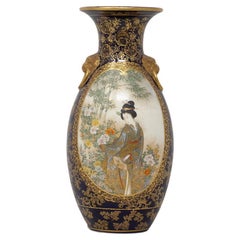
Japanese Antique Meiji Period Satsuma Vase by Kinkozan
By Kinkozan
Located in Newark, England
GLOBULAR FORM MINIATURE VASE
From our Japanese collection, we are delighted to offer this Japanese Satsuma Vase by Kinkozan. The Satsuma Vase made from earthenware pottery is potted...
Category
Early 1900s Japanese Meiji Antique Satsuma Antiquities
Materials
Ceramic, Earthenware, Pottery

Japanese Satsuma Dragon Vase, Meiji Period, c 1900, Japan
By Satsuma
Located in Austin, TX
A fantastic small Japanese Satsuma vase with image of writhing dragons, Meiji Period, circa 1900, Japan.
The vase of elegant baluster form, with a slightly flared foot, slender body...
Category
Early 1900s Japanese Meiji Antique Satsuma Antiquities
Materials
Ceramic, Porcelain, Pottery, Stoneware, Hardwood
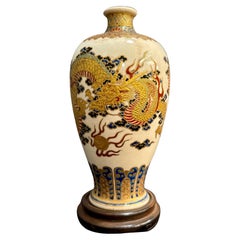
A Fine Japanese Satsuma Vase . Meiji Period. Kinkozan
Located in London, GB
A Fine Japanese Satsuma Vase with Bijin, Peacock, and Chrysanthemums.
Attributed to Kinkozan Workshop, Kyoto, Meiji period (late 19th century)
Of pear-shaped form with a flared f...
Category
19th Century Japanese Antique Satsuma Antiquities
Materials
Ceramic, Porcelain
Previously Available Items
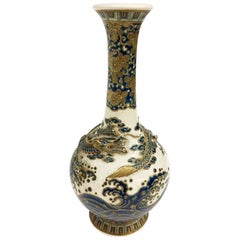
Satsuma Edo Period Gosu Blue Vase with Shimazu Mon Signature
By Satsuma
Located in Delft, NL
Satsuma Edo period Gosu blue vase with Shimazu Mon signature
With high relief water dragon wraps around the vase
Gosu blue is a glaze enamel on Satsuma "...
Category
19th Century Japanese Antique Satsuma Antiquities
Materials
Earthenware
Satsuma antiquities for sale on 1stDibs.
Satsuma antiquities are available for sale on 1stDibs. These distinctive items are frequently made of ceramic and are designed with extraordinary care. There are many options to choose from in our collection of Satsuma antiquities, although brown editions of this piece are particularly popular. Prices for Satsuma antiquities can differ depending upon size, time period and other attributes — on 1stDibs, these items begin at $4,500 and can go as high as $4,500, while a piece like these, on average, fetch $4,500.
Questions About Satsuma Antiquities
- 1stDibs ExpertApril 5, 2022Satsuma porcelain or pottery includes a maker’s mark with the name of the person who made the item. Japanese numbers may also indicate that a Satsuma piece was part of a collection. Genuine Satsuma pieces will not have a “Made in Japan” label and should only include Japanese characters. When in doubt, work with a certified appraiser to determine the authenticity of your Satsuma piece. Find a variety of expertly vetted Satsuma porcelain and pottery collectibles on 1stDibs.
- Is Satsuma pottery valuable?1 Answer1stDibs ExpertApril 26, 2024Yes, some Satsuma pottery is valuable. The age, type, style and condition will determine how much a particular piece is worth. In addition, the history of ownership may also make a piece more valuable. For example, if a piece was previously in the collection of a notable person, such as a member of the Japanese Imperial Family, it may be worth more. To get an estimated value for a particular piece, consult a certified appraiser or knowledgeable antiques dealer. Find a range of Satsuma pottery on 1stDibs.
- What is a Japanese Satsuma vase?1 Answer1stDibs ExpertOctober 12, 2021A type of Japanese pottery originated from Satsuma province in Japan is termed as Satsuma ware. A vase of this kind is known as a Satsuma vase. An interesting fact about Satsuma ware is that they feature a "makers mark" or marking as a key to help collectors unlock the value, age and authenticity of the piece. Shop a range of antique and vintage Japanese vases on 1stDibs.
- How do I date a Satsuma vase?1 Answer1stDibs ExpertMarch 22, 2022To date a Satsuma vase, study its mark. Vases made before World War II normally feature a mark in Japanese. A vase that says "Royal Satsuma" likely dates back to the late 20th century. You'll find a variety of expertly vetted Satsuma vases on 1stDibs.
- 1stDibs ExpertOctober 7, 2024The difference between Satsuma and moriage is that the former is a type of pottery, and the latter is a technique for decorating pottery. Satsuma pottery is the term for earthenware pottery from Japan's Satsuma region. Although there are different styles, the most common element of Satsuma pottery is a heavy, dark glaze. Moriage is the term for when potters add raised slip decorations to pottery, creating a three-dimensional effect. Some Satsuma pieces show off moriage details, while others do not. Shop a range of Satsuma pottery on 1stDibs.
- 1stDibs ExpertNovember 4, 2024To identify Satsuma pottery marks, you'll typically need to perform research using trusted online resources. Satsuma is a region in Japan known for its pottery, and many factories and artisans have operated there, including Kinkozan, Taizan, Yasuda, Choshuzan, Fuzan, Gyozan, Koshida and Maruni Kobe. Each maker has its own marks associated with it, and these typically are in Japanese kanji characters. You can compare the characters on your piece to pictures shared online to find a match. Alternatively, a certified appraiser or experienced antique dealer can help you identify your pottery markings. On 1stDibs, shop a selection of Satsuma pottery.
- 1stDibs ExpertSeptember 9, 2024Yes, some Satsuma pottery is worth something. Depending on their age, maker, type, style, condition and other factors, pieces may sell for a few hundred to several thousand dollars. Looking at sales and auction histories can give you a rough idea of the value of a piece. For a more definitive valuation, use the services of a certified appraiser or knowledgeable antique dealer. On 1stDibs, explore a collection of Satsuma pottery.
- 1stDibs ExpertFebruary 1, 2024One way to tell if your Satsuma vase is valuable is to look for markings on it. The oldest and typically most expensive pieces will usually have the Shimazu family crest — a circle with a cross through it — hand-painted on the bottom. If the piece is stamped with the marking or says "Made in Japan" in the Roman alphabet, it is a newer vase. Factors like the style of the vase and its condition will also impact its price. It's a good idea to have a certified appraiser or knowledgeable dealer evaluate your vase to determine its value. Find a variety of Satsuma vases on 1stDibs.