Shibayama Factory Furniture
to
1
1
1
1
1
1
1
1
1
1
1
1
12,448
3,850
2,368
2,228
Creator: Shibayama Factory
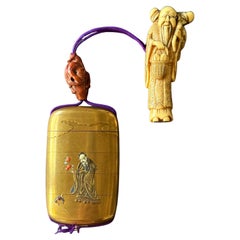
Fine Japanese Inro with Maki-e and Inlay by Shokasai and Shibayama
By Shibayama Factory
Located in Atlanta, GA
A Japanese four-case inro stringed together with a silk cord of a carved wood Ojime and a carved ivory netsuke circa 19th century of Edo period. This fine piece was made in collabora...
Category
19th Century Japanese Edo Antique Shibayama Factory Furniture
Materials
Wood, Lacquer
Related Items
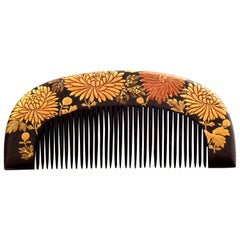
Japanese Antique Lacquer Hair Comb with Flowers in Gold Maki-e
Located in New York, NY
Stunning antique Japanese lacquer hair comb with a geometric petal-like background of stylized chrysanthemums and flowers done in gold and red maki-e. Possibly Edo or Meiji time peri...
Category
Mid-19th Century Japanese Antique Shibayama Factory Furniture
Materials
Giltwood, Lacquer

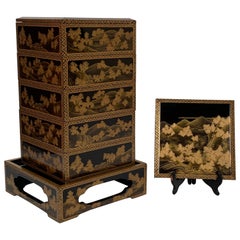
Japanese Maki-e Lacquer Stacking Box, Jubako, Meiji Period, Japan
Located in Austin, TX
A fine and impressive Japanese gold maki-e decorated black lacquer five-tier jubako with presentation tray, two lids, and the original tomobako storage box, Meiji period, late 19th c...
Category
Late 19th Century Japanese Meiji Antique Shibayama Factory Furniture
Materials
Lacquer
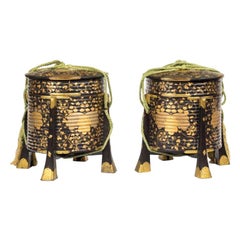
Pair of Edo Period Black and Gold Lacquer Samurai Helmet Boxes
Located in Lymington, Hampshire
A pair of Edo period black and gold lacquer Samurai helmet boxes (Hakko Bako), each of ribbed cylindrical form with a lid, a black lacquer interior,...
Category
19th Century Japanese Edo Antique Shibayama Factory Furniture
Materials
Lacquer
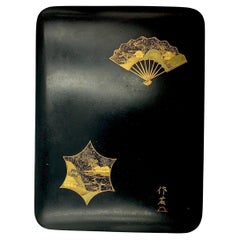
Japanese Meiji Period Antique Lacquer Box with Gold Maki-e Decoration
Located in New York, NY
A fine antique Japanese Meji Period lacquer box decorated with a fan and a stylized star shaped window in the maki-e technique. The fan at the top right corner, fully opened depictin...
Category
19th Century Japanese Meiji Antique Shibayama Factory Furniture
Materials
Lacquer
$1,700
H 4.5 in W 3.25 in D 1.88 in
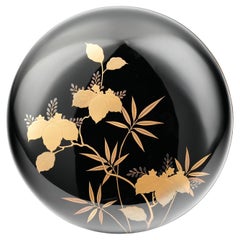
Antique Japanese Maki-e Lacquer Candy Dish with Paulownia and Bamboo Design
Located in Taichung, TW
This antique kashiki candy dish features a refined design of paulownia and bamboo executed in fine gold maki-e over a deep black lacquer ground. The paulownia is associated with puri...
Category
Late 19th Century Japanese Taisho Antique Shibayama Factory Furniture
Materials
Lacquer
$1,900
H 3.94 in W 4.26 in D 4.26 in
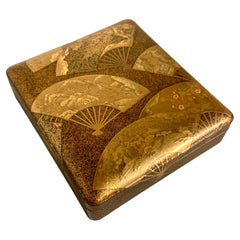
Japanese Maki-e Lacquer Document Box, Edo Period, early 19th Century, Japan
Located in Austin, TX
A spectacular Japanese maki-e lacquer lidded box, possibly a writing box, suzuribako, decorated with images of folding fans, ogi, Edo Period, earl...
Category
Early 19th Century Japanese Edo Antique Shibayama Factory Furniture
Materials
Coral
$12,000
H 2.5 in W 9 in D 10 in
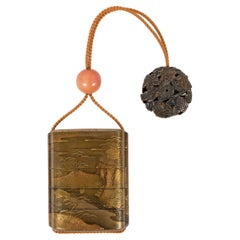
Japanese inro of the edo period adorned with a landscape houses near a lake
Located in PARIS, FR
Inrō with four gold lacquer compartments, decorated with a lake landscape. Accompanied by a bronze ryusa manju.
Small boxes formed of compartments that fit one on top of the other, i...
Category
Late 18th Century Japanese Edo Antique Shibayama Factory Furniture
Materials
Gold
$6,526
H 2.6 in W 2.17 in D 0.79 in
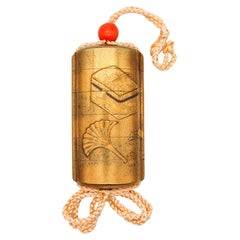
Japan 1800 Edo Period Six Drawer Inro In Lacquered Gilt Wood With Utensils
Located in Miami, FL
Japanese Inro from the Edo Period (1603-1867).
Beautiful Inro, created in Japan during the Edo period (Shogunate), circa 1800. It was carefully crafted in carved precious wood with ...
Category
Early 1800s Japanese Edo Antique Shibayama Factory Furniture
Materials
Coral
$2,600 Sale Price
20% Off
H 3.93 in W 1.96 in D 1.06 in
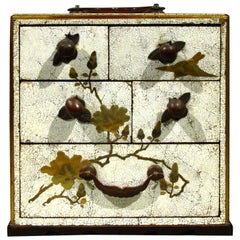
Signed Japanese White Lacquer and Maki-E Lacquer Tansu, Meiji Period
Located in Ottawa, Ontario
The case decorated overall in crackle-glaze white lacquer and fitted with a patinated metal carrying handle over three tiers of small drawers. The first two tiers are comprised of a ...
Category
Late 19th Century Japanese Meiji Antique Shibayama Factory Furniture
Materials
Lacquer
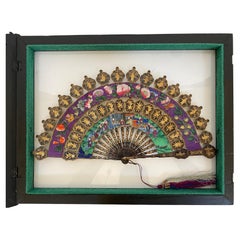
19th Century Chinese Lacquered and Giltwood Frame Fan
Located in Brea, CA
19th century Chinese lacquered and giltwood frame fan with chinoiserie decoration double leaf depicting Chinese daily scenes, animals and flowers with origi...
Category
Early 19th Century Chinese Qing Antique Shibayama Factory Furniture
Materials
Lacquer
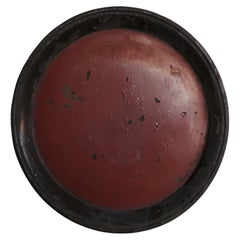
Old Round Plate with Japanese Lacquer / Meiji-Taisho / Urushi
Located in Sammu-shi, Chiba
A wooden vessel used from the Meiji era to the Taisho era.
Probably a beech tree.
It is made by hollowing out.
It's very cool, isn't it?
It is a lacquered tall foot round tray made ...
Category
Mid-20th Century Japanese Taisho Shibayama Factory Furniture
Materials
Beech, Lacquer
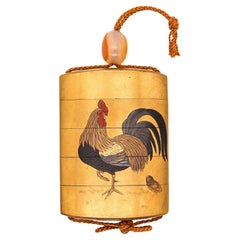
Japan 1810 Kajikawa Edo Period Five Drawer Inro Lacquered Gilt Wood With Rooster
Located in Miami, FL
Japanese Inro from the Edo period (1615-1868) created by Kajikawa.
Beautiful Inro, created in Japan by one of the Kajikawa family during the Edo period (1615-1868), circa 1810. Has been carefully crafted in carved precious wood with applications of gilding maki-e and decorated with Japonism patterns. All dan trays are attached together with a himo cord. The detailed craftsmanship was a true pleasure to behold.
Period: Edo period (1615-1868). Shogunate.
Approximate Date: 1790-1810
Motif: A family of birds consisting of a cockerel, the hen and three chicks.
Drawers: Five.
Shape: Rectangular navette.
Technique: Carved wood, lacquer and decorated in iroe-hiramaki-e on a gold ground.
Ojime: 15mm 20mm, oval carved from natural translucent agate.
Netsuke: None
Weight: 47.70 Grams.
Measurements: Inro is 78 mm by 55 mm by 18 mm (3.07 x 2.17 x 0.71 Inches).
Signatures: Kajikawa Saku, in the underside with the signature KAJIKAWA. By a member of the Kajikawa family, signed Kajikawa 梶川 Japan, late 18th century to early 19th century, Edo period (1615-1868).
The Kajikawa family
Kajikawa family, flourished in the 19th century, they was Japanese lacquerware artists whose school in Edo (now Tokyo) flourished for more than 200 years. This family is perhaps the most famous of all the dynasties of Japanese lacquer artists, and certainly the name most often found on inro. The family is said to have been founded by Hikobei at Edo in the early 17th century, although some claim that the family’s great reputation really stemmed from his son and pupil Kyujiro. In any event, Hikobei worked for the shogunate, as did his successors until well into the 19th century. Kijirō excelled in designing particularly delicate lacquer inrō, portable medicine cases...
Category
1810s Japanese Edo Antique Shibayama Factory Furniture
Materials
Agate, Gold
$3,560 Sale Price
20% Off
H 3.07 in W 2.17 in D 0.71 in
Previously Available Items
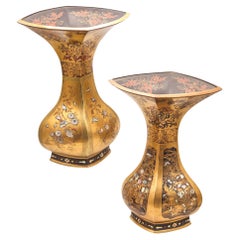
SHIBAYAMA Meiji 1880 Imperial Japan Pair Of Lacquered-Gilded Vases With Carvings
By Shibayama Factory
Located in Miami, FL
Pair of Shibayama imperial vases from the Japan Meiji period (1858-1912) .
This is a gorgeous pair of vases created in the Meiji period during the imperial Japan, back the the late 19th century. The vases are magnificent with very unusual tulips shape and very rare to see as a pair. They were masterfully crafted in gilded, silvered and lacquered wood, with rich Shibayama panels and intricate applications of inlaid carvings. They are exceptional quality and great condition with no missing parts.
Materials: Wood, gilt, silver, gold, carved nacre, carved abalone, carved agates, carved coral, black lacquer and red lacquer.
Gemstones: Decorated with two panels mounted with intricate scenes in the shibayama technique with carvings of jade, carnelian, agate, corals and nacre of different colors.
Techniques: Shibayama; Maki-e and Ramae.
Weight: The pair together is 920.95 Grams, (0.93 Kg).
Measurements: Each one is 255 mm by 185 mm by 159 mm (10.05 x 7.3 x 6.25 Inches).
Shibayama
The art form known as shibayama is named after the Shibayama area of present-day Chiba prefecture. The shibayama technique was created by Ōnoki Senzō, an Edo haberdasher who lived during the An’ei era (1772–1781). His style of inlaying became so popular that he named works done with the inlay technique after his hometown of Shibayama and later also adopted this name as his surname. Shibayama refers to the intricate carving and minute encrustation of various materials on to a ground material. The inlay typically consists of mother-of-pearl, ivory, tortoiseshell and coral, the combination creating a delightful contrast of colors and textures.
Meiji period
Is an era of Japanese history that extended from October 23, 1868 to July 30, 1912.The Meiji era was the first half of the Empire of Japan, when the Japanese people moved from being an isolated feudal society at risk of colonization by Western powers to the new paradigm of a modern, industrialized nation state and emergent great power, influenced by Western scientific, technological, philosophical, political, legal, and aesthetic ideas. As a result of such wholesale adoption of radically different ideas, the changes to Japan were profound, and affected its social structure, internal politics, economy, military, and foreign relations. The period corresponded to the reign of Emperor Meiji. It was preceded by the Keiō era and was succeeded by the Taishō era, upon the accession of Emperor Taishō.
Provenance: The Flying Cranes gallery, 1998 New York NY. Objets D'art Gallery, Kensington, MD.
Condition: The overall condition of these Japanese Shibayama vases...
Category
1880s Japanese Meiji Antique Shibayama Factory Furniture
Materials
Multi-gemstone, Gold, Silver
H 10.05 in W 7.3 in D 6.25 in
Shibayama Factory furniture for sale on 1stDibs.
Shibayama Factory furniture are available for sale on 1stDibs. These distinctive items are frequently made of bamboo and are designed with extraordinary care. Prices for Shibayama Factory furniture can differ depending upon size, time period and other attributes — on 1stDibs, these items begin at $1,600 and can go as high as $1,600, while a piece like these, on average, fetch $1,600.