Sunol Alvar Nude Prints
to
1
Overall Width
to
Overall Height
to
1
8
93
62
56
56
1
1
1
1
1
Artist: Sunol Alvar
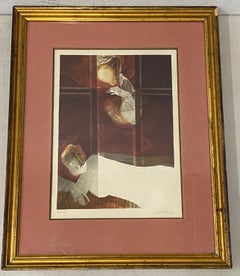
Alvar Sunol Embossed Figural Abstract Nude Lithograph C.1978
By Sunol Alvar
Located in San Francisco, CA
Alvar Sunol Embossed Figural Abstract Nude Lithograph C.1978
Number 46 from an edition of 100
Dimensions 12" x 16.5"
The frame measures 22" x 27.5"
The frame shows a chip at one...
Category
Mid-20th Century Abstract Sunol Alvar Nude Prints
Materials
Lithograph
Related Items
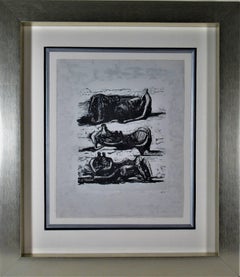
Three Reclining Figures
By Henry Moore
Located in San Francisco, CA
Artist: Henry Moore (British, 1898-1986)
Title: Three Reclining Figures
Year: 1976
Medium: Color lithograph
Edition: 110
Paper: Arches
I...
Category
1970s Abstract Sunol Alvar Nude Prints
Materials
Lithograph

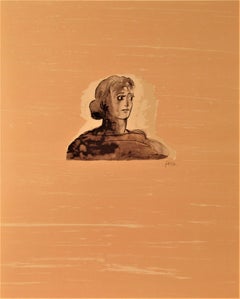
Dame Creole
By Henry Moore
Located in San Francisco, CA
Artist: Henry Moore (British, 1898-1986)
Title: Dame Creole
Year: 1976
Medium: Color lithograph
Edition: 110
Paper: Arches
Image size: 18.5 x 15 inches
paper size: 18.5 x 15 i...
Category
1970s Abstract Sunol Alvar Nude Prints
Materials
Lithograph
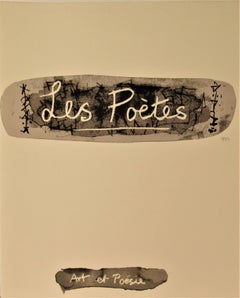
Les Poetes, La Poesie, Front Page
By Henry Moore
Located in San Francisco, CA
Artist: Henry Moore (British, 1898-1986)
Title: Les Poetes, La Poesie, Front Page
Year: 1976
Medium: Color lithograph
Edition: 110
Paper: Arches
Paper...
Category
1970s Abstract Sunol Alvar Nude Prints
Materials
Lithograph
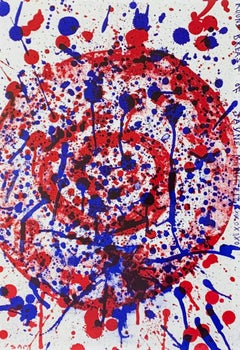
Sam Francis Round Breast of Jane Mansfield
By Sam Francis
Located in Washington, DC
Artist: Sam Francis
Medium: Lithograph
Title: Round Breast of Jayne Mansfield
Portfolio: 1964 1¢ Life
Year: 1964
Edition: 2000
Framed Size: 21 1/4" x 16 1/4"
Sheet Size: 16 1/8" x 11...
Category
1960s Sunol Alvar Nude Prints
Materials
Lithograph
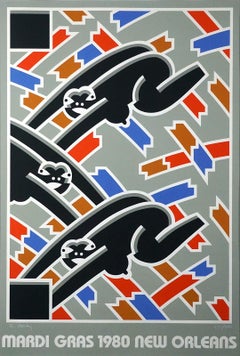
Mardi Gras 1980 New Orleans (playful forms cavorting in the carnival fun)
By Robert Gordy
Located in New Orleans, LA
"Mardi Gras 1980, New Orleans", shows playful forms cavorting in the carnival celebration. It is signed in the lower left, and stamped/numbered "671/850" in the lower right corner. ...
Category
20th Century Abstract Geometric Sunol Alvar Nude Prints
Materials
Screen
$187 Sale Price
25% Off
H 31 in W 21 in
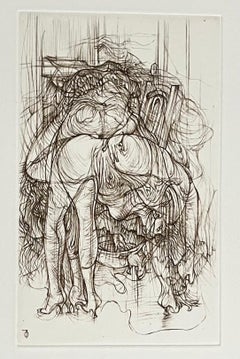
German Surrealist Hans Bellmer Etching Engraving Print Cecile Reims Surrealism
By Hans Bellmer
Located in Surfside, FL
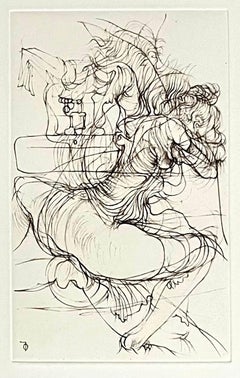
After Hans Bellmer (German, 1902-1975)
Surrealist engraving, etching
after drawings from a 1942 notebook,
engraved in 1974-75 by Cecile Reims
Printed by L'Atelier de Chalcographie du Louvre, Paris,
Having printed monogram lower left in plate, pencil notations and #7/10 and 'Musee du Louvre' blindstamp verso
Dimensions: Sheet 11 X 7.5, Plate size 6.5 X 4
Hans Bellmer ( 1902 – 1975) was a Polish born German artist, best known for his drawings, etchings that illustrates the 1940 edition of Histoire de l’œil, and the life-sized female sculpture mannequin dolls he produced in the mid-1930s. Historians of art and photography also consider him a Surrealist photographer.
Bellmer was born in the city of Kattowitz, then part of the German Empire (now Katowice, Poland). Up until 1926, he worked as a draftsman for his own advertising company.
Bellmer is most famous for the creation of a series of dolls as well as photographs of them. He was influenced in his choice of art form in part by reading the published letters of Oskar Kokoschka (Der Fetisch, 1925) and Surrealism. Bellmer's puppet doll project is also said to have been catalysed by a series of events in his personal life.
Hans Bellmer takes credit for provoking a physical crisis in his father and brings his own artistic creativity into association with childhood insubordination and resentment toward a severe and humorless paternal authority. Perhaps this is one reason for the nearly universal, unquestioning acceptance in the literature of Bellmer's promotion of his art as a struggle against his father, the police, and ultimately, fascism and the state. Events of his personal life also including meeting a beautiful teenage cousin in 1932 (and perhaps other unattainable beauties), attending a performance of Jacques Offenbach's Tales of Hoffmann (in which a man falls tragically in love with an automaton), and receiving a box of his old toys. After these events, he began to actually construct his first dolls. In his works, Bellmer explicitly sexualized the doll as a young girl (his work bears connection to the works of Bathus). Hirschfeld has claimed (without further argumentation) that Bellmer initiated his doll project to oppose the fascism of the Nazi Party by declaring that he would make no work that would support the new German state. Represented by mutated forms and unconventional poses, his dolls (according to this view) were directed specifically at the cult of the perfect body then prominent in Germany.
He visited Paris in 1935 and made contacts there, such as Paul Éluard, but returned to Berlin because his wife Margarete was dying of tuberculosis. He was part of the circle of Surrealist luminaries such as Man Ray, Marcel Duchamp, Max Ernst, Joan Miro, André Masson, René Magritte, Alberto Giacometti and Salvador Dali as well as women artists—such as Frida Kahlo, Dorothea Tanning and Leonora Carrington.
Bellmer produced the first doll in Berlin in 1933. Long since lost, the assemblage can nevertheless be correctly described thanks to approximately two dozen photographs Bellmer took at the time of its construction. Standing about fifty-six inches tall, the doll consisted of a modeled torso made of flax fiber, glue, and plaster; a mask-like head of the same material with glass eyes and a long, unkempt wig; and a pair of legs made from broomsticks or dowel rods. One of these legs terminated in a wooden, club-like foot; the other was encased in a more naturalistic plaster shell, jointed at the knee and ankle. As the project progressed, Bellmer made a second set of hollow plaster legs, with wooden ball joints for the doll's hips and knees. There were no arms to the first sculpture, but Bellmer did fashion or find a single wooden hand, which appears among the assortment of doll parts the artist documented in an untitled photograph of 1934, as well as in several photographs of later work.
Bellmer's 1934 anonymous book, The Doll (Die Puppe), produced and published privately in Germany, contains 10 black-and-white photographs of Bellmer's first doll arranged in a series of "tableaux vivants" (living pictures). The book was not credited to him, as he worked in isolation, and his photographs remained almost unknown in Germany. Yet Bellmer's work was eventually declared "degenerate" (entartete kunst) by the Nazi Party, and he was forced to flee Germany to France in 1938, where Bellmer's work was welcomed by the Surrealists around Andre Breton.
He aided the French Resistance during the war by making fake passports. He was imprisoned in the Camp des Milles prison at Aix-en-Provence, a brickworks camp for German nationals, from September 1939 until the end of the Phoney War in May 1940.
After the war, Bellmer lived the rest of his life in Paris. Bellmer gave up doll-making and spent the following decades creating erotic drawings, etchings, sexually explicit photographs, paintings, and prints of pubescent girls. In 1954, he met Unica Zürn...
Category
20th Century Sunol Alvar Nude Prints
Materials
Etching
André Masson - Original Lithograph
By André Masson
Located in Collonge Bellerive, Geneve, CH
Maurice Estève - Composition
Original Lithograph
1964
Dimensions: 32 x 25 cm
Revue XXe Siècle
Cahiers d'art published under the direction of G. di San Lazzaro.
French painter born...
Category
1960s Abstract Expressionist Sunol Alvar Nude Prints
Materials
Lithograph

German Surrealist Hans Bellmer Etching Engraving Print Cecile Reims Surrealism
By Hans Bellmer
Located in Surfside, FL
After Hans Bellmer (German, 1902-1975)
Surrealist engraving, etching
after drawings from a 1942 notebook,
engraved in 1974-75 by Cecile Reims
Printed by L'Atelier de Chalcographie du Louvre, Paris,
Having printed monogram lower left in plate, pencil notations and #7/10 and 'Musee du Louvre' blindstamp verso
Dimensions: Sheet 11 X 7.5, Plate size 6.5 X 4
Hans Bellmer ( 1902 – 1975) was a Polish born German artist, best known for his drawings, etchings that illustrates the 1940 edition of Histoire de l’œil, and the life-sized female sculpture mannequin dolls he produced in the mid-1930s. Historians of art and photography also consider him a Surrealist photographer.
Bellmer was born in the city of Kattowitz, then part of the German Empire (now Katowice, Poland). Up until 1926, he worked as a draftsman for his own advertising company.
Bellmer is most famous for the creation of a series of dolls as well as photographs of them. He was influenced in his choice of art form in part by reading the published letters of Oskar Kokoschka (Der Fetisch, 1925) and Surrealism. Bellmer's puppet doll project is also said to have been catalysed by a series of events in his personal life.
Hans Bellmer takes credit for provoking a physical crisis in his father and brings his own artistic creativity into association with childhood insubordination and resentment toward a severe and humorless paternal authority. Perhaps this is one reason for the nearly universal, unquestioning acceptance in the literature of Bellmer's promotion of his art as a struggle against his father, the police, and ultimately, fascism and the state. Events of his personal life also including meeting a beautiful teenage cousin in 1932 (and perhaps other unattainable beauties), attending a performance of Jacques Offenbach's Tales of Hoffmann (in which a man falls tragically in love with an automaton), and receiving a box of his old toys. After these events, he began to actually construct his first dolls. In his works, Bellmer explicitly sexualized the doll as a young girl (his work bears connection to the works of Bathus). Hirschfeld has claimed (without further argumentation) that Bellmer initiated his doll project to oppose the fascism of the Nazi Party by declaring that he would make no work that would support the new German state. Represented by mutated forms and unconventional poses, his dolls (according to this view) were directed specifically at the cult of the perfect body then prominent in Germany.
He visited Paris in 1935 and made contacts there, such as Paul Éluard, but returned to Berlin because his wife Margarete was dying of tuberculosis. He was part of the circle of Surrealist luminaries such as Man Ray, Marcel Duchamp, Max Ernst, Joan Miro, André Masson, René Magritte, Alberto Giacometti and Salvador Dali as well as women artists—such as Frida Kahlo, Dorothea Tanning and Leonora Carrington.
Bellmer produced the first doll in Berlin in 1933. Long since lost, the assemblage can nevertheless be correctly described thanks to approximately two dozen photographs Bellmer took at the time of its construction. Standing about fifty-six inches tall, the doll consisted of a modeled torso made of flax fiber, glue, and plaster; a mask-like head of the same material with glass eyes and a long, unkempt wig; and a pair of legs made from broomsticks or dowel rods. One of these legs terminated in a wooden, club-like foot; the other was encased in a more naturalistic plaster shell, jointed at the knee and ankle. As the project progressed, Bellmer made a second set of hollow plaster legs, with wooden ball joints for the doll's hips and knees. There were no arms to the first sculpture, but Bellmer did fashion or find a single wooden hand, which appears among the assortment of doll parts the artist documented in an untitled photograph of 1934, as well as in several photographs of later work.
Bellmer's 1934 anonymous book, The Doll (Die Puppe), produced and published privately in Germany, contains 10 black-and-white photographs of Bellmer's first doll arranged in a series of "tableaux vivants" (living pictures). The book was not credited to him, as he worked in isolation, and his photographs remained almost unknown in Germany. Yet Bellmer's work was eventually declared "degenerate" (entartete kunst) by the Nazi Party, and he was forced to flee Germany to France in 1938, where Bellmer's work was welcomed by the Surrealists around Andre Breton.
He aided the French Resistance during the war by making fake passports. He was imprisoned in the Camp des Milles prison at Aix-en-Provence, a brickworks camp for German nationals, from September 1939 until the end of the Phoney War in May 1940.
After the war, Bellmer lived the rest of his life in Paris. Bellmer gave up doll-making and spent the following decades creating erotic drawings, etchings, sexually explicit photographs, paintings, and prints of pubescent girls. In 1954, he met Unica Zürn...
Category
20th Century Sunol Alvar Nude Prints
Materials
Etching
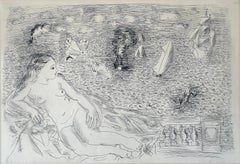
Nude on Balcony
By Raoul Dufy
Located in Wilton Manors, FL
Raoul Dufy (1877-1953).
Nude Figure on a Balcony.
Etching, plate measuring 13 x 18 inches; frame measurement 22 x 28 inches.
Edition authorized by Louvre Museum, Paris.
Vinta...
Category
Mid-20th Century Abstract Sunol Alvar Nude Prints
Materials
Etching
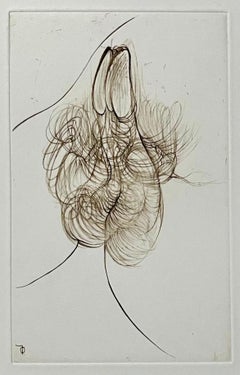
German Surrealist Hans Bellmer Etching Engraving Print Cecile Reims Surrealism
By Hans Bellmer
Located in Surfside, FL
After Hans Bellmer (German, 1902-1975)
Surrealist engraving, etching
after drawings from a 1942 notebook,
engraved in 1974-75 by Cecile Reims
Printed by L'Atelier de Chalcographie du Louvre, Paris,
Having printed monogram lower left in plate, pencil notations and #7/10 and 'Musee du Louvre' blindstamp verso
Dimensions: Sheet 11 X 7.5, Plate size 6.5 X 4
Hans Bellmer ( 1902 – 1975) was a Polish born German artist, best known for his drawings, etchings that illustrates the 1940 edition of Histoire de l’œil, and the life-sized female sculpture mannequin dolls he produced in the mid-1930s. Historians of art and photography also consider him a Surrealist photographer.
Bellmer was born in the city of Kattowitz, then part of the German Empire (now Katowice, Poland). Up until 1926, he worked as a draftsman for his own advertising company.
Bellmer is most famous for the creation of a series of dolls as well as photographs of them. He was influenced in his choice of art form in part by reading the published letters of Oskar Kokoschka (Der Fetisch, 1925) and Surrealism. Bellmer's puppet doll project is also said to have been catalysed by a series of events in his personal life.
Hans Bellmer takes credit for provoking a physical crisis in his father and brings his own artistic creativity into association with childhood insubordination and resentment toward a severe and humorless paternal authority. Perhaps this is one reason for the nearly universal, unquestioning acceptance in the literature of Bellmer's promotion of his art as a struggle against his father, the police, and ultimately, fascism and the state. Events of his personal life also including meeting a beautiful teenage cousin in 1932 (and perhaps other unattainable beauties), attending a performance of Jacques Offenbach's Tales of Hoffmann (in which a man falls tragically in love with an automaton), and receiving a box of his old toys. After these events, he began to actually construct his first dolls. In his works, Bellmer explicitly sexualized the doll as a young girl (his work bears connection to the works of Bathus). Hirschfeld has claimed (without further argumentation) that Bellmer initiated his doll project to oppose the fascism of the Nazi Party by declaring that he would make no work that would support the new German state. Represented by mutated forms and unconventional poses, his dolls (according to this view) were directed specifically at the cult of the perfect body then prominent in Germany.
He visited Paris in 1935 and made contacts there, such as Paul Éluard, but returned to Berlin because his wife Margarete was dying of tuberculosis. He was part of the circle of Surrealist luminaries such as Man Ray, Marcel Duchamp, Max Ernst, Joan Miro, André Masson, René Magritte, Alberto Giacometti and Salvador Dali as well as women artists—such as Frida Kahlo, Dorothea Tanning and Leonora Carrington.
Bellmer produced the first doll in Berlin in 1933. Long since lost, the assemblage can nevertheless be correctly described thanks to approximately two dozen photographs Bellmer took at the time of its construction. Standing about fifty-six inches tall, the doll consisted of a modeled torso made of flax fiber, glue, and plaster; a mask-like head of the same material with glass eyes and a long, unkempt wig; and a pair of legs made from broomsticks or dowel rods. One of these legs terminated in a wooden, club-like foot; the other was encased in a more naturalistic plaster shell, jointed at the knee and ankle. As the project progressed, Bellmer made a second set of hollow plaster legs, with wooden ball joints for the doll's hips and knees. There were no arms to the first sculpture, but Bellmer did fashion or find a single wooden hand, which appears among the assortment of doll parts the artist documented in an untitled photograph of 1934, as well as in several photographs of later work.
Bellmer's 1934 anonymous book, The Doll (Die Puppe), produced and published privately in Germany, contains 10 black-and-white photographs of Bellmer's first doll arranged in a series of "tableaux vivants" (living pictures). The book was not credited to him, as he worked in isolation, and his photographs remained almost unknown in Germany. Yet Bellmer's work was eventually declared "degenerate" (entartete kunst) by the Nazi Party, and he was forced to flee Germany to France in 1938, where Bellmer's work was welcomed by the Surrealists around Andre Breton.
He aided the French Resistance during the war by making fake passports. He was imprisoned in the Camp des Milles prison at Aix-en-Provence, a brickworks camp for German nationals, from September 1939 until the end of the Phoney War in May 1940.
After the war, Bellmer lived the rest of his life in Paris. Bellmer gave up doll-making and spent the following decades creating erotic drawings, etchings, sexually explicit photographs, paintings, and prints of pubescent girls. In 1954, he met Unica Zürn...
Category
20th Century Sunol Alvar Nude Prints
Materials
Etching
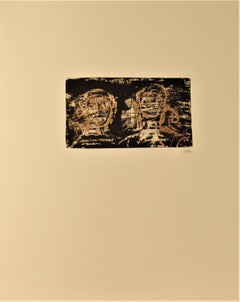
Les Poetes, La Poesie
By Henry Moore
Located in San Francisco, CA
Artist: Henry Moore (British, 1898-1986)
Title: Les Poetes, La Poesie
Year: 1976
Medium: Color lithograph
Edition: 110
Paper: Arches
Paper size: 18...
Category
1970s Abstract Sunol Alvar Nude Prints
Materials
Lithograph
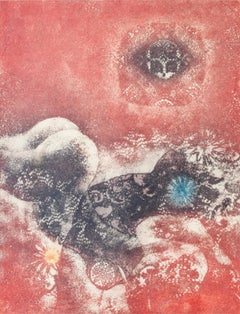
Vintage Abstracted Nude Print by Lanny Lasky
Located in New York, NY
Lanny Lasky (1923-2011)
Untitled, c. 1970s
Print (lithograph?)
Sight: 22 1/4 x 17 1/2 in. (image)
Framed: 30 1/2 x 22 1/2 x 1 1/2 in.
Signed lower right, numbered lower left: 113/120
Lasky was as passionate about making art accessible to all as she was about creating it. She devoted much of her time to art education — as an education director for the Hudson River Museum, at the Lincoln Center Institute and the Bronx Council on the Arts. She was a consultant to the New York State Council on the Arts and the Connecticut State Department of Education and worked in many capacities, including director at the Museum of Modern Art’s education department from 1986 to 2001.
Lasky brought art to countless Riverdale children and senior citizens through her work with Riverdale Neighborhood House.
“Throughout her life she was always committed to her work as an artist, but she was also seriously committed to art education and that was important,” her son, Michael Lasky, said.
“She worked toward innovative art programs and had the kids paint...
Category
1970s Abstract Sunol Alvar Nude Prints
Materials
Lithograph
Sunol Alvar nude prints for sale on 1stDibs.
Find a wide variety of authentic Sunol Alvar nude prints available for sale on 1stDibs. You can also browse by medium to find art by Sunol Alvar in lithograph and more. Much of the original work by this artist or collective was created during the 20th century and is mostly associated with the abstract style. Not every interior allows for large Sunol Alvar nude prints, so small editions measuring 22 inches across are available. Customers who are interested in this artist might also find the work of and Henry Moore. Sunol Alvar nude prints prices can differ depending upon medium, time period and other attributes. On 1stDibs, the price for these items starts at $575 and tops out at $575, while the average work can sell for $575.