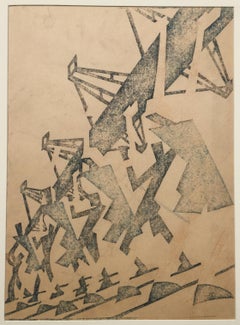
Sybil Andrews Figurative Prints

British, 1898-1992

Sybil Andrews was an English-Canadian artist who specialized in printmaking and is best known for her reductionist linocuts. Born in 1898 in Bury St Edmunds, Andrews was unable to go straight to art school after her high school, as her family could not afford the tuition fees. Given the shortage of young men during the First World War, in 1916 she was apprenticed as a welder, working in the Bristol Welding Company’s airplane factory, helping in the development of the first all-metal airplane. During this period, she took an art correspondence course. After the war, Andrews returned to Bury St Edmunds, where she was employed as an art teacher at Portland House School. Between 1922–24, she attended the Heatherley School of Fine Art in London. Andrews continued to practice the art and met the architect Cyril Power, who became a mentor figure, and then her working partner until 1938. Between 1930–38, Andrews and Power shared a studio in Hammersmith. In 1933, Andrews and Cyril Power had an exhibition of their color monotypes and linocuts at the Redfern Gallery. Most of her monotypes were destroyed by a fire in an Ottawa gallery, in 1959 and they are therefore now seldom seen.

to
1
5
1
Overall Width
to
Overall Height
to
4
2
8
859
382
367
310
6
2
4
5
1
3
2
1
1
1
1
1
1
1
1
1
4
2
3
6
Artist: Sybil Andrews
The New Cable British Modern Mid 20th Century Vorticist European Vorticism Woman
By Sybil Andrews
Located in New York, NY
The New Cable British Modern Mid 20th Century Vorticist European Vorticism Woman Sybil Andrews CPE (British/Canadian, 1898-1992) "The New Cable," 1931 12 x 16 1/2 inches Color linocut Signed, titled, inscribed 'Second State', and numbered 13/60 in pencil Framed: 19 x 24 inches Literature: Coppel Sa17 Illustrated on page 10 of the catalog The proposed edition of the first state of the Giant Cable was 50, but only 30 impressions were pulled. Andrews removed the blue background for the second state, which was published under the title The New Cable in an edition of 60. BIO Sybil Andrews was a printmaker, painter, graphic artist and educator who was born in Bury St. Edmonds, Suffolk, England. She moved to London (England) in 1922. In 1947, she emigrated to Campbell River (Vancouver Island) British Columbia, Canada, where she worked, taught and lived for the rest of her life. She died at a hospital in Victoria (B.C.) Her mediums were the colour linocut (1) (most famous), etching, posters, pastels, ink, watercolour, monoprint and oil. Her subjects were human activity (at work, sports, travel, etc.), figures, animals, genre, allegory, architecture and landscape. Her style was Art Deco (see AskART styles), Futurism, Cubism and Vorticism (2). Her work is identified by a simple format, clean lines, distortion, vivid colours, drama and rhythm. Quote: "The colour linocut was just the medium for me, being interested in dynamics and ideas and patterns... It is impossible to be fussy with lines, you have to simplify, you are forced to simplify your idea to its fundamentals." Andrews produced 76 linocuts in her life, of which 43 were made from 1929 to 1939, which is considered to be her best period. John Hassall's art correspondence course (1918) was the beginning of her formal art education. She went from there to Heatherley's School of Fine Art (London/1922) where she studied under Henry Massey (see AskART) and met artistic partner Cyril Power (see AskART). At the same time, she studied independently with sculptor Henri Glicenstein (see AskART) who taught her drypoint etching and to draw from life. She also attended the Grosvenor School of Modern Art (1925). Iain McNab (1890-1967) was Principal and Claude Flight (3) (see AskART) an instructor who had a great influence on her choice of linocut as a primary medium. Some of his other students and her associates were Edith Lawrence (1890-1973), Lill Tschudi (1911-2001), Eileen Mayo (see AskART) and William Greengrass (1896-1970). After emigrating to Canada she taught art continuously until a month before her death. She was elected a member of the Canadian Painters - Etchers Society (after 1976 the Print and Drawing Council of Canada) in 1951. She began exhibiting her work in 1921.In 1929 she was included in "The First Exhibition of British Linocuts...
Category

1930s Modern Sybil Andrews Figurative Prints

Materials

Linocut

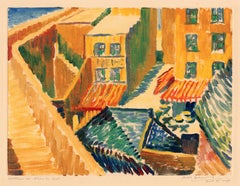
Hostellerie des Chiens du Guet — British Impressionism
By Sybil Andrews
Located in Myrtle Beach, SC
Sybil Andrews, 'Hostellerie des Chiens du Guet', color monotype, c. 1925; edition 2, proof 1. Signed 'Sybil Andrews pinx et imp' and titled in pencil. A superb, painterly impression, with fresh colors, on heavy cream wove paper; the full sheet with margins (5/8 to 1 3/4 inches). Printed by the artist. The artist’s original archival mounting tape remains in the four sheet corners, recto (well away from the image), in excellent condition. Matted to museum standards, unframed. A unique impression. Image size 8 15/16 x 11 15/16 inches (227 x 303 mm); sheet size 12 1/4 x 15 1/2 inches (311 x 394 mm). ABOUT THIS WORK In addition to her almost 80 celebrated modernist color linocuts, Sybil Andrews also worked in the monotype technique. She typically produced two or three impressions (or pulls) from each hand-painted plate, each proof unique in its qualities of color values and vibrancy. In 1933, Sybil Andrews and Cyril Power had an exhibition of their color monotypes and linocuts at the Redfern Gallery. Most of Andrews' monotypes were destroyed by a fire in an Ottawa gallery in 1959, and they now rarely come to the market. ABOUT THE IMAGE The Hostellerie des Chiens du Guet is a small hotel at the edge of...
Category

1920s Post-Impressionist Sybil Andrews Figurative Prints

Materials

Monotype

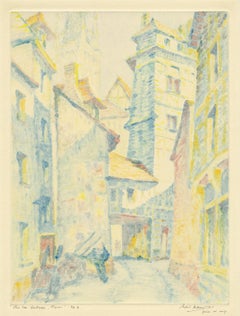
Rue du Hallage - Rouen — 1920s British Impressionism
By Sybil Andrews
Located in Myrtle Beach, SC
Sybil Andrews, 'Rue du Hallage - Rouen', color monotype, c. 1925, edition 3, proof 3. Signed 'Sybil Andrews pinx et imp' annotated 'No 3' and titled in pencil. Printed by the artist....
Category

1920s Post-Impressionist Sybil Andrews Figurative Prints

Materials

Monotype

"Rush Hour" British Modern Mid 20th Century Vorticist European Vorticism Woman
By Sybil Andrews
Located in New York, NY
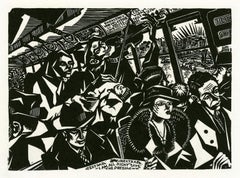
"Rush Hour" British Modern Mid 20th Century Vorticist European Vorticism Woman Sybil Andrews CPE (British/Canadian, 1898-1992) Rush Hour (Coppel SA 11) Linocut printed in Chinese orange, Chinese blue and black, 1930, on tissue thin oriental laid paper. Signed, titled and numbered 8/50 in pencil lower left, framed. Block 209 x 251mm (8 1/4 x 9 7/8in) Sheet 249 x 310mm (9 3/4 x 12 1/4in) Framed by Bark 14 1/2 x 16 inches BIO Sybil Andrews was a printmaker, painter, graphic artist and educator who was born in Bury St. Edmonds, Suffolk, England. She moved to London (England) in 1922. In 1947, she emigrated to Campbell River (Vancouver Island) British Columbia, Canada, where she worked, taught and lived for the rest of her life. She died at a hospital in Victoria (B.C.) Her mediums were the colour linocut (1) (most famous), etching, posters, pastels, ink, watercolour, monoprint and oil. Her subjects were human activity (at work, sports, travel, etc.), figures, animals, genre, allegory, architecture and landscape. Her style was Art Deco (see AskART styles), Futurism, Cubism and Vorticism (2). Her work is identified by a simple format, clean lines, distortion, vivid colours, drama and rhythm. Quote: "The colour linocut was just the medium for me, being interested in dynamics and ideas and patterns... It is impossible to be fussy with lines, you have to simplify, you are forced to simplify your idea to its fundamentals." Andrews produced 76 linocuts in her life, of which 43 were made from 1929 to 1939, which is considered to be her best period. John Hassall's art correspondence course (1918) was the beginning of her formal art education. She went from there to Heatherley's School of Fine Art (London/1922) where she studied under Henry Massey (see AskART) and met artistic partner Cyril Power (see AskART). At the same time, she studied independently with sculptor Henri Glicenstein (see AskART) who taught her drypoint etching and to draw from life. She also attended the Grosvenor School of Modern Art (1925). Iain McNab (1890-1967) was Principal and Claude Flight (3) (see AskART) an instructor who had a great influence on her choice of linocut as a primary medium. Some of his other students and her associates were Edith Lawrence (1890-1973), Lill Tschudi (1911-2001), Eileen Mayo (see AskART) and William Greengrass...
Category

1930s Modern Sybil Andrews Figurative Prints

Materials

Linocut

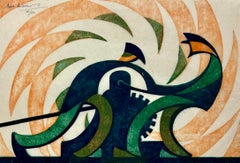
"Winch" British Linocut Grosvenor School Machine Age 1930 Woman Artist Print
By Sybil Andrews
Located in New York, NY
"Winch" British Linocut Grosvenor School Machine Age 1930 Woman Artist Print "The Winch" 1930. 7 3/4 x 11 (sight) inches. Linocut in colors on tissue...
Category

1930s Modern Sybil Andrews Figurative Prints

Materials

Linocut

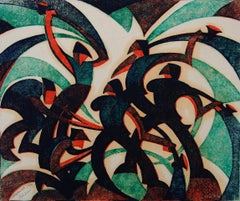
SLEDGEHAMMERS
By Sybil Andrews
Located in Portland, ME
Andrews, Sybil (English/Canadian, 1898-1992), C. SA26. "SLEDGEHAMMERS", Color Linocut, 1933, ed. 60 plus 4 trial proofs, Ref. C. SA 26, 10-1/4 x 12-1/2, signed, titled and numbered 6...
Category

1930s Modern Sybil Andrews Figurative Prints

Materials

Linocut

Related Items
"Les Fausses Confidences" Large original color lithograph
By Jean-Pierre Cassigneul
Located in San Francisco, CA
This art work titled "Les Fausses Confidences" 1988 is an original color lithograph on wove paper by French artist, Jean Pierre Cassigneul, born 1935. It is hand signed and inscribe...
Category

Late 20th Century Post-Impressionist Sybil Andrews Figurative Prints

Materials

Lithograph

Martha Reed, (Fishing)
By Martha Reed
Located in New York, NY
Martha Reed was the daughter of the artist Doel Reed and as an adult she joined her parents in Taos, New Mexico. There she designed clothes with a south-we...
Category

Mid-20th Century American Modern Sybil Andrews Figurative Prints

Materials

Linocut

THE MAKING OF TORTILLAS - Mural Size 47 1/2 inches Long
By Leopoldo Méndez
Located in Santa Monica, CA
LEOPOLDO MENDEZ (1902 – 1969) THE MAKING OF TORTILLAS 1954 Linocut. Edition unknown. This example signed in pencil and dated 1957. 14” x 47 3/8” ...
Category

1950s Modern Sybil Andrews Figurative Prints

Materials

Linocut

La Dame à la Collerette (Portrait de Jacqueline à la fraise)
By Pablo Picasso
Located in New York, NY
A superb impression of this color linoleum cut. Signed and numbered 29/50 in pencil by Picasso. Printed by Arnéra, Vallauris. Published by Galerie Louise Leiris, Paris. Catalogue r...
Category

1960s Modern Sybil Andrews Figurative Prints

Materials

Color, Linocut

Joan Miro, Figure, Bird, Star, from XXe siecle, 1959
By Joan Miró
Located in Southampton, NY
This exquisite linocut by Joan Miro (1893–1983), titled Personnage, Oiseau, Etoile (Figure, Bird, Star), from the album XXe Siecle, Nouvelle serie, XXIe Annee, No. 13, originates fro...
Category

1950s Surrealist Sybil Andrews Figurative Prints

Materials

Linocut

Fete Champetre
By Jean Dufy
Located in San Francisco, CA
This artwork titled "Fete Champetre" c.1950 is an original colors lithograph by renown artist Jean Dufy, 1888-1964. It is hand signed and numbered 80/220 in pencil by the artist. The...
Category

Mid-20th Century Fauvist Sybil Andrews Figurative Prints

Materials

Lithograph

Fete Champetre
Fete Champetre
$3,200
H 33 in W 38.75 in D 1.5 in
Modern Music — WPA Modernism, New York City El
Located in Myrtle Beach, SC
Albert Potter, 'Modern Music' also Twilight Melodies', linocut, c. 1935, from the posthumous edition of 20, printed in 1977, authorized by the artist’s widow. Estate authenticated in...
Category

1930s American Modern Sybil Andrews Figurative Prints

Materials

Linocut

Sisters — Renowned Black American, Harlem Renaissance Artist
Located in Myrtle Beach, SC
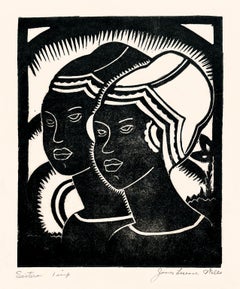
James Lesesne Wells, 'Sisters', linocut, edition not stated but small, 1928. Signed, titled, and annotated 'imp' in pencil. A fine impression on off-white wove Japan paper, with wide margins (1 7/8 to 3 3/4 inches), in excellent condition. Printed by the artist. Very scarce. Matted to museum standards, unframed. Image size 8 3/16 x 6 3/4 inches (208 x 171 mm); sheet size 13 1/2 x 10 3/4 inches (343 x 273 mm). Exhibition and Literature: 'Narratives of African American Art and Identity: The David C. Driskell Collection,' The Art Gallery at the University of Maryland, extensive touring exhibition, 1998-2000. Collections: Pennsylvania Academy of the Fine Arts, Smithsonian Institution (Anacostia Community Museum). ABOUT THE ARTIST “Wells is more than an artist with a deep concern for his fellow man. He carries many of his themes a step further into an apocalyptic world, a world of revelation and shifting lights. … He works on large blocks in a bold free style. … His work has a vigor, therefore, that is not often used in the medium today.” —Jacob Kainen (painter, critic, and collector) from Richard J. Powell’s 1986 essay Phoenix Ascending: The Art of James Lesesne Wells. James Lesesne Wells was an American painter, printmaker, educator, and pioneering figure of the Harlem Renaissance, whose work established a vital connection between African heritage, modernist form, and African American cultural identity. Known for his innovative use of linoleum and woodblock printing, Wells played a key role in shaping 20th-century African American art and inspired countless students throughout his lengthy career as a teacher at Howard University. Born in Atlanta, Georgia, Wells' early exposure to the arts came through church and community, where African American cultural traditions were central. He pursued formal artistic training at Lincoln University in Pennsylvania (earning a B.A. in 1924), followed by studies at the Pennsylvania Academy of the Fine Arts and the Barnes Foundation, where he encountered European modernists as well as traditional African sculpture, which profoundly influenced his style. Wells moved to New York in the late 1920s, swiftly immersing himself in the lively artistic and intellectual scene of Harlem. There, he became associated with artists, writers, and thinkers of the Harlem Renaissance, contributing to the growth of Black cultural identity. Considered a mentor to many famed artists of the Harlem Renaissance, Wells served as director of a summer art workshop in Harlem where his assistants included Charles Alston, Jacob Lawrence, and Palmer Hayden...
Category

1920s American Modern Sybil Andrews Figurative Prints

Materials

Linocut

"Hotel Lobby, " Linoleum Cut by Alexander Tillotson
Located in Milwaukee, WI
"Hotel Lobby" is a linoleum print by Alexander Tillotson. It features the view of a hotel lobby from the viewpoint of the back of two men. Thick lines and minimal negative space give...
Category

1930s American Modern Sybil Andrews Figurative Prints

Materials

Linocut

Henri Laurens, Sirens, from XXe siecle, 1938
By Henri Laurens
Located in Southampton, NY
This exquisite linocut by Henri Laurens (1885–1954), titled Sirenes (Sirens), from the album XXe siecle, Chroniques du jour, 13 rue Valette (5e), Directeur G. di San Lazzaro, Sommair...
Category

1930s Modern Sybil Andrews Figurative Prints

Materials

Linocut

Henri Matisse, Teeny, from XXe Siecle, 1959 (after)
By Henri Matisse
Located in Southampton, NY
This exquisite linocut after Henri Matisse (1869–1954), titled Teeny (Teeny), from the album XXe Siecle, Nouvelle serie, XXIe Annee, No. 13, Noel 1959, originates from the 1959 editi...
Category

1950s Fauvist Sybil Andrews Figurative Prints

Materials

Linocut

Henri Matisse, Teeny, from XXe Siecle, 1959 (after)
$956 Sale Price
20% Off
H 12.4 in W 9.65 in
Chris Ware New Yorker Cartoonist Limited Edition Thanksgiving Print NYC
By Chris Ware
Located in Surfside, FL
This is one print – printed in full color on 15" x 20" heavy cream-colored paper. It is from a limited edition series of 175, the portfolio is hand numbered and hand signed by Chris Ware. the individual prints are not. The page with the hand signature is included here as a photo for reference only it is not included in this sale. Franklin Christenson "Chris" Ware (born December 28, 1967), is an American cartoonist known for his Acme Novelty Library series (begun 1994) and the graphic novel Jimmy Corrigan, the Smartest Kid on Earth (2000) and Building Stories (2012). His works explore themes of social isolation, emotional torment and depression. He tends to use a vivid color palette and realistic, meticulous detail. His lettering and images are often elaborate and sometimes evoke the ragtime era or another early 20th-century American design style. Ware often refers to himself in the publicity for his work in self-effacing, even withering tones. He is considered by some critics and fellow notable illustrators and writers, such as Dave Eggers, to be among the best currently working in the medium; Canadian graphic-novelist Seth has said, "Chris really changed the playing field. After him, a lot of [cartoonists] really started to scramble and go, 'Holy [expletive], I think I have to try harder.'" While still a sophomore at UT, Ware came to the attention of Art Spiegelman, who invited Ware to contribute to Raw, the influential anthology magazine Spiegelman was co-editing with Françoise Mouly. Ware has acknowledged that being included in Raw gave him confidence and inspired him to explore printing techniques and self-publishing. His Fantagraphics series Acme Novelty Library defied comics publishing conventions with every issue. Ware's art reflects early 20th-century American styles of cartooning and graphic design, shifting through formats from traditional comic panels to faux advertisements and cut-out toys. Stylistic influences include advertising graphics from that same era; newspaper strip cartoonists Winsor McCay (Little Nemo in Slumberland) and Frank King (Gasoline Alley); Charles Schulz's post-WWII strip Peanuts and the cover designs of ragtime-era sheet music. Ware has spoken about finding inspiration in the work of artist Joseph Cornell and cites Richard McGuire's strip Here as a major influence on his use of non-linear narratives. He is one of the great practitioners who have elevated the graphic novel style along with, Shepard Fairey, Ben Katchor and Robert Crumb. Quimby the Mouse was an early character for Ware and something of a breakthrough. Rendered in the style of an early animation character like Felix the Cat, Quimby the Mouse is perhaps Ware's most autobiographical character. Ware's Building Stories was serialized in a host of different venues. It first appeared as a monthly strip in Nest Magazine. Installments later appeared in a number of publications, including The New Yorker, Kramer's Ergot, and most notably, the Sunday New York Times Magazine. Building Stories appeared weekly in the New York Times Magazine from September 18, 2005 until April 16, 2006. A full chapter was published in Acme Novelty Library, number 18. Another installment was published under the title "Touch Sensitive" as a digital app released through McSweeneys. The entire narrative was published as a boxed set of books by Pantheon in October 2012. Ware was commissioned by Chip Kidd to design the inner machinations of the bird on the cover of Haruki Murakami's novel The Wind-Up Bird Chronicle. In 2011, Ware created the poster for the U.S. release of the 2010 Palme d'Or winning film Uncle Boonmee Who Can Recall His Past Lives by Thai director Apichatpong Weerasethakul. Awards and honors Over the years his work garnered several awards, including the 1999 National Cartoonists Society's Award for Best Comic Book for Acme Novelty Library and Award for Graphic Novel for Building Stories. Ware has won numerous Eisner Awards and multiple Harvey Awards. In 2002, Ware became the first comics artist to be invited to exhibit at Whitney Museum of American Art biennial exhibition. With Will Eisner, Jack Kirby, Harvey Kurtzman, Robert Crumb and Gary Panter, Ware was among the artists honored in the exhibition "Masters of American Comics" at the Jewish Museum in New York City, New York, from September 16, 2006 to January 28, 2007. His work was the subject of solo exhibitions at the Museum of Contemporary Art, Chicago in 2006 and at the University of Nebraska's Sheldon Museum of Art, in 2007. Many famous artists have done covers for the New Yorker Magazine including, Saul Steinberg, Maira Kalman, Art Spiegelman, Francoise Mouly, Charles Addams, Peter Arno, Roz Chast, Ed Koren...
Category

Early 2000s American Modern Sybil Andrews Figurative Prints

Materials

Color

Previously Available Items
BRINGING IN THE BOAT - Early Working Proof of One Block
By Sybil Andrews
Located in Santa Monica, CA
SYBIL ANDREWS (1898 – 1992) BRINGING IN THE BOAT, 1933 (Coppel SA 24) Linocut, A rare proof impression of indigo block on newsprint, unsigned. 13” x 9 ½”. She...
Category

1930s Modern Sybil Andrews Figurative Prints

Materials

Linocut

Sybil Andrews figurative prints for sale on 1stDibs.

Find a wide variety of authentic Sybil Andrews figurative prints available for sale on 1stDibs. If you’re browsing the collection of figurative prints to introduce a pop of color in a neutral corner of your living room or bedroom, you can find work that includes elements of orange and other colors. You can also browse by medium to find art by Sybil Andrews in linocut, monotype and more. Much of the original work by this artist or collective was created during the 20th century and is mostly associated with the modern style. Not every interior allows for large Sybil Andrews figurative prints, so small editions measuring 9 inches across are available. Customers who are interested in this artist might also find the work of Maurice de Vlaminck, Edgar Chahine, and James Tissot. Sybil Andrews figurative prints prices can differ depending upon medium, time period and other attributes. On 1stDibs, the price for these items starts at $2,800 and tops out at $59,000, while the average work can sell for $20,200.

Recently Viewed

View All