Tadashi Kaminagai Furniture
Japanese, French, 1899-1982
nullto
1
1
1
1
1
1
1
1
1
1
1
1
12,712
3,850
2,368
2,228
Creator: Tadashi Kaminagai
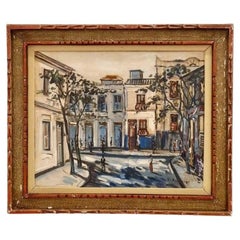
Tadashi Kaminagai, Paint. Casario do Rio de Janeiro, 1958. Oil on panel
By Tadashi Kaminagai
Located in PARIS, FR
Tadashi Kaminagai (1899–1982)
Casario do Rio de Janeiro, 1958
Oil on panel
Signed lower right and on the reverse
This rare painting by Tadashi Kaminagai, titled Casario do Rio de Jan...
Category
Mid-20th Century Brazilian Japonisme Tadashi Kaminagai Furniture
Materials
Plywood, Paint
Related Items
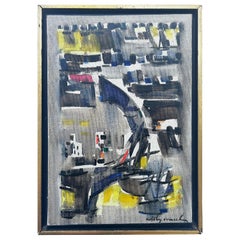
1958 Willy Mucha Abstract Oil Painting on Canvas, Signed
By Willy Mucha
Located in Miami, FL
1958 Willy Mucha Abstract Oil Painting on Canvas, Signed
Offered for sale is a 1958 Mid-century Modern abstract oil painting on linen canvas by Willy Mu...
Category
Mid-20th Century French Mid-Century Modern Tadashi Kaminagai Furniture
Materials
Canvas, Wood, Linen, Giltwood

$450 Sale Price
47% Off
H 15 in W 10.63 in D 1.38 in
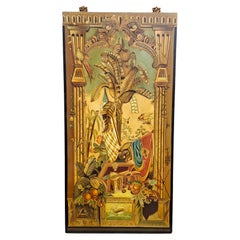
Maitland Smith Large Oil Hand Painted Canvas on Wood Panel
By Maitland Smith
Located in Germantown, MD
A large Maitland Smith Oil Hand Painted Canvas on Wood Panel.
Measures 36" in with and 72" in height.
Category
Late 20th Century Other Tadashi Kaminagai Furniture
Materials
Canvas, Wood, Paint
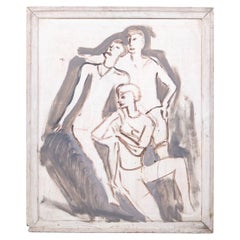
Eugène de Sala, Double-Sided Oil on Panel, Paris 1920s, Picasso-Inspired
By Eugène de Sala
Located in Kastrup, DK
Eugène de Sala (1899–1987)
Double-sided oil on panel by Danish-French modernist Eugène de Sala, unsigned. Likely painted in Paris during the 1920s. The front features a Picasso-inspi...
Category
Early 20th Century Danish Modern Tadashi Kaminagai Furniture
Materials
Wood
$3,547
H 33.08 in W 27.17 in D 0.99 in
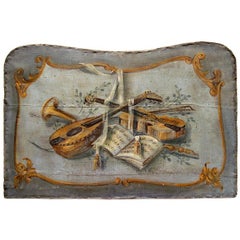
18th Century French Firescreen-Painted Oil on Cancas, Wood Panel
Located in New Orleans, LA
Originally an 18th century French firescreen with a musical motif painted in oil on canvas fixed to a wooden panel.
Category
Late 18th Century French Rococo Antique Tadashi Kaminagai Furniture
Materials
Canvas, Wood
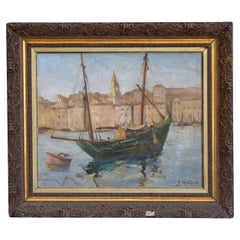
Port de Marseilles, Oil on Isorel Panel Seascape Painting Signed Georges Muller
Located in Atlanta, GA
An oil on panel landscape painting titled "Port De Marseille", signed Georges Muller in carved frame. Introducing "Port De Marseille," a captivating oil-on-panel painting signed by t...
Category
20th Century French Tadashi Kaminagai Furniture
Materials
Stucco, Wood, Paint
$1,500
H 21.6 in W 26.75 in D 1.75 in
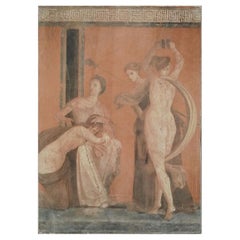
Painted Pompeii Fresco Panel on Canvas
Located in Los Angeles, CA
Painted Pompeii fresco panel depicting scene VIII from the "Sala di Grande Dipinto" in the Villa de Misteri at Pompeii on canvas. This is in the style of painted on canvas. Measures ...
Category
1950s Italian Other Vintage Tadashi Kaminagai Furniture
Materials
Canvas
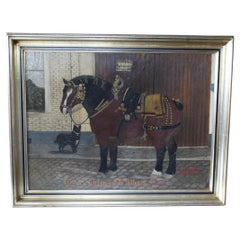
Oil on panel a horse
Located in grand Lancy, CH
Oil on panel a horse in front of a stable or a farm
Category
Early 20th Century English Tadashi Kaminagai Furniture
Materials
Wood
Capriccio View of Rio de Janeiro, Oil on Sailcloth, Circa 1810
Located in Seaford, GB
Rare Early 19th century Capriccio view of Rio de Janeiro Painting
Probably painted circa 1810 by one of Jean-Baptiste Debret, Italian Students.
Painted on Sailcloth.
Historical Context of Early 19th Century Portuguese Colonial Brazil
1.1 Transition from Colony to Empire
During the early 19th century, Brazil underwent a seismic shift in its political status. Originally a colony under the Portuguese Empire, the arrival of the Portuguese Royal Court in Rio de Janeiro in 1808 rapidly elevated the city’s cultural and political importance. By 1815, Brazil was declared a kingdom united with Portugal, setting the stage for the emergence of the Empire of Brazil in 1822. This period of transformation—often termed the transitional period from colony to empire—fueled a wave of artistic production in cities like Rio de Janeiro.
1.2 European Artistic Influence in Brazil
With the French Artistic Mission in Rio (initiated in 1816) and the presence of various Portuguese and European artists, Brazilian art of the early 1800s began to reflect diverse influences, from neoclassical painting to the early rumblings of romanticism. Painters such as Jean-Baptiste Debret, and Nicolas-Antoine Taunay, and local luminaries like Manuel de Araújo Porto-Alegre contributed to the fine arts tradition in Brazil. Their works featured scenes of local life, portraits of Brazilian society, and imaginative vistas—sometimes referred to as “capriccios,” in which real elements were combined with artistic liberties to create an idealized panorama.
1.3 Rio de Janeiro as Cultural and Political Hub
Rio de Janeiro, often called the Imperial capital after Brazil’s independence, was home to foundational institutions like the Imperial Academy of Fine Arts (Academia Imperial de Belas Artes). Later evolving into the Escola de Belas Artes (School of Fine Arts in Rio), these academies nurtured the talents of emerging painters, who found patronage under the Royal Court and, subsequently, the Imperial Court. The city’s significance was further enhanced by the construction of significant buildings, the modernization of infrastructure, and the mingling of European courtly customs with the traditions of local inhabitants.
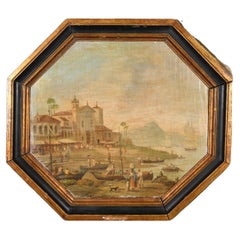
. Description of the Octagonal Oil on Canvas: A Capriccio View of Rio de Janeiro
2.1 Composition and Layout
The most striking characteristic of this 19th-century Brazilian art piece is its octagonal shape, a relatively unusual format that draws the viewer’s gaze toward its centre. The composition showcases Rio de Janeiro’s shoreline in the early 1800s, brimming with merchant ships and smaller boats anchored near the shore. On the sand, there is a bustling crowd of local people—men and women carrying food and goods on their heads, loading and unloading boats, and engaging in everyday commerce. The backdrop of soaring mountains suggests Rio’s iconic topography, embodying the landscape that famously defines the city.
2.2 Architectural and Religious Landmarks
On the left side, one can discern the silhouette of a church believed to be Santa Lucia, a significant religious structure in the heart of early 19th-century Rio. This element provides viewers with a tangible reference point, linking the scene to an actual location. However, because this painting is labelled as a “capriccio,” the artist might have taken creative liberties by rearranging or amplifying certain features of the city. The melding of real and idealized elements is characteristic of these imaginative vistas.
2.3 Evoking Daily Life in Colonial Rio
One of the painting’s greatest appeals lies in its portrayal of daily life during the colonial era. Men and women from various backgrounds populate the scene. Some appear to be carrying goods on their heads, a common practice in Brazil that has persisted through different centuries. Others appear to be haggling or trading near small vessels, revealing the commercial pulse of an active port city. This focus on local people, combined with the grandeur of merchant ships, captures the tension and synergy between the every day and the extraordinary—a hallmark of Brazilian colonial painting that balances the grand narratives of empire with the rhythms of ordinary life.
2.4 An Amalgamation of Neoclassical and Romantic Influences
Although academic art in early 19th century Brazil was highly influenced by neoclassicism, the onset of romanticism can be spotted in the emotional portrayal of the sky, the lively palette, and the dramatic emphasis on nature’s beauty (the mountains, in particular). This duality reflects the fine arts tradition in Brazil during the transitional phase when artists were embracing multiple styles. As part of the School of Rio or the Rio de Janeiro school, painters often integrated academic techniques learned from European masters with emerging local subjects and influences.
3. Institutions and Artistic Movements
3.1 Imperial Academy of Fine Arts
Originally known as the Royal School of Sciences, Arts, and Crafts, the Imperial Academy of Fine Arts in Rio de Janeiro was instrumental in shaping 19th-century Brazilian art. Influential artists and teachers from Portugal, France, and other European nations congregated at the Academy, imparting their expertise to native students. As the monarchy consolidated power, the Academy enjoyed royal patronage, leading to the creation of Imperial Academy-style works that combined European academic rigour with Brazilian-themed subject matter.
3.2 Impact of the French Artistic Mission
The French Artistic Mission, which arrived in 1816, played a pivotal role in introducing advanced European artistic techniques, thereby elevating the overall quality of painting in Brazil. Artists like Jean-Baptiste Debret not only documented Brazilian society but also spearheaded the development of a local visual identity that aligned with both academicism and the national context of a blossoming empire. Debret, alongside others such as Nicolas-Antoine Taunay, mentored Brazilian artists, sowing the seeds of what would become the Brazilian academic art movement.
3.3 Religious, Historical, and Landscape Paintings
In addition to everyday scenes and historical compositions, religious iconography remained crucial throughout Portuguese colonial and imperial Brazil. Churches were omnipresent in cityscapes like Rio de Janeiro. Many colonial-era Brazilian portraits...
Category
Early 19th Century Brazilian Spanish Colonial Antique Tadashi Kaminagai Furniture
Materials
Canvas
$2,951 Sale Price
20% Off
H 24.41 in W 26.78 in D 1.97 in
Early 20th Century Oil Painting on Panel - Sheep in Field - Arthur de Waerhert
By Arthur de Waerhert
Located in Casteren, Noord-Brabant
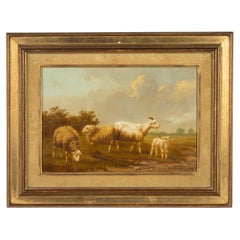
A sweet antique painting, oil on oak panel, depicting sheep in the field.
It is a painting by the famous Flemish artist Arthur de Waerhert. He lived from 1881 to 1944 and mainly pai...
Category
1910s Belgian Belle Époque Vintage Tadashi Kaminagai Furniture
Materials
Wood
$1,067
H 13.78 in W 17.72 in D 1.19 in
French Japonisme Hand-Painted Oil-on-canvas of a Geisha with a Fan
Located in New York, NY
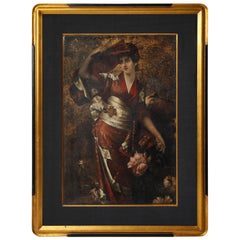
A beautiful 19th century French japonisme oil-on-canvas painting of a Geisha holding a fan. This beautiful Geisha is modeled after the Japonisme movement brought up by French artists integrating Japanese artistic styles into their art work. During the mid-1870s, the demand for Japanese decorative arts...
Category
1880s French Japonisme Antique Tadashi Kaminagai Furniture
Materials
Canvas
Danish Mid-century Painting by Elisabeth Karlinsky, Oil on panel, ca. 1958
Located in Copenhagen, DK
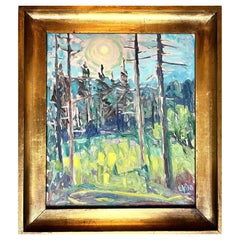
Oli on panel by Elisabeth Karlinsky.
Monogram: EK, 58.
Golden frame, from the periode.
With frame: 32x37 cm
Without: 24x29 cm
Style: modern/ danish
Motive: Sun over pine forrest
El...
Category
1950s Danish Scandinavian Modern Vintage Tadashi Kaminagai Furniture
Materials
Masonite, Paint
$1,730
H 11.42 in W 12.6 in D 1.19 in
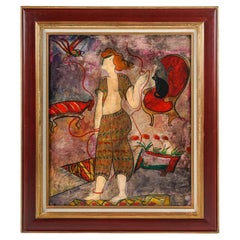
Oil Painting on Panel, Signed " Linda Le Kinff ", Danseuse De L
est
Located in Saint-Ouen, FR
"Oil Painting on Panel, signed " Linda Le Kinff " , Danseuse de l'Est"
Painting with the title "Danseuse de l'Est", Beautiful Oil on panel, well framed, by Linda Le Kinff, 20th ce...
Category
20th Century French Modern Tadashi Kaminagai Furniture
Materials
Wood
$6,882
H 37.41 in W 32.29 in D 1.97 in
Previously Available Items
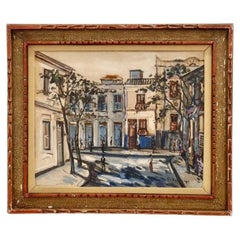
Tadashi Kaminagai, paint: “Casario do Rio de Janeiro, 1958”
By Tadashi Kaminagai
Located in PARIS, FR
“Casario do Rio de Janeiro, 1958”.
Oil s/ duratex.
Signed and dated at the bottom right.
The painting represents an urban landscape of the city of Rio de Janeiro, Brazil,
Thi...
Category
Mid-20th Century Brazilian Other Tadashi Kaminagai Furniture
Materials
Plywood, Paint
Tadashi Kaminagai furniture for sale on 1stDibs.
Tadashi Kaminagai furniture are available for sale on 1stDibs. These distinctive items are frequently made of wood and are designed with extraordinary care. Prices for Tadashi Kaminagai furniture can differ depending upon size, time period and other attributes — on 1stDibs, these items begin at $3,337 and can go as high as $3,337, while a piece like these, on average, fetch $3,337.