Thomas Hart Benton Figurative Prints
American, 1889-1975
Thomas Hart Benton was born in Neosho, Missouri on April 15, 1889. Even as a boy, he was no stranger to the "art of the deal" or to the smoke-filled rooms in which such deals were often consummated. His grandfather had been Missouri's first United States Senator and served in Washington for thirty years. His father, Maecenas Benton, was United States Attorney for the Western District of Missouri under Cleveland and served in the United States House of Representatives during the McKinley and Theodore Roosevelt administrations. Benton's brother, Nat, was prosecutor for Greene County, Missouri, during the 1930s.
As soon as he could walk, Benton traveled with his father on political tours. There he learned the arts of chewing and smoking, and while the men were involved in their heated discussions, Benton delighted in finding new cream colored wallpaper on the staircase wall, at the age of six or seven, and drew in charcoal his first mural, a long multi-car freight train.
As soon as he was eighteen, even though his father wanted him to study law, Benton left for Chicago where he studied at the Art Institute during the years 1907 and 1908. He continued his studies in Paris, where he learned delicious wickedness, aesthetic and otherwise.
Once back home, he became the leader of the Regionalist School, the most theatrical and gifted of the 1930s muralists and as Harry Truman described him,"the best damned painter in America."
Detractors said that Benton was "a fascist, a communist, a racist and a bigot"; the ingenious structure, powerful use of modeling and scale and the high-colored humanity of the murals and easel paintings are retort enough. He was a dark, active dynamo, only 5 ft., 3 1/2 in. tall. He was outspoken, open, charmingly profane; he had a great mane of hair and a face the texture of oak bark. He wore rumpled corduroy and flannel, and walked with the unsteady swagger of a sailor just ashore. He poured a salwart drink, chewed on small black cigars and spat in the fire.
Benton was once described as the "churlish dean of regionalist art." If you listened to a variety of art authorities, you would find them equally divided between Harry Truman's assessment of Benton as "the best damned painter in America" and Hilton Kramer who proclaimed Benton "a failed artist."
The East Coast art establishment tended to regard Benton as memorable for one reason only: he was the teacher of Jackson Pollock.
Benton was married in 1922 to Rita, a gregarious Italian lady, and they had a daughter and a son. At the height of his fame in the 1940s, Benton bungled the buy-out he was offered by Walt Disney and went his own way, completing his last mural in 1975 in acrylics the year of his death.
He died in 1975.to
3
4
2
Overall Width
to
Overall Height
to
5
20
890
385
373
310
9
4
2
2
5
4
8
7
4
2
2
2
2
1
1
1
1
1
9
5
5
4
Artist: Thomas Hart Benton
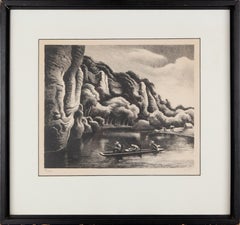
Making Camp
By Thomas Hart Benton
Located in Columbia, MO
Thomas Hart Benton (American, 1889 - 1975) was a painter, muralist, and printmaker whose sinuous, rhythmic style came to define the Regionalist movement. His paintings and lithograph...
Category
20th Century American Modern Thomas Hart Benton Figurative Prints
Materials
Lithograph
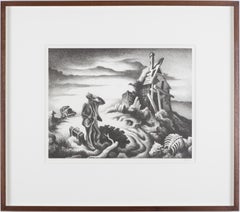
Prodigal Son
By Thomas Hart Benton
Located in London, GB
A man raises his hand to his chin, his neck tilted and face turned to look at a dilapidated farmhouse, barely held together by planks of wood and exposed to the elements. Behind him ...
Category
1930s American Modern Thomas Hart Benton Figurative Prints
Materials
Lithograph
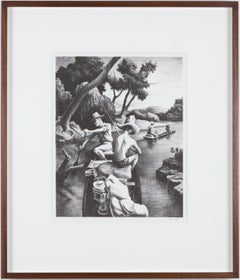
Down the River
By Thomas Hart Benton
Located in London, GB
In this sentimental work from 1939, Benton expresses his admiration for the rural lifestyle of the Midwest. He highlights the connection between man and the land by depicting two fig...
Category
1930s American Modern Thomas Hart Benton Figurative Prints
Materials
Lithograph
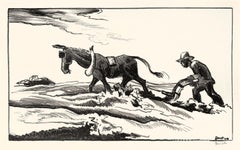
Plowing It Under
— WPA Era American Regionalism
By Thomas Hart Benton
Located in Myrtle Beach, SC
Thomas Hart Benton, 'Goin' Home', lithograph, 1937, edition 250, Fath 14. Signed in pencil. Signed in the stone, lower right. A fine, richly-inked impression, on off-white, wove pape...
Category
1930s American Realist Thomas Hart Benton Figurative Prints
Materials
Lithograph
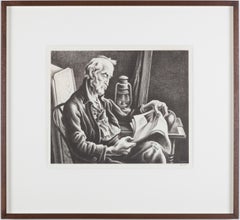
Old Man Reading
By Thomas Hart Benton
Located in London, GB
Accompanied by a lantern, an elderly man sits alone, engrossed in a newspaper. Benton used a lithographic process to draw and produce this image. He renders the face and paper well-l...
Category
1940s American Modern Thomas Hart Benton Figurative Prints
Materials
Lithograph
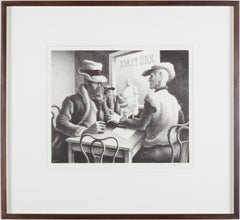
Discussion
By Thomas Hart Benton
Located in London, GB
In this charming regionalist lithograph, Benton captures a classic Midwestern American scene: two men talking, drinking, and smoking together in a bar. Titled 'Discussion', the artwo...
Category
1930s American Modern Thomas Hart Benton Figurative Prints
Materials
Lithograph
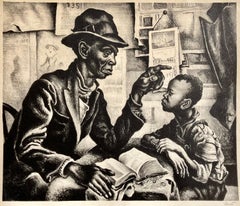
INSTRUCTION
By Thomas Hart Benton
Located in Santa Monica, CA
THOMAS HART BENTON (1889-1975)
INSTRUCTION 1940 (Fath 41)
Lithograph, signed edition of 250 as published by Associated American Artists.
10 ¼” x 12 ¼”. Full margins, deckle edges....
Category
1940s American Realist Thomas Hart Benton Figurative Prints
Materials
Lithograph
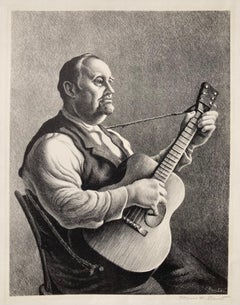
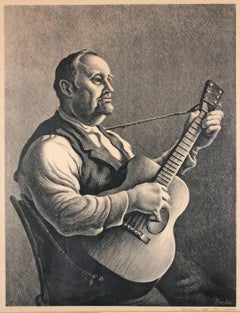
HYMN SINGER / THE MINSTREL / BURL IVES -- Large Benton
By Thomas Hart Benton
Located in Santa Monica, CA
THOMAS HART BENTON (1890- 1975)
HYMN SINGER / THE MINSTREL (Portrait of Burl Ives) 1950 (Fath 74)
Lithograph signed with full signature “Thomas H. Benton” A large image, 15 ¾ x 12 i...
Category
1950s American Realist Thomas Hart Benton Figurative Prints
Materials
Lithograph
The Hymn Singer
By Thomas Hart Benton
Located in Missouri, MO
Signed in Pencil Lower Right
Ed. 500
Circulated by Twayne Publishers, New York City
Image Size: 16 x 12 3/8
Framed Size: 24 1/4 x 20 1/2 inches
The legendary actor actor and musici...
Category
1950s American Realist Thomas Hart Benton Figurative Prints
Materials
Lithograph

Price Upon Request
Related Items
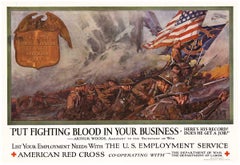
Put Fighting Blood in Your Business
Located in Spokane, WA
Original WW1 poster. Put Fighting Blood in Your Business. Here’s his record! Does he get a Job? Arthur Woods, Assistant to the Secretary of...
Category
1910s American Realist Thomas Hart Benton Figurative Prints
Materials
Lithograph
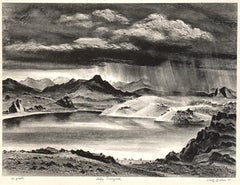
Adolf Dehn, Lake Tarryall, 1941 mid-century lithograph of Colorado mountain lake
By Adolf Dehn
Located in New York, NY
Lake Tarryall, a 1941 lithograph by Adolf Dehn (1895-1968) was made while he was teaching in Colorado. A native of Waterville, Minnesota, Dehn attended the Minneapolis School of Art ...
Category
1940s American Modern Thomas Hart Benton Figurative Prints
Materials
Lithograph
$600 Sale Price
20% Off
H 13.75 in W 17.25 in
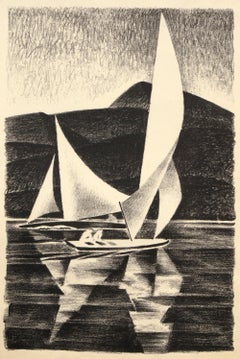
Arnold Ronnebeck 1930s Lithograph – Grand Lake Colorado Yacht Races, WPA Era
By Arnold Rönnebeck
Located in Denver, CO
This striking vintage 1930s black-and-white lithograph by celebrated Colorado artist Arnold Ronnebeck (1885–1947) captures the dynamic energy of the Grand Lake...
Category
1930s American Modern Thomas Hart Benton Figurative Prints
Materials
Lithograph
$1,600
H 12.75 in W 8.5 in D 0.1 in
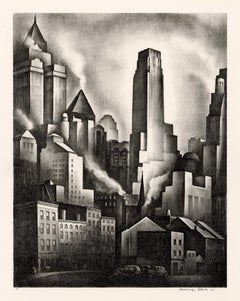
Financial District
, New York City — American Modernism
By Howard Norton Cook
Located in Myrtle Beach, SC
Howard Cook, 'Financial District', lithograph, 1931, edition 75, Duffy 155. A fine, richly-inked impression, on cream wove paper, the full sheet with wide margins (2 3/4 to 5 5/8 inches), in excellent condition. Image size 13 5/16 x 10 3/8 inches (338 x 264 mm); sheet size 23 x 16 inches (584 x 406 mm). Matted to museum standards, unframed.
Literature: 'American Master Prints from the Betty and Douglas Duffy Collection', the Trust for Museum Exhibitions, Washington, D.C., 1987.
Collections: Crystal Bridges Museum of American Art, Library of Congress, Metropolitan Museum of Art, Philadelphia Museum of Art, Smithsonian American Art Museum.
ABOUT THE ARTIST
Howard Norton Cook (1901-1980) was one of the best-known of the second generation of artists who moved to Taos. A native of Massachusetts, he studied at the Art Students League in New York City and at the Woodstock Art Colony. Beginning his association with Taos in 1926, he became a resident of the community in the 1930s. During his career, he received two Guggenheim Fellowships and was elected an Academician in the National Academy of Design. He earned a national reputation as a painter, muralist, and printmaker.
Cook’s work in the print mediums received acclaim early in his career with one-person exhibitions at the Denver Art Museum (1927) and the Museum of New Mexico (1928). He received numerous honors and awards over the years, including selection in best-of-the-year exhibitions sponsored by the American Institute of Graphics Arts, the Brooklyn Museum, the Society of American Etchers, and the Philadelphia Print Club. His first Guggenheim Fellowship took him to Taxco, Mexico in 1932 and 1933; his second in the following year enabled him to travel through the American South and Southwest.
Cook painted murals for the Public Works of Art Project in 1933 and the Treasury Departments Art Program in 1935. The latter project, completed in Pittsburgh, received a Gold Medal from the Architectural League of New York. One of his most acclaimed commissions was a mural in the San Antonio Post Office in 1937.
He and Barbara Latham settled in Talpa, south of Taos, in 1938 and remained there for over three decades. Cook volunteered in World War II as an Artist War Correspondent for the US Navy, where he was deployed in the Pacific. In 1943 he was appointed Leader of a War Art Unit...
Category
1930s American Modern Thomas Hart Benton Figurative Prints
Materials
Lithograph
$12,000
H 13.32 in W 10.38 in
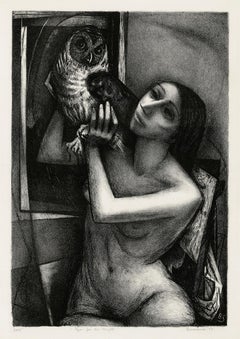
Eyes for the Night
— Mid-century American Surrealism
By Benton Murdoch Spruance
Located in Myrtle Beach, SC
Benton Spruance, 'Eyes for the Night', lithograph, 1947, edition 35, Fine and Looney 260. Signed, dated, titled, and annotated 'Ed 35' in pencil. A fine impression, on heavy, cream ...
Category
1940s American Modern Thomas Hart Benton Figurative Prints
Materials
Lithograph
$720 Sale Price
20% Off
H 18.88 in W 12.88 in
Mexican Orchestra (joy of the people is captured in this celebratory festival)
By George Overbury Hart
Located in New Orleans, LA
"Mexican Orchestra" is one of the George Overbury Hart's largest pieces. It is #14 from a limited edition of 50. The image captures a festive event with hanging lanterns, an orches...
Category
1920s American Modern Thomas Hart Benton Figurative Prints
Materials
Lithograph
Yelding the Right of Way
Located in San Francisco, CA
This artwork titled "Yelding the Right of Way" c.1975 is a color offset lithograph by renown western artist Arnold Friberg, 1913-2010. It is hand signed...
Category
Late 20th Century American Realist Thomas Hart Benton Figurative Prints
Materials
Lithograph
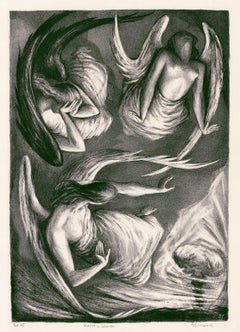
Havoc in Heaven
— Mid-Century Modernism
By Benton Murdoch Spruance
Located in Myrtle Beach, SC
Benton Spruance, 'Havoc in Heaven', lithograph, 1948, edition 30-35, Fine and Looney 270. Signed, titled, and numbered 'Ed 35' in pencil. Initialed in the stone, lower right. A fine,...
Category
1940s American Modern Thomas Hart Benton Figurative Prints
Materials
Lithograph
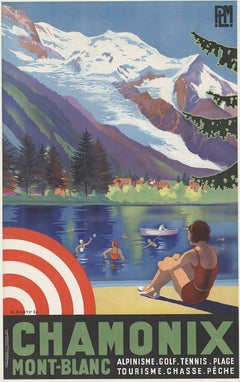
Original Chamonix Mont-Blanc vintage travel poster
Located in Spokane, WA
Original vintage travel poster Chamonix Mont-Blanc PLM French travel poster. Very good condition, archival linen backed. Ready to frame. ...
Category
1930s American Realist Thomas Hart Benton Figurative Prints
Materials
Lithograph
$8,500
H 39.38 in W 24.5 in D 0.07 in
A Kodak Moment
Located in San Francisco, CA
This artwork titled "A Kodak Moment" 1992 is an offset lithograph by renown Western artist Gary Carter, born 1938. It is hand signed and numbered 816/850 i...
Category
Late 20th Century American Realist Thomas Hart Benton Figurative Prints
Materials
Lithograph
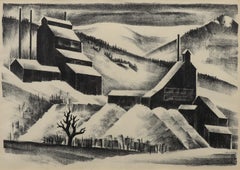
1933 Arnold Rönnebeck Lithograph Colorado Mountain Mine Winter Scene, Framed
By Arnold Rönnebeck
Located in Denver, CO
This rare 1933 lithograph by renowned modernist artist Arnold Rönnebeck depicts a striking winter scene of a Colorado mountain mine blanketed in snow. Rendered in dramatic black-and-...
Category
1930s American Modern Thomas Hart Benton Figurative Prints
Materials
Lithograph
$2,280 Sale Price
20% Off
H 18.25 in W 22.25 in D 0.75 in
When Predators Meet
Located in San Francisco, CA
This artwork titled "When Predators Meet" 1988 is an offset lithograph by renown Western artist Gary Carter, born 1938. It is hand signed and numbered 817/...
Category
Late 20th Century American Realist Thomas Hart Benton Figurative Prints
Materials
Lithograph
Previously Available Items
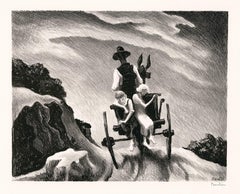
Goin
Home
— WPA Era American Regionalism
By Thomas Hart Benton
Located in Myrtle Beach, SC
Thomas Hart Benton, 'Goin' Home', lithograph, 1937, edition 250, Fath 14. Signed in pencil. Signed in the stone, lower right. A fine, richly-inked impression, on off-white, wove paper, with margins, in excellent condition. Published by Associated American Artists. Archivally matted to museum standards, unframed.
Image size 9 7/16 x 11 7/8 inches; sheet size 10 3/4 x 13 5/16 inches.
Impressions of this work are held in the following museum collections: Figge Art Museum, Georgetown University Art Collection, Indianapolis Museum of Art, Library of Congress, Metropolitan Museum of Art, and the Nelson-Atkins Museum of Art.
ABOUT THE ARTIST
“Benton’s idiom was essentially political and rhetorical, the painterly equivalent of the country stump speeches that were a Benton family tradition. The artist vividly recalled accompanying his father, Maecenas E. Benton — a four-term U.S. congressman, on campaigns through rural Missouri. Young Tom Benton grew up with an instinct for constituencies that led him to assess art on the basis of its audience appeal. His own art, after the experiments with abstraction, was high-spirited entertainment designed to catch and hold an audience with a political message neatly bracketed between humor and local color.”
—Elizabeth Broun “Thomas Hart Benton: A Politician in Art,” Smithsonian Studies in American Art, Spring 1987.
Born in 1889 in Neosho, Missouri, Thomas Hart Benton spent much of his childhood and adolescence in Washington, D.C., where his father, Maecenas Eason Benton, served as a Democratic member of Congress from 1897 to 1905. Hoping to prepare Benton for a political career, his father sent him to Western Military Academy. After nearly two years at the academy, Benton persuaded his mother to support him in attending the Art Institute of Chicago for two years, followed by two additional years at the Académie Julian in Paris.
In 1912, Benton returned to America and moved to New York to pursue his artistic career. One of his first jobs involved painting sets for silent films, which were being produced in Fort Lee, New Jersey. Benton credits this experience with equipping him with the skills necessary to create his large-scale murals.
When World War I broke out, Benton joined the Navy. Stationed in Norfolk, Virginia, he was assigned to create drawings of camouflaged ships arriving at Norfolk Naval Station. These renderings were used to identify vessels that might be lost in battle. Benton later remarked that being a "camofleur" profoundly impacted his career: "When I came out of the Navy after the First World War," he said, "I made up my mind that I wasn’t going to be just a studio painter, a pattern maker in the fashion then dominating the art world—as it still does. I began to think of returning to the painting of subjects, subjects with meanings, which people, in general, might be interested in."
While developing his Regionalist vision, Benton also taught art, first at a city-supported school and later at The Art Students League from 1926 to 1935. One of his students was a young Jackson Pollock, who regarded Benton as both a mentor and father figure. In 1930, Benton was commissioned to paint a mural for the New School for Social Research. The "America Today" mural, now permanently exhibited at the Metropolitan Museum of Art, led to many more commissions as Benton’s work gained wide recognition.
The Regionalist Movement became popular during the Great Depression of the 1930s. Painters such as Benton, Grant Wood, and John Steuart Curry rejected modernist European influences, choosing instead to depict realistic images of small-town and rural life—comforting representations of the American heartland during a period of upheaval. Time Magazine referred to Benton as "the most virile of U.S. painters of the U.S. Scene," featuring his self-portrait on the cover of a 1934 issue that included a story titled "The Birth of Regionalism."
In 1935, Benton left New York and returned to Missouri, where he taught at the Kansas City Art Institute. His outspoken criticism of modern art, art critics, and political views alienated him from many influential figures in both political and art circles. Nonetheless, Benton remained true to his beliefs, continuing to create murals, paintings, and prints that captured enduring images of American life. The dramatic and engaging characteristics of Benton’s artwork drawn the attention of Hollywood producers, leading him to create illustrations and posters for films, including his famous lithographs for the film adaptation of John Steinbeck’s "The Grapes of Wrath," produced by Twentieth Century Fox.
During the 1930s, The Limited Editions Club of New York asked Benton to illustrate special editions of three of Mark Twain’s books...
Category
1930s American Realist Thomas Hart Benton Figurative Prints
Materials
Lithograph
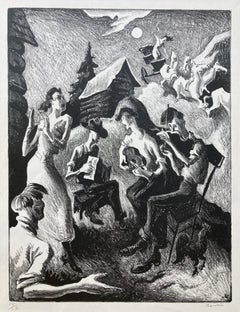
COMING ROUND THE MOUNTAIN
By Thomas Hart Benton
Located in Santa Monica, CA
THOMAS HART BENTON (1889-1975)
COMING ROUND THE MOUNTAIN (MISSOURI MUSICIANS) 1931 (Fath 4)
Lithograph, signed in pencil. Although Fath indicates an edition of 75, it is numbered ...
Category
1930s American Realist Thomas Hart Benton Figurative Prints
Materials
Lithograph
Morning Train or Soldier
s Farewell - 1940s Lithograph by Thomas Hart Benton
By Thomas Hart Benton
Located in Denver, CO
'Morning Train or Soldier's Farewell' is a lithograph by Thomas Hart Benton from 1943. Presented in a custom frame with all archival materials measuring 20 ¾ x 24 ½ inches; image size is 9 ¼ x 13 ½ inches.
Print is in good condition, please contact us for a detailed condition report.
About the Artist:
Born Missouri, 1889
Died Missouri, 1975
Thomas Hart Benton was born in Neosho, Missouri and named for a great uncle and early United States Senator. His father, Colonel M.E. Benton was a Congressman for eight years. The family lived in Washington D.C. in the winter and Neosho in the summer. Determined to pursue his talent he later said he had to run away from home to become an artist.
His draftsman experience in the Navy from 1918-19 led to his American Scene realist style, beginning with a mural titled The American Historical Epic made for the New School of Social Research in New York City. This work earned much respect for mural painting and was key to the support of artists in the Federal Art Projects.
His murals at the Missouri State Capitol in Jefferson City are major American Scene murals, and in 1957 he was commissioned by Robert Moses, chairman of the board of the Power Authority of the State of New York, to paint a mural for the Power Authority at Massena. For this work at the site, he did extensive research on the theme which was the Canadian expedition of Jacques Cartier in the mid-1500s.
During the early part of his career he lived in New York City where he taught at the Art Students League and became a major influence on the style of gestural painter, Jackson Pollock. But increasingly Benton grew to believe that art should express one’s surroundings rather than abstract ideas and that the ordinary person most exemplified American life. He inherited many of these ideas from his populist father who served as a Congressman from Missouri from 1897 to 1905.
In 1935, he established a studio in Kansas City where he painted for the next forty years until his death at age 85. Fellow Missourian and former US President...
Category
1940s American Modern Thomas Hart Benton Figurative Prints
Materials
Paper, Lithograph
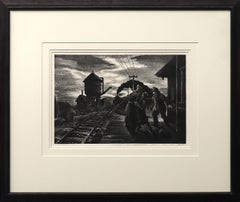
Thomas Hart BentonMorning Train or Soldier
s Farewell - 1940s Lithograph by Thomas Hart Benton, 1943
H 20.75 in W 24.5 in D 1 in
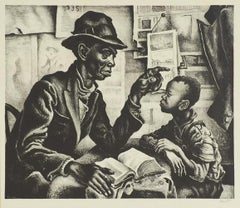
Instruction
1940
By Thomas Hart Benton
Located in Pembroke Pines, FL
THOMAS HART BENTON (American, 1889-1975)
"Instruction", 1940
Lithograph on paper
10-1/4 x 12-1/4 inches (26.0 x 31.1 cm) (image)
Ed. 250
Signed in lower right margin: Benton
Published by Associated American Artists, New York
LITERATURE:
Fath 41, The Lithographs of Thomas Hart Benton, Austin, and London, 1969 and 1979, no. 41, p. 102, illus. p. 103.
The artwork is in excellent condition.
Named after his great-uncle, a five-term senator, Thomas Hart Benton was born on April 15, 1889, in Neosho, Missouri. His father, Maecenus Eason Benton, was a lawyer and a United States representative from 1896 to 1904, so the young Benton spent his early years in both Washington, DC, and southwest Missouri. Benton dropped out of high school at 17 and started working as a cartoonist for the Joplin American newspaper. His mother, Elizabeth Wise Benton, was supportive of his artistic ambitions, but Benton’s father enrolled him in the Western Military Academy in Alton, Illinois, in 1906 before agreeing to allow him to attend the Art Institute of Chicago in 1907. The following year Benton traveled to Paris and studied at the Académie Julian. There he met California artist Stanton Macdonald-Wright (American, 1890 - 1973) and began to experiment with Macdonald-Wright’s synchromist style of abstract painting. In 1911 he returned to the United States and settled in New York. He taught briefly at the Chelsea Neighborhood Association, where he met his future wife, Rita Piacenza, one of his students. During World War I Benton served at the naval base in Norfolk, Virginia, where he made illustrations for a catalog of ships and military equipment. After the war Benton went back to New York, and in 1922 he married Piacenza. The couple was married for 53 years and had two children. They regularly spent summers on Martha’s Vineyard, Massachusetts.
Benton’s work until the early 1920s was generally modernist and often abstract. In 1924, however, Benton traveled to Missouri to see his sick father. Returning to his home state inspired him to reclaim his midwestern roots and break with modernism, focusing instead on American rural subjects such as life in steel mills, logging camps, coal mines, and cotton fields. Because of his leftist political leanings he championed working class people and represented them as heroes in his paintings and murals. Benton began to paint in a naturalistic style that was influenced by the Spanish master El Greco (Greek, 1541 - 1614), and he became known as the most innovative practitioner of mural painting in a decade of great importance for this medium in America. He completed monumental mural...
Category
1940s Post-War Thomas Hart Benton Figurative Prints
Materials
Lithograph
Arkansas Evening
1941
By Thomas Hart Benton
Located in Pembroke Pines, FL
Thomas Hart Benton
Arkansas Evening (or Nebraska Evening)
1941
Lithograph on paper
Image: 10 h x 13 w in (25 x 33 cm)
Sheet: 12.5 h x 16.5 w in (32 x 42 cm)
Signed to lower right 'Benton'.
This work is from the edition of 250 published by Associated American Artists, NY.
Literature: Fath 45
Condition: Excellent
Named after his great-uncle, a five-term senator, Thomas Hart Benton was born on April 15, 1889, in Neosho, Missouri. His father, Maecenus Eason Benton, was a lawyer and a United States representative from 1896 to 1904, so the young Benton spent his early years in both Washington, DC, and southwest Missouri. Benton dropped out of high school at 17 and started working as a cartoonist for the Joplin American newspaper. His mother, Elizabeth Wise Benton, was supportive of his artistic ambitions, but Benton’s father enrolled him in the Western Military Academy in Alton, Illinois, in 1906 before agreeing to allow him to attend the Art Institute of Chicago in 1907. The following year Benton traveled to Paris and studied at the Académie Julian. There he met California artist Stanton Macdonald-Wright (American, 1890 - 1973) and began to experiment with Macdonald-Wright’s synchromist style of abstract painting. In 1911 he returned to the United States and settled in New York. He taught briefly at the Chelsea Neighborhood Association, where he met his future wife, Rita Piacenza, one of his students. During World War I Benton served at the naval base in Norfolk, Virginia, where he made illustrations for a catalog of ships and military equipment. After the war Benton went back to New York, and in 1922 he married Piacenza. The couple was married for 53 years and had two children. They regularly spent summers on Martha’s Vineyard, Massachusetts.
Benton’s work until the early 1920s was generally modernist and often abstract. In 1924, however, Benton traveled to Missouri to see his sick father. Returning to his home state inspired him to reclaim his midwestern roots and break with modernism, focusing instead on American rural subjects such as life in steel mills, logging camps, coal mines, and cotton fields. Because of his leftist political leanings he championed working class people and represented them as heroes in his paintings and murals. Benton began to paint in a naturalistic style that was influenced by the Spanish master El Greco (Greek, 1541 - 1614), and he became known as the most innovative practitioner of mural painting in a decade of great importance for this medium in America. He completed monumental mural...
Category
1940s Contemporary Thomas Hart Benton Figurative Prints
Materials
Lithograph
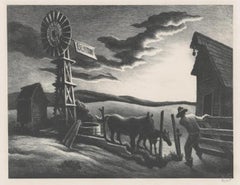
Threshing
By Thomas Hart Benton
Located in New York, NY
A superb, strong impression of this lithograph. The the edition of 250. Signed in pencil by Benton, lower right. Published by Associated American Artists...
Category
1940s American Realist Thomas Hart Benton Figurative Prints
Materials
Lithograph
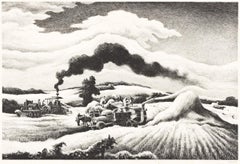
Threshing
— 1940s American Regionalism
By Thomas Hart Benton
Located in Myrtle Beach, SC
Thomas Hart Benton, 'Threshing', lithograph, 1941, edition 250, Fath 48. Signed in pencil. Signed in the stone, lower left. A fine, richly-inked impression, on off-white, wove paper, with full margins (1 3/8 to 1 5/8 inches), in excellent condition. Published by Associated American Artists. Image size 9 5/16 x 13 13/16 inches (237 x 351 mm); sheet size 12 1/2 x 16 5/8 inches (318 x 422 mm). Archivally matted to museum standards, unframed.
Impressions of this work are held in the following museum collections: Art Institute of Chicago, Fine Arts Museums of San Francisco, High Museum of Art, McNay Art Museum, Montgomery Museum of Fine Arts, and Nelson-Atkins Museum of Art.
ABOUT THE ARTIST
“Benton’s idiom was essentially political and rhetorical, the painterly equivalent of the country stump speeches that were a Benton family tradition. The artist vividly recalled accompanying his father, Maecenas E. Benton — a four-term U.S. congressman, on campaigns through rural Missouri. Young Tom Benton grew up with an instinct for constituencies that led him to assess art on the basis of its audience appeal. His own art, after the experiments with abstraction, was high-spirited entertainment designed to catch and hold an audience with a political message neatly bracketed between humor and local color.” —Elizabeth Broun “Thomas Hart Benton: A Politician in Art,” Smithsonian Studies in American Art, Spring 1987, p. 61
Born in 1889 in Neosho, Missouri, Benton spent much of his childhood and adolescence in Washington, D.C., where his lawyer father, Maecenas Eason Benton, served as a Democratic member of Congress from 1897 to 1905. Hoping to groom him for a political career, Benton’s father sent him to Western Military Academy. After nearly two years at the academy, Benton convinced his mother to support him through two years at the Art Institute of Chicago, followed by two more years at the Academie Julian in Paris.
Benton returned to America in 1912 and moved to New York to pursue his artistic career. One of his first jobs was painting sets for silent movies, which were being produced in Fort Lee, New Jersey. Benton credits this experience with giving him the skills he needed to make his large-scale murals.
When World War I broke out, Benton joined the Navy. Stationed in Norfolk, Virginia, he was assigned to create drawings of the camouflaged ships arriving at Norfolk Naval Station. The renderings were used to identify vessels should they be lost in battle. Benton credited being a ‘camofleur’ as having a profound impact on his career. “When I came out of the Navy after the First World War,” he said, “I made up my mind that I wasn’t going to be just a studio painter, a pattern maker in the fashion then dominating the art world–as it still does. I began to think of returning to the painting of subjects, subjects with meanings, which people, in general, might be interested in.”
While developing his ‘regionalist’ vision, Benton also taught art, first at a city-supported school and then at The Art Students League (1926–1935). One of his students was a young Jackson Pollock, who looked upon Benton as a mentor and a father figure. In 1930, Benton was commissioned to paint a mural for the New School for Social Research. The ‘America Today’ mural, now on permanent exhibit at the Metropolitan Museum of Art, was followed by many more commissions as Benton’s work gained acclaim.
The Regionalist Movement gained popularity during the Great Depression of the 1930s. Painters, including Benton, Grant Wood, and John Steuart Curry, rejected modernist European influences preferring to depict realistic images of small-town and rural life—reassuring images of the American heartland during a period of upheaval. Time Magazine called Benton 'the most virile of U.S. painters of the U.S. Scene,' featuring his self-portrait on the cover of a 1934 issue that included a story about 'The Birth of Regionalism.'
In 1935, Benton left New York and moved back to Missouri, where he taught at the Kansas City Art Institute. Benton’s outspoken criticism of modern art, art critics, and political views alienated him from many influencers in political and art scenes. While remaining true to his beliefs, Benton continued to create murals, paintings, and prints of some of the most enduring images of American life. The dramatic and engaging qualities of Benton’s paintings and murals attracted the attention of Hollywood producers. He was hired to create illustrations and posters for films, including his famous lithographs for the film adaptation of John Steinbeck’s ‘Grapes of Wrath’ produced by Twentieth Century Fox.
Benton’s work can be found at the Art Institute of Chicago, High Museum of Art, Fine Arts Museums of San Francisco, Library of Congress, McNay Art Museum, Metropolitan Museum of Art, Minneapolis Institute of Arts, Montgomery Museum of Fine Arts, National Gallery of Art, Nelson-Atkins Museum of Art, Smithsonian American Art Museum, Whitney Museum of American Art, The Truman Library and many other museums and galleries across the US. He was elected to the National Academy of Design, has illustrated many books, authored his autobiography, and is the subject of ‘Thomas Hart Benton,’ a documentary by Ken Burns.
Category
1940s American Realist Thomas Hart Benton Figurative Prints
Materials
Lithograph
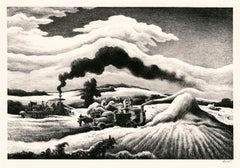
Planting
also
Spring Plowing
— 1930s American Regionalism
By Thomas Hart Benton
Located in Myrtle Beach, SC
Thomas Hart Benton, 'Planting (Spring Plowing)', lithograph, 1939, edition 250, Fath 28. Signed in pencil. Signed in the stone, lower right. A fine, richly-inked impression, on off-white wove paper, the full sheet with margins (7/8 to 1 13/16 inches), in excellent condition. Published by Associated American Artists. Image size 9 7/8 x 12 9/16 inches (251 x 319 mm); sheet size 11 3/4 x 15 7/8 inches (298 x 403 mm). Archivally matted to museum standards, framed.
Impressions of this work are held in the following museum collections: Figge Art Museum, Metropolitan Museum of Art, Minneapolis Institute of Arts, Museum of Florida History, McNay Art Museum, Nelson-Atkins Museum of Art, North Carolina Museum of Art, and the Smithsonian American Art Museum.
ABOUT THE ARTIST
“Benton’s idiom was essentially political and rhetorical, the painterly equivalent of the country stump speeches that were a Benton family tradition. The artist vividly recalled accompanying his father, Maecenas E. Benton — a four-term U.S. congressman, on campaigns through rural Missouri. Young Tom Benton grew up with an instinct for constituencies that led him to assess art on the basis of its audience appeal. His own art, after the experiments with abstraction, was high-spirited entertainment designed to catch and hold an audience with a political message neatly bracketed between humor and local color.” —Elizabeth Broun “Thomas Hart Benton: A Politician in Art,” Smithsonian Studies in American Art, Spring 1987, p. 61
Born in 1889 in Neosho, Missouri, Benton spent much of his childhood and adolescence in Washington, D.C., where his lawyer father, Maecenas Eason Benton, served as a Democratic member of Congress from 1897 to 1905. Hoping to groom him for a political career, Benton’s father sent him to Western Military Academy. After nearly two years at the academy, Benton convinced his mother to support him through two years at the Art Institute of Chicago, followed by two more years at the Academie Julian in Paris.
Benton returned to America in 1912 and moved to New York to pursue his artistic career. One of his first jobs was painting sets for silent movies, which were being produced in Fort Lee, New Jersey. Benton credits this experience with giving him the skills he needed to make his large-scale murals.
When World War I broke out, Benton joined the Navy. Stationed in Norfolk, Virginia, he was assigned to create drawings of the camouflaged ships arriving at Norfolk Naval Station. The renderings were used to identify vessels should they be lost in battle. Benton credited being a ‘camofleur’ as having a profound impact on his career. “When I came out of the Navy after the First World War,” he said, “I made up my mind that I wasn’t going to be just a studio painter, a pattern maker in the fashion then dominating the art world–as it still does. I began to think of returning to the painting of subjects, subjects with meanings, which people, in general, might be interested in.”
While developing his ‘regionalist’ vision, Benton also taught art, first at a city-supported school and then at The Art Students League (1926–1935). One of his students was a young Jackson Pollock, who looked upon Benton as a mentor and a father figure. In 1930, Benton was commissioned to paint a mural for the New School for Social Research. The ‘America Today’ mural, now on permanent exhibit at the Metropolitan Museum of Art, was followed by many more commissions as Benton’s work gained acclaim.
The Regionalist Movement gained popularity during the Great Depression of the 1930s. Painters, including Benton, Grant Wood, and John Steuart Curry, rejected modernist European influences preferring to depict realistic images of small-town and rural life—reassuring images of the American heartland during a period of upheaval. Time Magazine called Benton 'the most virile of U.S. painters of the U.S. Scene,' featuring his self-portrait on the cover of a 1934 issue that included a story about 'The Birth of Regionalism.'
In 1935, Benton left New York and moved back to Missouri, where he taught at the Kansas City Art Institute. Benton’s outspoken criticism of modern art, art critics, and political views alienated him from many influencers in political and art scenes. While remaining true to his beliefs, Benton continued to create murals, paintings, and prints of some of the most enduring images of American life. The dramatic and engaging qualities of Benton’s paintings and murals attracted the attention of Hollywood producers. He was hired to create illustrations and posters for films, including his famous lithographs for the film adaptation of John Steinbeck’s ‘Grapes of Wrath’ produced by Twentieth Century Fox.
Benton’s work can be found at the Art Institute of Chicago, High Museum of Art, Fine Arts Museums of San Francisco, Library of Congress, McNay Art Museum, Metropolitan Museum of Art, Minneapolis Institute of Arts, Montgomery Museum of Fine Arts, National Gallery of Art, Nelson-Atkins Museum of Art, Smithsonian American Art Museum, Whitney Museum of American Art, The Truman Library and many other museums and galleries across the US. He was elected to the National Academy of Design, has illustrated many books, authored his autobiography, and is the subject of ‘Thomas Hart Benton,’ a documentary by Ken Burns.
Category
1930s American Realist Thomas Hart Benton Figurative Prints
Materials
Lithograph
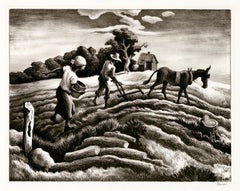
Goin
Home
— 1930s American Regionalism
By Thomas Hart Benton
Located in Myrtle Beach, SC
Thomas Hart Benton, 'Goin' Home', lithograph, 1937, edition 250, Fath 14. Signed in pencil. Signed in the stone, lower right. A fine, richly-inked impression, on off-white, wove paper, the full sheet with margins (1 1/4 to 2 3/8 inches), in excellent condition. Published by Associated American Artists. Image size 9 7/16 x 11 7/8 inches (240 x 302 mm); sheet size 11 7/8 x 16 inches (302 x 406 mm). Archivally matted to museum standards, unframed.
Impressions of this work are held in the following museum collections: Figge Art Museum, Georgetown University Art Collection, Indianapolis Museum of Art, Library of Congress, Metropolitan Museum of Art, and the Nelson-Atkins Museum of Art.
ABOUT THE ARTIST
“Benton’s idiom was essentially political and rhetorical, the painterly equivalent of the country stump speeches that were a Benton family tradition. The artist vividly recalled accompanying his father, Maecenas E. Benton — a four-term U.S. congressman, on campaigns through rural Missouri. Young Tom Benton grew up with an instinct for constituencies that led him to assess art on the basis of its audience appeal. His own art, after the experiments with abstraction, was high-spirited entertainment designed to catch and hold an audience with a political message neatly bracketed between humor and local color.” —Elizabeth Broun “Thomas Hart Benton: A Politician in Art,” Smithsonian Studies in American Art, Spring 1987, p. 61
Born in 1889 in Neosho, Missouri, Benton spent much of his childhood and adolescence in Washington, D.C., where his lawyer father, Maecenas Eason Benton, served as a Democratic member of Congress from 1897 to 1905. Hoping to groom him for a political career, Benton’s father sent him to Western Military Academy. After nearly two years at the academy, Benton convinced his mother to support him through two years at the Art Institute of Chicago, followed by two more years at the Academie Julian in Paris.
Benton returned to America in 1912 and moved to New York to pursue his artistic career. One of his first jobs was painting sets for silent movies, which were being produced in Fort Lee, New Jersey. Benton credits this experience with giving him the skills he needed to make his large-scale murals.
When World War I broke out, Benton joined the Navy. Stationed in Norfolk, Virginia, he was assigned to create drawings of the camouflaged ships arriving at Norfolk Naval Station. The renderings were used to identify vessels should they be lost in battle. Benton credited being a ‘camofleur’ as having a profound impact on his career. “When I came out of the Navy after the First World War,” he said, “I made up my mind that I wasn’t going to be just a studio painter, a pattern maker in the fashion then dominating the art world–as it still does. I began to think of returning to the painting of subjects, subjects with meanings, which people, in general, might be interested in.”
While developing his ‘regionalist’ vision, Benton also taught art, first at a city-supported school and then at The Art Students League (1926–1935). One of his students was a young Jackson Pollock, who looked upon Benton as a mentor and a father figure. In 1930, Benton was commissioned to paint a mural for the New School for Social Research. The ‘America Today’ mural, now on permanent exhibit at the Metropolitan Museum of Art, was followed by many more commissions as Benton’s work gained acclaim.
The Regionalist Movement gained popularity during the Great Depression of the 1930s. Painters, including Benton, Grant Wood, and John Steuart Curry, rejected modernist European influences preferring to depict realistic images of small-town and rural life—reassuring images of the American heartland during a period of upheaval. Time Magazine called Benton 'the most virile of U.S. painters of the U.S. Scene,' featuring his self-portrait on the cover of a 1934 issue that included a story about 'The Birth of Regionalism.'
In 1935, Benton left New York and moved back to Missouri, where he taught at the Kansas City Art Institute. Benton’s outspoken criticism of modern art, art critics, and political views alienated him from many influencers in political and art scenes. While remaining true to his beliefs, Benton continued to create murals, paintings, and prints of some of the most enduring images of American life. The dramatic and engaging qualities of Benton’s paintings and murals attracted the attention of Hollywood producers. He was hired to create illustrations and posters for films, including his famous lithographs for the film adaptation of John Steinbeck’s ‘Grapes of Wrath’ produced by Twentieth Century Fox.
Benton’s work can be found at the Art Institute of Chicago, High Museum of Art, Fine Arts Museums of San Francisco, Library of Congress, McNay Art Museum, Metropolitan Museum of Art, Minneapolis Institute of Arts, Montgomery Museum of Fine Arts, National Gallery of Art, Nelson-Atkins Museum of Art, Smithsonian American Art Museum, Whitney Museum of American Art, The Truman Library and many other museums and galleries across the US. He was elected to the National Academy of Design, has illustrated many books, authored his autobiography, and is the subject of ‘Thomas Hart Benton,’ a documentary by Ken Burns.
Category
1930s American Realist Thomas Hart Benton Figurative Prints
Materials
Lithograph
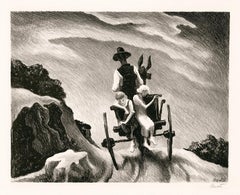
Island Hay
By Thomas Hart Benton
Located in Missouri, MO
Edition of 250, published by Associated American Artists (Fath, 68).
Signed "Benton" in pencil l.r. and within the matrix
Image Size: 9 7/8 x 12 5/8 in. (25.0 x 32.0 cm)
Framed Size:...
Category
1940s American Modern Thomas Hart Benton Figurative Prints
Materials
Lithograph
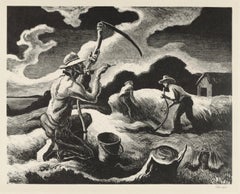
Cradling Wheat
By Thomas Hart Benton
Located in Washington, DC
Thomas Hart Benton Cradling Wheat
Artist: Thomas Hart Benton
Medium: Lithograph
Title: Cradling Wheat
Year: 1939
Edition Size: 250
Sheet Size: 11 7/8" x...
Category
1930s Thomas Hart Benton Figurative Prints
Materials
Lithograph
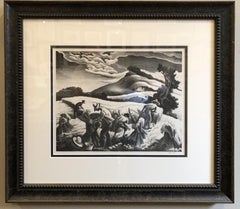
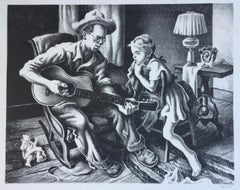
MUSIC LESSON
By Thomas Hart Benton
Located in Santa Monica, CA
THOMAS HART BENTON (1889-1975)
THE MUSIC LESSON 1943, (Fath 60)
Lithograph, signed in pencil lower right. Edition 250 as published by Associated Americ...
Category
1940s American Realist Thomas Hart Benton Figurative Prints
Materials
Lithograph
Thomas Hart Benton figurative prints for sale on 1stDibs.
Find a wide variety of authentic Thomas Hart Benton figurative prints available for sale on 1stDibs. You can also browse by medium to find art by Thomas Hart Benton in lithograph, paper and more. Much of the original work by this artist or collective was created during the 20th century and is mostly associated with the modern style. Not every interior allows for large Thomas Hart Benton figurative prints, so small editions measuring 7 inches across are available. Customers who are interested in this artist might also find the work of Warrington Colescott, Felix de Weldon , and Peter Milton. Thomas Hart Benton figurative prints prices can differ depending upon medium, time period and other attributes. On 1stDibs, the price for these items starts at $4,500 and tops out at $7,963, while the average work can sell for $7,000.