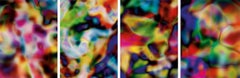
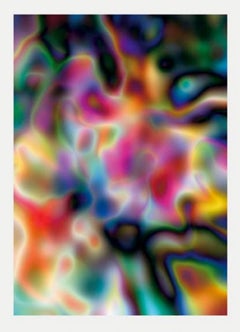
Thomas Ruff Abstract Prints

German, b. 1958
Thomas Ruff is one of the most renowned living photographers. He currently lives in Düsseldorf's where he shares a studio with other important German photographers such as Laurenz Berges, Andreas Gursky and Axel Hütte. Ruff was born in 1958 in Zell am Harmersbach, Germany and from 1977 to 1985, he attended Staatliche Kunstakademie, Düsseldorf. There he was taught by Bernd and Hilla Becher, who taught him about the conceptual aesthetics, how to break the standards and to use different techniques to reinforce the theme of his works. Ruff has always been a fan of the large format, concerned about the finest details and the main concept of his work. He works in series which can be as varied as portraits, night visions, astral constellations, porn nudes, re-photographed internet commercials o industrial elements. His Portrait series set him under the spotlight of the international photography scene. These where small and in black and white at the beginning but ended up being large scale of Passport like colour portraits of women and men on plain neutral backgrounds showing no sign of emotion thanks to a powerful flash. Thomas Ruff is the opposite to traditional photography and believes in the use of multiple techniques to achieve perfection. He can use digital processes or take advantage of the latest computer-modelling software but can also play with photogram, the camera less technique advanced by Man Ray and László Moholy-Nagy in which the picture is created placing the objects directly on to a light sensitive materials, such as photographic paper. His works are held in the collections of the Art Institute of Chicago, the Tate Gallery in London, the Kunstmuseum Basel, and The Museum of Modern Art in New York among many others.
to
3
1
Overall Width
to
Overall Height
to
3
1
15
675
209
165
158
4
2
2
1
1
1
1
1
3
3
1
Artist: Thomas Ruff
Thomas Ruff, PHG.S.01 - Chromogenic Print, Abstract Photography, Signed Print
By Thomas Ruff
Located in Hamburg, DE
Thomas Ruff (German, b. 1958) PHG.S.01, 2020 Medium: Chromogenic print Dimensions: 11 4/5 × 9 2/5 in (30 × 24 cm) Edition of 100: Hand signed and numbered, verso Condition: Mint (sol...
Category

21st Century and Contemporary Abstract Thomas Ruff Abstract Prints

Materials

C Print

Thomas Ruff, Untitled (Stars 17h 38m/-30°, 1990), Signed Photograph
By Thomas Ruff
Located in Hamburg, DE
Thomas Ruff (German, b. 1958) Untitled (Stars 17h 38m/-30°, 1990), 1990/2004 Medium: C-print, bookplate and artist’s book Dimensions: 40 × 30 cm (15 7/10 × 11 4/5 in) Edition of 30: ...
Category

21st Century and Contemporary Abstract Thomas Ruff Abstract Prints

Materials

C Print
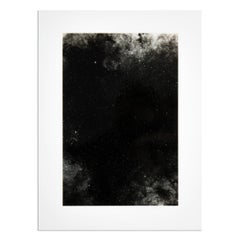
Thomas Ruff, Substrat - Contemporary Photography, Abstract Art, Signed Print
By Thomas Ruff
Located in Hamburg, DE
Thomas Ruff (German, b. 1958) Substrat, 2019 Medium: Chromogenic print Dimensions: 32 × 45.8 cm (12 3/5 × 18 in) Edition of 300: Hand-signed and numbered in pencil Condition: Excellent
Category

21st Century and Contemporary Abstract Thomas Ruff Abstract Prints

Materials

C Print
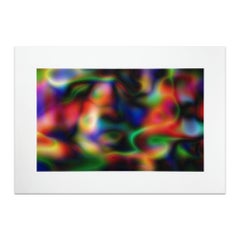
Nudes em 08
By Thomas Ruff
Located in New York, NY
A very good impression of this Iris print. Signed and numbered 23/50 on verso by Ruff.
Category

Early 2000s Contemporary Thomas Ruff Abstract Prints

Materials

Color
Related Items
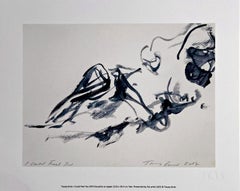
I Could Feel You, Tracey Emin, rare 2015 giclee print plate signed 300 gsm paper
By Tracey Emin
Located in New York, NY
Tracey Emin I Could Feel You, 2015 Archival quality giclée print on Purcell Ultrasmooth Fine Art Paper 300 GSM 9 1/2 × 12 inches Plate signed Unframed Rare archival quality, giclée reproduction of Tracey Emin's original gouache I Could Feel You, which is in the permanent modern art collection of the Tate. This was printed back in 2015 in an undisclosed limited edition, and is now long sold out. More details about the original 2014 work are on the Tate Gallery's website as follows: Emin, whose work is often candidly autobiographical, scrutinises her relationship with her own body, using drawing...
Category

2010s Contemporary Thomas Ruff Abstract Prints

Materials

Giclée

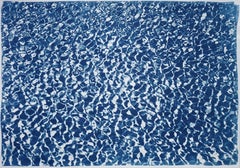
Infinity Pool Water Reflections, Blue White Pattern, Handmade Cyanotype Print
By Kind of Cyan
Located in Barcelona, ES
This is an exclusive handprinted limited edition cyanotype. "Infinity Pool" is a sophisticated image that captures the water reflections shimmering over ...
Category

2010s Abstract Thomas Ruff Abstract Prints

Materials

Emulsion, Watercolor, Photographic Paper, C Print, Lithograph, Monotype

Shiny Nude (Stealingworth, 33) silkscreen on kromekote paper + envelope AP/1000
By Tom Wesselmann
Located in New York, NY
Tom Wesselmann Shiny Nude (Stealingworth, 33), 1977 Silkscreen on glossy cast-coated Kromekote paper 8 × 8 inches Edition of 1000 (AP/1000) Pencil numbered ...
Category

1970s Pop Art Thomas Ruff Abstract Prints

Materials

Screen, Paper

Alexander Calder lithograph derrière le miroir
By Alexander Calder
Located in NEW YORK, NY
Alexander Calder Lithograph c. 1971 from Derrière le miroir: Lithograph in colors; 15 x 11 inches. Very good overall vintage condition; well-preseved. Unsigned from an edition of u...
Category

1970s Abstract Thomas Ruff Abstract Prints

Materials

Lithograph, Offset

Alexander Calder lithograph (derrière le miroir)
By Alexander Calder
Located in NEW YORK, NY
Alexander Calder Lithograph c. 1967 from Derrière le miroir: Lithograph in colors; 15 x 11 inches. Very good overall vintage condition; well-preseved. Unsigned from an edition of u...
Category

1960s Abstract Thomas Ruff Abstract Prints

Materials

Lithograph, Offset

German Surrealist Hans Bellmer Etching Engraving Print Cecile Reims Surrealism
By Hans Bellmer
Located in Surfside, FL
After Hans Bellmer (German, 1902-1975) Surrealist engraving, etching after drawings from a 1942 notebook, engraved in 1974-75 by Cecile Reims Printed by L'Atelier de Chalcographie du Louvre, Paris, Having printed monogram lower left in plate, pencil notations verso Editioned from a very small edition of #7/10 'Musee du Louvre' blindstamp. Dimensions: Sheet 11 X 7.5, Plate size 6.5 X 4 Hans Bellmer ( 1902 – 1975) was a Polish born German artist, best known for his drawings, etchings that illustrates the 1940 edition of Histoire de l’œil, and the life-sized female sculpture mannequin dolls he produced in the mid-1930s. Historians of art and photography also consider him a Surrealist photographer. Bellmer was born in the city of Kattowitz, then part of the German Empire (now Katowice, Poland). Up until 1926, he worked as a draftsman for his own advertising company. Bellmer is most famous for the creation of a series of dolls as well as photographs of them. He was influenced in his choice of art form in part by reading the published letters of Oskar Kokoschka (Der Fetisch, 1925) and Surrealism. Bellmer's puppet doll project is also said to have been catalysed by a series of events in his personal life. Hans Bellmer takes credit for provoking a physical crisis in his father and brings his own artistic creativity into association with childhood insubordination and resentment toward a severe and humorless paternal authority. Perhaps this is one reason for the nearly universal, unquestioning acceptance in the literature of Bellmer's promotion of his art as a struggle against his father, the police, and ultimately, fascism and the state. Events of his personal life also including meeting a beautiful teenage cousin in 1932 (and perhaps other unattainable beauties), attending a performance of Jacques Offenbach's Tales of Hoffmann (in which a man falls tragically in love with an automaton), and receiving a box of his old toys. After these events, he began to actually construct his first dolls. In his works, Bellmer explicitly sexualized the doll as a young girl (his work bears connection to the works of Bathus). Hirschfeld has claimed (without further argumentation) that Bellmer initiated his doll project to oppose the fascism of the Nazi Party by declaring that he would make no work that would support the new German state. Represented by mutated forms and unconventional poses, his dolls (according to this view) were directed specifically at the cult of the perfect body then prominent in Germany. He visited Paris in 1935 and made contacts there, such as Paul Éluard, but returned to Berlin because his wife Margarete was dying of tuberculosis. He was part of the circle of Surrealist luminaries such as Man Ray, Marcel Duchamp, Max Ernst, Joan Miro, André Masson, René Magritte, Alberto Giacometti and Salvador Dali as well as women artists—such as Frida Kahlo, Dorothea Tanning and Leonora Carrington. Bellmer produced the first doll in Berlin in 1933. Long since lost, the assemblage can nevertheless be correctly described thanks to approximately two dozen photographs Bellmer took at the time of its construction. Standing about fifty-six inches tall, the doll consisted of a modeled torso made of flax fiber, glue, and plaster; a mask-like head of the same material with glass eyes and a long, unkempt wig; and a pair of legs made from broomsticks or dowel rods. One of these legs terminated in a wooden, club-like foot; the other was encased in a more naturalistic plaster shell, jointed at the knee and ankle. As the project progressed, Bellmer made a second set of hollow plaster legs, with wooden ball joints for the doll's hips and knees. There were no arms to the first sculpture, but Bellmer did fashion or find a single wooden hand, which appears among the assortment of doll parts the artist documented in an untitled photograph of 1934, as well as in several photographs of later work. Bellmer's 1934 anonymous book, The Doll (Die Puppe), produced and published privately in Germany, contains 10 black-and-white photographs of Bellmer's first doll arranged in a series of "tableaux vivants" (living pictures). The book was not credited to him, as he worked in isolation, and his photographs remained almost unknown in Germany. Yet Bellmer's work was eventually declared "degenerate" (entartete kunst) by the Nazi Party, and he was forced to flee Germany to France in 1938, where Bellmer's work was welcomed by the Surrealists around Andre Breton. He aided the French Resistance during the war by making fake passports. He was imprisoned in the Camp des Milles prison at Aix-en-Provence, a brickworks camp for German nationals, from September 1939 until the end of the Phoney War in May 1940. After the war, Bellmer lived the rest of his life in Paris. Bellmer gave up doll-making and spent the following decades creating erotic drawings, etchings, sexually explicit photographs, paintings, and prints of pubescent girls. In 1954, he met Unica Zürn...
Category

20th Century Thomas Ruff Abstract Prints

Materials

Etching

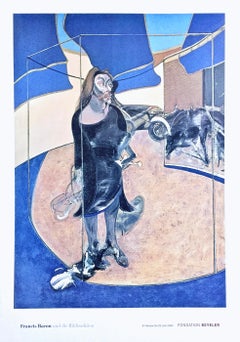
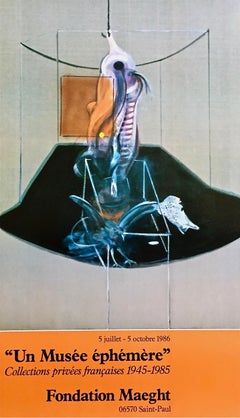
Bacon, Le Boeuf, 1986
By Francis Bacon
Located in Fairfield, CT
Artist: After Francis Bacon (1909-1992) Title: Le Boeuf, exhibition poster Year: 1986 Medium: Offset Lithograph on premium paper Size: 30.75 x 18 inches Condition: Excellent Notes: Published by Foundation Maeght FRANCIS BACON (1909-1992) Francis Bacon has a distinctive style as a figure painter. In his mature style, developed in the 1950s, the paintings include images of either friends or lovers, or images of people found in movie stills...
Category

1980s Abstract Expressionist Thomas Ruff Abstract Prints

Materials

Lithograph, Offset

Bacon, Le Boeuf, 1986
$316 Sale Price
20% Off
H 30.75 in W 18 in
Water Reflection of Fish Under Water, Pool Monotype Cyanotype in Blue Tones
By Kind of Cyan
Located in Barcelona, ES
This is an exclusive handprinted unique cyanotype that takes its inspiration from the mid-century modern shapes. It's made by layering paper cutouts and different exposures using uv-...
Category

2010s Abstract Impressionist Thomas Ruff Abstract Prints

Materials

Photographic Film, Emulsion, Watercolor, Photographic Paper, C Print, Co...

New York State Dare, Dream Discover, Offset lithograph Hand Signed Ed. of 100
By Frank Stella
Located in New York, NY
Frank Stella The New York State Christopher Columbus Quincentenary Commission, 1991 Offset Lithograph Printed in Colors Signed and dated by the artist in ink on the lower right front in black ink (Edition of 100) Limited Edition of 100 (unnumbered) 39 1/2 × 23 1/2 inches Unframed Accompanied by gallery issued Certificate of Guarantee This vibrant, hand signed offset lithograph poster designed by Frank Stella commemorates The New York State Christopher Columbus Quincentenary Commission. The poster alone is uncommon, but it is extremely rare to find a hand signed edition as this one. Highly collectible and desirable! An uncommon Stella print...
Category

1990s Abstract Expressionist Thomas Ruff Abstract Prints

Materials

Ink, Lithograph, Offset

UNTITLED (PURPLE)
By Yaacov Agam
Located in Aventura, FL
Serigraph in colors on paper. From the Menorah series. Hand signed and numbered by the artist. Edition of 200. Certificate of Authenticity Included. Artwork in Excellent Conditi...
Category

Late 20th Century Abstract Thomas Ruff Abstract Prints

Materials

Paper, Screen

UNTITLED (PURPLE)
UNTITLED (PURPLE)
$1,400 Sale Price
30% Off
H 52 in W 19 in
German Surrealist Hans Bellmer Etching Engraving Print Cecile Reims Surrealism
By Hans Bellmer
Located in Surfside, FL
After Hans Bellmer (German, 1902-1975) Surrealist engraving, etching after drawings from a 1942 notebook, engraved in 1974-75 by Cecile Reims Printed by L'Atelier de Chalcographie du Louvre, Paris, Having printed monogram lower left in plate, pencil notations verso Editioned from a very small edition of #7/10 and 'Musee du Louvre' blindstamp. Dimensions: Sheet 11 X 7.5, Plate size 6.5 X 4 Hans Bellmer ( 1902 – 1975) was a Polish born German artist, best known for his drawings, etchings that illustrates the 1940 edition of Histoire de l’œil, and the life-sized female sculpture mannequin dolls he produced in the mid-1930s. Historians of art and photography also consider him a Surrealist photographer. Bellmer was born in the city of Kattowitz, then part of the German Empire (now Katowice, Poland). Up until 1926, he worked as a draftsman for his own advertising company. Bellmer is most famous for the creation of a series of dolls as well as photographs of them. He was influenced in his choice of art form in part by reading the published letters of Oskar Kokoschka (Der Fetisch, 1925) and Surrealism. Bellmer's puppet doll project is also said to have been catalysed by a series of events in his personal life. Hans Bellmer takes credit for provoking a physical crisis in his father and brings his own artistic creativity into association with childhood insubordination and resentment toward a severe and humorless paternal authority. Perhaps this is one reason for the nearly universal, unquestioning acceptance in the literature of Bellmer's promotion of his art as a struggle against his father, the police, and ultimately, fascism and the state. Events of his personal life also including meeting a beautiful teenage cousin in 1932 (and perhaps other unattainable beauties), attending a performance of Jacques Offenbach's Tales of Hoffmann (in which a man falls tragically in love with an automaton), and receiving a box of his old toys. After these events, he began to actually construct his first dolls. In his works, Bellmer explicitly sexualized the doll as a young girl (his work bears connection to the works of Bathus). Hirschfeld has claimed (without further argumentation) that Bellmer initiated his doll project to oppose the fascism of the Nazi Party by declaring that he would make no work that would support the new German state. Represented by mutated forms and unconventional poses, his dolls (according to this view) were directed specifically at the cult of the perfect body then prominent in Germany. He visited Paris in 1935 and made contacts there, such as Paul Éluard, but returned to Berlin because his wife Margarete was dying of tuberculosis. He was part of the circle of Surrealist luminaries such as Man Ray, Marcel Duchamp, Max Ernst, Joan Miro, André Masson, René Magritte, Alberto Giacometti and Salvador Dali as well as women artists—such as Frida Kahlo, Dorothea Tanning and Leonora Carrington. Bellmer produced the first doll in Berlin in 1933. Long since lost, the assemblage can nevertheless be correctly described thanks to approximately two dozen photographs Bellmer took at the time of its construction. Standing about fifty-six inches tall, the doll consisted of a modeled torso made of flax fiber, glue, and plaster; a mask-like head of the same material with glass eyes and a long, unkempt wig; and a pair of legs made from broomsticks or dowel rods. One of these legs terminated in a wooden, club-like foot; the other was encased in a more naturalistic plaster shell, jointed at the knee and ankle. As the project progressed, Bellmer made a second set of hollow plaster legs, with wooden ball joints for the doll's hips and knees. There were no arms to the first sculpture, but Bellmer did fashion or find a single wooden hand, which appears among the assortment of doll parts the artist documented in an untitled photograph of 1934, as well as in several photographs of later work. Bellmer's 1934 anonymous book, The Doll (Die Puppe), produced and published privately in Germany, contains 10 black-and-white photographs of Bellmer's first doll arranged in a series of "tableaux vivants" (living pictures). The book was not credited to him, as he worked in isolation, and his photographs remained almost unknown in Germany. Yet Bellmer's work was eventually declared "degenerate" (entartete kunst) by the Nazi Party, and he was forced to flee Germany to France in 1938, where Bellmer's work was welcomed by the Surrealists around Andre Breton. He aided the French Resistance during the war by making fake passports. He was imprisoned in the Camp des Milles prison at Aix-en-Provence, a brickworks camp for German nationals, from September 1939 until the end of the Phoney War in May 1940. After the war, Bellmer lived the rest of his life in Paris. Bellmer gave up doll-making and spent the following decades creating erotic drawings, etchings, sexually explicit photographs, paintings, and prints of pubescent girls. In 1954, he met Unica Zürn...
Category

20th Century Thomas Ruff Abstract Prints

Materials

Etching

Alvar Sunol Embossed Figural Abstract Nude Lithograph C.1978
By Sunol Alvar
Located in San Francisco, CA
Alvar Sunol Embossed Figural Abstract Nude Lithograph C.1978 Number 46 from an edition of 100 Dimensions 12" x 16.5" The frame measures 22" x 27.5" The frame shows a chip at one...
Category

Mid-20th Century Abstract Thomas Ruff Abstract Prints

Materials

Lithograph

Previously Available Items
Substrate
By Thomas Ruff
Located in New York, NY
A stunning and vibrant 8-part leporello digital pigment print on paper. Signed in black in and numbered in pencil by the artist, from an edition of 75. From "Forty Are Better Than On...
Category

Early 2000s Contemporary Thomas Ruff Abstract Prints

Materials

Digital Pigment

Substrate
Substrate
H 12.5 in W 78.75 in
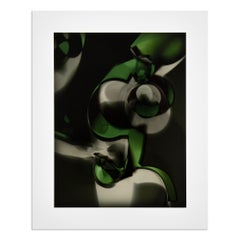
Substrat, Contemporary Photography, Abstract Art
By Thomas Ruff
Located in Hamburg, DE
Thomas Ruff (German, b. 1958) Substrat, 2019 Medium: Chromogenic print Dimensions: 32 × 45.8 cm (12 3/5 × 18 in) Edition of 300: Hand signed and numbered in pencil Condition: Excellent
Category

21st Century and Contemporary Abstract Thomas Ruff Abstract Prints

Materials

C Print
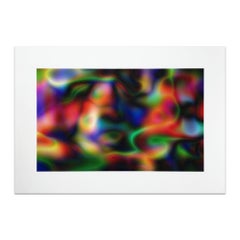
Substrate A
By Thomas Ruff
Located in Long Island City, NY
Thomas Ruff uses technological advancements to realize new visual possibilities of photography and question its artistic qualities. This is an abstract print from his 2003 Substrate...
Category

Early 2000s Abstract Thomas Ruff Abstract Prints

Materials

C Print
Substrate A
H 39.5 in W 29.5 in

Thomas Ruff abstract prints for sale on 1stDibs.

Find a wide variety of authentic Thomas Ruff abstract prints available for sale on 1stDibs. You can also browse by medium to find art by Thomas Ruff in c print, digital print, lithograph and more. Much of the original work by this artist or collective was created during the 21st century and contemporary and is mostly associated with the abstract style. Not every interior allows for large Thomas Ruff abstract prints, so small editions measuring 10 inches across are available. Customers who are interested in this artist might also find the work of Daniel Richter, Friedel Dzubas, and Günther Förg. Thomas Ruff abstract prints prices can differ depending upon medium, time period and other attributes. On 1stDibs, the price for these items starts at $2,164 and tops out at $6,103, while the average work can sell for $3,786.

Recently Viewed

View All