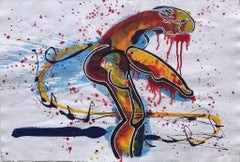
Thomas Symington Halliday Figurative Drawings and Watercolors
Thomas Symington Halliday was a Scottish artist and teacher. Although Halliday was an accomplished sculptor, painter and teacher, he is also known for his designs for stained glass windows. Halliday was born in Thornhill near Dumfries. His father was a grain merchant and he grew up on a farm. After attending Ayr Academy, Halliday spent some years working as a marine engineer on the River Clyde in Glasgow before he enrolled at the Glasgow School of Art. Helped by the artist Norman Forrest, Halliday began his career as a sculptor in 1932 and would, in due course, produce figures of animals and birds in wood, bronze, and terracotta. Halliday worked as the Art Master at Prestwick High School for several years and also taught at Ayr Academy. In 1941, he was appointed principal of the art department at the High School of Dundee, a post he retained until he retired in 1965. During World War II, Halliday painted shipbuilding and naval camouflage operations on the Clyde. Two of these paintings were subsequently purchased by the War Artists’ Advisory Committee and are now held by the Imperial War Museum in London. Later, he was commissioned to paint a large mural of the Batlle of Narvik for the Royal Naval Dockyard at Rosyth. In 1947, he co-edited with the poet George Bruce, the magazine Scottish Sculpture. For many years, Halliday lived at Wormit at Newport-on-Tay. There he carved the war memorial for the parish church and designed a coat of arms for the Town Council. Newport-on-Tay Town Council also commissioned him to produce a carving of a stag, which they presented to the Queen in 1958. He designed numerous stained glass windows including several for parish churches in and around Ayr and Dundee. He was a founding member of the Guild of Aviation Artists, was a member of the Royal Society of Marine Artists and was elected to the Society of Scottish Artists in 1943. In 1963, he exhibited works with the New Scottish Group. Halliday was also a regular exhibitor with both the Royal Scottish Academy and the Royal Glasgow Institute of the Fine Arts. He was awarded an MBE in 1963. The Most Excellent Order of the British Empire is a British order of chivalry rewarding contributions to the arts and sciences.
Mid-20th Century Thomas Symington Halliday Figurative Drawings and Watercolors
Watercolor
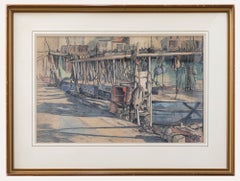
1950s Art Deco Thomas Symington Halliday Figurative Drawings and Watercolors
Gouache
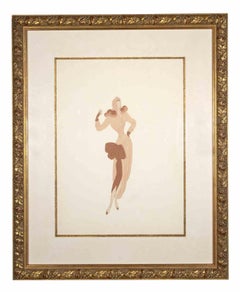

1930s Dada Thomas Symington Halliday Figurative Drawings and Watercolors
Ink, Watercolor

1920s Academic Thomas Symington Halliday Figurative Drawings and Watercolors
Ink, Watercolor, Gouache
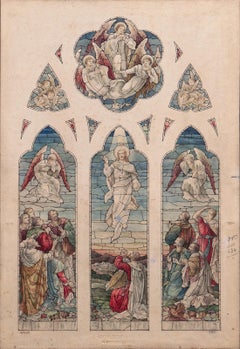
2010s Modern Thomas Symington Halliday Figurative Drawings and Watercolors
Archival Paper, Charcoal, Graphite, Watercolor
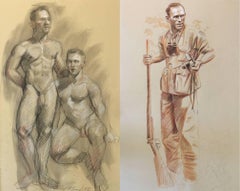
Late 18th Century French School Thomas Symington Halliday Figurative Drawings and Watercolors
Ink, Handmade Paper, Watercolor
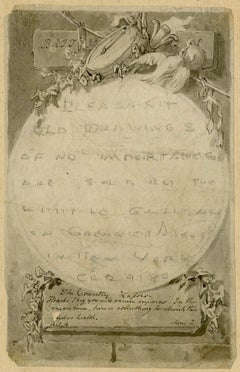
21st Century and Contemporary Contemporary Thomas Symington Halliday Figurative Drawings and Watercolors
Paper, Ink, Watercolor, Gouache
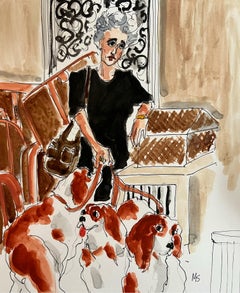
1840s Victorian Thomas Symington Halliday Figurative Drawings and Watercolors
Watercolor, Handmade Paper
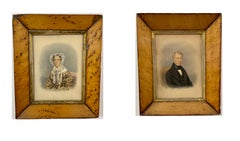
Early 20th Century Art Nouveau Thomas Symington Halliday Figurative Drawings and Watercolors
Ink, Watercolor, Paper
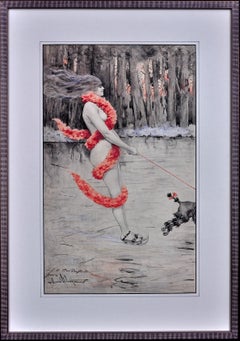
Early 20th Century Impressionist Thomas Symington Halliday Figurative Drawings and Watercolors
Gouache, Illustration Board
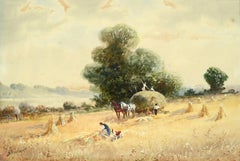
1940s Modern Thomas Symington Halliday Figurative Drawings and Watercolors
Paste, Gouache
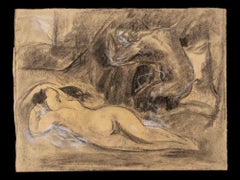
2010s Contemporary Thomas Symington Halliday Figurative Drawings and Watercolors
Paper, Gouache
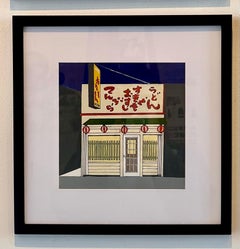
2010s Contemporary Thomas Symington Halliday Figurative Drawings and Watercolors
Paper, Ink, Acrylic, Watercolor