Toshi Yoshida Prints and Multiples
to
4
Overall Width
to
Overall Height
to
2
4
1,221
968
914
840
4
2
2
2
2
2
2
1
1
1
1
1
1
1
2
2
2
4
Artist: Toshi Yoshida
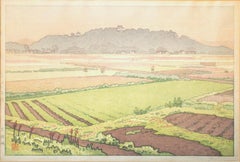
"Green Farming" Japanese Landscape Woodblock Print
By Toshi Yoshida 1
Located in Austin, TX
Japanese woodblock print (etching) of a landscape by Toshi Yoshida
11" x 15" - Page Size
17 x 21.25 - Frame Size
Category
20th Century Toshi Yoshida Prints and Multiples
Materials
Etching
Impression B
By Toshi Yoshida 1
Located in Fairlawn, OH
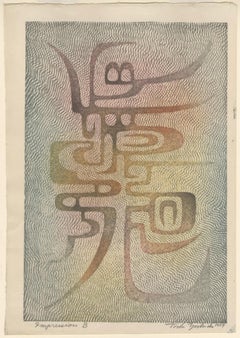
Impression B
Color woodcut, 1959
Signed and dated lower right (see photo)
Titled lower left (see photo)
A trial proof, prior to the edition of 100, signed and numbered
Condition: Excellent
Image size: 14 1/2 x 9 3/4 inches
Provenance: Estate of the artist
by decent to his heirs
"Printmaker and painter Toshi Yoshida was born on July 25, 1911, into the respected Yoshida family of artists of Tokyo, Japan. Father Hiroshi was a celebrated landscape painter and printmaker, and mother Fujio established herself as the first female Yoshida artist as well as an Abstract artist later in her career. Younger brother Hodaka was an Abstract printmaker whose style, completely separate from his family's historic traditional bent, later influenced Toshi. Hodaka's wife Chizuko would become a pioneering female Japanese artist whose own exploration of Surrealism and Abstraction challenged the status quo. Toshi, however, as the eldest sibling, was expected to follow in his father's footsteps, and from an early age he was trained by Hiroshi in his studio.
Unable to attend formal schooling due to the polio-induced paralyzation of his leg, Toshi would instead help with his family's printmaking studio and go on sketching trips with Hiroshi. As he got older, these trips would include India and Southeast Asia, working from morning to night taking night trains to get from one destination to another. Among Toshi's favorite subjects were the animals he discovered along the way. However, these trips ended as Japan entered military dictatorship in the mid 1930s, and artists whose work showed signs of Western influence were barred from exhibiting. At this time, Toshi left Japan for China and Korea, where he would remain for the duration of the war. He stuck to patriotic themes to remain in business, and after the end of World War II, as Japan struggled to recover from wartime economic depression, he earned his living creating traditional Japanese woodcut landscapes...
Category
1950s Abstract Toshi Yoshida Prints and Multiples
Materials
Woodcut
Impression B
By Toshi Yoshida 1
Located in Fairlawn, OH
Impression B
Color woodcut, 1959
Signed and dated lower right (see photo)
Titled lower left (see photo)
A trial proof, prior to the edition of 100, signed and numbered
Condition: Excellent
Image size: 14 1/2 x 9 3/4 inches
Provenance: Estate of the artist
by decent to his heirs
"Printmaker and painter Toshi Yoshida was born on July 25, 1911, into the respected Yoshida family of artists of Tokyo, Japan. Father Hiroshi was a celebrated landscape painter and printmaker, and mother Fujio established herself as the first female Yoshida artist as well as an Abstract artist later in her career. Younger brother Hodaka was an Abstract printmaker whose style, completely separate from his family's historic traditional bent, later influenced Toshi. Hodaka's wife Chizuko would become a pioneering female Japanese artist whose own exploration of Surrealism and Abstraction challenged the status quo. Toshi, however, as the eldest sibling, was expected to follow in his father's footsteps, and from an early age he was trained by Hiroshi in his studio.
Unable to attend formal schooling due to the polio-induced paralyzation of his leg, Toshi would instead help with his family's printmaking studio and go on sketching trips with Hiroshi. As he got older, these trips would include India and Southeast Asia, working from morning to night taking night trains to get from one destination to another. Among Toshi's favorite subjects were the animals he discovered along the way. However, these trips ended as Japan entered military dictatorship in the mid 1930s, and artists whose work showed signs of Western influence were barred from exhibiting. At this time, Toshi left Japan for China and Korea, where he would remain for the duration of the war. He stuck to patriotic themes to remain in business, and after the end of World War II, as Japan struggled to recover from wartime economic depression, he earned his living creating traditional Japanese woodcut landscapes...
Category
1950s Abstract Toshi Yoshida Prints and Multiples
Materials
Woodcut
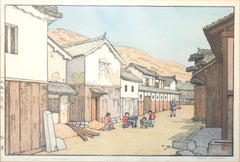
Grey Village Scene
By Toshi Yoshida 1
Located in Austin, TX
Woodblock etching of a Japanese village by Toshi Yoshido
11" x 15"
Category
20th Century Toshi Yoshida Prints and Multiples
Materials
Etching
Related Items
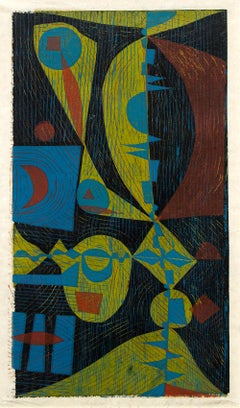
Mid-Century Modern Abstract Woodcut Print, Geometric Fine Art in Color
By Edward Marecak
Located in Denver, CO
This original mid-century modern woodcut print on linen, titled "Shapes", is by renowned American artist Edward Marecak (1919–1993). A striking example of his abstract work, this pie...
Category
20th Century Abstract Geometric Toshi Yoshida Prints and Multiples
Materials
Woodcut

$1,650
H 29 in W 19.25 in D 1.25 in
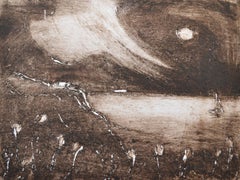
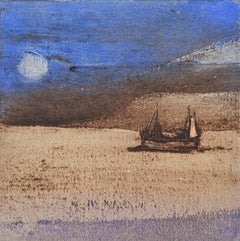
Sepia Seascape, Limited Edition Etching
By Ian Laurie
Located in Brecon, Powys
Sepia Seascape by Ian Laurie. Limited edition 5/25, signed and numbered
Sepia view from the clifftops out to sea, pleasing work by this very well coll...
Category
21st Century and Contemporary Contemporary Toshi Yoshida Prints and Multiples
Materials
Etching
Mounts Bay Mood. Contemporary limited edition etching
By Ian Laurie
Located in Brecon, Powys
Mounts Bay Mood. Limited Edition etching from the well collected studio of Ian Laurie. Signed and numbered 14 of 50. Each one of the 25 is slightly different in tone and color
Image...
Category
21st Century and Contemporary Impressionist Toshi Yoshida Prints and Multiples
Materials
Etching
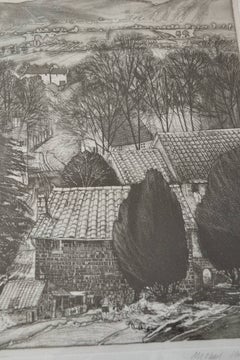
Italian Summer, Framed Etching by Michael Chapman
By Michael James Chaplin
Located in Brecon, Powys
Etching from the studio of this acclaimed British Watercolorist.
Good condition. Image 15.5" x 11.5"
English artist Michael Chaplin is a Member of the Royal Watercolor Society, pa...
Category
1990s Realist Toshi Yoshida Prints and Multiples
Materials
Etching
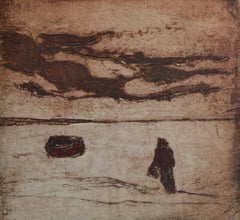
Night Fishing
.Contemporary Limited Edition Etching
By Ian Laurie
Located in Brecon, Powys
Signed and numbered (17 of 25) etching from this much collected Scottish Artist.
Image 6.75 x 7.75 Excellent condition. Matted
Ian Laurie was born in 1933 and is a self taught ...
Category
2010s Impressionist Toshi Yoshida Prints and Multiples
Materials
Etching
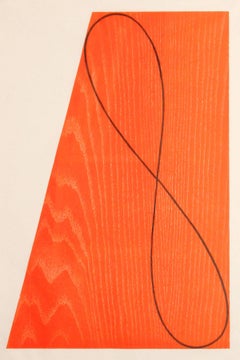
Untitled
By Robert Mangold
Located in New York, NY
Associated with the Minimalist art movement of the 1960s, Mangold developed a reductive vocabulary based on geometric forms, monochromatic color, and an emphasis on the flatness of t...
Category
1990s Abstract Toshi Yoshida Prints and Multiples
Materials
Woodcut
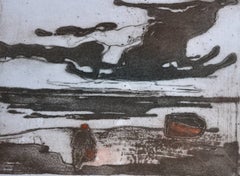
Gathering Storm:Contemporary Limited Edition Etching
By Ian Laurie
Located in Brecon, Powys
A different side of Ian Laurie. landscapes from Cornish coast England
14/25
signed and dated
Ian Laurie was born in 1933 and is a self taught artist who made the transition fr...
Category
21st Century and Contemporary Modern Toshi Yoshida Prints and Multiples
Materials
Etching
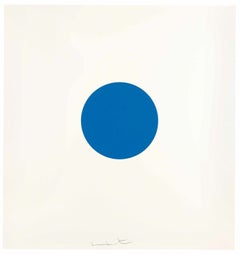
Pridinol (Artist
s Proof) - Damien Hirst Spot Print, 2010, Excellent Condition
By Damien Hirst
Located in Manchester, GB
A rare opportunity to purchase an Artist's Proof of one of Damien Hirst's Spot prints.
With a low edition size - 24 - and in mint condition, this artwork is an invaluable addition ...
Category
2010s Abstract Geometric Toshi Yoshida Prints and Multiples
Materials
Woodcut
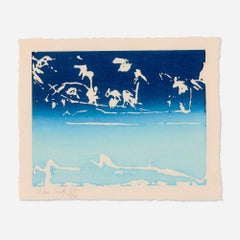
Coleman Pond III
By Alex Katz
Located in Miami, FL
Alex Katz (b. 1927)
Coleman Pond III (Bauer 446)
Heliorelief woodcut on tosa washi hanga natural paper
Signed and numbered “Pres 1/6” in the lower margin. Printed by Tom Pruitt, G...
Category
21st Century and Contemporary Abstract Toshi Yoshida Prints and Multiples
Materials
Etching, Woodcut
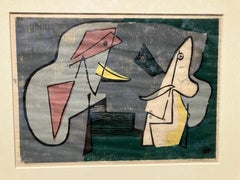
Louis SCHANKER “Jai Alai”
By Louis Schanker
Located in San Francisco, CA
Louis Schanker : 1903-1981. Well, listed American abstract artist. He was well exhibited and is in the permanent collections of many important museums. This fabulous piece is a color...
Category
1930s Abstract Toshi Yoshida Prints and Multiples
Materials
Woodcut
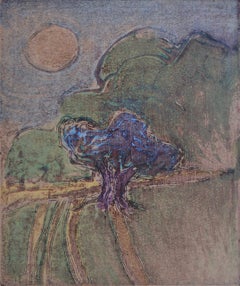
Lonely Giant. Contemporary Limited Edition Etching
By Ian Laurie
Located in Brecon, Powys
Limited Edition , 5 of 15, etching from this very collected Scottish artist.
Signed. Excellent condition
Image 9" x 7.5"
Ian Laurie was born in 1933 and is a self taught artist who...
Category
21st Century and Contemporary Impressionist Toshi Yoshida Prints and Multiples
Materials
Etching
Evening - The depth of the visible -
Located in Berlin, DE
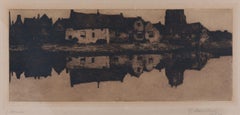
Max Clarenbach (1880 Neuss - Cologne 1952), Evening. Etching, 18 x 41 cm (platemark), 33.5 x 57 cm (frame), inscribed "Abend" in pencil at lower left, signed and dated "M. Clarenbach. 28.III.[19]09". Framed and mounted under glass.
- Somewhat browned and slightly foxed.
About the artwork
The horizontally elongated etching depicts the panoramic view of a small town as seen from the other side of the river. There are gabled houses on the left and a mighty church spire on the right. The bourgeois houses and the large religious building indicate the urban character. These buildings are rendered in dark tones to emphasise the lighter row of houses in the centre of the picture, closer to the water. The chiaroscuro contrast creates two parallel planes that open up a space for the imagination of what the city could be. The imagination is stimulated by the almost entirely dark, barely recognisable buildings, while the arm of the river leading into the city further stimulates the imagination.
However, as the silhouette of the city as a whole is reflected in the water, the parallel planes are perceived as a band of houses that stretches across the entire horizontality of the etching and seems to continue beyond the borders of the picture. The reflection has almost the same intensity as the houses themselves, so that the band of buildings merges with their reflection to form the dominant formal unit of the picture. Only the parallel horizontal hatching creates the convincing impression of seeing water, demonstrating Max Clarenbach's mastery of the etching needle.
The water is completely motionless, the reflection unclouded by the slightest movement of the waves, creating a symmetry within the formal unity of the cityscape and its reflection that goes beyond the motif of a mere cityscape. A pictorial order is established that integrates everything in the picture and has a metaphysical character as a structure of order that transcends the individual things. This pictorial order is not only relevant in the pictorial world, but the picture itself reveals the order of the reality it depicts. Revealing the metaphysical order of reality in the structures of its visibility is what drives Clarenbach as an artist and motivates him to return to the same circle of motifs.
The symmetry described is at the same time inherent an asymmetry that is a reflection on art: While the real cityscape is cut off at the top of the picture, two chimneys and above all the church tower are not visible, the reflection illustrates reality in its entirety. The reflection occupies a much larger space in the picture than reality itself. Since antiquity, art has been understood primarily as a reflection of reality, but here Clarenbach makes it clear that art is not a mere appearance, which can at best be a reflection of reality, but that art has the potential to reveal reality itself.
The revealed structure of order is by no means purely formalistic; it appears at the same time as the mood of the landscape. The picture is filled with an almost sacred silence. Nothing in the picture evokes a sound, and there is complete stillness. There are no people in Clarenbach's landscape paintings to bring action into the picture. Not even we ourselves are assigned a viewing position in the picture, so that we do not become thematic subjects of action. Clarenbach also refrains from depicting technical achievements. The absence of man and technology creates an atmosphere of timelessness. Even if the specific date proves that Clarenbach is depicting something that happened before his eyes, without the date we would not be able to say which decade, or even which century, we are in. The motionless stillness, then, does not result in time being frozen in the picture, but rather in a timeless eternity that is nevertheless, as the title "Abend" (evening), added by Clarenbach himself, makes clear, a phenomenon of transition. The landscape of the stalls is about to be completely plunged into darkness, the buildings behind it only faintly discernible. The slightly darkened state of the sheet is in keeping with this transitional quality, which also lends the scene a sepia quality that underlines its timelessness. And yet the depiction is tied to a very specific time. Clarenbach dates the picture to the evening of 28 March 1909, which does not refer to the making of the etching, but to the capture of the landscape's essence in the landscape itself.
If the real landscape is thus in a state of transition, and therefore something ephemeral, art reveals its true nature in that reality, subject to the flow of phenomena, is transferred to an eternal moment, subject to a supra-temporal structure of order - revealed by art. Despite this supratemporality, the picture also shows the harbingers of night as the coming darkening of the world, which gives the picture a deeply melancholy quality, enhanced by the browning of the leaf.
It is the philosophical content and the lyrical-melancholic effect of the graphic that give it its enchanting power. Once we are immersed in the image, it literally takes a jerk to disengage from it.
This etching, so characteristic of Max Clarenbach's art, is - not least because of its dimensions - a major work in his graphic oeuvre.
About the artist
Born into poverty and orphaned at an early age, the artistically gifted young Max Clarenbach was discovered by Andreas Achenbach and admitted to the Düsseldorf Art Academy at the age of 13.
"Completely penniless, I worked for an uncle in a cardboard factory in the evenings to pay for my studies.”
- Max Clarenbach
At the academy he studied under Arthur Kampf, among others, and in 1897 was accepted into Eugen Dücker...
Category
Early 1900s Realist Toshi Yoshida Prints and Multiples
Materials
Etching
Previously Available Items
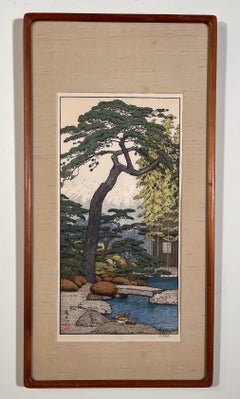
PINE TREE OF THE FRIENDLY GARDEN
By Toshi Yoshida 1
Located in Portland, ME
Yoshida, Toshi. A PINE TREE OF THE FRIENDLY GARDEN. Color woodblock print, 1980. Signed in Pencil in Japanese. Commissioned by the Franklin Mint, and printed and published by the Yo...
Category
1980s Toshi Yoshida Prints and Multiples
Materials
Woodcut
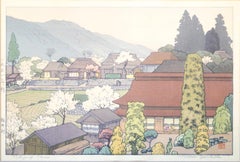
"Purple Farming" Japanese Woodblock Landscape Print
By Toshi Yoshida 1
Located in Austin, TX
A woodblock print etching of a Japanese farm by Toshi Yoshida
11" x 15"
Category
20th Century Toshi Yoshida Prints and Multiples
Materials
Etching
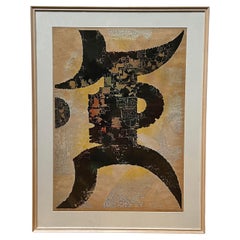
Nonobjective “Sosaku Hanga” Woodblock Print by Toshi Yoshida
By Toshi Yoshida 1
Located in Pasadena, CA
Toshi Yoshida's Materia is a stunning mid-century color woodblock print. Hand-signed, dated, and numbered 8/30 by the artist in 1962.
Thisimpressive pie...
Category
1960s Toshi Yoshida Prints and Multiples
Materials
Woodcut
H 40.25 in W 30.75 in D 0.88 in
Transcendance
— 1960s Japanese Sôsaku-hanga Abstraction
By Toshi Yoshida 1
Located in Myrtle Beach, SC
Toshi Yoshida, 'Transcendance', color woodblock print, 1968, edition 120. Signed, dated, titled, and numbered '71/120' in pencil. A fine, richly-inked impression, with fresh colors, on cream-wove Japan paper; the full sheet with margins (9/16 to 1 inch); slight toning on the top and right sheet edges, well away from the image, otherwise in very good condition. Image size 19 5/8 x 14 1/2 inches; sheet size 21 1/4 x 16 1/16 inches (double Oban). Archivally sleeved, unmatted.
Exhibited: 'Color in Relief: Wood Block Prints from Origins to Abstraction', Georgetown University Library, 2016.
Collection: Georgetown University Library.
ABOUT THE ARTIST
Yoshida Toshi (1911-1995) began training at the age of 14 under his father, Yoshida Hiroshi, one of the most acclaimed artists of the Japanese 20th-century printmaking revival movement shin-hanga (’new prints’ created in the traditional collaborative system of Japanese printmaking). He studied from 1932 to 1935 at the Taiheiyo-Gakai (Pacific Painting Association), co-founded by his father.
Before the Pacific War, Toshi traveled widely with his father in Asia, Europe, Egypt, and the United States. Later he continued his worldwide travels, especially in Mexico, the United States, Canada, and Africa. Following his father’s death in 1950, Toshi began his very personal exploration of abstraction, joining the sôsaku-hanga movement (’creative prints’ wherein the artist is creator, carver, and printer). During this richly creative period (1954 to 1973), Toshi created over three hundred nonobjective designs.
In the early 1960s, Toshi returned to large-scale figurative work, concentrating on scenes of African wildlife in its natural habitat, and in 1984 he published the first of many illustrated children's books on African wildlife (Dobutsu Ehon Shirizu), which he continued to produce until the early 1990s.
In 1966 he published a book with the artist Yuki Rei...
Category
1960s Abstract Toshi Yoshida Prints and Multiples
Materials
Woodcut
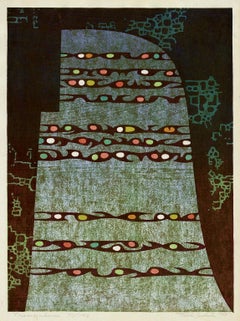
Transcendance
— Sôsaku-hanga abstraction
By Toshi Yoshida 1
Located in Myrtle Beach, SC
Toshi Yoshida, 'Transcendance', color woodblock print, 1968, edition 120. Signed, dated, titled, and numbered '117/120' in pencil. A fine, richly-inked impression, with fresh colors, on cream wove Japan paper; the full sheet with margins (9/16 to 1 inch); slight toning on the top and right sheet edges, well away from the image, otherwise in very good condition. Image size 19 5/8 x 14 1/2 inches; sheet size 21 3/8 x 16 1/16 inches (double Oban). Archivally sleeved, unmatted.
Exhibited: 'Color in Relief: Wood Block Prints from Origins to Abstraction', Georgetown University Library, 2016.
Collection: Georgetown University Library.
ABOUT THE ARTIST
Yoshida Toshi (1911-1995) began training at age 14 under his father Yoshida Hiroshi, one of the most acclaimed artists of the Japanese 20th-century printmaking revival movement shin-hanga (’new prints’ created in the traditional collaborative system of Japanese printmaking). He studied from 1932 to 1935 at the Taiheiyo-Gakai (Pacific Painting Association), which was co-founded by his father.
Before the Pacific War, Toshi traveled widely with his father in Asia, Europe, Egypt, and the United States. Later he continued his worldwide travels, especially in Mexico, the United States, Canada, and Africa. Following his father’s death in 1950, Toshi began his very personal exploration of abstraction, joining the sôsaku-hanga movement (’creative prints’ wherein the artist is creator, carver, and printer). During this richly creative period (1954 to 1973), Toshi created over three hundred nonobjective designs.
In the early 1960s, Toshi returned to large-scale figurative work, concentrating on scenes of African wildlife in its natural habitat, and in 1984 he published the first of many illustrated children's books on African wildlife (Dobutsu Ehon Shirizu), which he continued to produce until the early 1990s.
In 1966 he published a book with the artist Yuki Rei...
Category
1960s Showa Toshi Yoshida Prints and Multiples
Materials
Woodcut
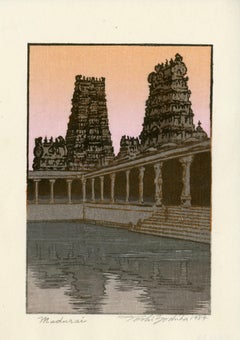
Madurai
By Toshi Yoshida 1
Located in Fairlawn, OH
Signed in pencil
Stamp title lower left of image
Image: 6 15/16 x 4 3/4"
Note: Madurai is an ancient city on the Vaigai River in the South Indian state of Tamil Nadu. Its skyline ...
Category
1980s Modern Toshi Yoshida Prints and Multiples
Materials
Woodcut
Toshi Yoshida prints and multiples for sale on 1stDibs.
Find a wide variety of authentic Toshi Yoshida prints and multiples available for sale on 1stDibs. You can also browse by medium to find art by Toshi Yoshida in etching, woodcut print and more. Much of the original work by this artist or collective was created during the 20th century and is mostly associated with the abstract style. Not every interior allows for large Toshi Yoshida prints and multiples, so small editions measuring 10 inches across are available. Customers who are interested in this artist might also find the work of Katherine Chang Liu, Giovanni Guerrini, and José Ortega. Toshi Yoshida prints and multiples prices can differ depending upon medium, time period and other attributes. On 1stDibs, the price for these items starts at $400 and tops out at $1,200, while the average work can sell for $600.