Vacheron Constantin Nautical Objects

Swiss

Iconic Swiss watchmaker Vacheron Constantin was among the first brands to embrace the Geneva Seal and is the oldest watch producer in the world that is still in operation. Vintage Vacheron Constantin watches continue to charm and captivate collectors near and far, and the manufacturer’s Maltese cross logo, adopted in 1877, is instantly recognizable as an emblem of luxurious design and enduring quality.

Vacheron Constantin was founded in 1755 by Jean-Marc Vacheron, the son of a master weaver in Geneva who instilled in his children his belief that working with one’s hands is a noble endeavor. Jean-Marc took his father’s convictions to heart and opened his watchmaking workshop at the age of 24. The watchmaker made custom watches for royalty and flourished as an innovator in its field.

Vacheron Constantin functioned as a family business for several decades after Jean-Marc’s death. His grandson, Jacques-Barthélemy, took over the business in 1810 and promptly realized that he would need support in order to expand the company’s reach as well as oversee production. He searched for a partner who was versed in international business and who had a fondness for watches — and he found it in successful businessman François Constantin, who became his associate in 1819.

Constantin was born to a merchant in Geneva. From a young age, he traveled extensively and honed his business skills, fast becoming a venerable merchant himself. Shortly after joining Vacheron, Constantin coined the company's motto, "Do better if possible, and that is always possible." These words continue to guide the brand to this day.

Since becoming known as Vacheron Constantin in 1819 — and later, Vacheron Constantin — the company has enjoyed international acclaim for everything from jewelry watches to provocative shaped designs, and its alluring timepieces are highly sought after by antique and vintage watch enthusiasts.

Widely loved models designed by Vacheron Constantin include the sporty Overseas and the Patrimony, while a number of Vacheron Constantin watches hold world records. A vintage pocket watch previously owned by King Fuad I of Egypt is one of the most expensive watches ever sold at auction. Another watch — the Reference 57260 pocket watch — has 57 complications and took eight years to build. In 2022 Vacheron Constantin exhibited a selection of its rarely seen mid-century watches in its New York City flagship store. Since the 1990s, the company has been a subsidiary of the Swiss Richemont Group.

Find a range of Vacheron Constantin pocket watches, wristwatches and bracelets on 1stDibs.

to
1
1
1
1
1
1
1
1
1
1
93
8
6
6
5
Creator: Vacheron Constantin
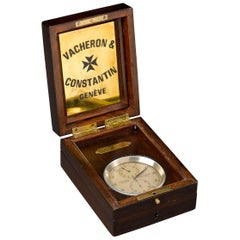
Vacheron Constantin Chronometer
By Vacheron Constantin
Located in New Orleans, LA
This exceptionally rare and important precision chronometer, or deck watch, was crafted by the famed Vacheron Constantin. One of the most accurate instrumen...
Category

20th Century Swiss Other Vacheron Constantin Nautical Objects

Materials

Mahogany

Related Items
20th Century Italian Solid Silver and Briar Double Bass Player
By Creazioni Sacchetti
Located in VALENZA, IT
Double bass player in 800 solid silver. The double bass is in briar with silver details. The double bass bow is in silver. The player and the double bass ...
Category

1980s Italian Other Vintage Vacheron Constantin Nautical Objects

Materials

Silver

20th Century Italian Solid Silver and Briar Double Bass Player
$2,055 Sale Price
20% Off
H 8.67 in W 3.94 in D 2.76 in
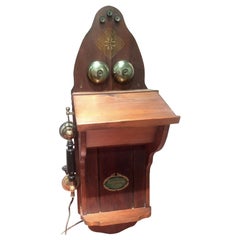
Kjøbenhavns Telefon Aktieselskab (KTAS) Wall Phone Scandinavia 19th-20th Century
By Kjøbenhavns Telefon Aktieselskab
Located in Madrid, ES
Kjøbenhavns Telefon Aktieselskab (KTAS) wall phone. Scandinavia, late 19th-early 20th century. Wall phone from the company Kjøbenhavns Telefon (later known...
Category

Early 20th Century Scandinavian Other Vacheron Constantin Nautical Objects

Materials

Other

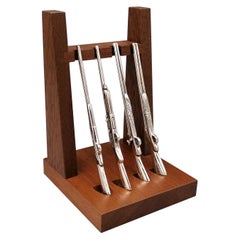
20th Century Italian Miniature Wooden Rack, 4 Hunting Rifles in Sterling Silver
By La Medusa Oro
Located in VALENZA, IT
Miniature wooden rack with 4 hunting rifles in 925 sterling silver. The rifles for hunting, in four different models, are in solid sterling silver casting ...
Category

1990s Italian Other Vacheron Constantin Nautical Objects

Materials

Sterling Silver

20th Century Italian Miniature Wooden Rack, 4 Hunting Rifles in Sterling Silver
$650 Sale Price / item
20% Off
H 5.52 in W 3.55 in D 3.55 in
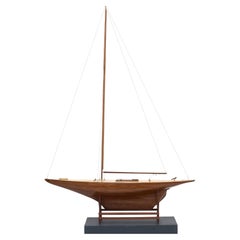
English Pond Yacht Wooden Ship Model
Located in Kastrup, DK
Large elegant wooden pond yacht model. High quality, hand-built. Hull made in mahogany, deck in maple wood. Very decorative and beautifully exec...
Category

Early 20th Century English Other Vacheron Constantin Nautical Objects

Materials

Mahogany, Maple

English Pond Yacht Wooden Ship Model
$3,573
H 79.93 in W 59.45 in D 9.85 in
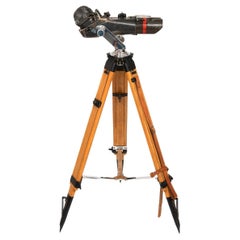
Zeiss German Jumelles World `War 2, 12 x 60 Binoculars. Exceptional Optics.
By ZEISS
Located in Canterbury, England
Zeiss German Jumelles WW2 12 x 60 Binoculars . These Zeiss Binoculars were primarily used by Luftwaffe Flak Artillery ground crews for spotting and identifying enemy aircraft and directing the crew served Rangefinders, Searchlights and Flak Cannons of the Anti-Aircraft batteries based around many German and occupied ports, cities and industrial centres. Due to their superb optics they naturally also proved useful on the battlefield for tactical observation and from the outset of 1939 were used in many theatres of war by the German Army. Presented here are a very high quality set of binoculars, manufactured by Zeiss bearing the marker of 'Jumelles 12 x 60' , indicating that they would have been made between 1942 and 1944 in occupied France. This set are unpolished in original dark grey with red stripe and are fitted to a polished cradle. They are fitted with adjustable and variable light shades (marked farbglasser) for use in all daytime and darker light conditions and have the later war style rain shield...
Category

1940s Other Vintage Vacheron Constantin Nautical Objects

Materials

Aluminum

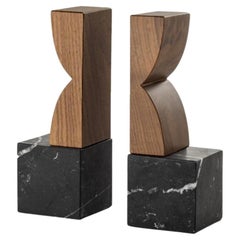
Constantin Bookends, C by Colé Italia
Located in Geneve, CH
Constantin Bookends by Colé Italia, C with Agustina Bottoni Dimensions: H.20 D.7 W.7 cm Materials: The body is a cube in Marquina black marble with white veins. The top is in solid...
Category

2010s Italian Modern Vacheron Constantin Nautical Objects

Materials

Oak, Walnut

Constantin Bookends, C by Colé Italia
$597 / item
H 7.88 in W 2.76 in D 2.76 in
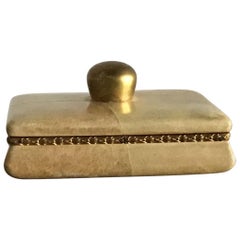
Aldo Tura Wooden Jewelry Box with Parchment and Golden Knob, 1950, Italy
By Aldo Tura
Located in Milano, IT
Aldo Tura wooden jewelry box with parchment and golden knob, 1950, Italy.
Category

1950s Italian Other Vintage Vacheron Constantin Nautical Objects

Materials

Wood

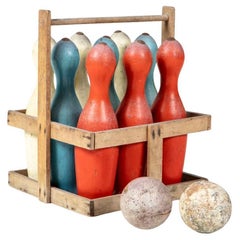
French vintage skittle game, circa 1920–1930.
Located in Kastrup, DK
Charming French skittle set consisting of 9 wooden pins (3 red, 3 white, and 3 blue) and 2 balls. The set comes in its original wooden box with a handle. Original condition with a be...
Category

Early 20th Century French Other Vacheron Constantin Nautical Objects

Materials

Wood

French vintage skittle game, circa 1920–1930.
$694
H 13.78 in W 11.62 in D 11.03 in
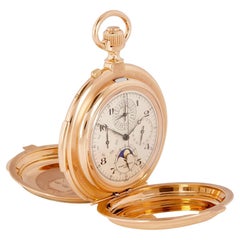
Vacheron Constantin Ref. 92115, a very fine, unique 18K pink gold pocket watch
By Vacheron Constantin
Located in London, GB
Vacheron Constantin Ref. 92115, an extremely fine and unique 18K pink gold pocket watch Swiss-made, October 2001, Height 9cm, width 6.5cm, depth 1.5cm Open: height 9cm, width 13cm, d...
Category

Early 2000s Swiss Vacheron Constantin Nautical Objects

Materials

Gold

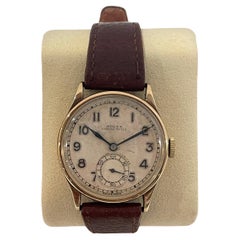
Rolex Chronometer "Northern Goldsmiths" – 1939 Vintage 9K Gold Manual-Wind Watch
Located in Encino, CA
A Rare Pre-WWII Rolex Chronometer with Co-Branded Dial and High-Precision 18-Jewel Movement This is a highly collectible and historically significant 1939 R...
Category

1930s Swiss Vintage Vacheron Constantin Nautical Objects

Materials

Gold

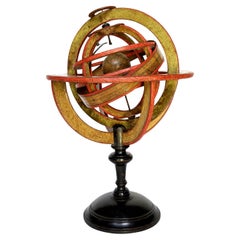
Ptolemaic Armillary Sphere, Charles-François Delamarche, Paris, ante 1798
By Charles Francois Delamarche
Located in Milano, IT
Ptolemaic armillary sphere Charles-François Delamarche Paris, ante 1798 Wood and papier-mâché covered with printed and partly hand-colored paper It measures 16.37 in in height x Ø 10.94 in (41.60 cm - Ø 27.80 cm) It weights 2.33 lb (1,058 g) State of conservation: consistent with its age and use, the paper shows some signs of use, stains and abrasions. The sphere is Ptolemaic, with the Earth placed at its center, surrounded by the Moon and the Sun mounted on two metal arms. The sphere is composed of six horizontal and two vertical rings (armillae), each bearing graduations and its own name. The first horizontal ring is illegible. The others, in descending order are: North Pole, Tropic of Cancer, Equator, Tropic of Capricorn, South Pole. The vertical rings consist of two double meridians. The sphere is then connected to the large meridian by two pins, a vertical ring inserted perpendicularly into the circle of the Horizon, in turn supported by four semicircles connected to the turned and black-stained wooden base. Each element is covered with printed paper. It contains various pieces of information: latitudes, length of days, names and zodiac symbols, calendar, wind directions, etc. The vertical circles mention the latitudes and longitudes of different cities: Rome, Bordeaux, Madrid, Boston, Batavia (Jakarta), Acapulco, etc. Even the small terrestrial globe is covered with printed paper: continents and oceans appear with numerous geographical markings indicating the most recent explorations. In the Pacific Ocean, west of South America bears the following inscription: GLOBE TERRESTRIAL à Paris chez Delamarche Géog Rue du Foin Jacques Au Collège de M.e Gervais The North American coasts are well delineated and California appears correctly as a peninsula - reports from Spanish explorers in the region had given rise to confusion as to whether it was connected to the mainland or not. The geographical nature of California was confirmed after the explorations of Juan Bautista de Anza (1774-1776). Alaska is not described and is only partially traced; it would become part of the United States in 1867. Various Pacific islands are indicated. Australia (the name definitely used from 1824) is called "Nouvelle Hollande." Tasmania is still represented as a peninsula and this is an important detail for the dating of our armillary sphere. The island is separated from Australia by Bass Strait, which was crossed by Matthew Flinders for the first time in 1798, showing that it was not a peninsula. Delamarche certainly would not have waited a long time to update such an important geographical datum: presumably he did so shortly after receiving the news. Charles-François Delamarche (1740-1817) founded his laboratory around 1770 and, in a few years, he became the most famous French cartographer and globe maker between the 18th and 19th centuries. After having acquired the laboratory of the late Didier Robert de Vaugondy (1723-1786; himself a renowned cartographer who continued the family business founded by his grandfather Nicolas Sanson in the seventeenth century) and after having purchased, between 1788 and around 1800, the businesses of Jean-Baptiste Fortin (1750-1831) and Jean Lattré (around 1750-1800), he began to call himself "Successeur de MM. Sanson and Robert de Vaugondi, Géographes du Roi and de M. Fortin, Ingénieur-mécanicien du Roi pour les globes et les sphères." Thus, at the end of the eighteenth century, Delamarche possessed the warehouse stocks, as well as the manufacturing skills of the globes of his main rivals in Paris. In addition to this aggressive acquisition policy, the key to its success also lay in the combination of high-quality cartography combined with extremely attractive globes and armillary spheres; and, of course, its famous red paint finishing touch. His laboratory was located on Rue de Foin St Jacques "au Collège Me. (or "Mtre") Gervais" in the Latin Quarter of Paris until around 1805, when he moved to rue du Jardinet No. 13. On the death of Charles-François in 1817, the reins of the company passed to his son Félix (1779-1835), who continued to publish, often in collaboration with the engraver Charles Dien, Sr. In 1835 the company first moved to rue du Jardinet No. 12 and a little later to rue du Battoir No. 7. Bibliography: Dekker, Elly, et al. Globes at Greenwich...
Category

1790s French Other Antique Vacheron Constantin Nautical Objects

Materials

Wood, Paper

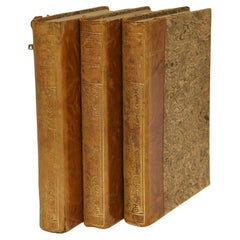
Three Ancient French Books by Balzac
By Honoré de Balzac 1
Located in Alessandria, Piemonte
Three ancient books in French by Balzac "Lost illusions" - Binding of 1926. 25 specimens on Japanese paper - 25 " " Chinese " 50 " " ...
Category

Early 20th Century French Other Vacheron Constantin Nautical Objects

Materials

Paper

Three Ancient French Books by Balzac
$286 / set
H 8.08 in W 5.52 in D 0.99 in

Vacheron Constantin nautical objects for sale on 1stDibs.

Vacheron Constantin nautical objects are available for sale on 1stDibs. These distinctive items are frequently made of wood and are designed with extraordinary care. There are many options to choose from in our collection of Vacheron Constantin nautical objects, although brown editions of this piece are particularly popular. Prices for Vacheron Constantin nautical objects can differ depending upon size, time period and other attributes — on 1stDibs, these items begin at $24,500 and can go as high as $24,500, while a piece like these, on average, fetch $24,500.
Questions About Vacheron Constantin Nautical Objects
  • 1stDibs ExpertMarch 22, 2022
    Vacheron Constantin is a luxury watchmaker founded by Jean-Marc Vacheron on September 17, 1755, in Geneva, Switzerland. Today, Compagnie Financière Richemont S.A. owns the brand. Its headquarters are in Bellevue, Switzerland. Shop a range of Vacheron Constantin watches on 1stDibs.
  • 1stDibs ExpertMarch 22, 2022
    To pronounce Vacheron Constantin, say "VA-chir-un KAAN-stun-teen." The first word in the name refers to Jean-Marc Vacheron, who founded the brand in 1755. "Constantin" comes from the surname of the man who became Vacheron's business partner in 1819, François Constantin. Find a variety of Vacheron Constantin watches on 1stDibs.
  • 1stDibs ExpertMarch 22, 2022
    Compagnie Financière Richemont S.A owns Vacheron Constantin as of December 2021. The public company trades on the SIX Swiss Exchange under the initial CFR and operates out of headquarters in Bellevue, Switzerland. You'll find a variety of Vacheron Constantin watches on 1stDibs.
  • 1stDibs ExpertApril 5, 2022
    Vacheron Constantin is made in factories located in Geneva and Vallée de Joux in Switzerland. Jean-Marc Vacheron founded the luxury watchmaker in 1755. Its headquarters are located in Geneva, Switzerland. You'll find a range of Vacheron Constantin watches on 1stDibs.
  • 1stDibs ExpertMarch 22, 2022
    Yes, Vacheron Constantin watches typically retain their value over time. In fact, their value usually increases due to demand and inflation. Maintaining your watch properly will help to preserve its value. Shop a selection of Vacheron Constantin watches on 1stDibs.
  • 1stDibs ExpertMarch 22, 2022
    To wind a Vacheron Constantin, turn the winding crown clockwise until you sense some resistance. Typically, manual-winding watches require daily winding. You usually won't have to wind a self-winding timepiece unless you do not wear it for a day or two. Shop a range of Vacheron Constantin watches on 1stDibs.
  • 1stDibs ExpertMay 5, 2023
    Yes, Vacheron Constantin is a luxury watch. The iconic Swiss watchmaker was among the first brands to embrace the Geneva Seal and is the oldest watch producer in the world that is still in operation. Vintage Vacheron Constantin watches continue to charm and captivate collectors near and far, and the manufacturer’s Maltese cross logo, adopted in 1877, is instantly recognizable as an emblem of luxurious design and enduring quality. Shop a collection of Vacheron Constantin watches from some of the world’s top sellers on 1stDibs.
  • 1stDibs ExpertSeptember 9, 2024
    Yes, many watch lovers believe that Vacheron Constantin is worth the money. The Swiss watchmaker was among the first brands to embrace the Geneva Seal and is the oldest watch producer in the world still in operation. Vintage Vacheron Constantin watches continue to charm and captivate collectors near and far, and the manufacturer’s Maltese cross logo, adopted in 1877, is instantly recognizable as an emblem of luxurious design and enduring quality. However, whether or not it’s worth investing in Vacheron Constantin watches is totally subjective! At 1stDibs, we believe in buying what you love. Our shopping experience enables discovery and learning, whether you are a seasoned connoisseur or just beginning your collection. Find Vacheron Constantin watches and other watches on 1stDibs.
  • 1stDibs ExpertNovember 26, 2024
    To spot a fake Vacheron Constantin, first look at the movement and the back for a serial number and logo. By cross-referencing the serial number with trusted online databases, you can roughly determine when your watch was made. Then, look at online image guides to find out what the Vacheron Constantin logo looked like during that time frame. If the logo on your watch is an exact match, your timepiece may not be authentic. Counterfeit timepieces may also have subtle imperfections, such as poorly executed open bridges, uneven finishes or sub-dials that are difficult to read. If you have lingering doubts about your timepiece, consider having a certified appraiser or experienced dealer evaluate it. On 1stDibs, find a range of Vacheron Constantin watches.
  • 1stDibs ExpertNovember 22, 2024
    Vacheron Constantin watches are so expensive for a few reasons. For one thing, the luxury Swiss watchmaker consistently uses high-quality materials, such as 18-karat gold, platinum, titanium, ceramics and sapphire glass, to produce its timepieces. In addition, all movements and complications are made in-house and, in some cases, can take as many as 6 to 12 months to complete. Assembling the watches requires more time and effort and exact attentiveness to detail. As a result, Vacheron Constantin only produces around 20,000 watches annually. The limited supply, compared to the great demand for the watches, increases selling prices. Shop a variety of Vacheron Constantin watches on 1stDibs.
  • 1stDibs ExpertMarch 22, 2022
    Which Vacheron Constantin watch you should buy is largely a matter of personal preference. The brand produces pocket watches and wristwatches for men as well as wristwatches for women. In addition to contemporary designs, you can find authentic timepieces produced in the 19th- and 20th-centuries. Shop a collection of Vacheron Constantin watches on 1stDibs.
  • 1stDibs ExpertMarch 22, 2022
    To spot a fake Vacheron Constantin watch, look closely at the details. Authentic timepieces made by the brand are highly complex and detailed. If you notice any flaws or asymmetry in the design, you are likely seeing a replica. Inside a real watch, you'll find the official gold seal of the Canton of Geneva. Shop a variety of Vacheron Constantin watches on 1stDibs.
  • 1stDibs ExpertNovember 22, 2024
    Yes, Vacheron Constantin is the oldest watch company in the world that remains in operation today. It was founded in 1755 by Jean-Marc Vacheron, the son of a master weaver in Geneva who instilled in his children his belief that working with one’s hands is a noble endeavor. Vacheron took his father’s convictions to heart and opened his watchmaking workshop at the age of 24. The watchmaker made custom watches for royalty and was an innovator in its field. Since becoming known as Vacheron Constantin in 1819 — and later, Vacheron Constantin — the company has enjoyed international acclaim for everything from jewelry watches to provocatively shaped designs. On 1stDibs, explore a wide range of Vacheron Constantin watches.

Still Thinking About These?

All Recently Viewed