Victoria Crowe Paintings
to
1
1
Overall Width
to
Overall Height
to
1
1
1
1
2
2
1
1
1
1
1
1
1
1
1
1
1
2
781
713
712
689
2
2
Artist: Victoria Crowe
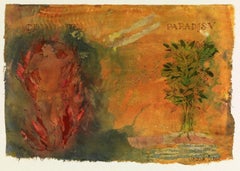
Burning Man near Paradise
By Victoria Crowe
Located in Edinburgh, GB
Victoria Crowe (1945), Burning Man near Paradise, 2012, mixed media on paper, 17.5 x 25 cm.
Category
21st Century and Contemporary Victoria Crowe Paintings
Materials
Mixed Media
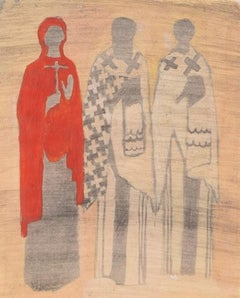
Iconography Study IV: Three Figures, Red Religious Icon on Paper, 1967/8
By Victoria Crowe
Located in Kingsclere, GB
Iconography Study IV: Three Figures
Category
20th Century Victoria Crowe Paintings
Materials
Gouache
Related Items
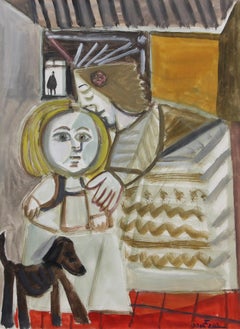
The Family
By Raymond Debieve
Located in London, GB
'The Family', gouache on fine art paper (1984), by Raymond Dèbieve. In a clear nod to Picasso's influence both stylistically and in terms of subject matter ...
Category
1980s Modern Victoria Crowe Paintings
Materials
Paper, Gouache

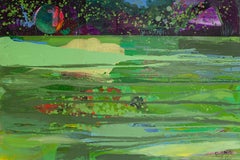
Green River – Oil-Collage, Atmospheric Nature Painting, Abstraction, Expression
By Agnieszka Zawisza
Located in Salzburg, AT
Agnieszka Zawisza (born 1970) is a painter, visual artist and art teacher. She studied at the Warsaw Art Academy, Department of Painting (1994-2000),...
Category
2010s Contemporary Victoria Crowe Paintings
Materials
Canvas, Oil, Mixed Media
$2,609
H 31.5 in W 47.25 in D 0.79 in
Raoul Dufy
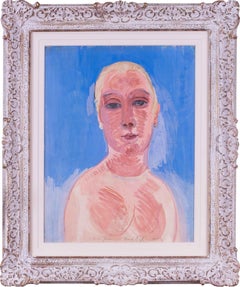
s wife by Raoul Dufy, gouache on paper, 1915, French Fauvist portrait
By Raoul Dufy
Located in Petworth, West Sussex
A striking and very intimate work created by the renowned Fauvist artist Raoul Dufy in the early 20th century, depicting his wife in 1915. This artwork is a rare and very precious ge...
Category
Early 20th Century Fauvist Victoria Crowe Paintings
Materials
Paper, Gouache
$36,642
H 24 in W 18.88 in D 1 in
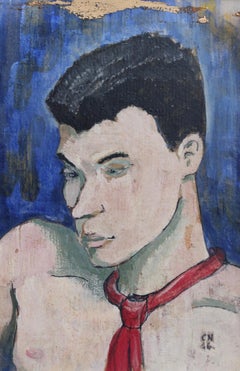
Portrait of a Young Man in a Red Tie
French School (1956)
Located in London, GB
'Portrait of a Young Man in a Red Tie', gouache and ink on art paper, French School (1956). Step into the world of mid-20th century European art with a striking portrait that capture...
Category
1950s Modern Victoria Crowe Paintings
Materials
Paper, Ink, Gouache
$572 Sale Price
30% Off
H 14.97 in W 12.8 in
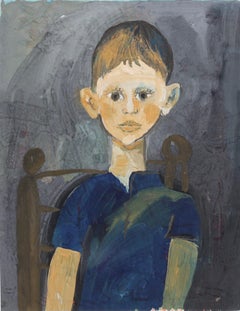
Portrait of Boy in a Chair
By Raymond Debieve
Located in London, GB
'Portrait of Boy in a Chair', gouache on art paper, by Raymond Debiève (circa 1960s). Here the artist paints a young boy, very probably his son, Vincent, sitting in a chair posing fo...
Category
1960s Modern Victoria Crowe Paintings
Materials
Paper, Gouache
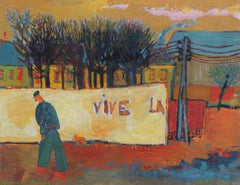
Winter in Provence
By Raymond Debieve
Located in London, GB
'Winter in Provence', gouache on art paper, by Raymond Debiève (circa 1970s). There is both beauty and melancholy in this delightfully charming artwork. The artist's naive style is at odds with the refinement, poise and sophistication of the painting. Perhaps the artist was making a statement as well with the broken wall...
Category
1970s Modern Victoria Crowe Paintings
Materials
Paper, Gouache
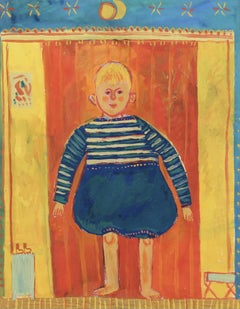
French Boy in Bloomers
By Raymond Debieve
Located in London, GB
'French Boy in Bloomers', gouache on art paper (circa 1960s-70s), by Raymond Debiève. A young boy emerges from a beach cabana wearing a bloomer bathing costume that was still in use ...
Category
1960s Modern Victoria Crowe Paintings
Materials
Paper, Gouache
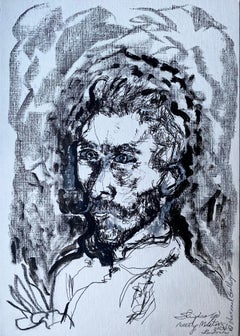
Original-Meeting Van Gogh-Study Master Series-British Awarded Artist-Ink Drawing
Located in London, GB
This drawing studied of Van Gogh's self-portrait at his Solo exhibition " Poets and Lovers" in National Gallery, London, 2024.
Shizico Yi learned her craft in drawings from old mast...
Category
2010s Contemporary Victoria Crowe Paintings
Materials
Ink, Archival Paper, Charcoal, Gouache, Acrylic
$518
H 8.27 in W 11.7 in D 0.08 in
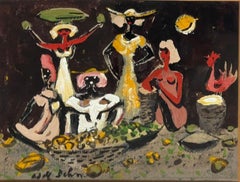
Adolf Dehn, Haitian Scene A, signed painting, Associated American Artists, 1950s
By Adolf Arthur Dehn
Located in New York, NY
Adolf Arthur Dehn
Haitian Scene A, ca. 1951
Watercolor gouache on board
Signed on the front
Frame included: held in vintage modern frame
Measurements:
Framed:
11 inches vertical by 13 inches horizontal by .75
Painting
4.5 inches by 6 inches
Watercolor gouache, hand signed; framed with AAA Gallery label verso
Signed on the front bearing the original label on the verso of Dehn's longtime gallery, the prestigious Associated American Artists Gallery, New York City.
Provenance
Associated American Artists
Frame included: held in vintage frame with original label as provenance
Dehn, an influential artist and teacher (and author of the definitive textbook of his era on watercolor painting) joined Associated American Artists gallery in 1941. Although this painting is undated, it is likely circa early 1950s, as in 1951 Dehn won a Guggenheim Fellowship, which enabled him to travel to Haiti -- the subject of this work. It was part of a series inspired by Dehn's visit to Haiti.
Dehn, an influential artist and teacher (and author of the definitive textbook of his era on watercolor painting) joined Associated American Artists gallery in 1941. Although this painting is undated, it is likely circa early 1950s, as in 1951 Dehn won a Guggenheim Fellowship, which enabled him to travel to Haiti.
ADLOF DEHN
Adolf Dehn, American Watercolorist and Printmaker, 1895-1968
Adolf Dehn was an artist who achieved extraordinary artistic heights, but in a very particular artistic sphere - not so much in oil painting as in watercolor and lithography. Long recognized as a master by serious print collectors, he is gradually gaining recognition as a notable and influential figure in the overall history of American art.
In the 19th century, with the invention of the rotary press, which made possible enormous print runs, and the development of the popular, mass-market magazines, newspaper and magazine illustration developed into an artistic realm of its own, often surprisingly divorced from the world of museums and art exhibitions, and today remains surprisingly overlooked by most art historians. Dehn in many regards was an outgrowth of this world, although in an unusual way, since as a young man he produced most of his illustrative work not for popular magazines, such as The Saturday Evening Post, but rather for radical journals, such as The Masses or The Liberator, or artistic "little magazines" such as The Dial. This background established the foundation of his outlook, and led later to his unique and distinctive contribution to American graphic art.
If there’s a distinctive quality to his work, it was his skill in introducing unusual tonal and textural effects into his work, particularly in printmaking but also in watercolor. Jackson Pollock seems to have been one of many notable artists who were influenced by his techniques.
Early Years, 1895 - 1922
For an artist largely remembered for scenes of Vienna and Paris, Adolf Dehn’s background was a surprising one. Born in Waterville, Minnesota, on November 22, 1895, Dehn was the descendent of farmers who had emigrated from Germany and homesteaded in the region, initially in a one-room log cabin with a dirt floor. Adolf’s father, Arthur Clark Dehn, was a hunter and trapper who took pride that he had no boss but himself, and who had little use for art. Indeed, during Adolf’s boyhood the walls of his bedroom and the space under his bed were filled with the pelts of mink, muskrats and skunks that his father had killed, skinned and stretched on drying boards. It was Adolf’s mother, Emilie Haas Dehn, a faithful member of the German Lutheran Evangelical Church, who encouraged his interest in art, which became apparent early in childhood. Both parents were ardent socialists, and supporters of Eugene Debs...
Category
1950s Modern Victoria Crowe Paintings
Materials
Watercolor, Gouache, Board
$2,500
H 11 in W 13 in D 0.75 in
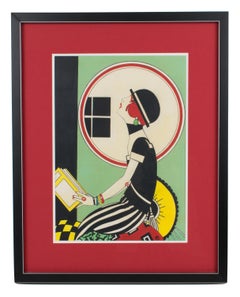
French Art Deco Woman Singing Gouache Painting
Located in Atlanta, GA
A lovely gouache on cardboard painting featuring an Art Deco singer with a typical stylish outfit. Utilizing the contrast of black and white components against primary colors like y...
Category
1930s Art Deco Victoria Crowe Paintings
Materials
Gouache, Board, Cardboard
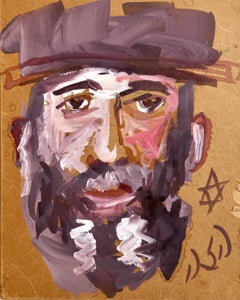
Outsider Folk Art Expressionist Rabbi Israeli Painting Signed Hebrew Jewish Star
Located in Surfside, FL
This is a signed portrait painting done in an outsider, folk art, expressionist style. it is signed in Hebrew, also marked with a Jewish star. this is from a collection of works by the same hand. they are all signed. Some have markings to the back of the paper. they have some age to them. They bear similarities to artists as dissimilar as Moshe Tamir, Mane Katz and an Israeli version of Purvis Young. In this piece the artist choice of colors is muted yet powerful.
Israel has had a Vibrant Folk Art, Naive art scene for a long time now, artists like Yisrael Paldi, Nahum Guttman, Reuven Rubin and even Yefim Ladyzhensky had naive periods. The most well know of the strict naive artists are Shalom of Safed, Irene Awret, Gabriel Cohen, Natan Heber, Michael Falk and Kopel Gurwin.
Naïve art is any form of visual art that is created by a person who lacks the formal education and training that a professional artist undergoes (in anatomy, art history, technique, perspective, ways of seeing). Unlike folk art, naïve art does not necessarily evince a distinct cultural context or tradition. Naïve art is recognized, and often imitated, for its childlike simplicity and frankness. Paintings of this kind typically have a flat rendering style with a rudimentary expression of perspective.
One particularly influential painter of "naïve art" was Henri Rousseau (1844–1910), a French Post-Impressionist who was discovered by Pablo Picasso.
Naïve art is often seen as outsider art that is by someone without formal (or little) training or degree. While this was true before the twentieth century, there are now academies for naïve art. Naïve art is now a fully recognized art genre, represented in art galleries worldwide.
Museums devoted to naïve art now exist in Kecskemét, Hungary; Riga, Latvia; Jaen, Spain; Rio de Janeiro, Brasil; Vicq France and Paris. "Primitive art" is another term often applied to art by those without formal training, but is historically more often applied to work from certain cultures that have been judged socially or technologically "primitive" by Western academia, such as Native American, sub saharan African or Pacific Island art (see Tribal art). This is distinguished from the self-conscious, "primitive" inspired movement primitivism. Another term related to (but not completely synonymous with) naïve art is folk art.
There also exist the terms "naïvism" and "primitivism" which are usually applied to professional painters working in the style of naïve art (like Paul Gauguin, Mikhail Larionov, Paul Klee).
At all events, naive art can be regarded as having occupied an "official" position in the annals of twentieth-century art since - at the very latest - the publication of the Der Blaue Reiter, an almanac in 1912. Wassily Kandinsky and Franz Marc, who brought out the almanac, presented 6 reproductions of paintings by le Douanier' Rousseau (Henri Rousseau), comparing them with other pictorial examples. However, most experts agree that the year that naive art was "discovered" was 1885, when the painter Paul Signac became aware of the talents of Henri Rousseau and set about organizing exhibitions of his work in a number of prestigious galleries.
The Earth Group (Grupa Zemlja) were Croatian artists, architects and intellectuals active in Zagreb from 1929 to 1935. The group included the painters Krsto Hegedušić, Edo Kovačević, Omer Mujadžić, Kamilo Ružička, Ivan Tabaković, and Oton Postružnik, the sculptors Antun Augustinčić, Frano Kršinić, and the architect Drago Ibler. Art brut, primitive art, primitive, art naïf, naïve art. Outsider art. A term applied to Yugoslav (Croatian) naive painters working in or around the village of Hlebine, near the Hungarian border, from about 1930. Some of the best known naive artists are Dragan Gaži, Ivan Generalić, Josip Generalić, Krsto Hegedušić, Mijo Kovačić, Ivan Lacković-Croata, Franjo Mraz, Ivan Večenaj and Mirko Virius.
Camille Bombois (1883–1970) Ferdinand Cheval, known as 'le facteur Cheval' (1836–1924)
Henry Darger (1892–1973) L. S. Lowry (1887–1976) Grandma Moses, Anna Mary Robertson (1860–1961) Nikifor (1895–1968) Poland, Horace Pippin (1888–1946) Jon Serl (1894-1993) United States
Alfred Wallis (1855–1942) Scottie Wilson (1890–1972) Gesner Abelard (b. 1922) Jan Balet (1913–2009) Michel Delacroix (b. 1933) France Howard Finster (1916–2001) Ivan Rabuzin (1921–2008)
Spontaneous Art Museum in Brussels
Art en Marge Museum in Brussels
MADmusée in Liege
International Museum of Naive Art of Brazil in Cosme Velho, Rio de Janeiro
Gallery Jacques Ardies in São Paulo
Musée international d'art naïf de Magog in Magog
Croatian Museum of Naïve Art in Zagreb
Gallery of Croatian Naïve Art...
Category
20th Century Outsider Art Victoria Crowe Paintings
Materials
Gouache
$400
H 12 in W 9.5 in
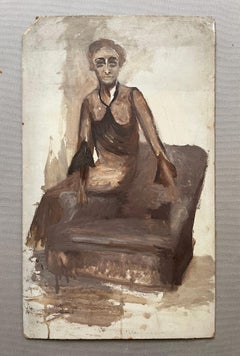
Woman On An Armchair, Sketch, Gouache On Cardboard
Located in SAINT-OUEN-SUR-SEINE, FR
Woman on an armchair.
Gouache on cardboard.
Upper left corner broken, lower corners trimmed.
Small dirt.
46 x 27.5 cm
Category
Early 20th Century Victoria Crowe Paintings
Materials
Gouache, Cardboard
Victoria Crowe paintings for sale on 1stDibs.
Find a wide variety of authentic Victoria Crowe paintings available for sale on 1stDibs. You can also browse by medium to find art by Victoria Crowe in mixed media and more. Not every interior allows for large Victoria Crowe paintings, so small editions measuring 20 inches across are available. Victoria Crowe paintings prices can differ depending upon medium, time period and other attributes. On 1stDibs, the price for these items starts at $579 and tops out at $579, while the average work can sell for $579.