Wiener Keramik Werkstätte Sculptures
to
2
3
3
3
1
1
2
1
3
1
3
3
3
Height
to
Width
to
3
3
3
3
366
269
244
200
Creator: Wiener Keramik Werkstätte
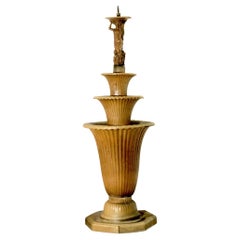
Original and Unique Ceramic Fountain by Otto Prutscher and Michael Powolny, 1914
By Wiener Keramik Werkstätte, Michael Powolny, Otto Prutscher
Located in Vienna, AT
Executed by Michael Powolny for the Wienerberger Keramikwerkstätten, ceramic and stoneware, ochre colored, body holding a dish in her outstretched arms standing above a three-tired C...
Category
Early 20th Century Austrian Jugendstil Wiener Keramik Werkstätte Sculptures
Materials
Ceramic, Stoneware
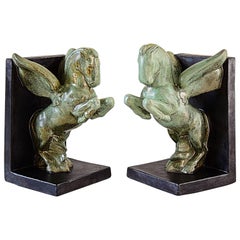
Pair of Art Deco Wienerberger Ceramics Bookholder Showing Pegasus, circa 1925s
By Wiener Keramik Werkstätte
Located in Wien, AT
Pair of Wienerberger ceramics bookholder showing pegasus.
Excellent original condition.
Category
1920s Austrian Art Deco Vintage Wiener Keramik Werkstätte Sculptures
Materials
Ceramic

$765 Sale Price / set
64% Off
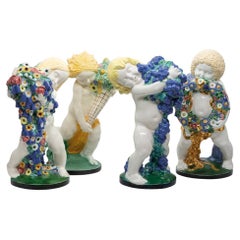
Michael Powolny Four Seasons Putti ca. 1906
By Michael Powolny, Wiener Keramik Werkstätte
Located in Klosterneuburg, AT
four seasons Putti, Michael Powolny, Wiener Keramik, ca. 1906
Michael Powolny's renowned design is one of the most famous example of Jugendstil ceramics. They were produced by Wiene...
Category
Early 1900s Austrian Jugendstil Antique Wiener Keramik Werkstätte Sculptures
Materials
Ceramic
$168,325 Sale Price / set
20% Off
Related Items
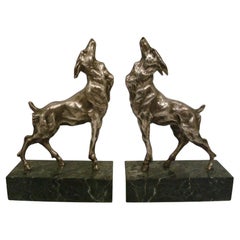
Art Deco Emile Carlier Figural Goat Bookends, France 1925
By Émile Nestor Joseph Carlier 1
Located in Buenos Aires, Olivos
Art Deco Bookends. Emile Joseph Nestor Carlier, (French, 1849-1927). Figural Goat Bookends. Silvered Metal mounted over Green Marble bases. Nice and heav...
Category
Early 20th Century French Art Deco Wiener Keramik Werkstätte Sculptures
Materials
Marble, Metal
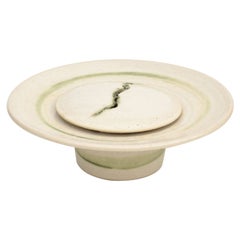
Architectural Studio Pottery Fountain by Piet Knepper
By Mobach, Piet Knepper
Located in London, GB
Fountain with two different tops by Piet Knepper for Mobach white glaze with copper oxide details and cracked surface, hand turned studio ceramic .
This is an example of Modern Scho...
Category
1980s European Vintage Wiener Keramik Werkstätte Sculptures
Materials
Ceramic
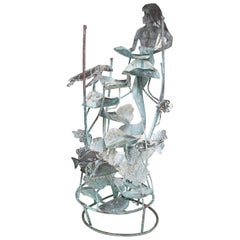
Copper Mermaid Fountain by Glen Mayo
By Glen Mayo
Located in West Palm Beach, FL
Whimsical fountain sculpture, of copper, by metal artist Glen Mayo; its mermaid focal point holding a leaf which cascades water down the fountain, among turtles, angel fish, other se...
Category
1990s North American Wiener Keramik Werkstätte Sculptures
Materials
Copper
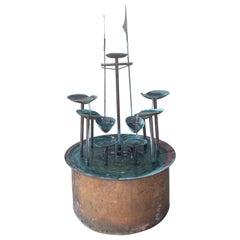
Wonderful Modernist Kenetic Motion Copper Fountain / Water Feature, Hand Made
Located in Buffalo, NY
Ingenious copper fountain / water feature, solid copper construction, Modernist design Artisan made, hand executed. Sculpture in motion, great for garden, or indoor space.
Category
1970s American Mid-Century Modern Vintage Wiener Keramik Werkstätte Sculptures
Materials
Copper
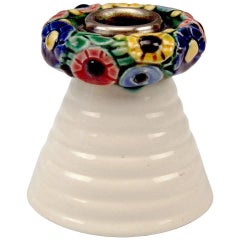
Michael Powolny VWGK Vienna Candlestick Made, circa 1907
By Michael Powolny
Located in Vienna, AT
Elegant candlestick for holding one candle
Modelled by Michael Powolny (1871-1954), circa 1907
Hallmarked:
Manufactured by Wiener Keramik and Gmundner Keramik
(union Of Vienna Ceramics & Gmunden Ceramics - VWGK / Hallmarked)
Material is Ceramics (glossy finish / multicolored painted).
Model Number 142
Made circa 1913
Subject: The cream white candlestick is decorated with horizontal lines attached to surface. The Grommet is surrounded/encircled by A Wreath Of Flowers' blossoms.
Height: 8.0 cm (= 3.14 inches)
Diameter: 8.0 cm (= 3.14 inches)
Bibliography:
Waltraud Neuwirth, Markenlexikon fu¨r Kunstgewerbe (3), Wiener Keramik / Modelle 1906-13; page 122
Experts of Fine Arts assess Michael Powolny's work nowadays as result of activity of one the most important ceramics...
Category
Early 20th Century Austrian Art Nouveau Wiener Keramik Werkstätte Sculptures
Materials
Ceramic
Meissen style porcelain and gilt bronze table fountain by Samson
Located in London, GB
This colourful porcelain table fountain, fashioned in the German Meissen style, was crafted in the 19th Century by the French porcelain company Samson et Cie.
The table fountain co...
Category
19th Century German Louis XV Antique Wiener Keramik Werkstätte Sculptures
Materials
Ormolu
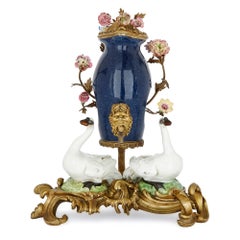
$24,600
H 12.21 in W 10.63 in D 5.91 in
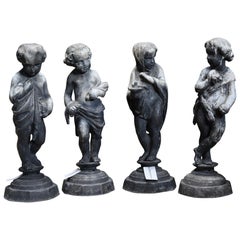
19th Century Lead Statues, Four Seasons
Located in Bloomfield Hills, MI
In the grand tradition of classical mythology, these four lead sculptures represent the original personifications of nature in all their seasonal aspects.
Each figure has been creat...
Category
Late 19th Century English Late Victorian Antique Wiener Keramik Werkstätte Sculptures
Materials
Lead
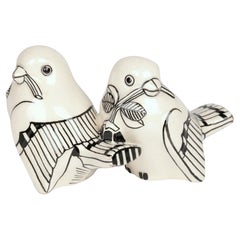
Michael Powolny Rare Pottery Pair Sparrows Figure c.1907
By Michael Powolny
Located in Bishop
s Stortford, Hertfordshire
A delightful and rare Austrian Wiener Keramik pair of pottery sparrows by renowned sculptor and ceramicist Michael Powolny (Austrian, 1871-1954) and dating from around 1907.
Michael...
Category
Early 1900s Austrian Art Nouveau Antique Wiener Keramik Werkstätte Sculptures
Materials
Pottery
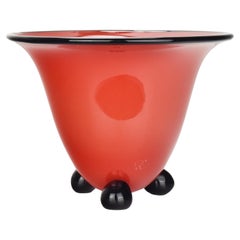
Bohemian Loetz Red Tango Glass Vase w. Black Accents by Michael Powolny
By Loetz Glass, Michael Powolny
Located in Bad Säckingen, DE
This antique Art Nouveau art glass vase by Michael Powolny for Loetz is an impressive and highly sought-after art piece from the early 20th cen...
Category
1910s Austrian Vienna Secession Vintage Wiener Keramik Werkstätte Sculptures
Materials
Glass, Art Glass, Blown Glass
$1,147 Sale Price
20% Off
H 5.28 in Dm 6.89 in
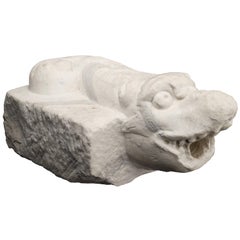
Italian Ancient Marble Sculpture Fountain, Late 16th Century
Located in Milano, IT
Sea monster
Carrara marble mouth fountain
Italy, late 16th century
It measures 13.8 x 31.5 x 18.9 in (35 x 80 x 48 cm)
State of conservation: some small evident gaps and widespread signs of wear due to outdoor exposure. The gray marks crossing it do not come from restoration, but are rather the natural veins of the marble.
This work has some morphological characteristics typically associated with the iconography of the sea monster: an elongated muzzle, sharp teeth, protruding eyes, elongated ears, and a coiled serpent's tail.
An in-depth series of studies on artistic depictions of the sea monster attempted to verify how this symbol evolved in antiquity in the European and Mediterranean contexts and how it gradually changed its image and function over time. The iconography itself is mutable and imaginative and its history is rich with cultural and artistic exchange, as well as the overlapping of ideas. This occurred so much that it is difficult to accurately pinpoint the "types" that satisfactorily represent its various developments.
However, we can try to summarize the main figures, starting from the biblical Leviathan and the marine creature that swallowed Jonah (in the Christian version, this figure was to become a whale or a "big fish", the “ketos mega”, translation of the Hebrew “dag gadol”). Other specimens ranged from the dragons mentioned in the Iliad (which were winged and had legs) to "ketos” (also from Greek mythology), the terrifying being from whose Latinized name (“cetus”) derives the word "cetacean". See J. Boardman, “Very Like a Whale” - Classical Sea Monsters, in Monsters and Demons in the Ancient and Medieval Worlds, in Papers presented in Honor of Edith Porada, Mainz am Rhein 1987, pp. 73-84).
In Italy the monster underwent yet further variations: it can be found in Etruscan art on the front of some sarcophagi representing the companion of souls, while among the Romans we find the “Pistrice” (cited by Plinio in Naturalis Historia PLIN., Nat., II 9, 8 and by Virgilio in Eneide: VERG., Aen., III, 427), which appeared in the shape of a stylized hippocampus or a very large monstrous cetacean and evolved into a hideous being with a dragon's head and long webbed fins.
During the Middle Ages, the sea monster was the object of new transformations: at this time, it is often winged, the head is stretched like a crocodile, the front legs are often very sharp fins - sometimes real paws - until the image merges with dragons, the typical figures of medieval visionary spirituality widely found throughout Europe (on this topic and much more, see: Baltrušaitis, J., Il Medioevo fantastico. Antichità ed esotismi nell’arte gotica, Gli Adelphi 1997).
In Italy during the 15th and 16th centuries, the revival of classicism - representative of the humanistic and Renaissance periods - led to a different reading of these "creatures". Indeed, the sea monster was also to find widespread use as an isolated decorative motif, especially in numerous fountains and sculptures where dolphins or sea monsters were used as a characterizing element linked to water (on this theme see: Chet Van Duzer, Sea Monsters on Medieval and Renaissance Maps, London, The British library, 2013).
From the morphological point of view, the "sea monsters" of this period are mostly depicted as hybrid figures, in which the body of a mythological or real being (a hippocampus, a sea snake, a dolphin), is joined to a head with a rather indistinct appearance. It was usually characterized by large upright ears, an elongated snout, sharp teeth and globular, protruding eyes; a complex and indefinite figure, both from the symbolic point of view and from that of its genesis.
The work we are examining is placed as a cross between the medieval sea serpent and the Renaissance dolphin, with stylistic features which recall the snake as often used in heraldry (such as the "snake" depicted in the coat of arms of the Visconti - the lords and then dukes of Milan between 1277 and 1447 - and which, for some, may be derived from the representations of the “Pistrice” that swallowed Jonah).
In the search for sources, Renaissance cartography and in particular woodcuts should not be neglected. See for example the monsters of Olaus Magnus, from the editions of the “Historia de gentibus septentrionalibus” (“History of the peoples of the north”) and the natural histories of Conrad Gesner, Ulisse...
Category
16th Century Italian Renaissance Antique Wiener Keramik Werkstätte Sculptures
Materials
Carrara Marble
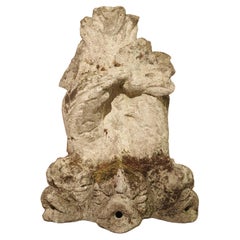
Antique French Stone Fountain Piece with Triple Dolphin Spouts, Circa 1900
Located in Dallas, TX
This charming French fountain piece with triple dolphin spouts was made circa 1900. The dolphins are made from reconstituted stone, which is natural lim...
Category
Early 1900s French Antique Wiener Keramik Werkstätte Sculptures
Materials
Stone
$2,700
H 17.5 in W 13.25 in D 10 in
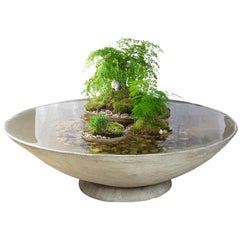
Ukiyo Saucer, Concrete Fountain/Fishpond by OPIARY (D50")
By Robert Remer
Located in Brooklyn, NY
Opiary is a Brooklyn-based biophilic design and production studio. We integrate nature in each of our designs, incorporating live greenery and organic shapes into bespoke furniture, planters, and sculpture. Through the ethos of biophilia, our work reflects the shifting, yet timeless relationship between humans and nature.
This modern, minimalist fountain is a tasteful way to incorporate aquatic life into any indoor or outdoor space. The Ukiyo Saucer...
Category
21st Century and Contemporary Modern Wiener Keramik Werkstätte Sculptures
Materials
Cement
Previously Available Items
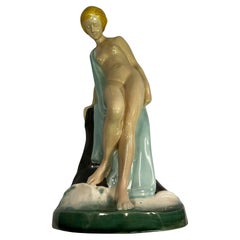
Bathing woman figure, Wiener Kunstkeramische Werkstätte, ceramics, 1915, Vienna
By Wiener Keramik Werkstätte
Located in Wien, AT
Very rare figure, the bathing woman designed by Johanna Meier-Michel, executed by the Vienna Kunstkeramische Werkstätte, during the Art Nouveau period.
This ceramic piece, model "Di...
Category
1910s Austrian Jugendstil Vintage Wiener Keramik Werkstätte Sculptures
Materials
Ceramic
H 10.24 in W 5.12 in D 4.72 in
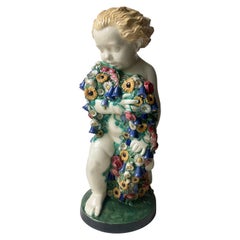
Michael Powolny Ceramic Pottery Sculpture, Large Putto "Spring" Winer Keramik
By Wiener Keramik Werkstätte, Michael Powolny
Located in Los Angeles, CA
Beautiful, ceramic / pottery Putto. "Figure of Spring" designed by Michael Powolny 1871-1954, made by Wiener Ceramic, marked with MP and WK as shown in picture. This is one of the la...
Category
Early 20th Century Austrian Art Nouveau Wiener Keramik Werkstätte Sculptures
Materials
Ceramic
Excellent Centerpiece of Two Cherubs Wiener Kunstkeramische Werkstaette c.1910
By Wiener Keramik Werkstätte
Located in Vienna, AT
Excellent Centrepiece Supported By Two Cherubs
Made by Wiener Kunstkeramische Werkstaette (Busch & Ludescher), Vienna
Most lovely appearance: Two cher...
Category
Early 20th Century Austrian Art Nouveau Wiener Keramik Werkstätte Sculptures
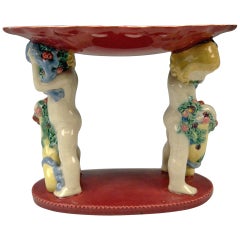
H 8 in W 10 in D 4.4 in
Wiener Keramik Werkstätte sculptures for sale on 1stDibs.
Wiener Keramik Werkstätte sculptures are available for sale on 1stDibs. These distinctive items are frequently made of ceramic and are designed with extraordinary care. There are many options to choose from in our collection of Wiener Keramik Werkstätte sculptures, although brown editions of this piece are particularly popular. Many of the original sculptures by Wiener Keramik Werkstätte were created in the Art Nouveau style in europe during the early 20th century. If you’re looking for additional options, many customers also consider sculptures by Ernst Wahliss, Michael Powolny, and Wilhelm Thomasch. Prices for Wiener Keramik Werkstätte sculptures can differ depending upon size, time period and other attributes — on 1stDibs, these items begin at $2,010 and can go as high as $160,819, while a piece like these, on average, fetch $28,000.