William Hogarth Interior Prints
British, 1697-1764
William Hogarth (1697-1764) was an English painter, printmaker, pictorial satirist, social critic, and editorial cartoonist. Hogarth's work was extremely diverse, ranging from serious realistic paintings and portraits to satire and moralistic pieces filled with symbolism. He often communicated his moral message in a series of paintings and engravings, such as: A Rake's Progress, Marriage A-la-Mode and A Harlot's Progress. He was by far the most significant English artist of his generation and inspired a movement of English caricaturists and satirists, including James Gillray (1756-1815), Thomas Rowlandson (1757-1827), Isaac Cruickshank (1764-1811) and George Cruickshank (1792-1878). His work has been studied intensely for the greater than two and a half centuries since his death with several academic scholars focusing their careers on the analysis of every element of each of his creations.to
1
1
Overall Width
to
Overall Height
to
1
13
108
79
46
30
1
1
1
1
1
1
1
1
1
1
Artist: William Hogarth
William Hogarth
s "Analysis of Beauty": A Set of Two Framed 18th C. Engravings
By William Hogarth
Located in Alamo, CA
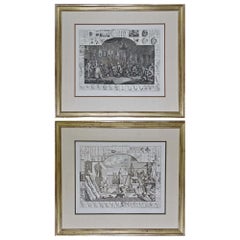
The two plates in this set were created utilizing both engraving and etching techniques by William Hogarth in 1753, originally as illustrations of his book on aesthetics, entitled "Analysis of Beauty". Due to their popularity, these plates were later published separately. The publication line in the lower right reads: "Designed, Engraved, and Publish'd by Wm. Hogarth, March 5th 1753, according to Act of Parliament." Hogarth's original copper plates were refurbished where needed by James Heath and engravings were republished in London in 1822 by Braddock, Cradock & Joy. This was the last time Hogarth's copper plates were used for printing. Most were melted during World War I for the construction of bombs.
These large folio sized "Analysis of Beauty" engravings are presented in antiqued gold-colored frames with double mats; the outer silk mats are light brown-colored and the inner mats are dark brown. Each frame measures 27.38" x 31.25" x 1.13". There is one tiny spot in the right margin of plate 1 and another in the lower margin; the latter could be from the printing process. The prints are otherwise in excellent condition.
The "Analysis of Beauty" series is in the collection of many major museums, including: The British Museum, The Metropolitan Museum of Art, The Tate Museum, The Chicago Art Institute and The Fine Arts Museums of San Francisco.
The first engraving (Plate 1) depicts a courtyard of statues which is filled with some of the most famous works of classical sculpture. The most important sculptures are surrounded by less impressive works. The Medicean Venus (#13) is in the center with a statue of Julius Caesar (#19) to the right, elevated on a pulley with a short, overdressed Brutus stands over the falling Caesar. The Apollo Belvedere (#12) is next. A judge stands to the right with his foot on a cherub (#16). Another crying cherub holds a gallows and wipes his tears with the judge's robe.
A sphinx (#21) and the drunken Silenus (#107) are below the Venus. Michaelangelo's torso (#54) and a statue of Antonius (#6) are seen in the foreground. The Farnese Hercules (#3) and a bust of another Hercules (#4) under two statuettes of Isis are also included in the scene.
The key to these objects is included in the form of a serpentine line winding around a cone (#26), Hogarth's "Line of Beauty". For Hogarth the winding line is an essential element of beauty in art. Hogarth's theory of beauty is communicated in this plate.
Plate 2 is thought to represent the Wanstead Assembly, with the Earl of Tynley and his household. It is an adaptation of a scene in the Happy Marriage series, which complements Hogarth's Marriage à la Mode...
Category
Mid-18th Century Old Masters William Hogarth Interior Prints
Materials
Engraving, Etching
Related Items
Sportsmen
By Louis Legrand
Located in Storrs, CT
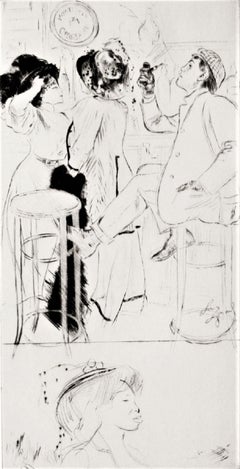
Sportsmen. 1908. Etching and drypoint. Exsteens 271.i/ii. 11 1/4 x 5 3/4 (sheet 17 3/8 x 12 1/4). Series: Les Bars. From the first state edition of 30 proofs with the remarque sketch...
Category
Early 1900s Post-Impressionist William Hogarth Interior Prints
Materials
Drypoint, Etching

Jesus and the Woman at the Well,
by Amand-Durand, Engraving
By Armand Durand
Located in Oklahoma City, OK
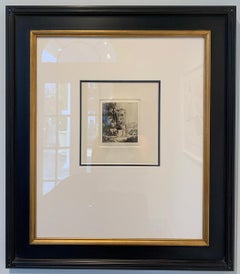
This early 19th century framed 35" x 31" engraving by artist Amand-Durand depcits an etching of 'Jesus and the Woman at the Well,' after the Dutch master, Rembrandt van Rijn. This poignant Biblical story is depicted by Arman-Durand in Rembrandt style...
Category
Early 19th Century Old Masters William Hogarth Interior Prints
Materials
Engraving
$1,200 Sale Price
20% Off
H 30.5 in W 26.5 in D 1.5 in
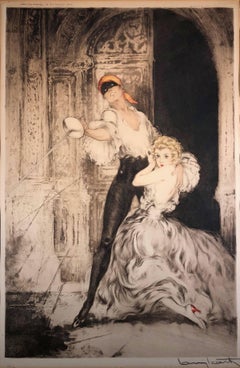
Don Juan
By Louis Icart
Located in Missouri, MO
Aquating Engraving
Image Size: approx. 20 1/4 x 13 3/8
Framed Size: 28 x 20.5 inches
Pencil Signed Lower Right
Louis Justin Laurent Icart was born in Toulouse in 1890 and died in Paris in 1950. He lived in New York City in the 1920s, where he became known for his Art-Deco color etchings of glamourous women.
He was first son of Jean and Elisabeth Icart and was officially named Louis Justin Laurent Icart. The use of his initials L.I. would be sufficient in this household. Therefore, from the moment of his birth he was dubbed 'Helli'. The Icart family lived modestly in a small brick home on rue Traversière-de-la-balance, in the culturally rich Southern French city of Toulouse, which was the home of many prominent writers and artists, the most famous being Henri de Toulouse-Lautrec.
Icart entered the l'Ecole Superieure de Commerce de Toulouse in order to continue his studies for a career in business, particularly banking (his father's profession). However, he soon discovered the play writings of Victor Hugo (1802-1885), which were to change the course of his life. Icart borrowed whatever books he could find by Hugo at the Toulouse library, devouring the tales, rich in both romantic imagery and the dilemmas of the human condition. It was through Icart's love of the theater that he developed a taste for all the arts, though the urge to paint was not as yet as strong for him as the urge to act.
It was not until his move to Paris in 1907 that Icart would concentrate on painting, drawing and the production of countless beautiful etchings, which have served (more than the other mediums) to indelibly preserve his name in twentieth century art history.
Art Deco, a term coined at the 1925 Paris Exposition des Arts Decoratifs, had taken its grip on the Paris of the 1920s. By the late 1920s Icart, working for both publications and major fashion and design studios, had become very successful, both artistically and financially. His etchings reached their height of brilliance in this era of Art Deco, and Icart had become the symbol of the epoch. Yet, although Icart has created for us a picture of Paris and New York life in the 1920s and 1930s, he worked in his own style, derived principally from the study of eighteenth-century French masters such as Jean Antoine Watteau, François Boucher and Jean Honoré Fragonard.
In Icart's drawings, one sees the Impressionists Degas...
Category
1920s Art Deco William Hogarth Interior Prints
Materials
Engraving, Aquatint
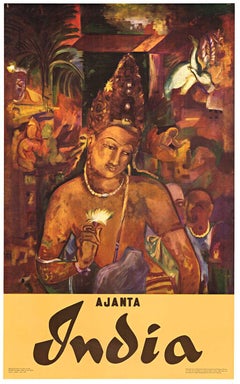
Original AJANTA INDIA Bodhisattva Padmapani vintage travel poster 1959
Located in Spokane, WA
Original Ajanta India vintage travel poster from 1959. Archival linen backed in Grade A condition, ready to frame. Note that a later edition of this poster was printed but the im...
Category
1950s Old Masters William Hogarth Interior Prints
Materials
Lithograph
$995
H 39.5 in W 24.25 in D 0.3 in
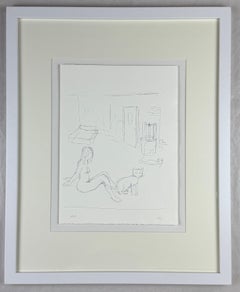
Xisco Mensua Spanish artist 1995 original signed framed engraving print n2
By Xisco Mensua
Located in Miami, FL
Xisco Mensua (Spain, 1960)
Untitled from Portfolio "Junio - Julio", 1995
engraving on paper
12.6 x 9.5 in. (32 x 24 cm.)
Edition of 6
Frame 16x20 in.
ID: MEN1253-002
Hand-signed by a...
Category
1990s Contemporary William Hogarth Interior Prints
Materials
Paper, Engraving
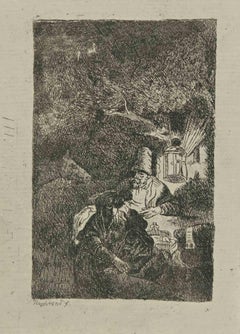
The Rest on the Flight into Egypt - engraving after Rembrandt - 19th Century
By Charles Amand Durand
Located in Roma, IT
The Rest on the Flight into Egypt is an engraving on ivory-colored paper realized after Rembrandt by Charles Amand Durand (1831-1905) after an etching by Rembrandt. This wonderful pi...
Category
19th Century Old Masters William Hogarth Interior Prints
Materials
Engraving
$355
H 4.34 in W 3.15 in D 0.04 in
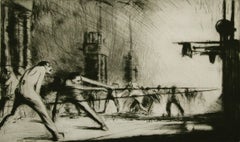
France at her Furnaces
By James McBey
Located in Storrs, CT
1917. Etching. Hardie 175. 8 x 15 (sheet 10 1/8 x 16 15/16). Edition 76. Slight mat line; otherwise excellent condition. A rich impression printed on antique laid paper with full m...
Category
1910s Modern William Hogarth Interior Prints
Materials
Drypoint, Etching
Interiors VI: Soundings
By Peter Milton
Located in New York, NY
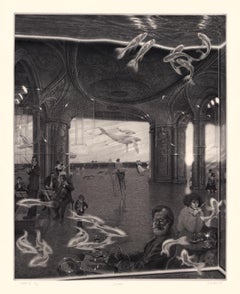
Contemporary artist Peter Milton created this etching and engraving entitled "Interiors VI: Soundings" in 1989. The printed image size is 29 7/8 x 23 13/16 and paper size is 36 x 29 inches. This impression is signed, dated, and titled in pencil and inscribed “93/175” – the 93 impression of 175.
“I do love to draw. I feel that I am being granted membership in the Brotherhood of Merlin, conjuring forth some apparition. As a drawing develops, I sense a vague presence coming more and more into focus, something in a white fog emerging and becoming increasingly palpable.” – P. Milton, “The primacy of touch. The Drawings of Peter Milton”
“Working in layers, Milton begins with drawings based on people and places, with nods to Western art history and culture. He is a master of the appropriated image, a term that may conjure Andy Warhol and his Pop Art comrades. But Milton steps further back in history, avoiding the Pop sense of cool advertising and popular culture references. Instead, a broader cultural past is tapped through historical photographs of key players, architecture, and locales, which he reinvents by hand. He adds content drawn from his life as an avid reader – always with multiple possible interpretations – thus incorporating deeper meaning in his cinematic worlds. Elements of Greek mythology, classical music, art history, and history coalesce in his images, which embrace the messiness, sorrow, and elation that is life. One is hard-pressed to imagine a more erudite, skilled, passionate, and cheeky soul."
– T. L. Johnson and A. Shafer
Peter Milton was born in Pennsylvania in 1930. He studied for two years at the Virginia Military Institute...
Category
Late 20th Century Surrealist William Hogarth Interior Prints
Materials
Engraving, Etching
The Tribute Money - engraving after Rembrandt - 19th Century
By Charles Amand Durand
Located in Roma, IT
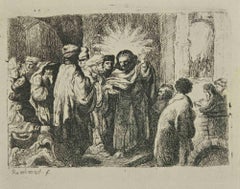
The Tribute Money is an engraving on ivory-colored paper realized after Rembrandt by Charles Amand Durand (1831-1905) after an etching by Rembrandt. This wonderful piece of art belo...
Category
19th Century Old Masters William Hogarth Interior Prints
Materials
Engraving
$315 Sale Price
30% Off
H 4.34 in W 3.15 in D 0.04 in
Interiors I: Family Reunion — A penetrating scene with a hidden homage to Eadwea
By Peter Milton
Located in Middletown, NY
Interiors I: Family Reunion
1984
Resist ground etching and engraving on BFK Rives wove paper, 20 x 36 inches (501 x 913 mm), full margins. Signed, titled, dated and numbered 49/175 in pencil, lower margin. In excellent condition with minor mat tone. A luminous, rich, and well-inked impression of this haunting image, with astonishing detail and depth. Framed handsomely under museum grade glass with archival materials in a solid wood frame with silver finish. [Milton 107]
Intended to be a stand alone image in its inception, Family Reunion ended up spawning seven additional images, and became a sort of Primo Pensiero in the sprawling, masterpiece suite now known as Interiors. The suite took eight years to complete, and consists of works of varying format, psychological intensity, and subject matter. The thematic darkness in the eight images waxes and wanes, and Milton intentionally included several interlude works to lighten the tension he felt while composing several of the darker images. The first two in the series, Family Reunion, and Hotel Paradise Café, were meant to be companion pieces. The equilibrium of each composition is anchored on a central brooding figure; a man (perhaps based on a Thomas Eakins portrait of the American anthropologist Frank Hamilton...
Category
1980s American Modern William Hogarth Interior Prints
Materials
Engraving, Etching
Soup
By Edmund Blampied
Located in Storrs, CT
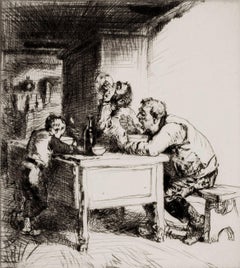
Soup. 1920. Drypoint. Appleby 65. 9 x 8 1/8 (sheet 15 x 11 9/16). Edition 100. Illlustrated: Print Collector's Quarterly 13 (1926): 85. Signed in pencil.
Edmund Blampied was a painter, etcher, lithographer and sculptor. Born in 1886 to a family of three boys in St. Martin, Jersey, Blampied became interested in drawing at an early age. After visiting the studio of John Helier Lander in 1899, Blampied decided to make a career as an artist. In 1903 he went to London to attend Lambeth Art School, where he studied etching under Walter Seymour.
In 1905, he joined the Daily Chronicle as an artist. In that year he was awarded a scholarship to Bolt Court Scool of Photo-engraving and Lithography.
In 1912 he left the Chronicle and established his own studio. He earned a living by illustrating novels and short stories.
In 1913, he had his first exhibition at the Leicester Gallery in London. The following year he married Marianne Van Abbé.
During the 1920's, he became a member of the Royal Society of Painter-Etchers and Engravers. During the 1920s Blampied became a member of the Royal Society of Painters-Etchers and Engravers and exhibited in London to critical acclaim. He produced a folio of comic drawings in the 1930s which was published in New York in 1934 and another that was published in London in 1936. The Keeper of Prints and Drawings at the British Museum published a mongraph on his work. His London exhibitions were highly successful.
In 1938, he moved to Bulwarks, St.Aubin in Jersey, but at the onset of the Occupation, had to relocate to Route Orange, St. Brelade. remained there throughout World War II during the German Occupation, despite the fact that his wife was Jewish. During the Occupation he designed bank...
Category
1920s Modern William Hogarth Interior Prints
Materials
Drypoint, Etching
La diligence de Beaucaire
By Félix Hilaire Buhot
Located in Middletown, NY
Paris: Lemerre, 1880.
Etching, drypoint, aquatint (dust ground and spirit ground), spit bite, and roulette in black on cream laid paper with a deckle edge, 6 3/4 x 4 1/2 inches (170 x 112 mm), full margins. Third state (of 3). An illustration from Alphonse Daudet's, Lettres de mon moulin, Paris, 1880. In very good condition with some light uniform toning and two areas of paper tape at the top right and left corners on the verso (from a former mount). With the 1921 J.H. de Bois circular ink stamp in green ink in the lower right margin on the recto (Lugt L.733).
[Bourcard 110].
A note regarding the provenance:
J. H. de Bois was a well known late-19th century modern art...
Category
1880s French School William Hogarth Interior Prints
Materials
Laid Paper, Drypoint, Etching, Aquatint

Previously Available Items
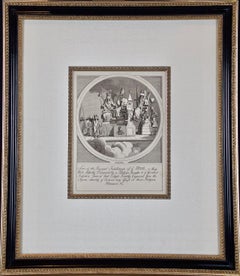
"Principal Inhabitants of the Moon": A Framed 18th Century Satire by Hogarth
By William Hogarth
Located in Alamo, CA
This is a framed original satirical etching/engraving by William Hogarth, entitled "Some Principal Inhabitants of ye Moon: Royalty, Episcopacy and Law", originally published in London in 1760.The inscription reads: ""Some of the principal inhabitants of [the] moon as they were perfectly discover'd by a telescope brought to [the] greatest perfection since [the] last eclipse; exactly engraved from the objects whereby [the] curious may guess at their religion, manners, &c.". Although this may be an original life-time printing, it may have been published by Baldwin Craddock and Joy in London in 1822 from Hogarth's original copper plate that was reworked where needed by Heath, referred to as the Heath edition. This publication was the last time that Hogarth's plates were used for a printing. Most were subsequently destroyed and those remaining are primarily held by institutions.
The scene is presented within a circle, as if seen through a telescope viewing the moon, surrounded by a square border, under which is engraved the title. The figures, who are satirically supposed to be the inhabitants of the moon, sit on a wooden platform suspended above the clouds. Three seated figures are supposed to represent the "Monarchy, Episcopacy, and Law". "Monarchy", representing royalty, sits on a throne wears a crown and he holds a globe and a sceptre. His face is a gold coin. The symbol of perpetuity, is embroidered on the cloth under his throne.
"Episcopacy", representing the church, is operating a pump by pulling on a bell-rope fastened around a bible attached to the pump handle. The pump pours out money into a chest representing the church coffers and wealth. The chest is decorated with an armorial escutcheon, containing a knife and fork, topped by a church leader's mitre. Episcopacy's face is a Jew’s Harp and his right foot rests on a pile of three cushions. A cloven foot is seen protruding from under his religious robe.
"Law" wears the type of wig worn by 18th century English judges. He holds a large sword on the right, but he does not appear to have a left arm. His face is a hammer resembling that of the Viking god Thor. Behind him a dagger appears to be thrust through the bottom of a sieve.
The bodies of the attendants on Monarchy are composed of circular fire-screens, resembling shields. The trunks of the Courtiers are large looking-glasses, the sconces, with candles in them serving for hands and arms. The face of the chief of these is the reverse of a sixpence; and a key significantly appended to his sash at once denotes his sex and office. Under the figure of Law are a male and female modishly dressed. Her head is a tea-pot, her neck is a drinking-glass and her body is a half open fan. The male figure's face is a coat of arms and his legs are fan sticks. He appears to be courting the female.
There is a great deal of satirical symbolism in this print and their meaning is not always obvious. Hogarth may have planned to include an explanation since there are letters a, b, c, d, e, f and g placed over or under some of the figures and objects. The reference books by Ronald Paulson, such as "Hogarth's Graphic Works, provide some possible interpretations.
The print is presented in an ornate glossy black wood frame with beaded gold-colored outer and inner trim, a beaded gold-colored fillet and a cream-colored silk mat. There is a small defect in the frame's right upper edge. The print was not examined out of the frame, but the visible portions of the print are in excellent condition. The frame and mat style are identical to another old master print listed on 1stdibs, a 17th century portrait of the old master artist Petrus de Jode by Anthony van Dyck. This print can be viewed by placing the 1stdibs reference # LU117327129592 in the search field. These two framed prints would make a striking display grouping. A discount is available for purchase of the pair.
Artist: William Hogarth (1697-1764) was an English painter, printmaker, pictorial satirist, social critic, and editorial cartoonist. Hogarth's work was extremely diverse, ranging from serious realistic paintings and portraits to satire and moralistic pieces filled with symbolism. He often communicated his moral message in a series of paintings and engravings, such as: A Rake's Progress, Marriage A...
Category
Mid-18th Century Old Masters William Hogarth Interior Prints
Materials
Engraving, Etching
H 22 in W 19 in D 1.13 in
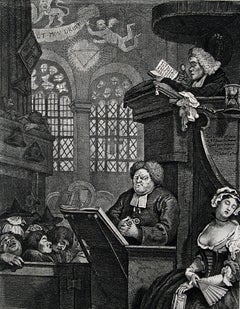
The Sleeping Congregation.
By William Hogarth
Located in Storrs, CT
1736 (Heath Edition 1822). Etching and engraving. Paulson 140 iv/iv; British Museum Satires 2285. 10 1/2 x 8 3/16 (sheet: 12 7/8 x 9 3/4). Inscription: in plate below image, lower le...
Category
1730s Old Masters William Hogarth Interior Prints
Materials
Engraving, Etching
William Hogarth interior prints for sale on 1stDibs.
Find a wide variety of authentic William Hogarth interior prints available for sale on 1stDibs. You can also browse by medium to find art by William Hogarth in engraving, etching and more. Much of the original work by this artist or collective was created during the 18th century and is mostly associated with the Old Masters style. Not every interior allows for large William Hogarth interior prints, so small editions measuring 32 inches across are available. Customers who are interested in this artist might also find the work of Giovanni Battista Piranesi, and Rembrandt van Rijn. William Hogarth interior prints prices can differ depending upon medium, time period and other attributes. On 1stDibs, the price for these items starts at $2,380 and tops out at $2,380, while the average work can sell for $2,380.