William Stanley Haseltine Paintings
to
1
Overall Width
to
Overall Height
to
1
1
1
1
1
1
1
1
1
1
1
1
1
781
713
712
689
1
Artist: William Stanley Haseltine
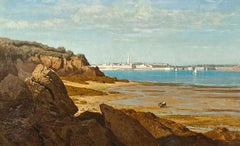
Saint-Malo, Brittany
By William Stanley Haseltine
Located in New York, NY
The career of William Stanley Haseltine spans the entire second half of the nineteenth century. During these years he witnessed the growth and decline of American landscape painting, the new concept of plein-air painting practiced by the Barbizon artists, and the revolutionary techniques of the French Impressionists, all of which had profound effects on the development of painting in the western world. Haseltine remained open to these new developments, selecting aspects of each and assimilating them into his work. What remained constant was his love of nature and his skill at rendering exactly what he saw. His views, at once precise and poetic, are, in effect, portraits of the many places he visited and the landscapes he loved.
Haseltine was born in Philadelphia, the son of a prosperous businessman. In 1850, at the age of fifteen, he began his art studies with Paul Weber, a German artist who had settled in Philadelphia two years earlier. From Weber, Haseltine learned about Romanticism and the meticulous draftsmanship that characterized the German School. At the same time, Haseltine enrolled at the University of Pennsylvania, and took sketching trips around the Pennsylvania countryside, exploring areas along the Delaware and Susquehanna rivers. Following his sophomore year, Haseltine transferred to Harvard University.
After graduating from Harvard in 1854, Haseltine returned to Philadelphia and resumed his studies with Weber. Although Weber encouraged Haseltine to continue his training in Europe, the elder Haseltine was reluctant to encourage his son to pursue a career as an artist. During the next year, Haseltine took various sketching trips along the Hudson River and produced a number of pictures, some of which were exhibited at the Pennsylvania Academy of the Fine Arts in the spring of 1855. Ultimately, having convinced his father that he should be allowed to study in Europe, Haseltine accompanied Weber to Düsseldorf.
The Düsseldorf Academy was, during the 1850s, at the peak of its popularity among American artists. The Academy’s strict course of study emphasized the importance of accurate draftsmanship and a strong sense of professionalism. Landscape painting was the dominant department at the Düsseldorf Academy during this period, and the most famous landscape painter there was Andreas Achenbach, under whom Haseltine studied. Achenbach’s realistic style stressed close observation of form and detail, and reinforced much of what Haseltine had already learned. His Düsseldorf training remained an important influence on him for the rest of his life.
At Düsseldorf, Haseltine became friendly with other American artists studying there, especially Emanuel Leutze, Worthington Whittredge, and Albert Bierstadt. They were constant companions, and in the spring and summer months took sketching trips together. In the summer of 1856 the group took a tour of the Rhine, Ahr, and Nahe valleys, continuing through the Swiss alps and over the Saint Gotthard Pass into northern Italy. The following summer Haseltine, Whittredge, and the painter John Irving returned to Switzerland and Italy, and this time continued on to Rome.
Rome was a fertile ground for artists at mid-century. When Haseltine arrived in the fall of 1857, the American sculptors Harriet Hosmer, Chauncey B. Ives, Joseph Mozier, William Henry Rinehart...
Category
19th Century American Realist William Stanley Haseltine Paintings
Materials
Canvas, Oil
Related Items
A New Way Forward
By Wes Hempel
Located in Fairfield, CT
A walk through any major museum will reveal paintings that depict or legitimate only certain kinds of experience. Despite the good intentions of critical theorists questioning the va...
Category
2010s American Realist William Stanley Haseltine Paintings
Materials
Canvas, Oil

Unexpected Blessing II
By Wes Hempel
Located in Fairfield, CT
Represented by George Billis Gallery, NYC & LA --A walk through any major museum will reveal paintings that depict or legitimate only certain kinds of experience. Despite the good in...
Category
2010s American Realist William Stanley Haseltine Paintings
Materials
Canvas, Oil

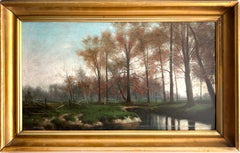
Stunning Antique American Oil Painting Lake Original Frame Signed Illegibly Rare
Located in Buffalo, NY
This tranquil landscape captures a sunlit autumn morning along a quiet stream. Delicate mist softens the background, while a weathered split-rail fence leads the eye through a grove ...
Category
Late 19th Century American Realist William Stanley Haseltine Paintings
Materials
Canvas, Oil
The Artist
s Garden
, Munich Academy, Art Institute of Chicago, PAFA, Corcoran
By Julius Moessel
Located in Santa Cruz, CA
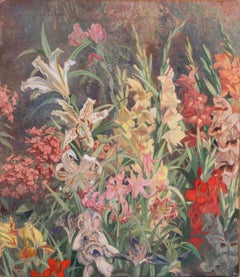
'The Artist's Garden' by Julius Moessel, 1943.
Munich Academy, Art Institute of Chicago, Philadelphia Academy of Fine Arts, Corcoran
-----
Signed lower left 'Moessel' for Julius Moe...
Category
1940s American Realist William Stanley Haseltine Paintings
Materials
Canvas, Oil

$5,000
H 30 in W 26 in D 0.75 in
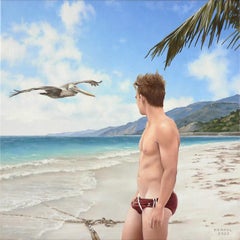
Santa Monica Beach, 11AM
By Wes Hempel
Located in Fairfield, CT
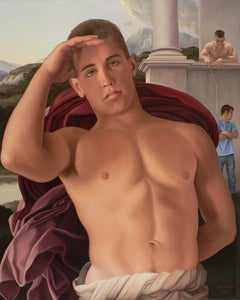
A walk through any major museum will reveal paintings that depict or legitimate only certain kinds of experience. Despite the good intentions of critical theorists questioning the va...
Category
2010s American Realist William Stanley Haseltine Paintings
Materials
Canvas, Oil
No Longer Tied To The Past
By Wes Hempel
Located in Fairfield, CT
Represented by George Billis Gallery, NYC & LA --A walk through any major museum will reveal paintings that depict or legitimate only certain kinds of experience. Despite the good in...
Category
2010s American Realist William Stanley Haseltine Paintings
Materials
Canvas, Oil

String Theory
By Wes Hempel
Located in Fairfield, CT
A walk through any major museum will reveal paintings that depict or legitimate only certain kinds of experience. Despite the good intentions of critical theorists questioning the va...
Category
2010s American Realist William Stanley Haseltine Paintings
Materials
Canvas, Oil
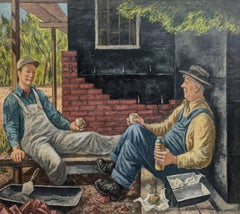
"Lunch Break” Fletcher Martin, Men Working, Bricklayers, WPA, American Scene
By Fletcher Martin
Located in New York, NY
Fletcher Martin
Lunch Break, circa 1940
Signed lower right
Oil on canvas
31 1/2 x 37 3/8 inches
When Fletcher Martin died in 1979, the New York Times entitled his obituary “Artist o...
Category
1940s American Realist William Stanley Haseltine Paintings
Materials
Canvas, Oil
$11,500
H 36.63 in W 42.25 in
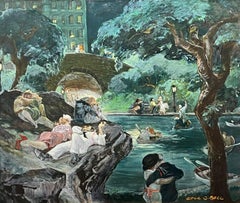
World War II Invades Central Park
By Cecil Crosley Bell
Located in Los Angeles, CA
World War II Invades Central Park, 1943, oil on canvas, signed lower right, 30 x 36 inches, literature: Barton, Phyllis, Cecil C. Bell, McGrew Color Graphics (Kansas City, MO, 1976),...
Category
1940s American Realist William Stanley Haseltine Paintings
Materials
Canvas, Oil
Morning Ride
By Wes Hempel
Located in Fairfield, CT
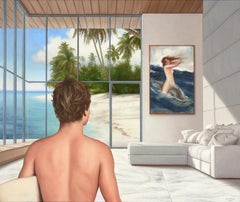
A walk through any major museum will reveal paintings that depict or legitimate only certain kinds of experience. Despite the good intentions of critical theorists questioning the va...
Category
2010s American Realist William Stanley Haseltine Paintings
Materials
Canvas, Oil
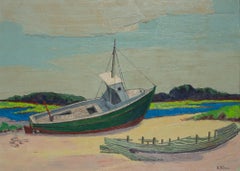
"Low Tide at Noon, Wellfleet, Massachusetts, " Ernest Fiene, WPA, Boat on Beach
By Ernest Fiene
Located in New York, NY
Ernest Fiene (1894 - 1965)
Low Tide at Noon, Wellfleet, Massachusetts
Oil on canvas
26 x 36 inches
Signed lower right
Ernest Fiene was born in Elberfeld, Germany in 1894. As a teenager, Fiene immigrated to the United States in 1912. He studied art at the National Academy of Design in New York City from 1914 to 1918, taking day classes with Thomas Maynard and evening classes with Leon Kroll. Fiene continued his studies at the Beaux-Arts Institute of Design in Paris from 1916 to 1918, adding classes in printmaking at the Art Students League in 1923.
Fiene began his career as an artist in 1919 with his first exhibition of watercolors at the MacDowell Club arranged by his mentor Robert Henri. In 1923 the Whitney Studio Club mounted a large exhibition of his works. The following year he had an exhibition at the New Gallery in New York, which completely sold out all fifty-two works, including paintings, watercolors, drawings, and etchings. With the proceeds of sales from the New Gallery exhibition, Ernest Fiene and his younger brother Paul, a sculptor, built studios in Woodstock, New York in 1925.
In the early Twenties Ernest Fiene painted mostly landscapes of Woodstock and both the Ramapo and Hudson River Valleys. He was the subject of the first monograph for the Younger Artists Series in 1922. Published in Woodstock, the series went on to include Alexander Brook, Peggy Bacon, and Yasuo Kuniyoshi. The book reproduced 1 illustration in color and another 27 reproductions in black and white. Around 1925 Fiene became fascinated with the intensity, excitement, and opportunities for color harmonies New York City offered as a subject. His paintings shifted to urban and industrial themes with architecture, industry, and transportation becoming his subjects.
By 1926 Fiene had attracted the dealer Frank K.M. Rehn, who gave him a one-man exhibition that year, which travelled to the Boston Arts Club. C.W. Kraushaar Galleries gave Fiene a one-man exhibition of urban, landscape, portrait, and still life paintings in 1927. Julianna Force, the director of the Whitney Studio Club and first director of the Whitney Museum of American Art, included two of Fiene's paintings in a fall exhibition in 1928. The Whitney Studio Club showed Fiene's paintings in a two-man exhibition with Glenn O. Coleman that year and acquired three of Fiene's paintings. Also in 1928 Fiene became affiliated with Edith Halpert's Downtown Gallery where he had an exhibition of 20 lithographs in the spring. Fiene sold his house in Woodstock in 1928 to spend more of his time in New York City.
With so many successful exhibitions, Fiene returned to Paris in 1928-29 where he rented Jules Pascin's studio and studied at the Académie de la Grande Chaumière. In France, Fiene painted both landscape and urban subjects developed from ideas influenced by Cubist geometry and the use of flat areas of broad color. Upon returning to New York in 1930, Fiene used this new approach to continue to paint New York skyscraper and waterfront subjects, as well as to begin a series of paintings on changing old New York based on the excavations for Radio City Music Hall and the construction of the Empire State Building. Frank K.M. Rehn Galleries exhibited this series, titled "Changing Old New York," in 1931. Fiene also has solo exhibitions at Rehn Galleries in 1930 and 1932. Fiene's oil paintings are exhibited at the Chicago Arts Club in 1930 as well.
Fiene was included in the Museum of Modern Art's exhibition Painting and Sculpture by Living Americans in December of 1931. Visiting New York, Henri Matisse saw the exhibition and called Fiene's Razing Buildings, West 49th Street the finest painting he had seen in New York. Fiene had two mural studies from his Mechanical Progress series exhibited at the Museum of Modern Art's exhibition Murals by American Painters and Photographers in 1932. Fiene sent View from my Window which depicts Fiene working on a lithograph stone while looking out his window to the newly completed Empire State Building to the Carnegie International in 1931. In 1932 Fiene participated in the first Biennial of American Painting at the Whitney Museum and his prints were included in exhibitions at the Downtown Gallery and the Wehye Gallery. In the same year, Fiene was awarded a Guggenheim fellowship to further study mural painting in Florence, Italy.
On his return from Italy in 1933 Fiene re-engaged himself in New York City life and won several public and private mural projects. Fiene resumed his active exhibition schedule, participating in two group exhibitions at the Whitney Museum and a one-man exhibition of recent paintings at the Downtown Gallery in January 1934. In 1933 he purchased a farm in Southbury, Connecticut, which added Connecticut scenes to his landscape subjects. This was also the year Fiene began to spend summers on Monhegan Island, Maine, where he painted seascapes, harbor scenes, and still lifes.
Fiene's landscape paintings attracted numerous commissions as part of the American Scene movement. From 1935-36 Fiene took an extended sketching trip through the urban, industrial, and farming areas of Pennsylvania and West Virginia. Most of the twenty-four Pennsylvania urban and rural paintings from this trip were featured in an exhibition held at the First National Bank in Pittsburgh in October of 1937 by the Pittsburgh Commission for Industrial Expansion. Fiene said of these works that he formed rhythm, opportunity for space and color, and integrity in the Pennsylvania mill and furnace paintings. Fiene received the silver medal for one of the Pittsburgh paintings...
Category
Mid-20th Century American Realist William Stanley Haseltine Paintings
Materials
Canvas, Oil
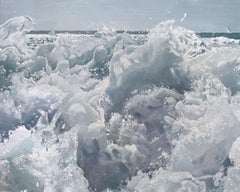
Surf
Sailboat
By Stephen Wright
Located in Fairfield, CT
Water does not have a form; it adapts to forms created by energy. There is something kind of futile yet exciting about capturing the effect of water in a painting. There is no start...
Category
2010s American Realist William Stanley Haseltine Paintings
Materials
Canvas, Oil
William Stanley Haseltine paintings for sale on 1stDibs.
Find a wide variety of authentic William Stanley Haseltine paintings available for sale on 1stDibs. You can also browse by medium to find art by William Stanley Haseltine in canvas, fabric, oil paint and more. Not every interior allows for large William Stanley Haseltine paintings, so small editions measuring 23 inches across are available. Customers who are interested in this artist might also find the work of James Edward Buttersworth, William Rickarby Miller, and Robert Riggs. William Stanley Haseltine paintings prices can differ depending upon medium, time period and other attributes. On 1stDibs, the price for these items starts at $110,000 and tops out at $110,000, while the average work can sell for $110,000.