William Watson Scientific Instruments
British, 1831-1921
William Watson flourished between 1866 and 1920. He came from a family of painters originating in Liverpool. A pupil of iconic Sir Edwin Landseer and also French artist Rosa Bonheur, William's work was detailed yet also full of movement with an excellent sense of the proportion and majesty of the animals. Exhibiting locally and also at the Royal Academy of Arts in 1972, his works can now be found in galleries and museums as far-flung as Minneapolis in the USA.
to
1
1
1
1
1
1
1
1
1
1
1
1
1
1
1
3
9
7
6
6
Creator: William Watson
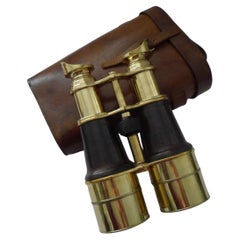
Superb Large Pair Antique English Binoculars by W. Watson
Sons, London
By William Watson
Located in Bath, GB
A fabulous pair of antique English polished brass binoculars meticulously professionally cleaned and polished, restoring them to their former glory; the barrels wrapped in leather. ...
Category
1910s British George IV Vintage William Watson Scientific Instruments
Materials
Brass
Related Items
Antique English Brass
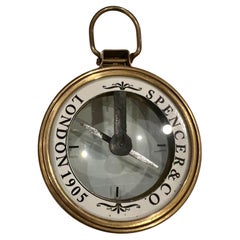
Glass Elegant Compass by Spencer
Co London
By Spencer
Company
Located in San Diego, CA
Beautiful elegant compass circa 1970's in solid brass with glass bt spencer & Co.
Category
20th Century English Hollywood Regency William Watson Scientific Instruments
Materials
Brass

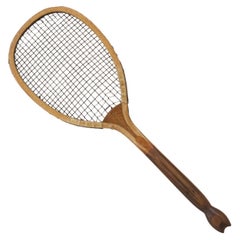
Antique Fishtail Tennis Racket by Prosser
Son
Located in Oxfordshire, GB
Wooden Prosser & Sons Fishtail Tennis Racket.
A lawn tennis racket by T.H. Prosser & Sons with nice ash frame with convex walnut wedge. The wedge is s...
Category
Early 20th Century British William Watson Scientific Instruments
Materials
Ash
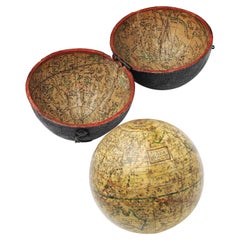
English Pocket Globe, London, Circa 1775-1798
By Herman Moll
Located in Milano, IT
Pocket globe
London, between 1775 and 1798
Re-edition of the globe of Hermann Moll (1678-1732) dated 1719
The globe is contained in its original case, which itself is covered in shark skin.
There are slight gaps in the original paint on the sphere. The case no longer closes.
The sphere measures 2.7 in (7 cm) in diameter whereas the case measures 2.9 in (7.4 cm) in diameter.
lb 0.22 (kg 0.1)
The globe is made up of twelve printed paper gores aligned and glued to the sphere.
In the North Pacific Ocean there is a cartouche with the inscription:
A Correct
Globe
with the new
Discoveries.
The celestial globe is depicted on the inside of the box and is divided into two hemispheres with the cartouche:
A correct globe
with ye new cons
relations of Dr.
Halley & c.
It shows the ecliptic divided into the days of the zodiacal calendar and the constellations represented as animals and mythological figures.
On the globe are delineated the equinoctial line, divided by degrees and hours, the ecliptic and the meridian (passing west of Greenwich). The continents are shaded and outlined in pink, green and yellow. It shows: the Cook routes; a wind rose in the Southern Indian Ocean; Antarctica without land; Africa with Negroland (Hermann Moll is considered the first geographer to name the West African region in his 1727 map. (Encyclopaedia Britannica, ed. 1902, under "States of Central Africa"); Tartary in Central Asia; the Mogul kingdom in northern India; in North America only New England, Virginia, Carolina, Florida, Mississippi are identified; California is already a peninsula; the northwest coast of America is "unknown parts" (Alaska is not described and it is only partially delineated, it was to become part of the United States in 1867); Mexico is named "Spain"; Central South America "Amazone America". Australia (which was to be so named after 1829) is called New Holland. The route of Admiral Anson is traced (1740) and the trade winds are indicated by arrows. (See Van der Krogt, P., Old Globes in the Netherlands, Utrecht 1984, p. 146 and Van der Krogt, P. - Dekker, E., Globes from the Western World, London 1993, pp. 115.)
Elly Dekker, comparing Moll’s 1719 globe and his re-edition (of which the one described above is a sample), identifies the differences between them: the two editions are quite similar to each other, but in the "anonymous" globe, compared to the previous globe of 1719, California looks like a proper peninsula - the reports of the Spanish explorers of the region had given rise to uncertainty over whether it was connected to the mainland or not. The geographical nature of California was confirmed after the explorations of Juan Bautista de Anza (1774-1776). The routes of Dampier's journey were partially erased and the route of Captain James Cook's first voyage was superimposed on them, and the geography of Australasia was adapted accordingly, including the denomination of the Cook Strait. See Dekker, Elly, Globes at Greenwich, 1999.
An important ante quem element is represented by Tasmania: it is not separated from Australia by the Bass Strait...
Category
Late 18th Century English George III Antique William Watson Scientific Instruments
Materials
Shagreen, Paper
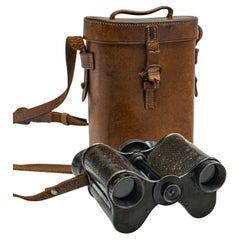
Antique Pair of Cased Binoculars, English, Brass, Optical Instrument, Victorian
Located in Hele, Devon, GB
This is an antique pair of cased binoculars. An English, enamel brass optical instrument, dating to the Victorian period, circa 1900.
Appealing weathering and presented in an attrac...
Category
Early 20th Century British Late Victorian William Watson Scientific Instruments
Materials
Brass
$862
H 5.71 in W 4.73 in D 2.96 in
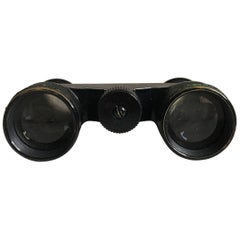
Opera Glasses, Binoculars by G.Rodenstock
Located in Miami, FL
Opera glasses, binoculars by G. Rodenstock.
Category
Late 20th Century German Art Deco William Watson Scientific Instruments
Materials
Bakelite
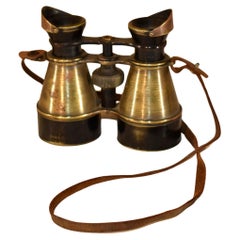
Pair of Brass Field Binoculars by W. Watson &. Sons of London
Located in High Point, NC
Pair of wonderfully aged brass field binoculars with moveable brass eye shields, which help to give clearer views without additional light coming through the sides. This pair of bin...
Category
1910s English Vintage William Watson Scientific Instruments
Materials
Brass
1940
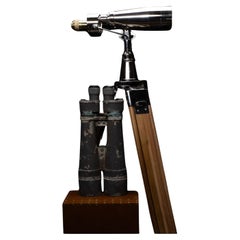
s WW2 Binoculars.
By Nikon
Located in Aspen, CO
Nikon marine binoculars mounted on a wooden period tripod, these exceptional binoculars display entirely Original optics in a distinctly Japanese straight-body instrument with 15mm x magnification with 80 mm objective naval lens that have been originally restored in a time-consuming process to reveal a crystal clear Image.A one of a kind pair of Nikon binoculars...
Category
1940s Japanese Vintage William Watson Scientific Instruments
Materials
Aluminum, Silver
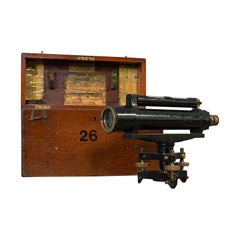
Antique Surveyor
s Level, English, Brass, Scientific Instrument, Halden
Sons
Located in Hele, Devon, GB
This is an antique surveyor's level. An English, brass scientific instrument by J. Halden & Sons of Manchester, dating to the early 20th century, circ...
Category
Early 20th Century British William Watson Scientific Instruments
Materials
Brass
$1,011
H 7.09 in W 11.23 in D 4.34 in
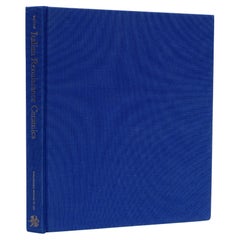
Italian Renaissance Ceramics by Wendy M. Watson
Located in valatie, NY
Italian Renaissance ceramics by Wendy M. Watson. Published by Philadelphia Museum of Art, Philadelphia, PA, 2001. 1st Ed Exhibition hardcover no d...
Category
21st Century and Contemporary American William Watson Scientific Instruments
Materials
Paper
Albert Watson Kaos
Located in Los Angeles, CA
Celebrate the “photographer’s photographer,” Albert Watson, one of the most in-demand and versatile portrait, fine art, and fashion photographers. This Collector’s Edition showcases ...
Category
21st Century and Contemporary European William Watson Scientific Instruments
Materials
Paper, Leather, Faux Fur

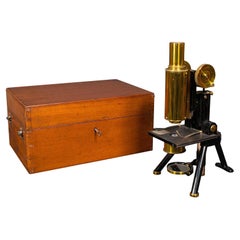
Antique Cased Microscope, English, Scientific Instrument, Swift
Son, Edwardian
Located in Hele, Devon, GB
This is an antique cased microscope. An English, black enamel scientific instrument by J. Swift & Son of London, dating to the Edwardian period, circa 191...
Category
Early 20th Century British Edwardian William Watson Scientific Instruments
Materials
Brass, Enamel
$1,838
H 10.83 in W 5.32 in D 7.29 in
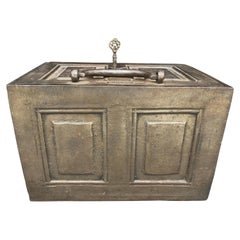
Unusual English Iron Strong Box by W. Graham
Son, London
Located in Essex, MA
Paneled case with top lifting handle and side handles. Signed on top with working lock and key.
Category
Early 19th Century English Antique William Watson Scientific Instruments
Materials
Iron
William Watson scientific instruments for sale on 1stDibs.
William Watson scientific instruments are available for sale on 1stDibs. These distinctive items are frequently made of metal and are designed with extraordinary care. There are many options to choose from in our collection of William Watson scientific instruments, although black editions of this piece are particularly popular. Many of the original scientific instruments by William Watson were created in the Georgian style in united kingdom during the 1910s. Prices for William Watson scientific instruments can differ depending upon size, time period and other attributes — on 1stDibs, these items begin at $1,140 and can go as high as $1,140, while a piece like these, on average, fetch $1,140.