Objekte ähnlich wie German school Landscape river scene Signed oil painting
Video wird geladen …
Möchten Sie mehr Bilder oder Videos?
Zusätzliche Bilder oder Videos von dem*der Anbieter*in anfordern
1 von 17
French School MastersGerman school Landscape river scene Signed oil painting1938
1938
290 €
1.800 €83 % Rabatt
Angaben zum Objekt
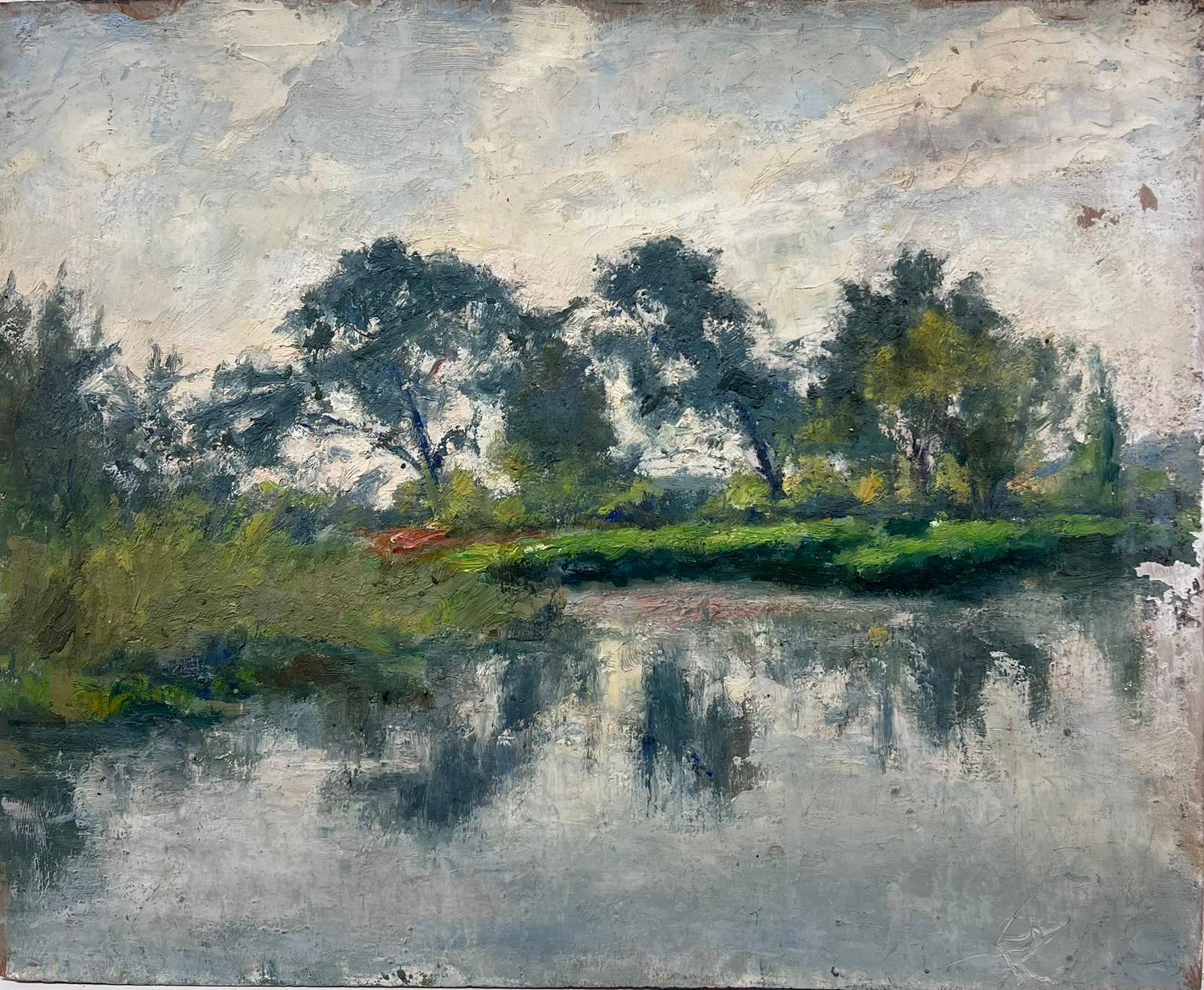
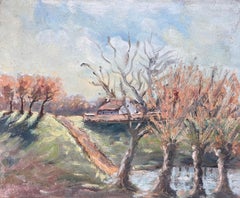
➡️ Landscape river scene ⬅️
⏩It is signed Mindermann⏪
⭐Medium:⭐ Oil on canvas
⭐Technique: ⭐Impasto painting with expressive brushwork.
⭐Size:⭐54x65cm / 21.3x25.6 inch
⭐Date: 1938⭐
⭐Condition : ⭐ Good condition. NO cracks, but several restorations
⭐Provenance:⭐ Private collection - France.
⭐Shipping:⭐ from France is fast 4-6 days with Fedex / DHL
🟢🟢🟢🟢🟢🟢🟢🟢🟢🟢🟢🟢🟢🟢🟢🟢🟢🟢
More about the painting:
☀️Early Life and Dual Career☀️
Johann Heinz Mindermann was born in 1872 in Bremen, Germany, where he spent his formative years in one of the country's most important maritime and trading cities. Unlike many artists who pursued their vocation from youth, Mindermann initially embarked on a career in law, studying jurisprudence before making the significant decision to dedicate himself to art. This unusual trajectory from legal studies to artistic practice reveals a man of considerable intellectual breadth and suggests that his eventual turn to painting was a deeply considered choice rather than a youthful impetuosity.
This dual background in law and art would prove valuable in his later career, particularly in his role as a gallery owner and art dealer, where both aesthetic judgment and business acumen were essential. The precision and structural integrity evident in his paintings may well reflect the analytical mind developed through his legal training, combined with the observational sensitivity of the artist.
☀️Gallery Owner and Art Dealer☀️
Before the outbreak of World War I in 1914, Mindermann had already established himself as a significant figure in the German art world, operating galleries in Bad Kissingen, a fashionable spa town in Bavaria, and in Cologne, one of Germany's major cultural centers. This experience as a gallerist gave him intimate knowledge of the art market, contemporary artistic trends, and the tastes of collectors. His dual role as both creator and merchant of art was not uncommon in this period and provided him with financial stability while allowing him to maintain his artistic practice.
☀️Post-War Settlement in Norderney☀️
Following the upheaval of World War I, Mindermann made a decisive geographical and artistic choice that would define the remainder of his long career. He moved to Norderney, one of the East Frisian Islands in the North Sea off the German coast. This island, known for its dramatic seascapes, sweeping beaches, shifting dunes, and the ever-changing moods of the North Sea, became both his home and his primary artistic subject.
On Norderney, Mindermann worked as both a painter and art dealer until his death in 1959, at the age of 87. The island's maritime environment profoundly influenced his artistic output, and he became particularly known for his seascapes and coastal scenes. His paintings typically featured fishing boats, sailboats, dramatic skies, rolling waves, and the characteristic landscape of dunes and beaches that define the East Frisian archipelago.
☀️Artistic Style and Approach☀️
Mindermann's work belongs to the tradition of German impressionism and naturalistic landscape painting that flourished in the late 19th and early 20th centuries. His technique demonstrates a confident, gestural approach to oil painting, with loose, expressive brushwork that captures atmospheric effects and the play of light rather than precise photographic detail. This approach aligns him with the plein-air tradition, where artists work directly from nature, seeking to capture the immediate, fleeting impressions of a scene.
His paintings reveal a sophisticated understanding of color relationships, atmospheric perspective, and compositional structure. The visible brushstrokes and economy of means in his work suggest an artist who had achieved technical mastery and knew precisely how much information was necessary to convey a convincing sense of place and atmosphere.
The 1938 Riverside Landscape: An Atypical Work
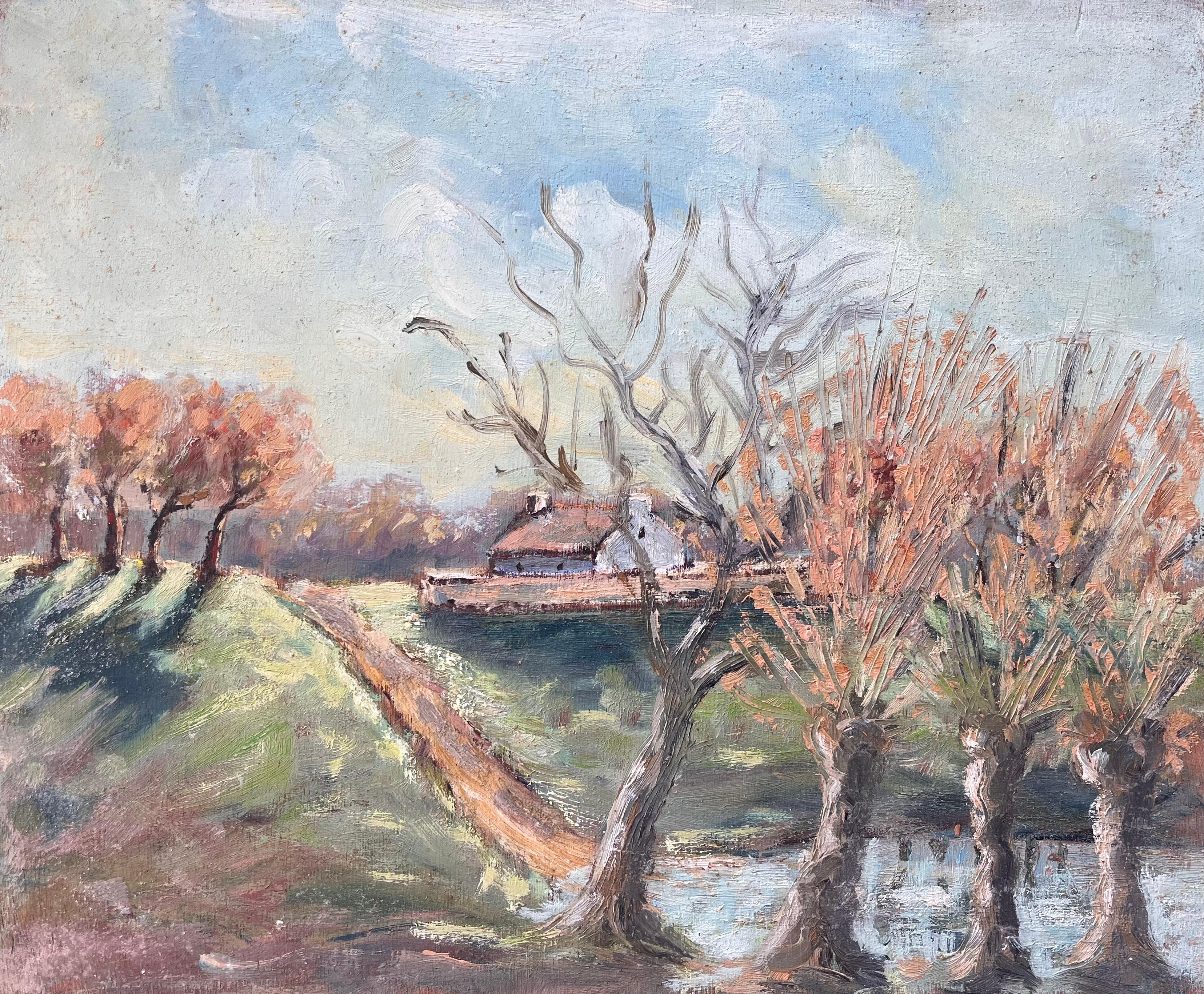
The painting under examination, dated 1938, represents an intriguing departure from Mindermann's typical maritime subjects. This work depicts a riverside or waterside scene rather than a coastal view, featuring bare, skeletal trees, a pathway or embankment, modest buildings, and a pale, overcast sky. The scene appears to be set inland, possibly along a river such as the Rhine, Elbe, or another German waterway, rather than on the North Sea coast that dominated his later work.
☀️Compositional Analysis☀️
The composition is notably horizontal, with the viewer's eye led along a receding pathway that disappears into the misty distance. This recession is masterfully handled through progressive softening of forms and gradual dissolution of detail, creating a convincing sense of atmospheric perspective. The painting captures what appears to be a cold day in late autumn or winter, when the landscape is stripped of foliage and reduced to essential forms.
The bare trees dominate the middle ground, their dark, angular branches creating stark contrast against the luminous sky. These skeletal forms are rendered with quick, decisive strokes in dark grey and black, creating a calligraphic quality that energizes the composition. They function as vertical accents breaking the horizontal flow while their intricate branch patterns create visual interest and suggest the complexity of natural forms even in their dormant state.
☀️Technical Execution☀️
Mindermann's brushwork in this piece is loose and expressive, with visible strokes constructing form through accumulated marks rather than precise delineation. The sky, occupying roughly half the composition, is rendered in sweeping horizontal strokes of grey, cream, and pale blue, with occasional darker accents suggesting moving clouds or atmospheric disturbance. This treatment creates a palpable sense of moisture in the air, of heavy clouds and diffused light characteristic of northern European climates.
The foreground demonstrates considerable sophistication, using warm ochres, tans, and muted earth tones to define the path or embankment. Small figures are suggested through minimal marks, providing scale and human presence without demanding attention. These abbreviated human forms are characteristic of plein-air painting, where the artist captures the essence of a scene quickly, focusing on overall impression rather than detail.
The middle ground reveals buildings or structures rendered in simplified forms, their presence felt more through suggestion than explicit description. This economy of means speaks to Mindermann's confidence and experience—knowing precisely how much information is necessary to convey architectural presence without overworking the surface. The structures read as working-class or industrial buildings, grounding the painting in everyday reality rather than pastoral idealization.
Color and Atmosphere
The palette is notably restrained, dominated by a harmony of greys, blues, ochres, and warm earth tones. This limited palette unifies the composition and reinforces its atmospheric quality. Mindermann demonstrates sophisticated color mixing, with subtle modulations creating luminosity despite the generally subdued tonality. Small accents of brighter color, particularly what appears to be a pink or red mark near the center, provide visual punctuation without disrupting the overall harmony.
☀️Historical Context: 1938☀️
The date of 1938 places this work within a particularly significant and troubling moment in German history. This was the year of the Anschluss, when Nazi Germany annexed Austria, and the Munich Agreement, which ceded Czechoslovakia's Sudetenland to Germany. It was also the year of Kristallnacht, the violent pogrom against Jews throughout Germany and Austria. The cultural atmosphere was increasingly oppressive, with the Nazi regime's promotion of "heroic" Germanic art and condemnation of "degenerate" modern art.
At 66 years old in 1938, Mindermann was in the mature phase of his career. The fact that he continued to paint landscapes of direct observation in a relatively loose, impressionistic style, rather than conforming to the rigid, propagandistic aesthetic promoted by the Nazi regime, suggests an artist committed to his personal vision. While not overtly political, his continued practice of straightforward landscape painting can be seen as a quiet assertion of artistic independence.
The scene itself, with its bare trees, muted colors, and grey skies, might be read as reflecting something of the somber mood of the times, though such interpretations must remain speculative. What is clear is that Mindermann was documenting the everyday German landscape with honesty and sensitivity, finding beauty in ordinary scenes rather than grandiose or idealized subjects.
Significance Within Mindermann's Oeuvre
This 1938 riverside landscape is particularly valuable for understanding Mindermann as an artist because it demonstrates the breadth of his subject matter beyond his signature maritime scenes. While his reputation rests primarily on his Norderney seascapes, this work proves that he continued to engage with other types of landscapes, perhaps during travels or based on memories of other German regions.
The painting reveals that Mindermann's skills extended beyond depicting the specific challenges of maritime subjects, the movement of water, the drama of coastal weather, the textures of sand and surf. Here he demonstrates equal facility with riverine landscapes, bare winter trees, architectural elements, and the subtle atmospheric effects of inland weather.
☀️Legacy and Market Presence☀️
Mindermann remained active as both artist and art dealer in Norderney until his death in 1959, spanning nearly nine decades of life and encompassing some of the most tumultuous periods in German and European history. His works, particularly his maritime scenes from Norderney, appear regularly in the art market and auction houses, indicating that he was a prolific artist whose work found favor with collectors both during his lifetime and posthumously.
- Schöpfer*in:French School Masters (Französisch)
- Entstehungsjahr:1938
- Maße:Höhe: 54 cm (21,26 in)Breite: 65 cm (25,6 in)Tiefe: 2 cm (0,79 in)
- Medium:
- Bewegung und Stil:
- Zeitalter:
- Zustand:
- Galeriestandort:Zofingen, CH
- Referenznummer:Anbieter*in: Mindermann1stDibs: LU2203217441262
Anbieterinformationen
5,0
Platin-Anbieter*in
Premium-Anbieter*innen mit einer Bewertung über 4,7 und 24 Stunden Reaktionszeit
Gründungsjahr 2019
1stDibs-Anbieter*in seit 2022
730 Verkäufe auf 1stDibs
Typische Antwortzeit: 2 Stunde
- VersandAngebot wird abgerufen …Versand von: La Baule, Frankreich
- Rückgabebedingungen
Einige Inhalte dieser Seite wurden automatisch übersetzt. Daher kann 1stDibs nicht die Richtigkeit der Übersetzungen garantieren. Englisch ist die Standardsprache dieser Website.
Mehr von diesem*dieser Anbieter*in
Alle anzeigenFranzösische Schule Landschaft Flussszene Signiert
➡️ Schöne Studie Landscape⬅️
Titel: Sur les bords du Loing (Seine et Marne Frankreich) Jean Baptiste Camille Corot
Medium: Öl auf Leinwand
Zeitraum: Wahrscheinlich Mitte des 19. Jah...
Kategorie
1850er, Tonalismus, Figurative Gemälde
Materialien
Gips, Leinwand, Öl, Keilrahmenleisten
111.000 € Verkaufspreis
26 % Rabatt
Französische Schule Landschaft am Flussufer Unterzeichnet
➡️ LandschaftDer Fluss von Rousseau⬅️
Sie trägt die Unterschrift R Rousseau.⏪
⭐Medium:⭐ Öl auf Leinwand
⭐Technik: ⭐Impasto-Malerei mit ausdrucksstarken Pinselstrichen.
⭐Größe...
Kategorie
1890er, Schule von Barbizon, Figurative Gemälde
Materialien
Gips, Leinwand, Öl, Keilrahmenleisten

414 € Verkaufspreis
77 % Rabatt
Französische Schullandschaft auf dem Lande
Landschaftsszene aus Rohlfs
⭐Gezeichnet:⭐ ROHLFS
⭐Medium:⭐ Öl auf Leinwand
⭐Technik: ⭐Impasto-Malerei mit Pinselstrich
⭐Größe:⭐19x24cm / 7.48x9.44inch
⭐Datum:⭐18/06/1936
⭐Zusta...
Kategorie
1930er, Impressionismus, Landschaftsgemälde
Materialien
Öl, Leinwand, Keilrahmenleisten
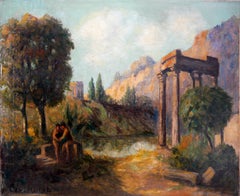
Französisch Schule Antike Szene Landschaft Signiert
➡️Vivid Antike Szene Landscape⬅️
Sie ist mit J. Ch. Millet unterzeichnet.⏪
Jean Charles Millet (1892-1944)
Wie wurde Jean-Charles Millet, der Enkel des berühmten Malers, zum Meist...
Kategorie
1920er, Tonalismus, Figurative Gemälde
Materialien
Gips, Leinwand, Öl, Keilrahmenleisten
370 € Verkaufspreis
79 % Rabatt
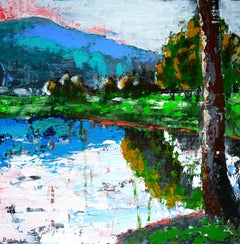
Französische Schule Impressionistische Landschaft Le Lac Rose th Jahrhundert MAK
Landschaft Le lac Rose - Rosa See
Technik: Öl, Acryl, Tinte auf Holzrahmen 40x40cm / 15,7x15,7inch
》》R E A D Y -- T O -- H A N G《《
❶ → Original signiertes Werk. Mit Echtheitszer...
Kategorie
Frühes 20. Jhdt., Tonalismus, Figurative Gemälde
Materialien
Tinte, Öl, Acryl
380 € Verkaufspreis
68 % Rabatt
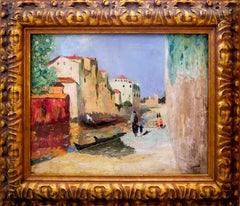
Französische Schule Lebendige Venedig-Szene Signiert
➡️Vivid Landscape⬅️
➡️Impressionist Landscape⬅️
Es trägt die Unterschrift C.Thiers.⏪
Möglicherweise war Charles Louis Thiers, der Bruder von Adolphe Thiers, eine der wichtigsten po...
Kategorie
1920er, Impressionismus, Figurative Gemälde
Materialien
Gips, Leinwand, Öl, Keilrahmenleisten
370 € Verkaufspreis
76 % Rabatt
Das könnte Ihnen auch gefallen
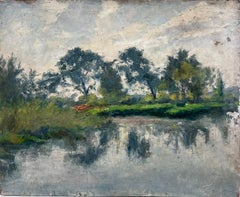
Feines antikes französisches impressionistisches signiertes Ölgemälde einer schönen Flusslandschaft, signiert
Flusslandschaft
von Charles Martin-Sauvaigo (französisch 1881-1970) * siehe Anmerkungen unten
Französischer Maler des Impressionismus
Ölgemälde auf Holztafel
ungerahmt
Größe: 13 x 1...
Kategorie
Frühes 20. Jahrhundert, Impressionismus, Landschaftsgemälde
Materialien
Öl
Flusslandschaft", französischer Impressionist, Musée d
Art Moderne, Salon d
Automne
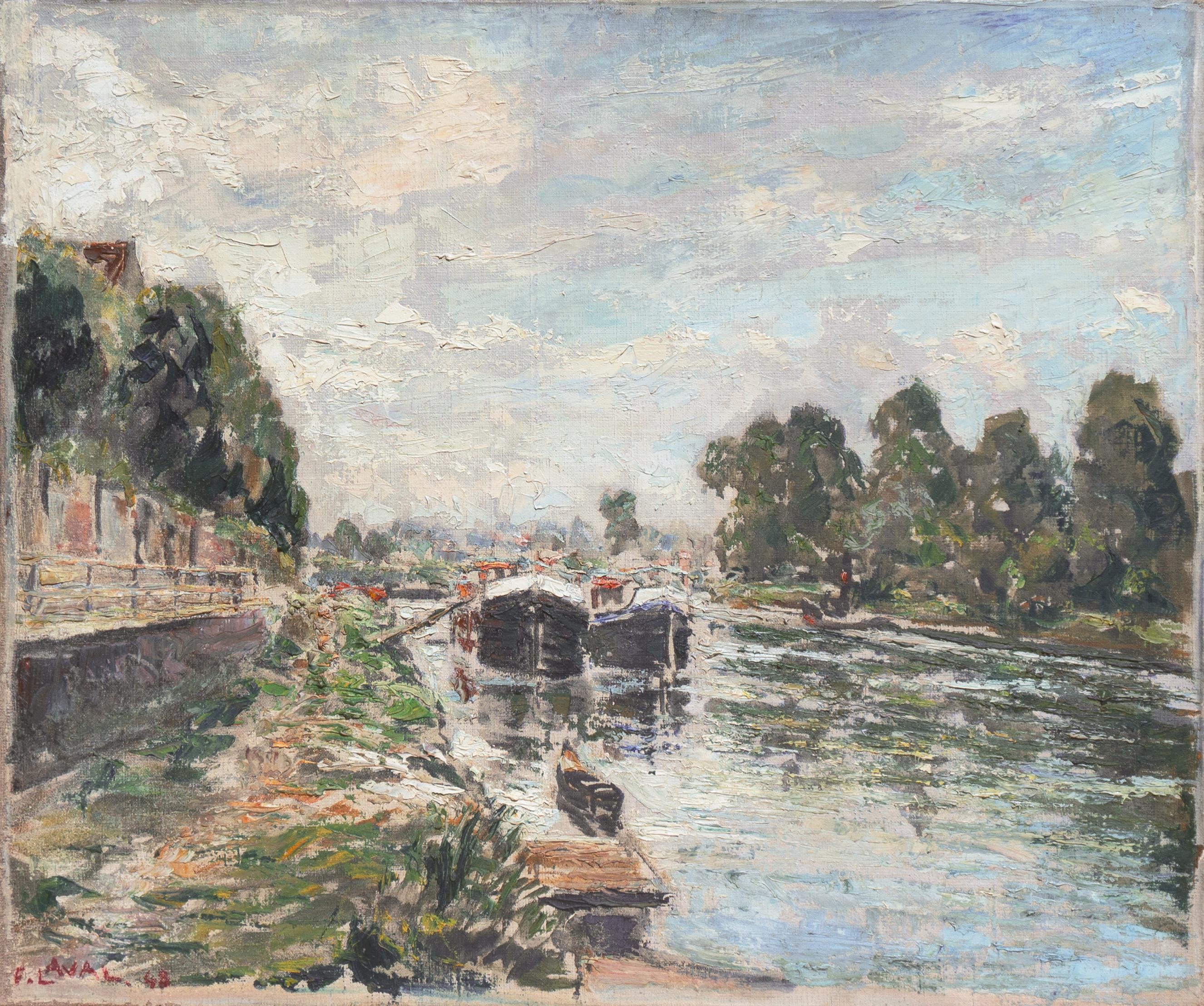
Von Fernand Laval
Signiert unten links, "F. Laval" für Fernand Laval (französisch, 1886-1966) und datiert 1948.
Der in der Dordogne geborene Fernand Laval kam im Alter von 26 Jahren nach Paris, um K...
Kategorie
1940er, Impressionismus, Landschaftsgemälde
Materialien
Leinwand, Öl
Französisches Vintage-Ölgemälde, breite Landschaft eines Sees, der schwebend in der Stadt
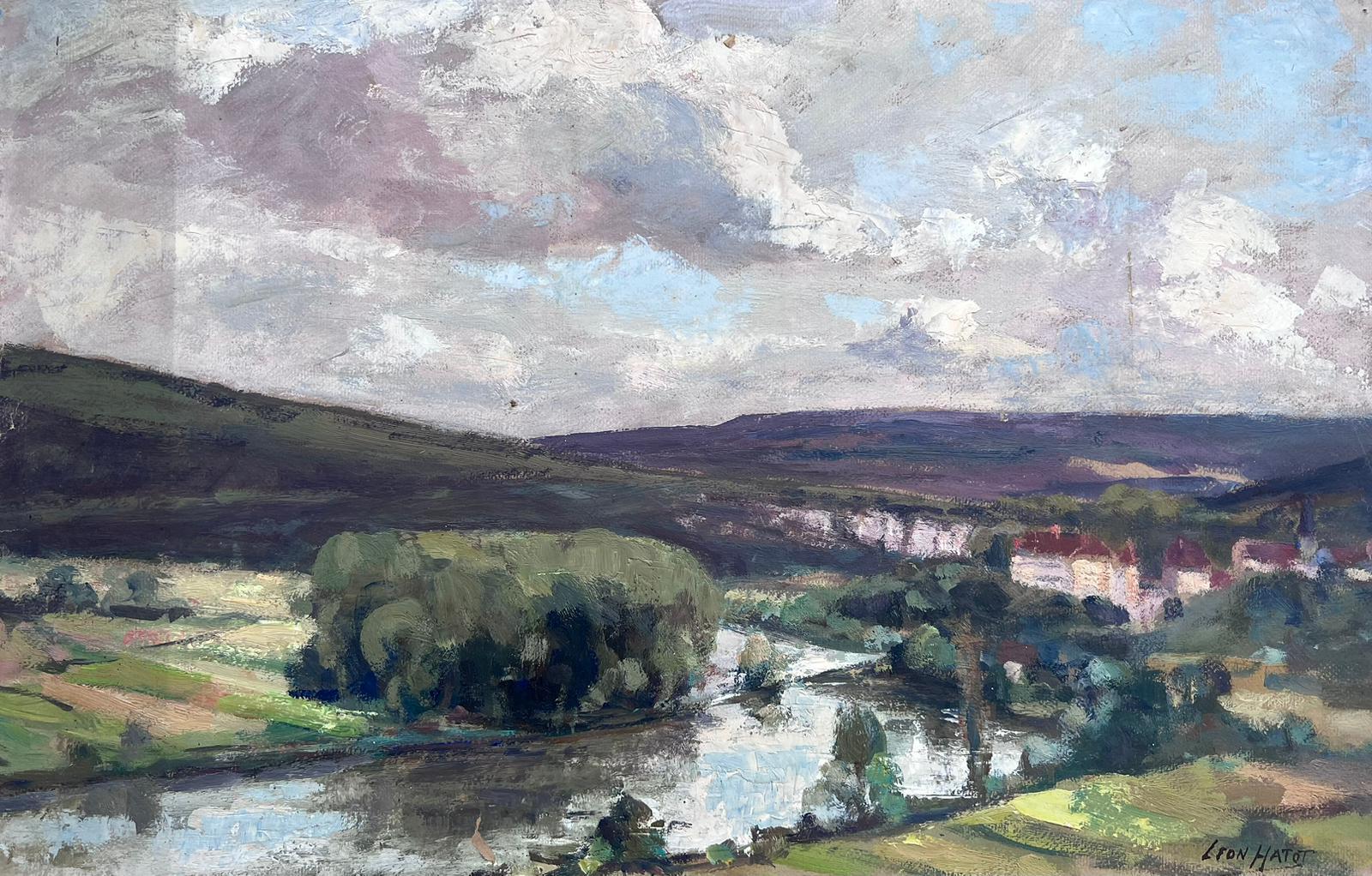
Artist/ School: Leon Hatot (French 1883-1953)
Title: Impressionist oil painting
Medium: signed oil painting on thick paper, stuck on board unframed
Size: painting: 13 x 20 inche...
Kategorie
Frühes 20. Jahrhundert, Impressionismus, Landschaftsgemälde
Materialien
Öl
634 € Verkaufspreis
20 % Rabatt
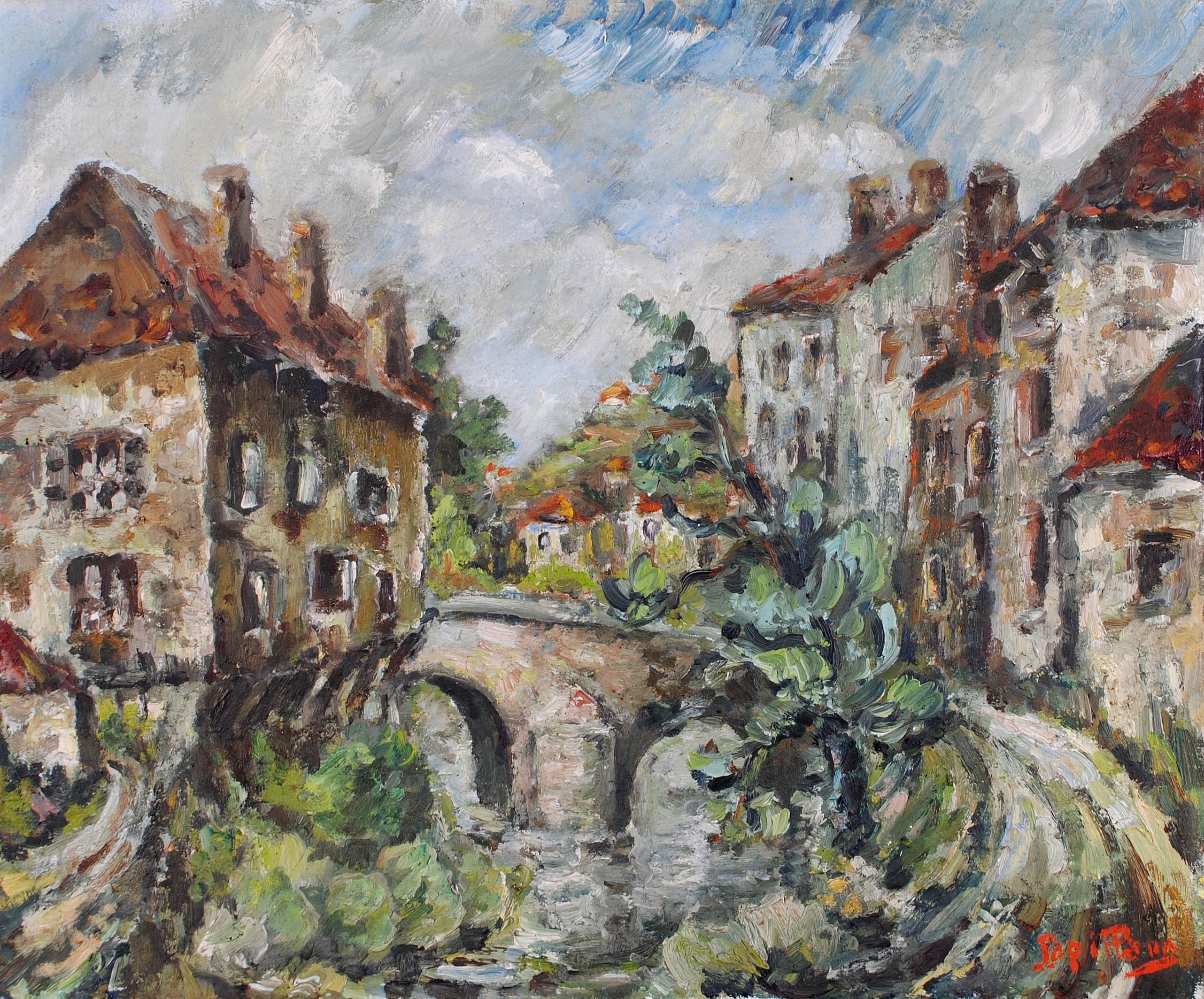
Flusslandschaft - Antikes französisches expressionistisches Ölgemälde des frühen 20. Jahrhunderts
Ein schönes französisches expressionistisches Ölgemälde aus den 1930er Jahren, das eine Flusslandschaft mit einer Brücke und Häusern unter einem dramatischen Himmel zeigt.
Hervorrag...
Kategorie
Frühes 20. Jahrhundert, Expressionismus, Landschaftsgemälde
Materialien
Leinwand, Öl
Französisch-impressionistisches Öl Tranquil River Seine in Incheville, signiert
Die Seine bei Incheville
von Guy Pichon (1933-2007)
Öl auf Leinwand, gerahmt
unterzeichnet und datiert 93'
Betitelt verso
Leinwand: 24 x 29 Zoll
Provenienz: Privatsammlung, Frankrei...
Kategorie
Ende des 20. Jahrhunderts, Impressionismus, Landschaftsgemälde
Materialien
Öl, Leinwand
1.593 € Verkaufspreis
20 % Rabatt
Französische Landschaftslandschaft, Ölgemälde eines Bauernhauspfads und gepolsterter Bäume von Fluss
Von Fanch Lel
Titel: Französische Landschaft Öl mit Bauernhofweg und gefällten Bäumen am Fluss
Von Fanch Lel
Größe: 13,25 x 15,75 Zoll (Höhe x Breite)
Ölgemälde auf Karton, ungerahmt
Zustand: Das ...
Kategorie
20. Jahrhundert, Impressionismus, Landschaftsgemälde
Materialien
Öl
393 € Verkaufspreis
35 % Rabatt