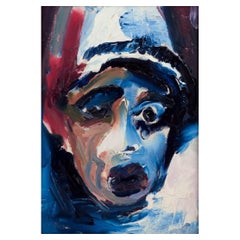
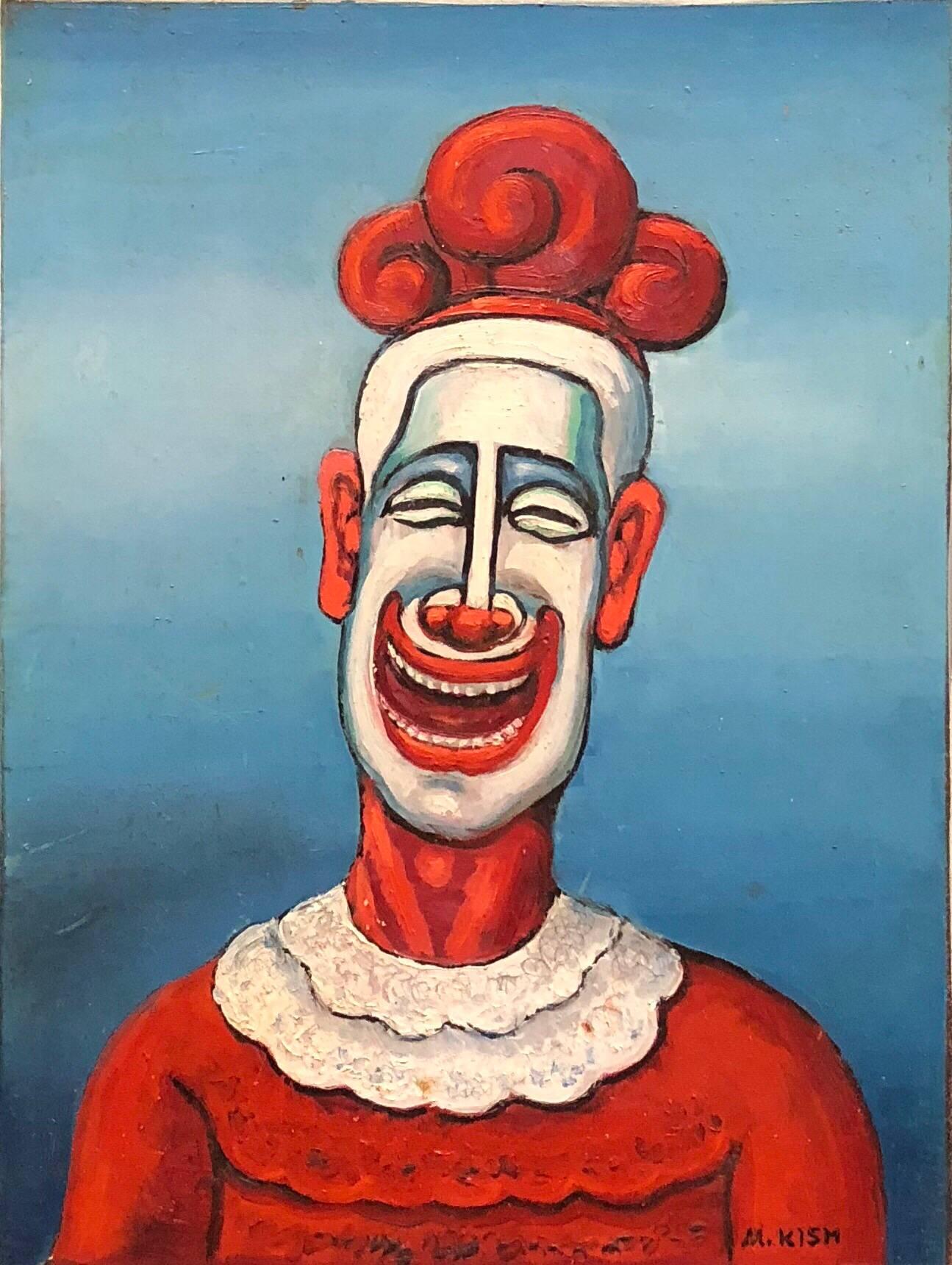
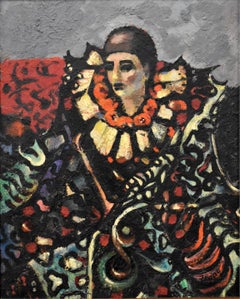
Objekte ähnlich wie The Clown Surrealist Oil Painting Maurice Kish WPA Artist American Modernist
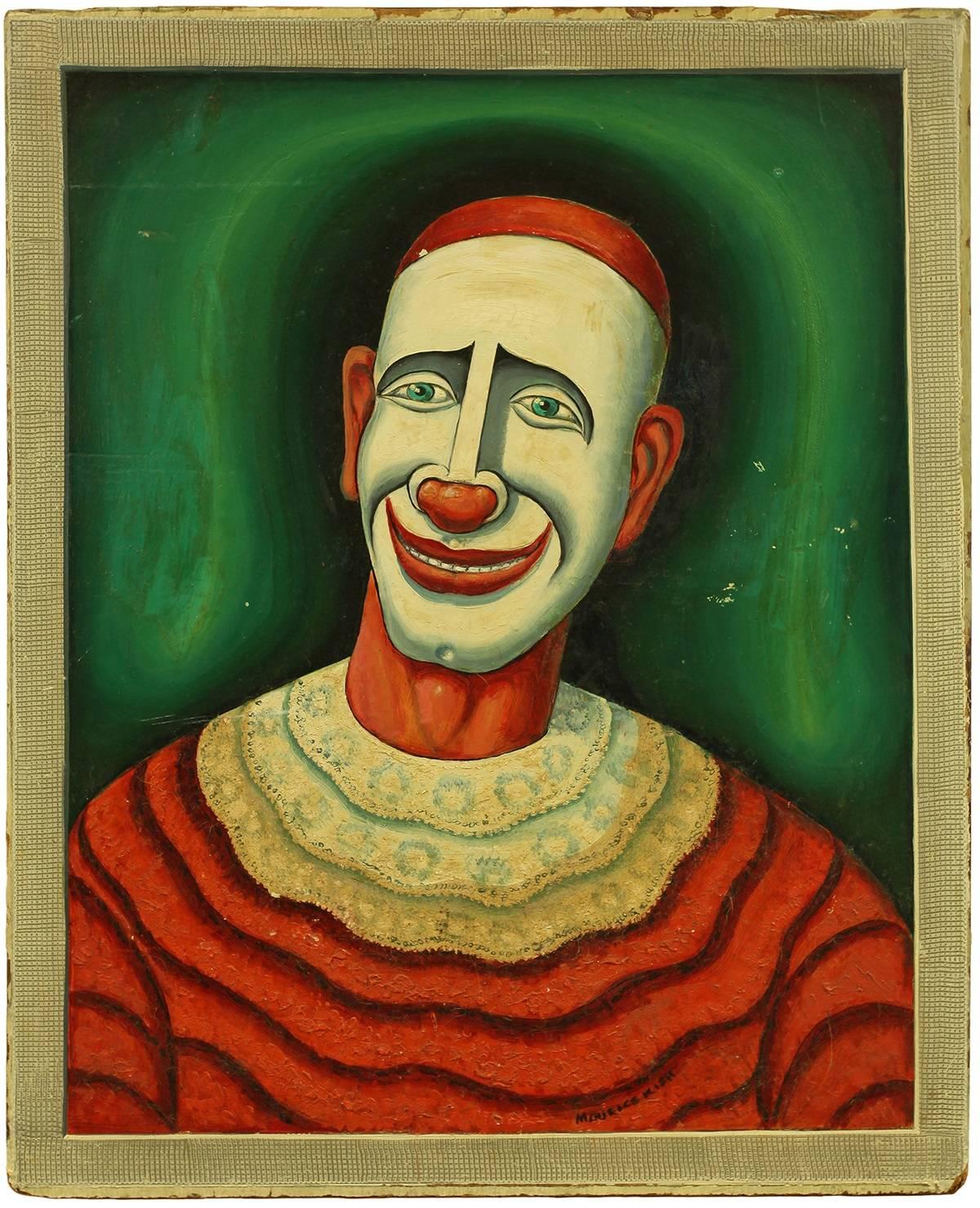
Möchten Sie mehr Bilder oder Videos?
Zusätzliche Bilder oder Videos von dem*der Anbieter*in anfordern
1 von 8
Maurice KishThe Clown Surrealist Oil Painting Maurice Kish WPA Artist American Modernistc.1940
c.1940
1.738,87 €
Angaben zum Objekt
The imagery of Maurice Kish (1895-1987), whether factories or carousels, reliably subverts expectations. His vision hovers just around the unraveling edge of things, where what is solid and clear becomes ambiguous. He is fascinated, often delighted, by the falling apart. This unexpected, fresh perspective results in oddly affecting pictures of a now long-gone New York.
Born Moishe in a town called Dvinsk, Russia (what is now Daugavpils, Latvia), Kish came with his family to New York when he was in his teens. The family settled in Brownsville, and for the rest of Kish’s life Brooklyn remained his home, though he moved from one neighborhood to another. He was close to his parents, who recognized his talent and supported his desire to become an artist.
Kish attended the National Academy of Design as well as Cooper Union. His fellow students included many other immigrants and children of immigrants who were particularly receptive to the Modernism coming from Europe. As his career progressed, Kish himself applied different strains of Modernism to different purposes. For him, the story was held above all else.
For years, Kish used the skills he acquired in art school to earn his living at a Manhattan glass factory where he painted floral designs on vases. During the Depression, Kish became a WPA painter in the Federal Art Project (FAP). FAP artists were given a mandate to create works that celebrated labor. The artists tended to be socially progressive, as Kish certainly was. Kish's work from this period, with its dark colors and rolling clouds, reveals the influence of Social Realists like Thomas Hart Benton. Apparent, too, is Kish's interest in the urban monumentality of Charles Sheeler. Kish's structures, however, lack Sheeler's almost dehumanized precision. Rather than the soulless, sleek machines of a typical modern urban dystopia, Kish's factories are shaggy old beasts as worn out as the laborers who troop through their doors. In End of Day's Toil, now at the Smithsonian, the viewer feels some affection for that rambly grandfather of a building all the tired small workers are leaving behind.
Much of Kish's work, for the FAP and elsewhere, undermines received truths in a similar way. Some early works with themes from Yiddish culture are overtly humorous: a painting of a big jolly wedding guest, looking invitingly over her shoulder; a big fiddler on a small roof. Later, the humor becomes more ironic and reflective. In another work, the rather imposing organ grinder of the late 1930s looms above a child, yet his intermediary the cockatoo is bright and appealing, and offers the girl a fortune with his beak. This could read as an allegory for capitalism as easily as a straightforward colorful street scene. A small painting of a snowy day in Washington Square gives a bird's eye view of people bent against the wind walking alone or in pairs. The huge triumphal arch at the middle of it has no connection to their movements or their lives. Kish makes its size and centrality a quiet joke about the futility of grandiose gestures. Like the buildings in his FAP works, the arch has a personality. It is a landmark that looks a bit lost.
A favorite location for Kish was Coney Island. For the laborers of the city, this was a place of great freedom and possibility. There were no bosses! Anyone could go to ride the rides and swim in the sea. For Kish, Coney Island, and especially Luna Park, became a place richly symbolic of workers’ rights. For the dreamlike paintings he set there, Kish looked past the Social Realists to the Expressionists. His colors are brilliant and his lines are wild. These images, joyfully unrestrained, give full voice to an anarchic vision merely hinted at in other works. If the structures of the earlier pictures came further out of the background than expected, these Coney Island structures completely take over the scene.
Kish made several variations on the theme of the carousel as a site of revolution. In the moonlight, the horses have broken from their poles and spin away from the calm center. The workers have come to manic life, have released themselves from the yoke of labor and have abandoned their master, the merry-go-round. They escape to different corners of the pleasure park, dance together and ride the ferris wheel. One horse pretends to be a ticket seller. It is another allegory, one that depicts a worker's holiday paradise in carnival fashion.
A painter who embraced ambiguity, Kish was himself a man who occupied many worlds simultaneously. Even during the period when he had shows at prestigious galleries and belonged to several artists' groups, he identified most strongly as an outsider, a Yiddischer. He wrote poetry in Yiddish throughout his life. In 1968, he published a volume of fifty years of these poems, Di Velt ist Mayn Lid (The World is My Song) in Yiddish, with no English translation, for his peers. Kish also translated English-language poetry into Yiddish and acted as a guide to help other Yiddish writers. Long after the art organizations ceased to provide meaning and fulfillment, Kish was a devoted member of the Yiddish Culture Association.
In addition to painting and poetry, Kish was a dancer who taught during the summers at various Jewish resorts in the Catskills. Small but lithe, he also spent some years as an amateur boxer. Well into his eighties, Kish was proud of the quality of his handball game.
By the 1940s, Kish’s career was going well, but his descriptive style of working began to fall out of fashion, supplanted by a more formal Abstraction. Kish was never able to support himself solely through his art, yet in the midst of all of his other activities, Kish continued to create his distinctive images of an immigrant's New York. He departed far from the mainstream, and in later years, seldom showed his work, preferring to keep it for himself (although he sometimes traded paintings for rent).
Of making art, Kish said, "It is a sacred mission to enrich, to elevate and to make our lives more complete." His works, though frequently playful, encourage a second look at ordinary things. His irreverence elevates by revealing flaws where his audience, all workers and outsiders of a kind, can get a purchase. Kish's art fondly celebrates the beauty of the irregular.
- Schöpfer*in:Maurice Kish (1895-1987, Amerikanisch)
- Entstehungsjahr:c.1940
- Maße:Höhe: 33,66 cm (13,25 in)Breite: 28,58 cm (11,25 in)
- Medium:
- Bewegung und Stil:
- Zeitalter:
- Zustand:Measurements include frame.
- Galeriestandort:Surfside, FL
- Referenznummer:1stDibs: LU38217346702
Anbieterinformationen
4,9
Platin-Anbieter*in
Premium-Anbieter*innen mit einer Bewertung über 4,7 und 24 Stunden Reaktionszeit
Gründungsjahr 1995
1stDibs-Anbieter*in seit 2014
1.843 Verkäufe auf 1stDibs
Typische Antwortzeit: 1 Stunde
- VersandAngebot wird abgerufen …Versand von: Surfside, FL
- Rückgabebedingungen
Einige Inhalte dieser Seite wurden automatisch übersetzt. Daher kann 1stDibs nicht die Richtigkeit der Übersetzungen garantieren. Englisch ist die Standardsprache dieser Website.
Mehr von diesem*dieser Anbieter*in
Alle anzeigenClown, Modernistisches Ölgemälde auf Karton, WPA-Künstler
Von Maurice Kish
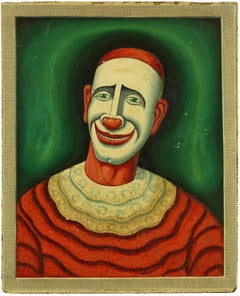
Dieses Porträt eines Clowns von Maurice Kish ist Teil einer Serie von Karnevalsfiguren, Zirkusclowns und Karussellpferden und -reitern, die er in den 30er und 40er Jahren anfertigte....
Kategorie
Frühes 20. Jahrhundert, Moderne, Porträts
Materialien
Öl, Karton
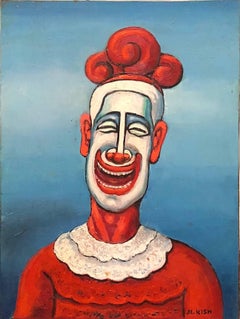
Clown, Frühes 20. Jahrhundert Verspieltes Ölgemälde auf Karton
Von Maurice Kish
Dieses Porträt eines Clowns von Maurice Kish ist Teil einer Serie von Karnevalsfiguren, Zirkusclowns und Karussellpferden und -reitern, die er in den 30er und 40er Jahren anfertigte....
Kategorie
Frühes 20. Jahrhundert, Moderne, Porträts
Materialien
Öl, Karton
Der glückliche Schwiegersohn, Ölgemälde
Von Maurice Kish
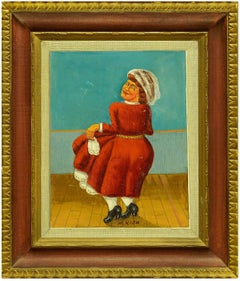
Die Bilder von Maurice Kish (1895-1987), ob Fabriken oder Karussells, unterlaufen zuverlässig die Erwartungen. Seine Vision bewegt sich am Rande der Auflösung der Dinge, wo das, was ...
Kategorie
20. Jahrhundert, Volkskunst, Figurative Gemälde
Materialien
Öl, Karton
Polnische französische Ecole de Paris Mid-Century Modernistisches Ölgemälde, Clown Juggler, Mid-Century Modern
Von Abram Krol
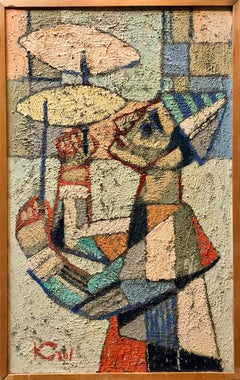
Abram Abraham Krol wurde am 22. Januar 1919 in Pabianice (Lodz), Polen, geboren.
Abram Krol ging 1938 nach Frankreich, um an der Universität von Caen Bauingenieurwesen zu studieren...
Kategorie
1950er, Moderne, Figurative Gemälde
Materialien
Leinwand, Öl
Polnische französische Ecole de Paris Mid-Century Modernistisches Ölgemälde, Clown Juggler, Mid-Century Modern
Von Abram Krol
Abram Abraham Krol wurde am 22. Januar 1919 in Pabianice (Lodz), Polen, geboren.
Abram Krol ging 1938 nach Frankreich, um an der Universität von Caen Bauingenieurwesen zu studieren...
Kategorie
1950er, Moderne, Figurative Gemälde
Materialien
Leinwand, Öl
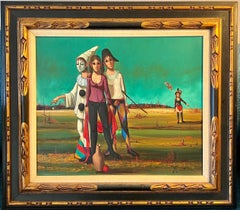
Französisches Ölgemälde, Surrealistische Kommedia dell
arte, Zirkusszene, Ölgemälde J.P. Serrier
Von Jean Pierre Serrier
Jean Pierre Serrier (Französisch, 1934-1989)
Gemälde in Öl auf Leinwand, das vier Figuren darstellt
Handsigniert unten rechts.
Maße (Rahmen) 26,5" x 30" breit, und (Sicht) 18,25" x...
Kategorie
Mitte des 20. Jahrhunderts, Surrealismus, Figurative Gemälde
Materialien
Leinwand, Öl
Das könnte Ihnen auch gefallen
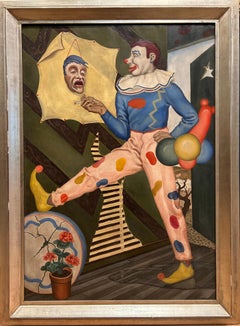
Ölgemälde eines Clowns
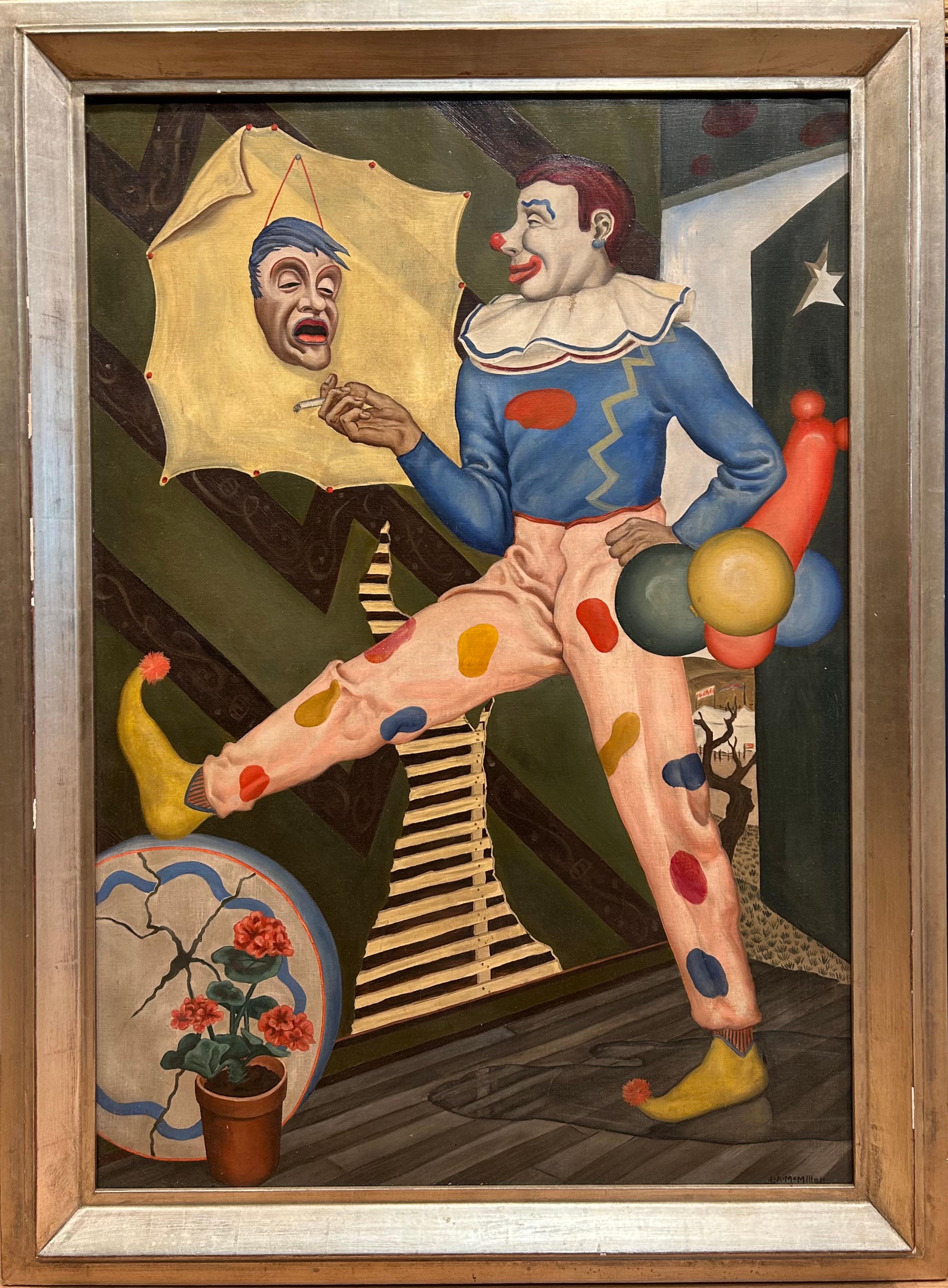
Dies ist ein Gemälde des amerikanischen Künstlers L.A. McMillen. Es ist unten rechts signiert und für die damalige Zeit in ausgezeichnetem Zustand. Es zeigt eine Clownszene mit dem G...
Kategorie
Frühes 20. Jahrhundert, Surrealismus, Figurative Gemälde
Materialien
Leinwand, Öl
"The Clown" Ölgemälde von Unknown Painter
Die Bildsprache zum Thema Clowns ist vielschichtig und offenbart oft mehrere Deutungsebenen. Jenseits des Lachens und der Belustigung, die mit Zirkusartisten verbunden sind, gibt es ...
Kategorie
Mitte des 20. Jahrhunderts, amerikanisch, Moderne der Mitte des Jahrhund...
Materialien
Leinwand
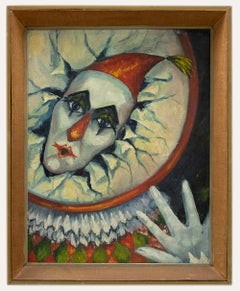
Ölgemälde des 20. Jahrhunderts – Das Clown
Ein eindrucksvolles Porträt eines Clowns in voller Montur. Der Künstler fängt den Charakter in lebhaften Farben ein, die die kühne Komposition ergänzen. Nicht signiert. Präsentiert i...
Kategorie
20. Jahrhundert, Figurative Gemälde
Materialien
Öl
228 € Verkaufspreis
20 % Rabatt
""THE CLOWN"" MICHAEL FRARY MID CENTURY MODERN TEXAS KÜNSTLER
Von Michael Frary
Michael Frary
(1918 - 2005)
Austin Künstler
Bildgröße: 16 x 12,5
Medium: Öl
"Der Clown"
Biografie
Michael Frary (1918 - 2005)
Michael Frary wurde am 28. Mai 1918 in Santa Monica, Kal...
Kategorie
1960er, Amerikanische Moderne, Figurative Gemälde
Materialien
Öl
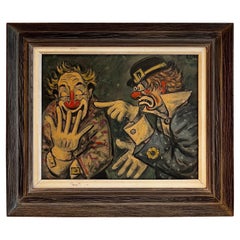
Expressionistisches Clown-Gemälde, signiert, um 1950
Ausdrucksstarke Clown-Malerei - signiert "Jen"
um 1950 - großer Rahmen
Rahmengröße = 22,5 x 26,5
Bildgröße = 15,5 x 19,5.
Kategorie
Mitte des 20. Jahrhunderts, amerikanisch, Moderne der Mitte des Jahrhund...
Materialien
Farbe
652 € Verkaufspreis
60 % Rabatt
Europäischer Künstler. Öl auf Karton. Porträt eines Clowns. Datiert 1962
Europäischer Künstler.
Öl auf Karton.
Porträt eines Clowns.
Expressionistischer Stil mit pastosen Strichen. Koloristische Palette.
Auf der Rückseite mit 1962 datiert.
Undeutlich unte...
Kategorie
Vintage, 1960er, Unbekannt, Moderne, Gemälde
Materialien
Sonstiges