Zum Hauptinhalt wechseln
Möchten Sie mehr Bilder oder Videos?
Zusätzliche Bilder oder Videos von dem*der Anbieter*in anfordern
1 von 21

Albert-Ernest Carrier-Belleuse
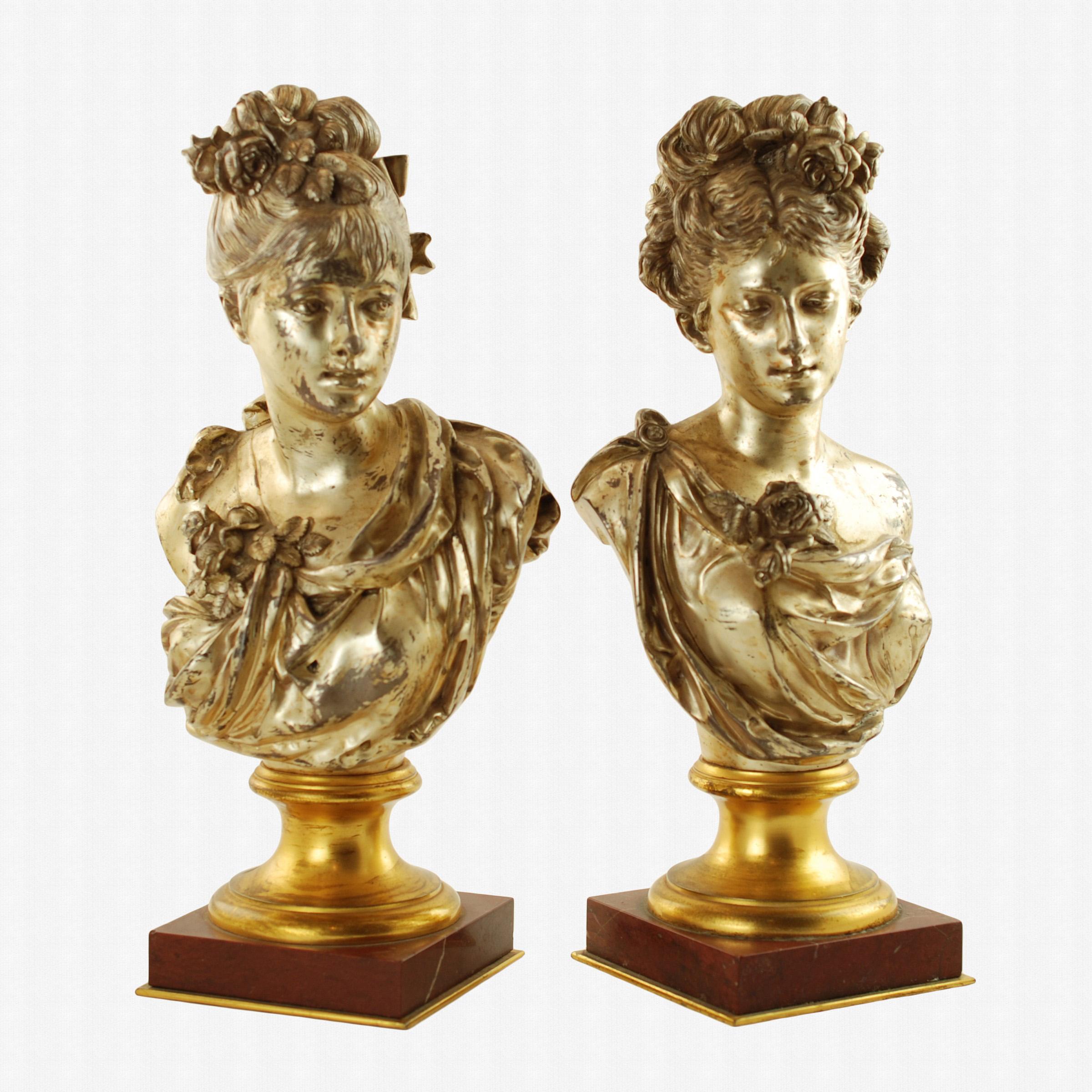
Pair of busts of Dürer and Rembrandt

circa 1860

6.800 €Einschließlich MwSt.

Angaben zum Objekt

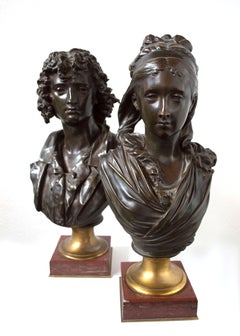
Pair of busts of Albrecht Dürer and Rembrandt van Rijn by Albert-Ernest CARRIER-BELLEUSE (1824-1887) A pair of silvered bronze busts Each signed on the back "A. Carrier" The all reposing on their original red and black marble bases France circa 1860 total height with the base 38,5 cm width 12 cm depth 12 cm Biography : Albert-Ernest Carrier de Belleuse known as Carrier-Belleuse (1824-1887) was one of the most prolific artists of the century and had the greatest successes under the Second Empire, enjoying the personal support of Napoleon III. His work was greatly influenced by the style of the Italian Renaissance and that of the 18th century, which he helped to bring up to date. In 1837, the young Carrier-Belleuse apprenticed in the workshop of the engraver Bauchery. He was admitted soon after to the goldsmith Jacques Henri Fauconnier. Through François Arago, he met the sculptor David d'Angers who facilitated his admission to the School of Fine Arts. Carrier-Belleuse entered it in 1840. Noted for his skill by the great bronze companies in Paris such as Barbedienne and Denière, he soon received numerous orders for models for candelabras, pendulums, fittings for fireplaces, etc. In 1848, probably at the initiative of François Arago, who became head of state, he received his first public order for a small statue of "Mademoiselle Rachel singing La Marseillaise". In 1851, he appeared for the first time at the Salon of French Artists, where he presented two bronze medallions. From 1851 to 1855, Carrier-Belleuse stayed in England, in Stoke-on-Trent where he served as director of the modeling and drawing school of the Minton house, a large porcelain manufacturer. Back in France, Carrier-Belleuse moved to Paris in a large workshop located 15 rue de la Tour d´Auvergne. From 1857, he made regular sendings to the Salon and became famous thanks to the success of large marbles, such as the "Bacchante" exhibited at the Salon in 1863, and acquired by Napoleon III, "Angelica" (1866) or even "Hebe asleep" (1869). At the Salon of 1867, his group entitled "Messiah" earned him the medal of honor of sculpture. It was acquired by the State to adorn the Chapel of the Virgin in the Saint-Vincent-de-Paul church. Carrier-Belleuse acquired a great reputation in parallel for his terracotta busts which, in many respects, recall those of 18th century artists. He made portraits of a large number of celebrities of his time. He produced, among others, the busts of Napoleon III, Renan, Thiers, Grévy, Arago, Marguerite Bellanger, Théophile Gautier, Honoré Daumier, Delacroix, Hortense Schneider, Réjane… He also modelled numerous busts of mythological inspiration and historical and artistic portraits like Marie Stuart, Shakespeare or even Mozart. Carrier-Belleuse used and trained in his workshop in the rue de la Tour d´Auvergne many young talented artists such as Alexandre Falguière, Jules Desbois, Eugène Delaplanche, Jules Dalou or Joseph Chéret; but he was best known for having been the master of Auguste Rodin who entered his studio as a practitioner in 1864. Carrier-Belleuse devoted himself a lot to decorative sculpture. He contributed to the decorations of many important buildings. We owe him in particular the caryatids of the Renaissance theater in Paris, the pediment of the main entrance to the Banque de France, the stucco ceilings of the Lesdiguières and La Trémoïlle pavilions at the Louvre Palace, the frieze of the Palais de la Bourse in Brussels, or the decoration of the Hôtel de la Païva on the Champs-Elysées in Paris. He also received State commissions for monuments: that of Jean-Jacques Rousseau in Montmorency, of Alexandre Dumas, in Villers-Cotterêts, of Masséna in Nice. Abroad, he produced the equestrian statue of Michael the brave in Bucharest and the tomb of José de San Martín in Buenos Aires. In 1873, Carrier-Belleuse took part in the construction of the Paris Opera house, directed by his friend Charles Garnier. He created the two monumental torchieres flanking the grand staircase in the main hall and the caryatids of the chimney of the grand foyer. In 1875, he was appointed director of works of art at the Porcelain Manufacture de Sèvres. He imprinted on it a very modern impulse which manifested itself in the creation of a complete range of vases.

Mehr von diesem*dieser Anbieter*in

Alle anzeigen
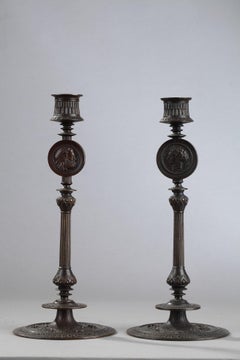
Paar Kerzenleuchter
Von Antoine-Louis Barye
Antoine-Louis BARYE (1796-1875) Paar Kerzenleuchter Paar neugriechische Kerzenständer Bronze mit dunkler Patina auf der Unterseite signiert "Barye" Alte Besetzung Frankreich um 189...
Kategorie

Spätes 19. Jahrhundert, Französische Schule, Figurative Skulpturen

Materialien

Bronze

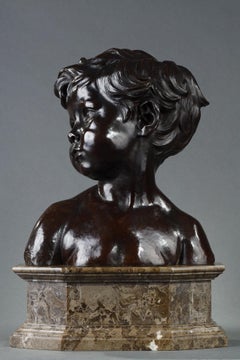
Bust des Kindes
Von Aimé-Jules Dalou
Bust des Kindes Aimé-Jules Dalou (1838-1902) Eine schöne Bronzeskulptur mit dunkelbrauner Patina Sehr schöner Guss von Hébrard Steht auf seinem ursprünglichen Marmorsockel Frankre...
Kategorie

Frühes 20. Jahrhundert, Französische Schule, Figurative Skulpturen

Materialien

Bronze

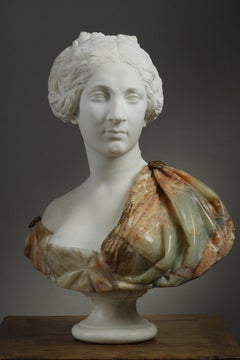
Porträt einer Dame
Porträt einer Dame von Charles CORDIER (1827-1905) Eine seltene Büste aus weißem Carrara-Marmor und Onyx für den Vorhang Rückseitig signiert " C. Cordier ". Präsentiert auf einem ru...
Kategorie

1860er, Französische Schule, Figurative Skulpturen

Materialien

Marmor

Paar Affen-Kandelaber
Von Christophe Fratin
Paar Affen-Kandelaber von Christophe FRATIN (1801-1864) Bronze mit nuancierter dunkelbrauner Patina signiert "Fratin" auf dem Fuß alte Besetzung Frankreich Mitte des 19. Jahrhunder...
Kategorie

Mittleres 19. Jahrhundert, Französische Schule, Figurative Skulpturen

Materialien

Bronze

Zwei junge Löwen
Von Georges Gardet
Georges GARDET (1863-1939) Zwei junge Löwen Bronzegruppe mit nuancierter dunkelbrauner Patina Signiert auf dem Sockel "G. Gardet". Gegossen von " Siot-Paris " (mit der Gießereimarke...
Kategorie

Frühes 20. Jahrhundert, Französische Schule, Figurative Skulpturen

Materialien

Bronze

La Rieuse napolitaine
La Rieuse napolitaine (Die lachende neapolitanische Frau) von Jean-Baptiste CARPEAUX (1827-1875) Büste aus Terrakotta, in "Propriété Carpeaux" Signiert an der Seite " JBte Carpeaux...
Kategorie

1870er, Französische Schule, Figurative Skulpturen

Materialien

Terrakotta

Das könnte Ihnen auch gefallen

Ein Paar Büsten aus dem 19. Jahrhundert von Albert Ernest Carrier-Belleuse
Von Albert-Ernest Carrier-Belleuse
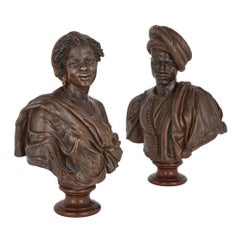
Unterzeichnet: A. Carrier-Belluese Zwei große Bronzebüsten eines unbekannten Mannes und einer unbekannten Frau 22 x 10 x 11" männlich 23 x 10 x 9" weiblich Beide weisen altersbeding...
Kategorie

19. Jahrhundert, Barock, Figurative Skulpturen

Materialien

Marmor, Bronze

Ein Paar Bsten aus dem 19. Jahrhundert nach Albert Ernest Carrier-Belleuse
Von Albert-Ernest Carrier-Belleuse
Dieses Büstenpaar aus dem 19. Jahrhundert stammt von dem bekannten französischen Bildhauer Albert Ernest Carrier-Belleuse (1824 - 1887). Die Stücke sind sehr detailliert und stellen...
Kategorie

Antik, Mittleres 19. Jahrhundert, Französisch, Beaux Arts, Büsten

Materialien

Metall

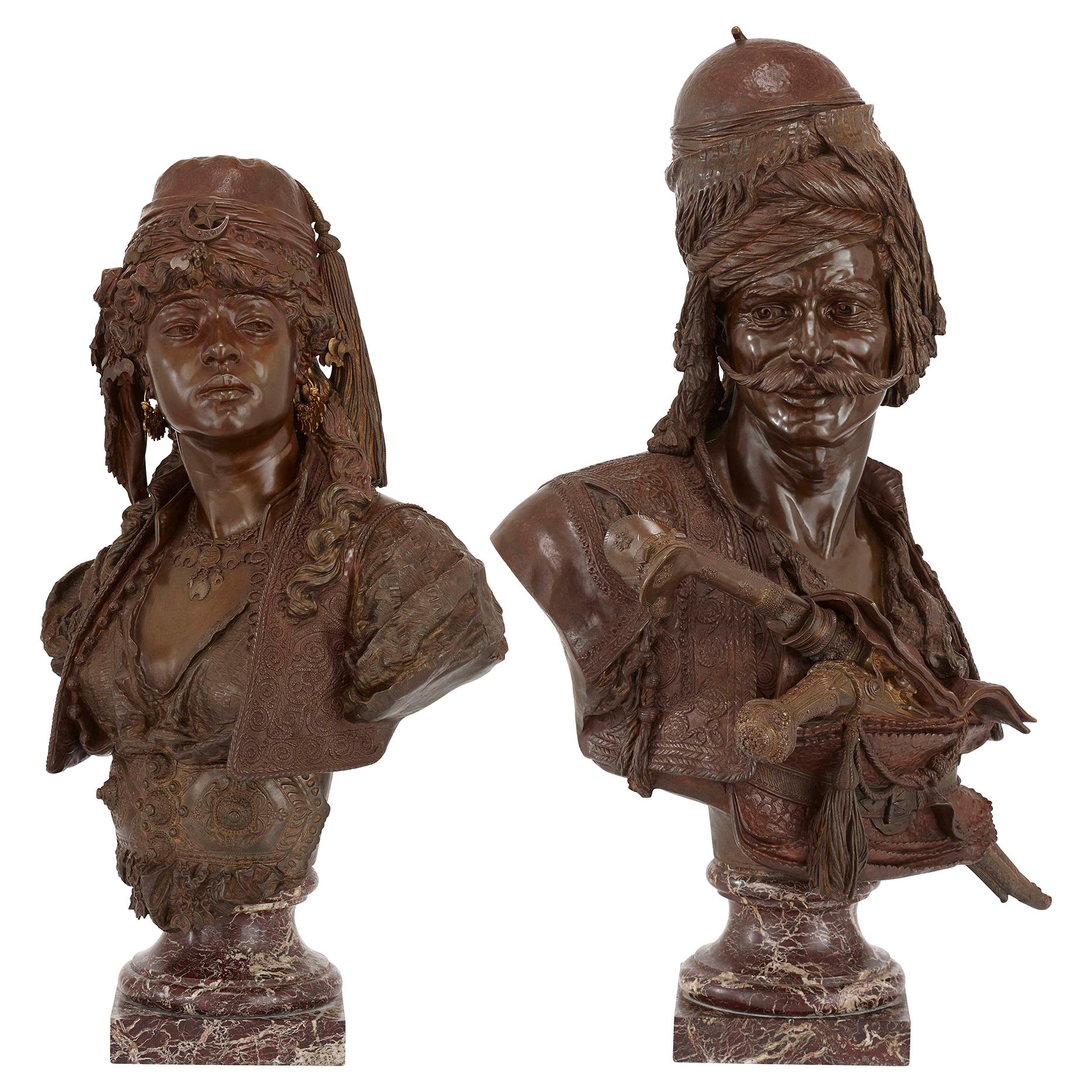
Orientalisches Paar Bronzebüsten aus Bronze von Cordier, 1861
Von Charles Henri Joseph Cordier 1
Paar orientalische Bronzebüsten von Cordier, 1861 Französisch, 1861 Mann: Höhe 42cm, Breite 32cm, Tiefe 18cm Frau: Höhe 40cm, Breite 26cm, Tiefe 16cm Dieses beeindruckende Bronzebüs...
Kategorie

Antik, 19. Jahrhundert, Französisch, Büsten

Materialien

Bronze

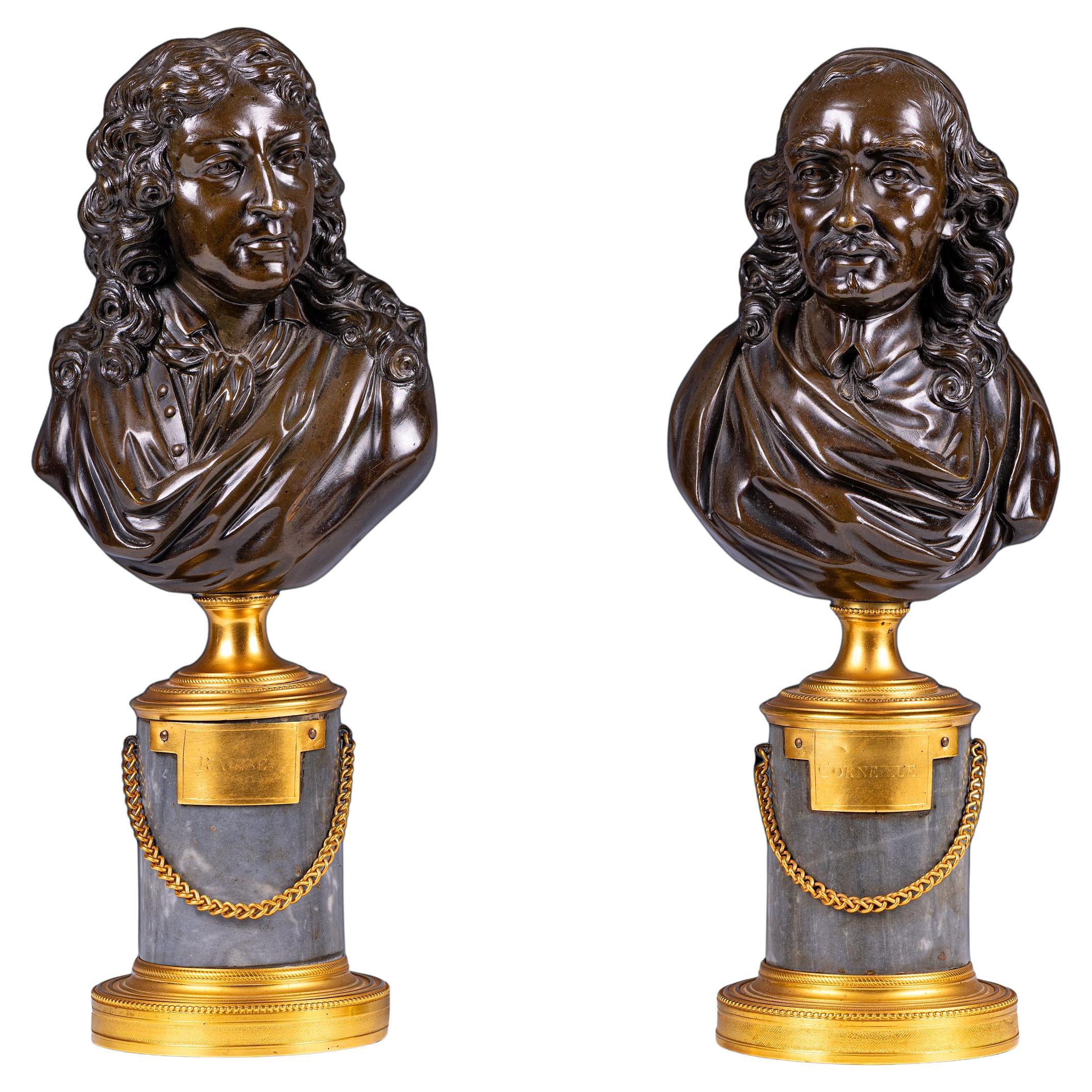
Paar französische patinierte Bronzebüsten von Racine und Corneille aus dem späten 18.
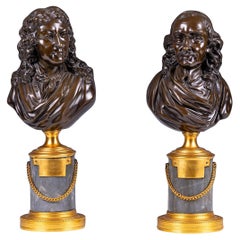
Ein hervorragendes, fein gegossenes und gut patiniertes Paar französischer Bronzebüsten, die Jean Racine und Pierre Corneille darstellen, zwei der berühmtesten Dramatiker des 17. Jah...
Kategorie

Antik, Spätes 18. Jahrhundert, Französisch, Neoklassisch, Büsten

Materialien

Marmor, Bronze, Goldbronze

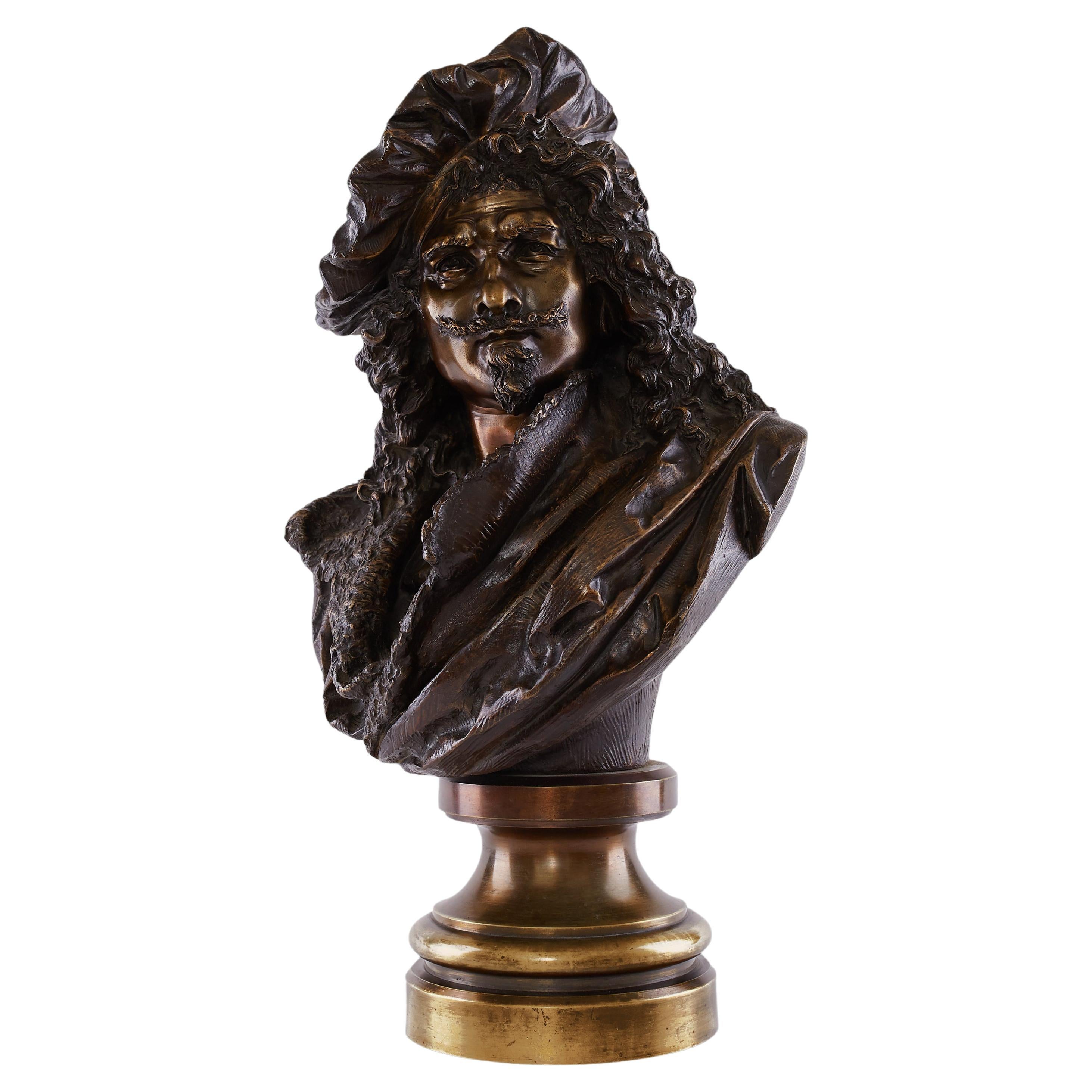
Bust von Rembrandt nach einem Modell von Albert Ernest Carrier-Belleuse
Von Albert-Ernest Carrier-Belleuse
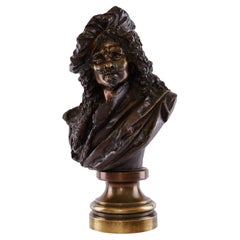
Diese fein gearbeitete Büste von Rembrandt van Rijn (1606-1669) ist nach einem Modell von Albert Ernest Carrier-Belleuse gefertigt. Albert Carrier-Belleuse schnitzte lange Zeit schön...
Kategorie

Antik, 19. Jahrhundert, Französisch, Romantik, Büsten

Materialien

Bronze

Paar orientalische Skulpturenbüsten von Guillemin
Von Émile Guillemin
Paar orientalische Büsten von Guillemin Französisch, um 1880-1890 Männliche Figur: Höhe 89,5cm, Breite 65cm, Tiefe 40cm Weibliche Figur: Höhe 79,5cm, Breite 65cm, Tiefe 40cm Es...
Kategorie

Antik, Spätes 19. Jahrhundert, Französisch, Büsten

Materialien

Marmor, Bronze